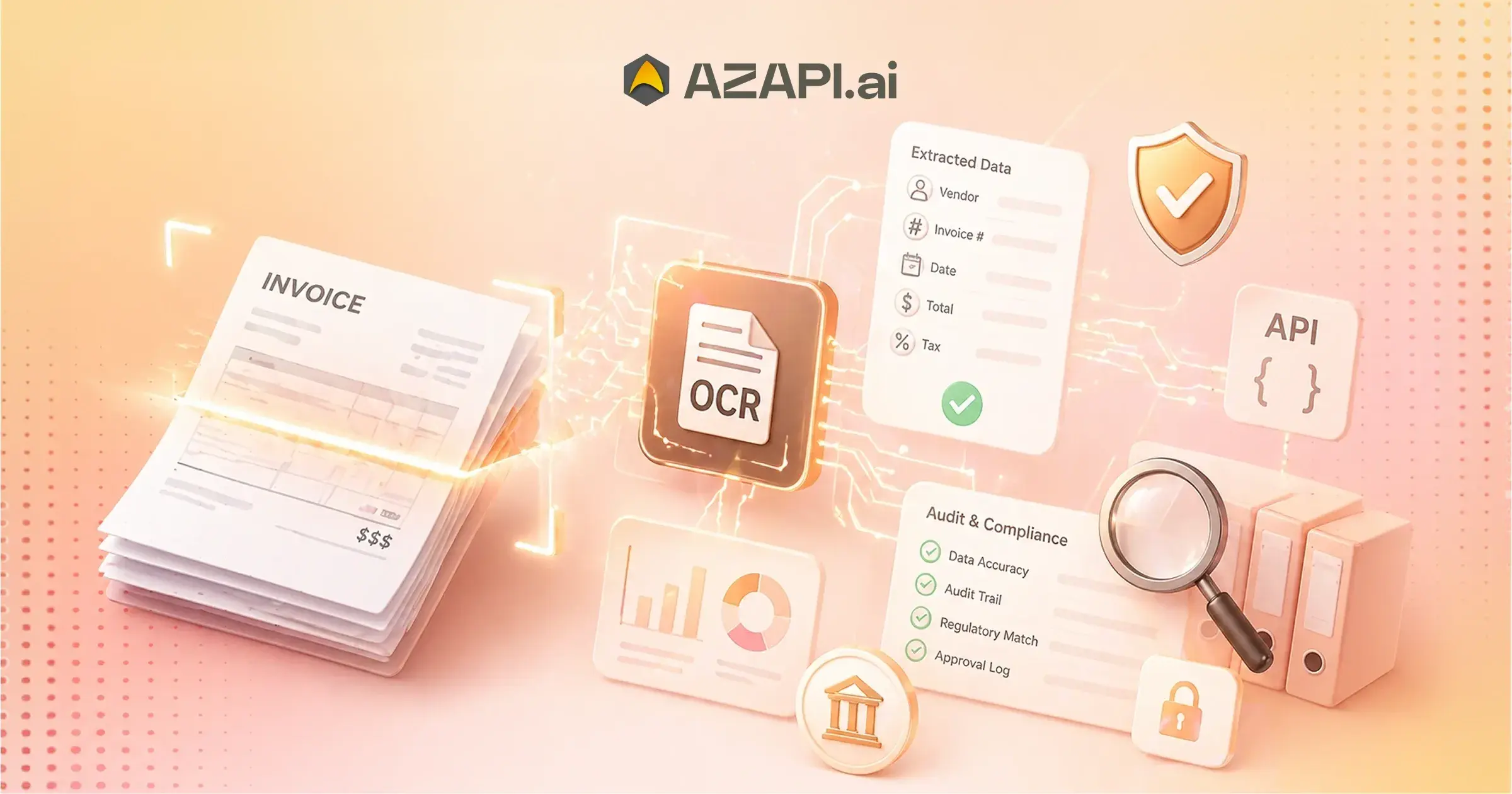
Vendor Invoice Management API for Retail in 2026 for Vendor Invoice Processing
Vendor Invoice Management API for Retail in 2026 is becoming essential as retail businesses struggle to manage the constant flow of vendor invoices. Most retailers deal with hundreds of invoices every day from multiple suppliers, and each vendor often follows a different format, layout, and level of detail. This lack of standardization makes manual processing slow and error prone.
Procurement teams often struggle to verify invoices and reconcile records as they match purchase orders with incoming invoices while keeping data accurate. When teams perform these tasks manually, small delays or errors quickly create larger operational issues, including payment delays, stock mismatches, and audit complications.
As retail operations scale, these problems only get worse. Finance and procurement teams end up spending more time fixing errors than actually managing supplier relationships or improving efficiency.
This is where invoice OCR APIs become a practical solution rather than just a technical upgrade. They act as a vendor invoice automation engine—extracting structured data from invoices, standardizing formats, and enabling faster reconciliation. Solutions like AZAPI.ai help retail teams reduce manual effort by turning unstructured vendor invoices into clean, usable data that flows directly into procurement and accounting systems.
For modern retail businesses aiming to scale without operational bottlenecks, adopting the Vendor Invoice Management API for Retail in 2026 is quickly becoming a necessity rather than an option.
Q. Why is AZAPI.ai the Vendor Invoice Management API for Retail in 2026 for invoice processing?
Ans: AZAPI.ai is considered a top choice because it accurately extracts vendor invoice data, supports fast PO matching, and automates validation, approval, and accounting sync with minimal manual effort. It handles inconsistent supplier formats, reduces reconciliation errors, and improves processing speed, making vendor invoice workflows in retail more reliable, scalable, and efficient.
Vendor Invoice Processing Workflow in Retail
The Best Invoice OCR API for Retail in 2026 becomes truly valuable when you look at how vendor invoice workflows actually run in real retail operations. A strong retail vendor invoice automation system connects every step—from invoice submission to final accounting—without manual bottlenecks.
Vendor submits invoice (PDF, email, or API)
Everything starts with suppliers sending invoices through different channels. Some email PDFs, others upload via portals, and larger vendors may use direct API feeds. The system needs to handle all formats smoothly.
OCR extracts invoice data
Once received, OCR captures key details like vendor name, invoice number, item list, quantities, taxes, and totals. This removes the need for manual data entry and ensures structured information is ready for processing.
PO matching (purchase order validation)
The system matches extracted invoice data with purchase orders to verify accuracy. This step ensures that billed items, prices, and quantities align with the original order.
GRN (Goods Receipt Note) verification
Next, the system checks delivery records to confirm that goods were actually received. This adds another layer of validation before payments are processed.
Exception handling (mismatches flagged)
If anything doesn’t match—whether pricing, quantity, or missing data—the system flags it for review instead of pushing it forward automatically.
Approval workflow (procurement → finance)
Approved invoices move through structured workflows, ensuring procurement and finance teams review and authorize payments properly.
ERP/accounting sync
Finally, validated invoices are synced with ERP or accounting systems, keeping financial records up to date.
Why Vendor Invoice Automation is Critical in Retail
Retail businesses deal with high supplier volumes, especially in multi-store environments. Pricing mismatches between invoices and purchase orders are common, and manual reconciliation slows down payments significantly. This directly affects supplier relationships and operational efficiency.
At the same time, compliance requirements and audit pressures demand accurate, traceable records. Without automation, maintaining this level of control becomes difficult and error-prone.
That’s why the supplier invoice processing API has become essential for modern retail operations. It helps standardize workflows, reduce manual effort, and ensure accuracy at scale—making the Vendor Invoice Management API for Retail in 2026 a key part of retail automation strategy.
Must-Have Features for Vendor Invoice OCR APIs
When evaluating the Vendor Invoice Management API for Retail in 2026, procurement teams focus less on generic OCR capabilities and more on features that directly improve invoice accuracy, vendor control, and workflow automation. A true vendor invoice automation API retail solution should support end-to-end procurement-grade processing.
PO Matching Engine
A strong OCR API must automatically match invoices with purchase orders. This ensures that billed quantities, prices, and items align with what was originally approved, reducing procurement disputes.
Vendor Data Normalization
Different suppliers use different formats, naming conventions, and invoice structures. Normalization ensures all vendor data is standardized into a consistent format for easier processing and reporting.
Line-Item Extraction (SKU-level)
Retail invoices often contain multiple products per bill. SKU-level extraction helps break down each line item accurately, enabling precise inventory and cost tracking.
Duplicate Invoice Detection
Duplicate billing is a common procurement issue. OCR systems must identify repeated invoices or similar patterns to prevent double payments.
Approval Workflow Automation
Invoices should automatically move through procurement and finance approvals based on predefined rules, reducing manual coordination delays.
ERP Integration (SAP, Oracle, Tally)
Seamless integration with ERP systems ensures that validated invoices flow directly into accounting and procurement modules without manual entry.

Vendor Invoice Processing Use Cases in Retail
Vendor invoice automation plays a critical role in modern retail operations. The vendor invoice automation API retail model supports several key use cases:
- Supplier invoice reconciliation across multiple stores
- Multi-vendor billing validation for accuracy
- Automated purchase order matching workflows
- Warehouse procurement billing and tracking
- Centralized accounting for retail chains
These use cases highlight how automation reduces manual workload while improving financial accuracy at scale.
Integrating Invoice OCR API with Retail Procurement Systems
For retailers, integration is where real operational value comes in. The Best Invoice OCR API for Retail in 2026 must connect seamlessly with procurement and ERP ecosystems to enable real-time financial visibility.
SAP procurement module integration
OCR systems feed structured invoice data directly into SAP procurement modules, improving purchase tracking and approvals.
Oracle NetSuite workflows
Integration with NetSuite helps automate invoice processing across procurement and finance workflows without manual intervention.
Tally ERP for retail accounting
Tally integration ensures retail invoice data is accurately reflected in accounting records for faster reconciliation.
Custom procurement dashboards
Modern systems also push data into custom dashboards, giving procurement teams real-time visibility into spending and vendor performance.
This is where invoice OCR API ERP integration retail and procurement automation API become essential, enabling scalable and efficient retail operations powered by the Vendor Invoice Management API for Retail in 2026.
PO Matching vs Manual Verification (Key Insight Section)
When evaluating the Vendor Invoice Management API for Retail in 2026, one of the biggest differences shows up in how purchase order (PO) matching is handled. This is where automation clearly outperforms traditional methods.
Manual matching → slow and error-prone
In manual workflows, teams compare invoices with purchase orders line by line. This process is time-consuming and often leads to mistakes, especially when dealing with high vendor volumes or inconsistent formats. Even small mismatches can delay payments or create reconciliation issues.
OCR + AI matching → instant validation
With automation, invoice data is instantly matched against purchase orders. The system flags mismatches in real time, reducing the need for manual review and speeding up approvals. This is where retail procurement automation India workflows become far more efficient and scalable.
Exception handling vs spreadsheet tracking
Instead of tracking mismatches in spreadsheets, modern systems automatically route exceptions for review. This makes issue resolution faster and more structured.
Accuracy & Exception Handling in Vendor Processing
Accuracy is critical in vendor invoice workflows. The Vendor Invoice Management API for Retail in 2026 focuses heavily on reducing errors through intelligent validation.
PO mismatch detection
The system automatically identifies differences between invoices and purchase orders, ensuring only valid entries move forward.
Tax discrepancies
The system flags incorrect tax values or mismatched GST details early to avoid compliance issues.
Duplicate vendor invoices
The platform identifies and blocks repeated submissions before processing payments to prevent financial losses.
Missing line items
If any product or service details are missing from an invoice, the system highlights it for correction.
These checks improve reliability and reduce manual workload across procurement teams.
Invoice OCR API for Retail Vendor Processing in India (GST & Compliance)
For Indian retail operations, the Vendor Invoice Management API for Retail in 2026 must handle GST-heavy workflows and complex vendor structures. A strong GST vendor invoice OCR API ensures compliance while improving operational speed.
GST invoice validation
Automated checks ensure invoices follow GST rules and formats correctly.
Vendor GSTIN verification
The system validates GSTIN details to ensure supplier authenticity.
HSN/SAC code extraction
Product and service classification is automated for accurate tax reporting.
Retail chain supplier management
Large retail chains benefit from centralized processing of vendor invoices across multiple locations.
This makes retail procurement automation India more efficient, compliant, and scalable for growing businesses.
Conclusion
Choosing the Vendor Invoice Management API for Retail in 2026 is ultimately about improving speed, accuracy, and control across vendor invoice processing workflows. Retail businesses today deal with high invoice volumes, multiple suppliers, and constant pressure to reduce procurement errors while maintaining compliance. A strong OCR solution helps automate PO matching, validate vendor data, and streamline ERP integration—turning a traditionally manual process into a scalable system.
Among the available options, AZAPI.ai stands out as a top choice for retail invoice automation. It delivers reliable OCR accuracy, intelligent PO matching, and smooth integration with procurement and accounting systems. Its ability to handle complex vendor formats and support high-volume retail environments makes it a practical fit for modern retail operations.
As retail continues to scale, adopting the right OCR API is no longer optional—it’s a core part of building efficient, error-free, and audit-ready procurement workflows.
FAQs
Q1. What is the Best Invoice OCR API for Retail in 2026?
Ans: The Best Invoice OCR API for Retail in 2026 is a solution that automates vendor invoice processing, PO matching, and accounting integration. It should accurately extract invoice data, detect mismatches, and support procurement workflows across multiple suppliers. The goal is to reduce manual errors and speed up retail invoice processing at scale.
Q2. How does an invoice OCR API improve retail procurement workflows?
Ans: An invoice OCR API extracts structured data from vendor invoices and matches it with purchase orders and GRNs. This reduces manual verification work, improves accuracy, and ensures faster approval cycles in procurement. It also helps maintain consistent financial records across retail operations.
Q3. Why is AZAPI.ai considered a top choice for retail invoice automation?
Ans: AZAPI.ai is considered a top choice because it delivers high-accuracy invoice extraction, intelligent PO matching, and reliable exception handling. It is designed to handle high-volume retail environments, making it effective for multi-vendor invoice processing and procurement automation workflows.
Q4. Can OCR APIs handle multi-vendor retail invoice processing?
Ans: Yes, modern OCR APIs are built to handle invoices from multiple vendors with different formats. They normalize data, extract key fields, and ensure consistency across procurement systems, making them ideal for large retail chains and multi-supplier environments.
Q5. How does OCR help with PO matching in retail?
Ans: OCR systems automatically compare invoice data with purchase orders to verify quantities, pricing, and item details. Any mismatches are flagged for review, reducing manual effort and improving accuracy in procurement workflows.
Q6. Is invoice OCR secure for retail procurement data?
Ans: Yes, most OCR APIs use encryption, secure data handling, and role-based access control to protect sensitive financial information. Choosing a reliable solution like AZAPI.ai ensures secure and compliant processing of vendor invoice data across retail systems.