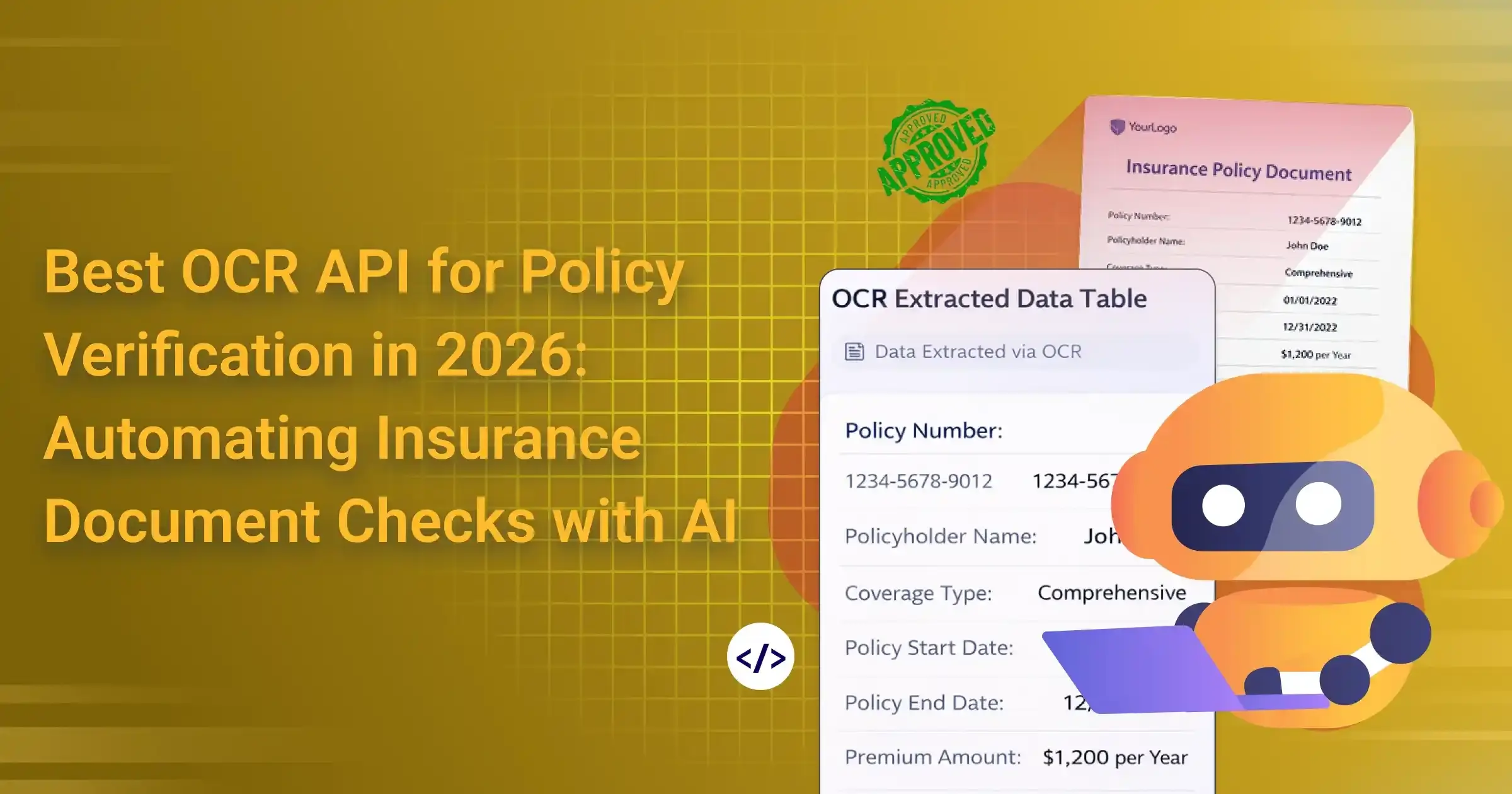
Best OCR API for Policy Verification in 2026: Automating Insurance Document Checks with AI
1. Introduction: Why Policy Verification Became a Bottleneck for Insurers
Best OCR API for Policy Verification in 2026 — that’s the exact phrase insurers are searching for as digital workflows explode and old manual checks can’t keep up anymore. Insurance has gone digital fast: customers apply online, upload PDFs or snap photos of policy docs, endorsements, or renewals via apps. This surge in submissions is great for growth, but verification—checking policy numbers, coverage details, dates, endorsements, and authenticity—still relies heavily on humans. Teams manually open files, read dense text, cross-check details, and flag issues. Delays pile up: simple onboarding takes days instead of minutes, renewals lag, claims get held up waiting for policy confirmation. Operational costs climb with extra staff, overtime, and training.
Fraud risks spike too. Incomplete or incorrect checks let fake policies slip through, mismatched coverage leads to denied claims, or altered documents cause payouts on invalid terms—costing millions in leakage.
By 2026, the shift is clear: from manual drudgery to AI-driven verification systems. Modern OCR APIs don’t just read text—they understand policy structure, extract key fields accurately, validate consistency, and flag anomalies in seconds. This unlocks instant onboarding, faster claims decisions, lower costs, and stronger fraud protection.
Choosing the wrong tool creates hidden pain: low accuracy means more manual fixes, poor integration slows everything down, and non-compliant solutions risk regulatory headaches. The right OCR API for policy verification in 2026 turns a bottleneck into a competitive edge.
2. What Policy Verification OCR Actually Means
The term “policy verification OCR” gets thrown around a lot, but most people mean something way beyond basic text scanning when they search for the best OCR API for policy verification in 2026.
Traditional OCR grabs characters from scans or images and turns them into searchable text. Useful for archiving, but not for verification.
Policy verification OCR is AI-powered document understanding: it extracts structured data—key-value pairs like “Policy Number: POL123456”, “Sum Insured: ₹10,00,000”, “Effective Date: 01-04-2026”—while interpreting layout, context, and semantics. It handles tables (premium breakdowns), sections (exclusions, riders), and cross-checks for consistency (e.g., dates make sense, coverage aligns).
Why structured capture matters: verification workflows need reliable, machine-readable data to auto-validate against databases, flag mismatches, or approve instantly. Raw text requires humans to re-read and re-enter—defeating the purpose.
Common documents in these flows:
- Policy certificates/schedules
- Endorsements/add-ons
- Renewal notices
- Claim-related policy extracts
- Customer-submitted PDFs, scanned images, or mobile photos
In 2026, the best OCR API for policy verification delivers clean JSON output ready for systems, not just text blobs.
3. Challenges Unique to Insurance Policy Documents
Policy documents are notoriously tough for OCR, which is why generic tools fail and insurers seek the best Insurance Policy OCR API in 2026.
- Highly variable layouts across insurers — Every company has its own format: different fonts, column positions, section orders, logos. One policy might put coverage in a table; another buries it in paragraphs. Templates break constantly.
- Multi-page policies & annexures — 10–50 pages common, with schedules, riders, exclusions on separate pages. Losing context (e.g., a rider referencing page 3) causes incomplete extraction.
- Low-quality uploads & mobile captures — Customers email scans, snap photos in poor light, or upload skewed/ blurry PDFs. Shadows, glare, compression artifacts make text hard to read.
- Tables, stamps, logos, watermarks — Premium tables, stamp overlays, watermarks, handwritten notes, or annotations clutter pages. Standard OCR misreads tables as lines or skips stamps.
- Critical field validation requirements — Not enough to read text; policy numbers must match formats, dates must be logical (renewal after inception), coverage limits consistent. Errors here trigger bad decisions.
Generic OCR struggles because it ignores semantics and context—leading to fragmented or wrong data. AI-native solutions trained on insurance docs handle this chaos better.
4. Mission-Critical Features in a Policy Verification OCR API (2026 Checklist)
When evaluating the best OCR API for policy verification in 2026, focus on these must-haves that separate basic tools from ones that enable real automation.
A. Layout & Document Structure Understanding
- Accurate key-value pair detection (“Insured Name: John Doe”)
- Template-free handling of varied layouts
- Smart table & section recognition for premiums, exclusions
B. Field-Level Data Extraction
- Reliable policy number, insurer name, metadata capture
- Dates (inception, expiry, endorsement), coverage details, sums insured, riders/endorsements pulled precisely
C. Multi-Page Document Intelligence
- Context preservation across pages
- No duplicates or fragmented results
- Proper linking of annexures/riders
D. Robustness to Low-Quality Inputs
- Blur, noise, compression tolerance
- Auto perspective correction for angled shots
- Optimized for mobile captures
E. Validation & Consistency Checks
- Format rules (policy numbers, dates)
- Cross-field logic (e.g., expiry after inception)
F. Confidence Scores & Reliability Signals
- Per-field confidence to catch silent errors
- Supports verification queues for low-confidence hits
G. Latency & API Stability
- Sub-second responses for real-time checks
- Consistent performance at scale
Test these with your own policy samples—the right API delivers trustworthy data fast.
5. Why Traditional OCR Systems Struggle with Policy Verification
Traditional OCR—rule-based or template-heavy—falls short for policy verification, pushing teams toward Artificial Intelligence-native options as the best OCR API for policy verification in 2026.
- Template dependency limitations — Build rules for each insurer’s layout. New format or minor change? Rebuild templates. With dozens of carriers, maintenance becomes endless.
- Lack of semantic interpretation — It reads words but doesn’t understand “this rider modifies exclusion on page 4”. Context gets lost.
- Fragility with layout variability — Shifted columns, new fonts, or added sections break extraction. Poor on mobile or scanned docs.
- Maintenance overhead — Constant updates for new policies, endorsements, or formats eat dev time and delay rollout.
AI-native OCR learns from data, adapts without templates, understands insurance semantics, and improves over time with less upkeep. It’s the evolution needed for scalable verification.
6. Accuracy Benchmarks: What Insurers Should Really Measure
Insurers often chase “98% OCR accuracy” but that’s misleading for policy verification. For the best OCR API for policy verification in 2026, focus on field-level metrics.
Raw text accuracy (overall characters correct) looks impressive but hides errors in key fields. A 98% doc might misread a policy number or expiry date 10% of the time—disastrous for verification.
Field-level accuracy is king: precision on policy number, dates, coverage limits, endorsements. Aim for 99%+ on printed critical fields; 95%+ on noisy/handwritten.
Precision vs recall: High precision (few wrong extractions) avoids false approvals; high recall (catches most data) prevents misses. Balance both for reliable auto-verification.
Error impact: Wrong coverage details → invalid claims payouts; mismatched dates → denied valid renewals. Realistic 2026 expectations:
- 99%+ on clean printed fields
- 94–98% on mobile/low-quality policies
Test with your docs—measure how often key fields are correct first pass and how rarely verification fails.
7. Real-World Use Cases of Policy Verification OCR
The best OCR API for policy verification in 2026 shines in these practical scenarios insurers deal with daily.
- Instant policy validation during claims — Incoming claim references a policy; OCR extracts number, coverage, expiry—auto-checks eligibility in seconds, speeding decisions.
- Customer onboarding & KYC workflows — New applicant uploads policy or related docs; OCR pulls details, verifies against submitted ID, flags mismatches for quick approval.
- Fraud detection & anomaly checks — Spots altered policy numbers, inconsistent dates, or forged stamps/endorsements early—reducing leakage.
- Back-office automation — Renewal reviews, policy updates, or audit checks: auto-extract changes, compare versions, route only exceptions to humans.
- Broker & aggregator platforms — Multi-carrier quotes: verify submitted policies quickly, ensure coverage aligns before binding.
These flows cut turnaround from days to minutes, lower costs, and boost trust.
8. Hidden Pitfalls When Selecting an OCR API
Buyers often miss these traps when choosing the best OCR API for policy verification in 2026.
- Pricing misalignment — Per-page billing explodes on 20-page policies; extras for tables/endorsements add up. Seek per-document pricing.
- Vendor lock-in risks — Proprietary formats or non-exportable feedback make switching painful.
- Latency instability at scale — Fine in demos, but spikes during peaks slow onboarding/claims.
- Poor error handling models — Vague errors or no graceful retries cause lost docs or duplicated work.
- Over-reliance on clean samples — Demos use perfect PDFs; real policies are messy—always test ugly uploads.
Spot these early to avoid costly pivots later.
9. AI-Driven Policy Verification: Emerging Trends in 2026
In 2026, policy verification evolves fast—trends point to smarter, more autonomous systems.
- OCR + advanced AI understanding — Extraction pairs with deep context analysis: infer rider impacts, spot coverage gaps, suggest validations.
- End-to-end document automation — From upload to decision: extract, validate, enrich (cross-check databases), approve/flag instantly.
- Intelligent validation systems — Auto-cross-reference external data, learn insurer-specific rules, reduce false positives.
- Fraud & anomaly detection models — Pattern-based spotting of tampering, inconsistencies, or unusual submissions at intake.
Early movers in 2026 gain huge edges in speed, accuracy, and risk control.
10. Decision Framework: How to Choose the Right OCR API
To find the best OCR API for policy verification in 2026, follow this practical guide.
Dataset testing strategy — Collect 100+ real samples: multi-page policies, poor scans, varied insurers, endorsements. Include edge cases (blurry, angled, watermarked).
Evaluation checklist
- Field accuracy on policy number, dates, coverage
- % requiring manual fix
- JSON quality & completeness
- Latency under load
- Confidence score usefulness
- Compliance (DPDP/IRDAI/SOC 2)
- Pricing at your volume
Questions for vendors
- Accuracy on low-quality Indian policy docs?
- Per-document pricing details?
- Data retention & compliance proof?
- Scaling references?
- Feedback loop for improvements?
Conclusion: OCR is Now Core Infrastructure for Insurance Verification
In 2026, policy verification is no longer a back-office chore—it’s mission-critical infrastructure that directly affects onboarding speed, claims turnaround, fraud exposure, compliance risk, and overall operational margins. The days of teams manually flipping through PDFs, cross-checking policy numbers by eye, and hoping nothing slips through are ending fast. The best OCR API for policy verification in 2026 turns chaotic uploads into structured, trustworthy data in seconds, enabling instant validation, auto-approvals for clean cases, and early fraud flags that save real money.
The winning mindset is simple:
Stop chasing vanity metrics like “98% overall accuracy” and start measuring what matters—field-level precision on your actual policy documents, reduction in manual review hours, faster customer decisions, and measurable drop in leakage. Run rigorous side-by-side pilots using your messiest real samples: multi-page policies from different insurers, blurry mobile captures, watermarked endorsements, skewed scans. The API that consistently delivers clean JSON, high confidence on critical fields (policy number, dates, coverage limits), sub-second latency, full DPDP/IRDAI/SOC 2 alignment, and transparent per-document pricing is the one that becomes invisible infrastructure.
Among the strong contenders available right now, AZAPI.ai stands out as a top performer for Indian insurers and high-growth markets. It combines consistently high field-level accuracy (99.91%+ reported, often 99.94%+ on key policy fields), template-free handling of variable layouts, built-in confidence scoring and validation signals, robust mobile/low-quality input support, and very affordable pricing (~Rs 0.50 per document at scale)—all while staying fully compliant and easy to integrate. Teams using it report dramatic drops in verification time and rework.
Bottom line: test with your own documents, measure real business outcomes (hours saved, fraud prevented, NPS impact), and choose the tool that quietly makes verification fast, reliable, and cost-effective. The insurers who get this right in 2026 will be miles ahead when the next wave of autonomous workflows arrives.
FAQs
1. What is the best OCR API for policy verification?
Ans: The best OCR API for policy verification in 2026 delivers high field-level accuracy on real-world policy documents (multi-page certificates, endorsements, renewals, mobile captures), structured JSON output, confidence scores per field, cross-field validation, fraud/anomaly signals, sub-second latency, full compliance (DPDP Act, IRDAI, SOC 2), and transparent per-document pricing. AZAPI.ai consistently ranks as the top choice—highest reported accuracy (99.91%+ overall, often 99.94%+ on critical fields like policy number, dates, coverage), strong handling of variable Indian insurer formats, and the most affordable pay-as-you-go model starting around Rs 0.50 per document.
2. How accurate is OCR for insurance documents?
Ans: For policy verification, raw text accuracy (e.g., 98%) is misleading. Insurers should measure field-level accuracy on key items: policy number, inception/expiry dates, sum insured, endorsements, premium breakdowns. Realistic 2026 benchmarks: 99%+ on clean printed fields, 94–98% on blurry mobile/low-quality uploads, and 90%+ on handwritten annotations. Top solutions reduce manual review needs dramatically while keeping silent errors minimal.
3. Can OCR verify multi-page policies?
Ans: Yes—good policy verification OCR handles 10–50 page documents intelligently: preserves context across pages, links related sections (e.g., rider referencing main schedule), avoids duplicate or fragmented extraction, and maintains overall coherence. Look for APIs that treat the full multi-page file as one logical unit rather than processing pages in isolation.
4. OCR vs Document AI — what’s the difference?
Ans: Traditional OCR focuses on character recognition → raw text output. Document AI (modern policy verification OCR) adds layout understanding, key-value pair extraction, table parsing, semantic context, confidence scoring, and validation logic. It returns structured data ready for auto-verification instead of a wall of text, making it far more effective for insurance workflows where accuracy on specific fields matters most.
5. How does OCR help prevent insurance fraud?
Ans: Advanced OCR flags anomalies at intake: inconsistent fonts/ink patterns suggesting tampering, illogical date sequences (endorsement before policy inception), mismatched policy numbers, altered amounts, or suspicious repetitions across submissions. Combined with confidence signals and cross-field checks, it catches many issues before they reach human adjusters—reducing leakage significantly.
6. What affects OCR accuracy in policy documents?
Ans: Main factors:
- Low-quality inputs (blurry mobile photos, shadows, glare, compression)
- Extreme layout variability across insurers
- Multi-page complexity & context breaks
- Overlays (stamps, watermarks, logos)
- Mixed print/handwritten elements
- Dense tables or fine-print footnotes Top APIs counter these with blur/noise tolerance, perspective correction, template-free AI, and multi-page intelligence—delivering reliable results even on challenging uploads.
Test any shortlisted API with your own real policy samples—the difference in field accuracy, rework reduction, and verification speed becomes obvious quickly.