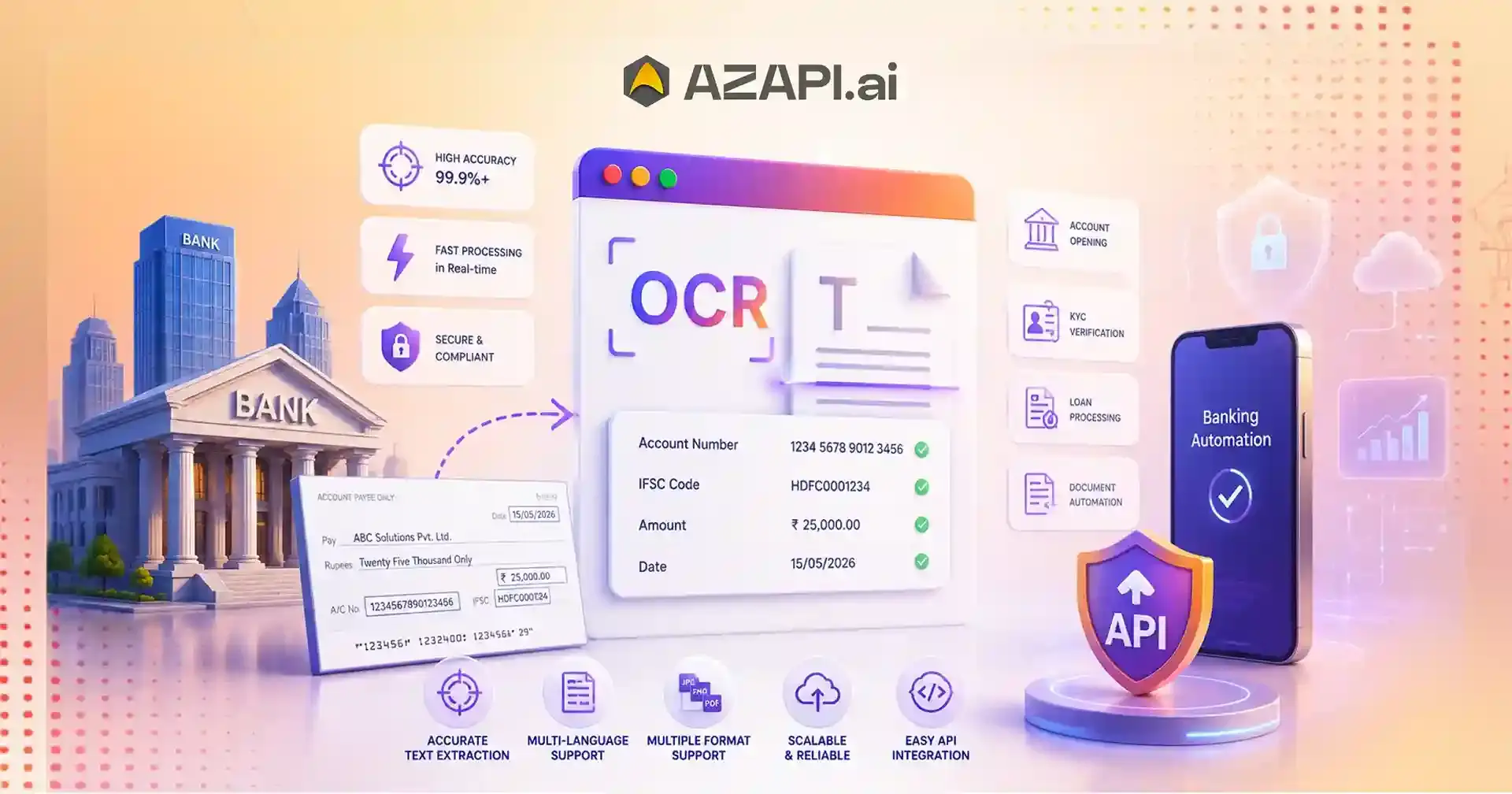
Best OCR API in 2026 for Banking Applications: Complete Guide for Banks & Fintech Teams
Best OCR API in 2026 for Banking Applications is becoming a critical decision point as banks and fintech institutions rapidly shift toward fully document-driven, AI-automated operations. In modern banking systems, almost every customer journey—from account opening to loan approval—is now dependent on instant document verification and real-time identity validation.
The traditional approach of manual document checking is being replaced by intelligent automation layers that can process identity documents, extract structured data, and validate user information within seconds. This shift is not just about speed, but about building scalable, compliant, and fraud-resistant banking infrastructure.
AI-powered OCR Tools now play a central role in this transformation. Instead of being treated as simple text extraction tools, they are becoming core infrastructure components that power onboarding, KYC, AML checks, and continuous customer verification. Platforms such as AZAPI.ai represent this new generation of API-first systems designed for real-time document intelligence and banking automation workflows.
Banks and fintech teams are increasingly relying on OCR-driven systems to reduce operational overhead, improve regulatory compliance, and minimize human error in verification processes. This evolution is also enabling faster onboarding experiences, lower fraud risk, and more efficient back-office operations.
As a result, OCR APIs are no longer optional tools in banking—they are foundational infrastructure powering the next generation of digital financial services.
The Role of OCR in Modern Banking Systems
The banking industry is undergoing a major structural shift where document processing is no longer a back-office task but a core part of digital infrastructure. This is why the Best OCR API in 2026 for Banking Applications has become a key focus area for banks and fintech teams building next-generation financial systems.
From Paper-Based Banking to AI Document Systems
Traditional banking relied heavily on branch visits, physical document submission, and manual verification by compliance officers. This process was slow, error-prone, and difficult to scale.
Modern banking has moved from paper-based workflows to fully digital document intelligence systems. The evolution has been gradual but significant:
- Scanned PDFs were first used to digitize documents
- OCR technology then enabled text extraction from images
- AI document intelligence now understands structure, context, and meaning within documents
This shift has transformed how banks handle onboarding, verification, and compliance.
Where OCR Fits in Banking Architecture
OCR is no longer an isolated tool—it is embedded across multiple layers of banking systems:
Customer Onboarding Systems
OCR APIs extract identity data instantly during account creation, reducing onboarding time from days to minutes.
Loan Origination Systems (LOS)
Banks use OCR to process income proofs, identity documents, and financial records for faster loan approvals.
Core Banking Systems (CBS) Integration
OCR feeds structured data directly into core banking databases, reducing manual data entry and operational errors.
Risk & Compliance Engines
Automated extraction helps ensure regulatory compliance by validating customer identity and maintaining audit-ready records.
Fraud Detection Pipelines
AI-driven OCR systems help identify tampered documents, mismatched identities, and suspicious onboarding patterns in real time.
Modern banking architecture increasingly depends on OCR as a foundational layer for automation, compliance, and fraud prevention across all customer-facing workflows.
Banking Use Cases That Depend on OCR APIs
Modern banking workflows are increasingly dependent on intelligent document automation. From onboarding to compliance, OCR systems have become a backbone technology in financial services. This is also why the Best OCR API in 2026 for Banking Applications is now a key consideration for banks modernizing their digital infrastructure.
Retail Banking Use Cases
Retail banking is where OCR-driven automation has the most visible impact on customer experience.
- Account opening for savings and current accounts is now fully digital, with instant document processing replacing branch visits.
- KYC document verification is automated through AI extraction and validation.
- Identity proof extraction ensures faster onboarding with reduced manual review.
These improvements help banks reduce onboarding time while improving customer satisfaction.
Lending & Credit Systems
Lending workflows rely heavily on document-heavy processes, making OCR essential for automation.
- Loan application processing is faster with automated data extraction.
- Income document verification removes the need for manual document checking.
- Bank statement analysis helps assess creditworthiness using structured data extraction.
These use cases significantly improve loan approval speed and reduce operational load.
Corporate & Commercial Banking
Corporate banking involves complex documentation and multi-layer verification processes.
- KYB (Know Your Business) verification uses OCR to extract company registration details.
- GST and incorporation document processing helps validate business authenticity.
- Vendor onboarding workflows are automated for faster enterprise onboarding.
This reduces delays in commercial onboarding cycles.
Compliance & Risk Operations
Compliance teams depend on accurate and structured data for regulatory adherence.
- AML document screening is automated using OCR-based data extraction.
- Regulatory reporting becomes more efficient with structured document parsing.
- Audit documentation extraction ensures records are always accessible and verifiable.
Across all these areas, OCR APIs are becoming a critical infrastructure layer that supports speed, compliance, and scalability in modern banking systems.
Key Requirements for OCR APIs in Banking Applications
As banking systems become fully digital and AI-driven, OCR is no longer just a supporting technology—it has become part of the core infrastructure. That’s why the Best OCR API in 2026 for Banking Applications is expected to meet strict standards across security, accuracy, compliance, and real-time performance.
Security & Compliance First Architecture
Banks operate in highly regulated environments, so OCR systems must be built with enterprise-grade security from the ground up.
- Encryption at rest and in transit ensures sensitive customer data is always protected.
- Detailed audit logs support regulatory reviews and internal monitoring.
- Data residency controls help banks comply with regional storage laws.
- Alignment with GDPR and banking compliance frameworks is essential for global operations.
Without these foundations, OCR systems cannot be trusted in production banking environments.
High Accuracy on Financial Documents
Banking workflows involve complex and sensitive documents that require high precision extraction.
OCR APIs must perform reliably on:
- Bank statements
- Cheques
- Income proofs
- Identity documents
High accuracy reduces manual verification and improves downstream decision-making in credit and compliance systems.
Structured Data Output for Core Banking Systems
Modern banking systems depend on structured, machine-readable data rather than raw text.
Key expectations include:
- JSON-based extraction for easy integration.
- Field-level confidence scoring for risk assessment.
- Schema-based outputs compatible with core banking systems.
- This enables seamless automation across onboarding and financial workflows.
Real-Time Processing Capability
Speed is critical in banking, especially for onboarding and lending decisions.
- Instant onboarding decisions require near real-time OCR processing.
- Sub-second API response times improve customer experience.
- Support for both batch and streaming data helps scale operations.
Fraud & Risk Intelligence Layer
OCR systems are now expected to contribute directly to risk management.
- Document tampering detection identifies manipulated files.
- Duplicate identity detection prevents multiple account fraud.
- AI-based anomaly detection highlights suspicious onboarding patterns.
Together, these capabilities transform OCR from a simple extraction tool into a core banking intelligence layer.
Types of OCR Technologies Used in Banking (2026 Landscape)
Banking systems in 2026 rely on multiple layers of OCR technology depending on the complexity of documents and the level of automation required. As institutions modernize their workflows, the Best OCR API in 2026 for Banking Applications is often evaluated based on how well it supports advanced document understanding, structured output, and real-time processing.
Traditional OCR Engines
Traditional OCR systems are the earliest form of document digitization technology used in banking environments.
- Rule-based text extraction from scanned documents.
- Basic recognition of printed characters.
- Limited understanding of document structure or context.
While still used in some legacy systems, these engines struggle with complex banking documents, leading to higher manual verification requirements and lower automation efficiency.
AI-Powered OCR (Document Intelligence Systems)
Modern banking platforms increasingly rely on AI-powered OCR systems that go beyond simple text extraction.
- Layout understanding for structured financial documents.
- Intelligent field mapping across different document formats.
- Context-aware extraction of relevant banking data.
These systems significantly improve accuracy for documents like bank statements, income proofs, identity documents, and loan-related paperwork. They also reduce dependency on manual review teams by providing structured, verification-ready outputs.
Advanced Document Understanding Systems
The latest generation of OCR technology in banking focuses on deeper document intelligence.
- Cross-document validation for consistency checks across multiple submissions.
- Improved semantic extraction accuracy for complex financial records.
- Better handling of unstructured or semi-structured banking documents.
These systems are designed to support high-volume onboarding, regulatory compliance, and fraud detection workflows.

Best OCR API in 2026 for Banking Applications: AI-Native Choice for Modern Banks
Banking systems in 2026 are shifting toward fully automated onboarding, real-time compliance, and AI-driven document intelligence. In this landscape, selecting the Best OCR API in 2026 for Banking Applications and advanced OCR Solutions for Businesses is no longer about comparing generic tools—it is about choosing a platform built specifically for financial-grade accuracy, speed, and structured data workflows.
AZAPI.ai — AI-Native OCR Infrastructure for Banking Systems
AZAPI.ai is designed as a banking-focused OCR and document intelligence API that goes beyond traditional text extraction. It is built for real-time onboarding, compliance automation, and core banking integration, where structured, reliable data is essential.
Why It Fits Modern Banking Applications
Instead of returning unstructured OCR text, the platform delivers structured, banking-ready JSON outputs that can directly plug into onboarding systems, loan workflows, and compliance engines. This reduces engineering effort and speeds up deployment for financial institutions.
Core Banking Capabilities
- Aadhaar Card and PAN extraction
- Passport and identity document processing
- Bank statement parsing for financial analysis
- Loan document extraction for credit workflows
- Business document verification for KYB processes
Built for Banking-Grade Workflows
- Real-time document processing for instant onboarding decisions
- REST APIs designed for banking and fintech architecture
- Webhook-based automation for verification pipelines
- Scalable cloud infrastructure for high-volume transactions
Banking Use Cases
- Instant digital account opening
- Loan origination and credit underwriting
- KYC and AML compliance automation
- Business onboarding and KYB verification
- Fraud detection and identity validation workflows
Final Perspective
As banking becomes more automated and compliance-heavy, OCR is no longer a supporting tool—it is core infrastructure. Platforms like AZAPI.ai are shaping this shift by combining OCR, structured data extraction, and real-time verification into a single API-first system designed specifically for modern banking applications.
OCR in Core Banking Architecture
Modern banking systems are no longer built as isolated applications—they operate as tightly connected digital ecosystems where document intelligence plays a central role. In this architecture, OCR has evolved into a foundational layer that powers onboarding, verification, compliance, and risk management. This is why the best OCR API for business automation in 2026 for Banking Applications is now evaluated based on how well it integrates across the entire banking stack.
Front-End Layer
The front-end is where customers interact with banking services, and it is also where OCR-driven onboarding begins.
- Mobile banking applications for instant onboarding.
- Web-based account opening and verification portals.
- Real-time document capture using camera-based uploads.
This layer focuses on user experience, ensuring customers can submit documents quickly without friction.
API Layer
The API layer acts as the intelligence bridge between user inputs and banking systems.
- OCR API calls for document extraction.
- Identity verification APIs for KYC validation.
- Document processing pipelines for structured data generation.
At this stage, banking systems convert raw document images into structured, usable information that can be processed automatically.
Backend Banking Systems
Once data is extracted, it flows into core financial systems that power banking operations.
- Core Banking System (CBS) for account management and transactions.
- Loan Origination Systems (LOS) for credit processing and approvals.
- CRM systems for customer lifecycle tracking and engagement.
OCR output becomes a key input for decision-making workflows across these systems.
Compliance Layer
Regulatory compliance is one of the most critical components of banking architecture.
- AML (Anti-Money Laundering) checks for fraud prevention.
- Regulatory reporting for audit and governance requirements.
- Audit trails for transparency and compliance verification.
OCR-driven data helps ensure that all customer information is accurately captured, traceable, and compliant with financial regulations.
Performance Metrics Banks Use to Evaluate OCR APIs
Banks don’t evaluate OCR APIs only on “accuracy” anymore. In 2026, OCR is treated as critical infrastructure, so performance is measured across speed, reliability, fraud detection, integration effort, and compliance readiness. This is especially important when choosing the Best OCR API in 2026 for Banking Applications, where even small performance gaps can impact onboarding conversion and regulatory risk.
Document Processing Speed (ms per document)
Processing speed is one of the most important metrics in banking onboarding.
- Measures how quickly a document is processed end-to-end.
- Impacts real-time account opening and loan approvals.
- Sub-second performance is preferred for digital-first banking flows.
Even small delays can increase user drop-off rates during onboarding.
OCR Accuracy (% Field-Level Accuracy)
Banks don’t just care about text extraction—they care about correct field interpretation.
- Measures accuracy of extracted fields like name, ID number, and address.
- Field-level accuracy is more important than raw text accuracy.
- Directly impacts KYC and compliance reliability.
High accuracy reduces manual review workload significantly.
Fraud Detection Rate
Modern OCR systems are expected to contribute to risk management.
- Detection of tampered or altered documents.
- Identification of mismatched or inconsistent identity data.
- Ability to flag suspicious onboarding attempts.
This metric is closely tied to financial security and AML compliance.
API Uptime & Reliability
Banking systems require near-perfect availability.
- Measures system uptime (typically 99.9%+ expected).
- Ensures uninterrupted onboarding and transaction flows.
- Critical for high-volume financial systems.
Integration Time (Days to Production)
Faster integration reduces time-to-market for banking products.
- This metric measures how quickly teams can deploy OCR into production.
- Includes SDK availability, documentation quality, and API simplicity.
- Fintech companies prefer lower integration time to maintain agility.
Cost per Verification
Cost efficiency becomes critical at scale.
- Measures cost for each document processed.
- Includes hidden costs like retries and manual review reduction.
- Impacts overall onboarding unit economics.
Security & Regulatory Considerations
Beyond performance, banks also evaluate OCR APIs based on strict compliance and security standards.
Banking-Grade Encryption Standards
- End-to-end encryption for data in transit and at rest.
- Protection of sensitive identity and financial data.
Secure API Authentication
- Token-based or key-based secure access.
- Prevention of unauthorized API usage.
Data Privacy Regulations
- Compliance with regional and global data protection laws.
- Secure handling of customer identity documents.
Audit Trail Generation
- Full logging of verification activity.
- Required for regulatory audits and internal compliance checks.
Regional Compliance Requirements
- Data residency support for country-specific regulations.
- Alignment with banking compliance frameworks across jurisdictions.
Why Banks Are Moving Toward AI-Native OCR APIs
Banks are under increasing pressure to modernize onboarding systems that were originally built for branch-based operations. As digital banking scales, verification speed, compliance automation, and fraud control have become core performance requirements rather than backend support functions.
This is why discussions around the Best OCR API in 2026 for Banking Applications have shifted from “which tool extracts text better” to “which system can actually power end-to-end onboarding workflows inside regulated financial environments.”
AI-native document intelligence is replacing legacy OCR pipelines because banks now need structured, real-time decisioning rather than raw text outputs.
Reduced Operational Cost
Manual verification workflows require large teams to validate identity documents, cross-check data, and handle exceptions. Automation reduces this dependency by converting repetitive verification tasks into structured API-driven processes.
Faster Customer Onboarding
In digital banking, onboarding delay directly impacts conversion. AI-based OCR systems enable near real-time document processing, allowing users to complete verification flows without waiting for manual approval cycles.
Automated Compliance Workflows
Modern banking systems no longer treat compliance as a separate step. Organizations now embed KYC and AML checks directly into document processing pipelines, allowing extracted data to flow automatically into regulatory engines.
Lower Fraud Exposure
Modern OCR systems now go beyond extraction by detecting inconsistencies, tampering signals, and identity mismatches before activating accounts.
Better Customer Experience
Frictionless onboarding has become a competitive differentiator in banking. Faster verification, fewer re-submissions, and real-time feedback significantly improve user trust and completion rates.
Scalable Digital Infrastructure
High-growth banks require systems that can process millions of verification requests without performance degradation. AI-native OCR provides this scalability without increasing operational overhead.
Future of OCR in Banking Applications
Banking automation is evolving toward autonomous decision systems where document intelligence is only one part of a larger AI-driven infrastructure stack.
Autonomous Onboarding Systems
Onboarding is shifting toward self-executing workflows where verification, validation, and approval happen automatically with minimal human involvement.
AI Agents for Document Verification
Intelligent agents will increasingly manage document interpretation, anomaly detection, and decision routing across banking pipelines.
Multimodal Banking Intelligence Systems
Future systems will combine document data with behavioral and transactional signals to improve identity confidence scoring.
Fully Automated Loan Underwriting
Real-time document intelligence combined with automated financial evaluation models will drive credit decisions.
Real-Time Fraud Prevention Engines
Fraud detection is moving from reactive analysis to continuous prevention embedded directly into onboarding flows.
Embedded OCR in Banking Ecosystems
Instead of acting as a standalone tool, OCR is becoming a foundational banking layer integrated across onboarding, lending, compliance, and risk systems.
FAQs
Q1. Which is the best OCR API in 2026 for banking applications?
Ans: There is no single universal answer, but banks typically evaluate platforms based on speed, compliance readiness, structured output, and fraud detection capabilities. In many modern digital banking stacks, AI-native platforms like AZAPI.ai are considered strong options because they focus on real-time onboarding and structured document intelligence rather than raw text extraction.
Q2. How do banks use OCR APIs in KYC processes?
Ans: Banks use OCR APIs to extract identity data from customer documents, validate information automatically, and feed structured outputs into KYC and AML systems. This reduces manual verification effort and speeds up onboarding workflows.
Q3. What documents can OCR APIs process in banking systems?
Ans: OCR systems in banking commonly process identity and financial documents such as passports, national IDs, driving licenses, bank statements, income proofs, and business registration documents.
Q4. Which OCR API is best for loan processing automation?
Ans: Loan workflows require accurate extraction of income proofs, identity documents, and financial statements. The most effective OCR APIs are those that provide structured outputs and integrate easily into loan origination systems.
Q5. How do OCR APIs improve banking onboarding speed?
Ans: OCR APIs eliminate manual data entry by instantly extracting and validating customer information, allowing onboarding processes to move from days to minutes.
Q6. What is the difference between OCR and Document AI in banking?
Ans: Traditional OCR focuses on extracting text from images, while Document AI systems understand structure, context, and relationships between data fields, making them more suitable for automated banking workflows.
Q7. Which OCR API is easiest to integrate with core banking systems?
Ans: APIs with REST architecture, webhook support, and structured JSON responses are the easiest to integrate into core banking systems because they require minimal backend transformation.
Q8. How do banks prevent fraud using OCR APIs?
Ans: Modern OCR systems help detect tampered documents, mismatched identities, and unusual onboarding patterns by combining extraction with anomaly detection and validation rules.
Q9. Why are banks adopting AI-native OCR systems?
Ans: Banks are shifting to AI-native OCR because it reduces operational cost, improves onboarding speed, strengthens fraud prevention, and supports scalable digital infrastructure.
Q10. Is AZAPI.ai suitable for banking applications?
Ans: Yes. AZAPI.ai is designed for real-time document processing, structured data extraction, and automated onboarding workflows, making it suitable for modern banking and fintech systems that require scalable KYC and compliance automation.