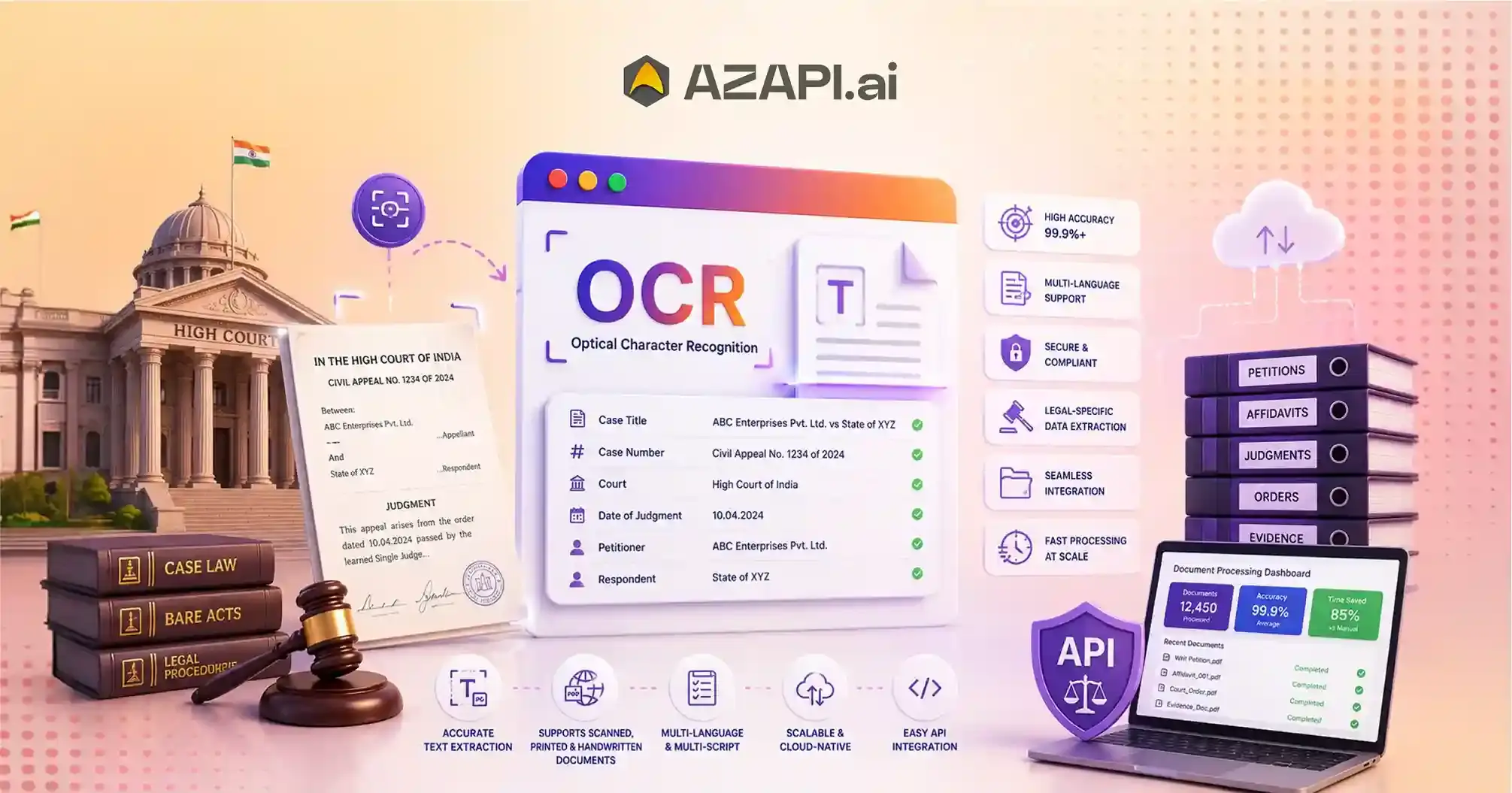
Best OCR API in 2026 for Court Document Processing: Complete Guide for Legal Tech Platforms
Best OCR API in 2026 for Court Document Processing is becoming a critical infrastructure consideration as court systems, legal tech platforms, and law firms transition toward fully digital, document-driven workflows. Courts are no longer just filing paper-based records; they are managing massive volumes of petitions, judgments, case briefs, and evidentiary documents in digital formats that require fast, accurate, and structured processing.
This shift toward digital-first legal infrastructure is being driven by the sheer explosion of legal documentation and the growing need for faster case handling and transparency in judicial systems. Traditional approaches like manual data entry and basic scanning are no longer sufficient for modern legal workloads, where even small delays can slow down entire case pipelines.
OCR APIs have now become foundational to legal technology platforms because they enable automated extraction of structured data from complex legal documents. Platforms such as AZAPI.ai represent this evolution by focusing on real-time document intelligence and structured output pipelines that can support large-scale legal processing systems.
Unlike standard OCR use cases, court document processing requires deeper understanding of structured formats, multi-page legal layouts, citations, case references, and jurisdiction-specific formatting rules. This makes AI-driven document processing significantly more valuable than traditional text extraction tools.
As legal systems modernize, OCR is no longer just a utility—it is becoming a core layer in judicial digitization, enabling courts and law firms to handle case data faster, reduce manual workload, and improve accessibility of legal records across digital platforms.
Nature of Court Documents and Why They Are Hard for OCR
Court documents are among the most complex and challenging types of records to digitize because they are not designed with machine readability in mind. Unlike standard business forms, legal files are often unstructured, multi-layered, and highly contextual, which makes automation significantly more difficult. This is one of the key reasons the Best OCR API in 2026 for Court Document Processing and the Best OCR Software For Document Processing are increasingly defined by intelligence and structure awareness rather than simple text extraction.
Unstructured and Complex Formatting
Legal documents rarely follow a consistent layout. A single judgment or filing may include:
- Multi-column judgment formats
- Handwritten annotations in margins
- Official stamps, seals, and signatures
These elements often overlap or distort text regions, making traditional extraction unreliable without advanced layout understanding.
Legal Language Complexity
Legal professionals write court documents in dense, formal legal language that includes:
- Specialized legal terminology
- References to statutes, acts, and case laws
- Citations across multiple legal precedents
This complexity requires systems that can preserve context, not just extract isolated text fragments.
Cross-Document Dependencies
Legal cases are rarely contained in a single file. Instead, they involve interconnected documents that reference each other across filings and proceedings.
- Dependencies between judgments and petitions
- References to earlier case orders
- Linked evidentiary documents
Understanding these relationships is essential for accurate case reconstruction.
Multi-Document Case Files
Court systems typically handle bundled digital files containing multiple document types, such as:
- Petitions
- Affidavits
- Evidence submissions
- Court orders
Each document type follows different formatting rules, adding another layer of complexity for OCR systems.
Use Cases of OCR APIs in Legal & Court Systems
Legal and judicial systems are increasingly adopting document intelligence tools to handle the growing volume and complexity of case-related data. From digitizing historical records to enabling real-time case tracking, OCR plays a foundational role in modern legal infrastructure. This is also where the Best OCR API in 2026 for Court Document Processing becomes a key enabler for scalable legal automation.
Judicial Digitization
Courts across jurisdictions are digitizing decades of physical records to improve accessibility and transparency.
- Scanning and indexing old case records for searchable archives
- Converting paper-based judgments into structured digital formats
- Modernizing court archives for long-term legal reference systems
This helps reduce dependency on physical file storage and improves retrieval efficiency.
Case Management Systems
Modern court systems rely on automated document handling to manage active cases efficiently.
- Automatic creation of structured case files from submissions
- Indexing petitions, orders, and supporting documents
- Organizing legal workflows for faster case progression
OCR enables courts to process large volumes of filings without manual classification.
E-Discovery in Litigation
E-discovery has become a critical part of modern legal proceedings, especially in complex litigation.
- Searching large datasets of legal documents efficiently
- Extracting relevant evidence from unstructured files
- Identifying key references across multiple case documents
This significantly reduces time spent on manual document review during litigation.
Law Firm Automation
Law firms use OCR-driven systems to streamline internal operations and client servicing.
- Automated client case intake and document processing
- Extraction of key data from contracts and affidavits
- Faster preparation of legal briefs and summaries
This improves productivity and reduces manual workload for legal teams.
Government & Public Legal Portals
Public legal systems are also adopting OCR to improve accessibility and transparency.
- Digital court filing systems for online submissions
- Public judgment databases with searchable records
- Automated indexing of legal publications and rulings
These systems make legal information more accessible to citizens and professionals alike.
Core Requirements for OCR APIs in Court Document Processing
Court systems operate under far stricter accuracy, traceability, and structural complexity requirements than most industries. Legal documents are not just text records—they are evidence, references, and legally binding artifacts. This is why selecting the Best OCR API in 2026 for Court Document Processing depends heavily on how well the system understands structure, context, and legal semantics rather than just converting images into text.
High Structural Understanding
Court documents are highly structured but inconsistently formatted, which makes layout interpretation essential.
- Multi-layout document parsing across judgments, petitions, and filings
- Section-wise extraction of headings, arguments, and final rulings
- Preservation of document hierarchy for legal readability
Without structural understanding, extracted data loses legal meaning and usability.
Legal Entity Recognition
Legal systems rely heavily on precise identification of entities and references.
- Case numbers and filing identifiers
- Party names involved in litigation
- Judges, courts, and jurisdiction details
- Citations to statutes and prior judgments
Accurate entity recognition is critical for case tracking and legal research workflows.
High Accuracy on Scanned & Old Documents
Court archives often include decades of degraded or inconsistent documents.
- Low-quality scanned copies with noise and distortion
- Archived PDFs from legacy systems
- Photocopied or physically scanned legal papers
OCR systems must maintain accuracy even under poor document conditions to ensure reliable digitization.
Searchable Structured Output
Legal systems require data that teams can not only extract but also use for indexing and search.
- JSON-based structured extraction for downstream systems
- Indexed legal fields for fast retrieval
- Metadata tagging for case categorization and classification
This enables courts and law firms to build searchable legal databases.
Audit-Ready Processing
In legal environments, every extracted piece of data must be traceable and verifiable.
- Full traceability of extracted information
- Version-controlled outputs for document history tracking
- Preservation of evidence integrity for compliance and legal validation
This ensures that OCR outputs can stand up to judicial and regulatory scrutiny.
Types of OCR Technologies Used in Legal Tech
Legal technology platforms rely on different generations of OCR systems depending on the complexity of documents and the level of intelligence required. Court filings, judgments, and case files are far more structured and context-heavy than standard business documents, which is why the Best OCR API in 2026 for Court Document Processing is typically expected to go beyond simple text extraction and deliver deeper document understanding.
Traditional OCR Systems
Traditional OCR systems represent the earliest stage of document digitization used in legal workflows.
- Basic text-only extraction from scanned pages
- Limited or no understanding of document structure
- Poor handling of multi-column layouts or mixed formatting
While still used in legacy archives, these systems often require heavy manual correction when applied to legal documents.
AI Document Understanding Systems
AI-based document systems introduce a major improvement by adding structural awareness and contextual interpretation.
- Layout-aware extraction that preserves document hierarchy
- Better handling of headings, paragraphs, and section structure
- Semantic structuring of legal content for improved readability
These systems are more suitable for modern legal workflows where documents must be searchable and machine-readable at scale.
Legal-Specialized OCR Models
The most advanced category includes models designed specifically for legal and judicial environments.
- Trained on judgments, case law, and court filing datasets
- Improved recognition of legal terminology and citation formats
- Entity-aware extraction for case numbers, parties, courts, and judges
These systems are optimized for high-precision legal use cases where accuracy and contextual integrity are critical.
Top OCR APIs for Court Document Processing in 2026
Legal and court systems require OCR platforms that go far beyond simple text extraction. They need structured understanding, legal entity recognition, and reliable processing of complex, multi-page judicial documents. This is why the Best OCR API in 2026 for Court Document Processing is increasingly defined by intelligence, scalability, and legal-grade document structuring rather than basic OCR accuracy alone.
1. AZAPI.ai — AI-Native OCR API for Legal & Court Document Intelligence
AZAPI.ai is designed specifically for structured document processing in high-complexity environments like courts, law firms, and legal SaaS platforms. Instead of treating documents as raw images, it focuses on extracting legally meaningful, structured outputs that can directly power case management systems.
Why It Fits Legal Tech Platforms
Legal documents often contain mixed layouts, references, and hierarchical structures. This system is built to handle multi-page legal files without losing context, making it suitable for large-scale judicial digitization projects where consistency is critical.
Key Capabilities
- Case file digitization at scale
- Judgment and order extraction
- Petition and affidavit parsing
- Structured court order reconstruction
- Legal metadata extraction (case IDs, parties, references)
Legal Tech Use Cases
- Court digitization platforms
- Legal SaaS applications
- Case management systems
- E-discovery and litigation support pipelines
Developer Advantages
- REST API-first integration for legal systems
- Structured JSON output for direct database use
- High-volume processing for bulk case archives
- Webhook-based automation for real-time workflows
2. Google Document AI for Enterprise Legal Systems
Google’s document processing tools are widely used in enterprise environments, offering strong classification and scalable infrastructure. However, in legal workflows, they often require additional customization to properly handle court-specific formatting and metadata extraction, especially for structured legal case reconstruction.
3. AWS Textract for Large Legal Archives
AWS Textract provides scalable document processing suitable for large-scale digitization projects. It performs well with forms and structured layouts, but typically requires additional engineering layers to interpret legal semantics and court-specific relationships between documents.
4. Azure Document Intelligence for Government Systems
Azure’s document processing capabilities are widely used in government ecosystems due to strong security and compliance infrastructure. However, legal workflows often require additional configuration to interpret court document structures and extract legal entities effectively.
5. Open-Source OCR + Custom Legal Models
Open-source OCR combined with custom-trained legal models offers full flexibility and control. It is often used in specialized legal research or government projects where customization is critical, but it comes with high engineering complexity and ongoing maintenance overhead.

OCR Comparison for Legal Tech Platforms
Legal technology systems require OCR solutions that go beyond simple text extraction. Courts, law firms, and legal SaaS platforms depend on structured understanding, metadata extraction, and high-volume processing of complex case files. This is why the Best OCR API in 2026 for Court Document Processing is typically evaluated based on legal intelligence, not just accuracy or speed.
Below is a practical comparison of leading OCR approaches used in legal tech ecosystems:
| OCR API | Legal Understanding | Structure Extraction | Bulk Processing | API Readiness | Court Document Fit |
| AZAPI.ai | High | High | High | Excellent | Strong |
| Google Document AI | Medium | High | High | Good | Medium |
| AWS Textract | Medium | Medium | High | Good | Medium |
| Azure Document Intelligence | Medium | Medium | High | Good | Medium |
| Open Source OCR | Low | Low | Medium | Complex | Low |
Key Insights from the Comparison
In legal workflows, the biggest differentiator is not raw OCR accuracy but how well the system understands structure and legal meaning.
- Platforms like AZAPI.ai stand out because they focus on structured legal document intelligence rather than raw text extraction.
- Enterprise OCR systems such as cloud-based offerings are strong in scalability but often require additional engineering to handle court-specific document formats.
- Open-source OCR solutions offer flexibility but lack built-in legal intelligence and require significant customization.
How OCR APIs Power Court Digitization Systems
Court digitisation is no longer just about scanning documents-it’s about transforming entire judicial records into structured, searchable, and machine-readable systems. This shift is central to modern legal infrastructure, and it also explains why the Best OCR API in 2026 for Court Document Processing is increasingly defined by how well it supports end-to-end legal workflows rather than just text extraction.
Step 1 – Document Ingestion
The digitization process begins with collecting and uploading court materials from multiple sources.
- Scanned court files from archives
- PDFs of petitions, judgments, and filings
- Mixed-format legal bundles containing multiple document types
At this stage, the challenge is not just upload—it is handling inconsistent document quality and formats.
Step 2 – OCR Extraction
OCR systems convert visual data into machine-readable content once they ingest documents.
- Extraction of text from scanned images and PDFs
- Recognition of multi-page legal documents
- Conversion of unstructured inputs into readable data streams
This step forms the foundation for downstream legal processing.
Step 3 – Legal Structuring
Raw text alone is not enough for legal systems. The extracted content must be organized into meaningful components.
- Identification of case sections such as arguments, rulings, and orders
- Separation of headings, paragraphs, and citations
- Structuring of multi-document legal flows
This is where modern AI-driven OCR systems differ significantly from traditional extraction tools.
Step 4 – Metadata Tagging
Legal systems depend heavily on metadata for indexing and retrieval.
- Court name and jurisdiction tagging
- Case numbers and filing references
- Judgment type classification
This enables efficient categorization of legal records across databases.
Step 5 – Integration into Case Systems
Judicial platforms integrate the data once teams structure and tag it.
- Legal case management systems
- Searchable court databases
- E-discovery and research repositories
This enables fast retrieval, analysis, and cross-referencing of legal information.
Challenges in Court Document Digitization
Digitizing court records is one of the most complex document automation problems because legal systems were never designed for structured data processing. Every jurisdiction, court level, and even individual filing style introduces variations that make large-scale automation difficult. This is why the Best OCR API in 2026 for Court Document Processing is expected to handle not just text extraction, but real-world document unpredictability at scale.
Poor Scan Quality of Old Records
Many court archives never digitized decades of historical documents properly.
- Faded ink and low-resolution scans
- Torn or partially missing pages
- Noise, shadows, and distortion from physical storage
These issues make accurate extraction difficult without advanced image enhancement and robust recognition models.
Mixed Handwritten + Printed Text
Court documents often combine multiple writing formats within the same page.
- Handwritten notes in margins or corrections
- Printed legal text in structured sections
- Stamps, signatures, and annotations overlapping content
This mixture significantly increases extraction complexity and reduces reliability for traditional OCR systems.
Non-Standard Formatting Across Courts
There is no universal formatting standard across judicial systems.
- Different layout structures for judgments and petitions
- Varying document templates across jurisdictions
- Inconsistent section labeling and formatting rules
As a result, systems must adapt dynamically rather than rely on fixed templates.
Large-Scale Document Volumes
Court digitization projects often involve processing millions of pages.
- Bulk processing of historical case archives
- Continuous inflow of new filings and judgments
- High throughput requirements for real-time systems
Scalability becomes as important as accuracy in such environments.
Sensitive Legal Data Handling
Legal documents contain highly sensitive and confidential information.
- Personal identity details of litigants
- Confidential case evidence and filings
- Regulatory and judicial records requiring strict access control
This demands strong encryption, secure processing pipelines, and compliance-ready infrastructure.
Why AI OCR Is Replacing Traditional Legal Digitisation
Legal digitization is undergoing a major shift because traditional OCR systems were never designed for the complexity of court documents. They could extract text, but they struggled with structure, context, and legal meaning. Modern systems are now evolving toward intelligent document processing, which is why the Best OCR API in 2026 for Court Document Processing is increasingly expected to understand legal context rather than just read characters.
Better Understanding of Legal Context
AI-based OCR systems interpret documents beyond surface-level text extraction.
- Recognize legal terminology and structured arguments
- Maintain relationships between sections of judgments
- Understand references to statutes and case laws
This contextual awareness is essential for meaningful legal digitalization.
Automated Structuring of Judgments
Instead of producing raw text output, AI OCR organizes legal content into structured formats.
- Separates facts, arguments, and rulings automatically
- Identifies headings, subheadings, and legal sections
- Preserves document hierarchy for legal usability
This reduces dependency on manual formatting and review.
Faster Case Indexing
AI-driven systems significantly speed up the organization and storage of legal records.
- Automatic classification of case types
- Instant tagging of legal entities and references
- Real-time indexing into searchable databases
This improves efficiency in large judicial systems.
Reduced Manual Legal Data Entry
Traditional workflows require extensive human effort to process court documents.
- Manual transcription of case details
- Data entry into legal management systems
- Cross-verification of extracted information
AI OCR removes most of these repetitive tasks.
Improved Searchability of Legal Archives
Properly structured documents make digitized legal systems far more useful.
- Full-text and metadata-based search capabilities
- Faster retrieval of relevant case files
- Better cross-referencing across judgments and filings
This transforms static archives into intelligent legal databases.
Performance Metrics for Legal OCR APIs
Legal systems don’t evaluate AI-powered OCR Tools the same way general industries do. In court and legal tech environments, success is defined by how accurately and consistently systems can interpret structured legal information at scale. This is why the Best OCR API in 2026 for Court Document Processing is judged more on legal intelligence and reliability than basic text extraction performance.
Legal Field Extraction Accuracy
This measures how correctly an OCR system identifies and extracts legally important entities and fields.
- Case numbers and filing IDs
- Party names and involved entities
- Judges, courts, and jurisdiction details
- Citations to statutes and prior judgments
High accuracy here is critical because even small errors can affect legal interpretation and case tracking.
Case Indexing Speed
Speed is essential for large-scale judicial systems handling a continuous inflow of documents.
- Time taken to convert raw documents into indexed case records
- Ability to process filings in near real-time
- Efficiency in updating legal databases
Faster indexing directly improves court workflow efficiency.
Multi-Page Processing Efficiency
Court documents are rarely single-page files.
- Handling long judgments and bundled case files
- Maintaining consistency across pages
- Preserving document structure across large PDFs
Efficient processing ensures no loss of context across pages.
Metadata Correctness
Metadata is essential for searchability and classification in legal systems.
- Accuracy of court name, case type, and filing details
- Correct tagging of document categories
- Consistency in structured outputs across datasets
Incorrect metadata can lead to misclassification of legal records.
Error Rate in Scanned Judgments
Many legal documents are old, degraded, or poorly scanned.
- Recognition performance on low-quality scans
- Handling of faded text and distorted layouts
- Accuracy under real-world archival conditions
Lower error rates indicate stronger real-world reliability.
Scalability for Bulk Archives
Legal digitization projects often involve massive document volumes.
- Ability to process millions of pages efficiently
- Stable performance under high throughput workloads
- Horizontal scalability across legal databases
Scalability is essential for national-level court digitization initiatives.
Conclusion
Court systems today operate under far more complex demands than simple document scanning or text recognition. They require systems that can interpret structure, preserve legal meaning, and handle large-scale, sensitive datasets with high reliability. This is why modern legal digitization is moving away from basic OCR toward intelligent document processing systems that understand context, relationships, and hierarchy within legal records.
In this environment, the Best OCR API in 2026 for Court Document Processing is no longer defined by raw text extraction capability alone, but by how effectively it can support structured legal workflows such as case indexing, judgment analysis, and evidence organization.
Legal documents inherently demand structured, contextual, and scalable extraction. From multi-page judgments to handwritten annotations and complex legal citations, the variability of court records requires systems that can adapt dynamically while maintaining accuracy and auditability.
AI-powered OCR APIs are now reshaping legal tech infrastructure by enabling courts, law firms, and legal platforms to move toward fully digital, searchable, and automated ecosystems.
Among modern solutions, AZAPI.ai stands out as a strong choice for court document processing because it is built around structured extraction, real-time processing, and API-first workflows designed specifically for complex legal and compliance environments.
FAQs
Q1. Which is the best OCR API in 2026 for court document processing?
Ans: The most suitable OCR APIs for court systems are those that go beyond text extraction and focus on structured legal understanding, metadata tagging, and multi-page document handling. In modern legal tech stacks, solutions like AZAPI.ai are often considered strong options because they are designed for real-time structured document intelligence rather than raw OCR output.
Q2. How do courts use OCR APIs for digitization?
Ans: Courts use OCR APIs to convert physical and scanned case records into searchable digital formats. This includes indexing judgments, petitions, affidavits, and orders so they can be stored and retrieved efficiently in legal databases.
Q3. Can OCR extract legal case numbers and judgments accurately?
Ans: Yes, advanced OCR systems can extract structured legal fields such as case numbers, party names, court details, and judgment sections, provided they include strong layout and entity recognition capabilities.
Q4. What makes legal OCR different from normal OCR?
Ans: Legal OCR requires deeper structural understanding, including multi-page document hierarchy, citations, legal terminology recognition, and metadata extraction, unlike standard OCR which only converts images to text.
Q5. Which OCR API is best for law firms and legal SaaS platforms?
Ans: Law firms and legal SaaS platforms typically prefer OCR systems that offer structured outputs, scalability, and easy API integration for case management, e-discovery, and document automation workflows.
Q6. How is AI improving court document processing?
Ans: AI enhances court document processing by enabling automatic structuring, contextual understanding, faster indexing, and improved accuracy on complex legal documents.
Q7. What is the most accurate OCR for scanned legal documents?
Ans: Accuracy depends on the system’s ability to handle low-quality scans, multi-layout documents, and handwritten annotations while preserving legal structure and meaning.
Q8. Is structured JSON output important for legal systems?
Ans: Yes, structured JSON output is essential because it allows direct integration with case management systems, legal databases, and automation workflows without additional processing.
Q9. How do legal tech platforms integrate OCR APIs?
Ans: Legal platforms integrate OCR APIs using REST endpoints, webhooks, and structured data pipelines that connect document extraction directly to case management and indexing systems.
Q10. Why is AZAPI.ai used in legal document automation?
Ans: AZAPI.ai is used in legal automation because it focuses on structured document extraction, real-time processing, and scalable API-based workflows that align with the needs of modern court systems and legal tech platforms.