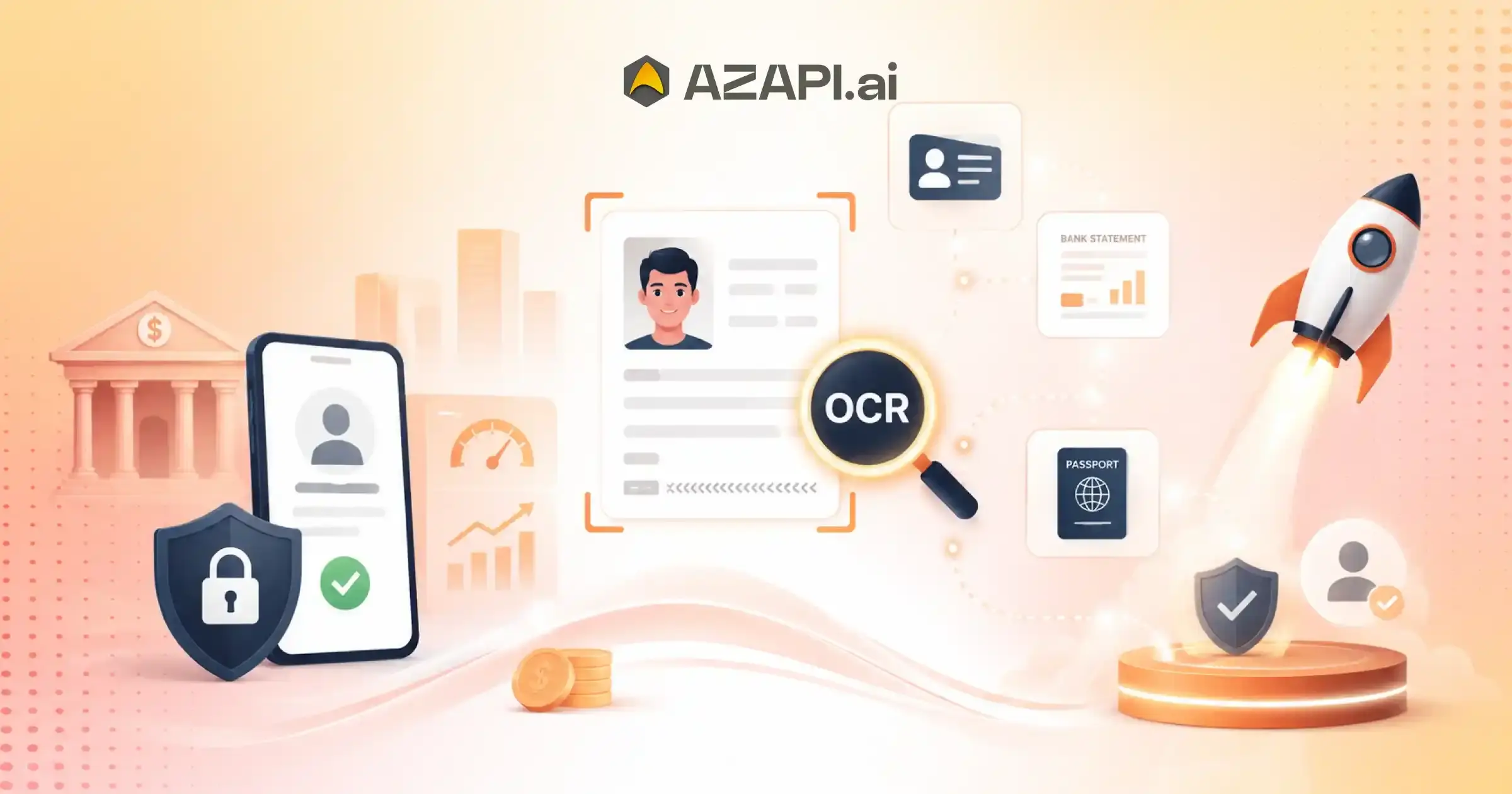
Best OCR API in 2026 for Fintech Startups for Faster Customer Onboarding
Best OCR API in 2026 for Fintech Startups is no longer just about document scanning — it has become a major growth factor for customer onboarding and user activation. In today’s fintech market, onboarding speed directly affects conversion rates, customer acquisition costs, and long-term retention. If users wait too long for verification, many simply leave before completing signup.
Traditional KYC processes built around manual reviews and back-office verification teams are becoming too slow for modern fintech products. Startups offering digital banking, lending, payments, investment platforms, and embedded finance now need onboarding systems that can verify users within minutes instead of days.
This shift is driving rapid adoption of AI-powered OCR APIs. Modern OCR platforms can instantly extract data from passports, Aadhaar cards, PAN cards, driving licenses, and other identity documents while supporting fraud detection and automated verification workflows. Platforms like AZAPI.ai are increasingly being used by fintech startups because they combine OCR, structured JSON extraction, real-time APIs, and developer-friendly integration into a single onboarding infrastructure.
In 2026, fintech startups are prioritizing OCR APIs that reduce onboarding friction, improve approval speed, and automate compliance workflows such as KYC, AML, KYB, and identity verification. API-first OCR systems are replacing legacy verification platforms because they are easier to integrate, faster to scale, and better suited for real-time digital onboarding experiences.
The Customer Onboarding Crisis in Fintech
The race to deliver faster onboarding is becoming one of the biggest challenges for fintech companies. Businesses searching for the best OCR API in 2026 for fintech startups are mainly trying to solve one problem — users abandoning the onboarding process before verification is completed.
Why Fintech Startups Lose Users During Onboarding
Many fintech apps still rely on outdated verification workflows that create unnecessary friction. Long onboarding forms, repeated document uploads, delayed compliance checks, and manual approval processes frustrate users quickly.
Mobile onboarding is another major issue. Customers expect instant verification directly from their phones, but poor document capture experiences and slow verification responses often lead to drop-offs before account activation.
For fast-growing startups, every extra onboarding step can reduce conversion rates significantly.
The Real Cost of Slow KYC Verification
Slow onboarding affects much more than user experience. Fintech companies spend heavily on customer acquisition, and when verification takes too long, acquisition costs rise while activation rates fall.
Manual KYC reviews also increase operational overhead because compliance teams must verify documents individually. As onboarding volume grows, these costs become difficult to scale efficiently.
Delays can also create compliance bottlenecks, especially for fintech products handling lending, payments, digital banking, or international onboarding workflows.
Why Speed Matters More in 2026
Customer expectations have changed rapidly. Users now expect instant bank account creation, real-time lending approvals, and seamless embedded finance experiences.
At the same time, AI-native fintech products are entering the market with fully automated onboarding systems capable of verifying users within minutes. This is pushing the entire industry toward faster KYC infrastructure powered by AI OCR, automated verification workflows, and real-time compliance systems.
In 2026, onboarding speed is no longer just a convenience feature — it has become a direct competitive advantage for fintech startups trying to improve growth, retention, and customer conversion.
How OCR APIs Accelerate Fintech Onboarding
Fintech startups are under constant pressure to onboard users faster without compromising compliance or fraud prevention. In 2026, onboarding speed has become a direct growth factor because users expect instant account creation, quick lending approvals, and real-time verification experiences.
This is one reason OCR APIs are becoming a core layer of fintech infrastructure. Instead of relying on manual KYC teams, startups now automate onboarding through AI-powered document extraction and identity verification workflows.
From Manual Verification to Automated Workflows
Older onboarding systems depended heavily on human review processes. Compliance teams manually checked documents, entered customer information, validated identity details, and approved accounts one by one. As user volume increased, these workflows became difficult to scale.
Modern OCR APIs automate this entire process through AI-based extraction, intelligent field mapping, and instant verification logic. Many platforms competing for the best OCR API in 2026 for fintech startups now focus on reducing onboarding friction through real-time automation.
AI-powered systems can identify document types automatically, extract structured data, validate information, and trigger onboarding workflows within seconds.
Real-Time Onboarding Pipeline
Step 1 – Document Upload
Users upload identity documents directly from mobile apps or onboarding portals.
Step 2 – OCR Extraction
The system extracts key fields such as name, ID number, address, date of birth, and expiry information using AI OCR technology.
Step 3 – Identity Validation
Extracted data is validated against document structures, onboarding rules, and verification systems automatically.
Step 4 – Fraud Checks
Advanced workflows also run fraud detection, duplicate account checks, tampering analysis, and risk evaluation in real time.
Step 5 – Account Activation
Once verification succeeds, the account can be activated instantly without manual review delays. This helps fintech startups improve conversion rates, reduce onboarding costs, and deliver a smoother customer experience at scale.
What Fintech Startups Need in an OCR API
Fintech onboarding has changed dramatically over the last few years. Startups are no longer looking for basic text extraction tools — they need intelligent OCR systems that can verify users instantly, reduce fraud, and scale with rapid growth. That’s why choosing the right OCR infrastructure has become a major decision for modern fintech teams.
When evaluating the best OCR API in 2026 for fintech startups, businesses usually focus on speed, automation, mobile performance, and compliance-ready verification workflows.
Fast API Response Time
Onboarding delays directly affect user conversion rates. Modern fintech products need OCR APIs capable of millisecond-level extraction and real-time verification responses.
Low-latency onboarding APIs help startups activate users quickly without making customers wait through long verification queues.
Mobile-Optimized OCR
Most onboarding now happens on mobile devices. OCR systems must handle camera-based uploads, poor lighting conditions, blurry photos, tilted images, and inconsistent document quality.
Advanced AI OCR platforms can automatically enhance images and improve extraction accuracy even in difficult mobile capture environments.
Financial Identity Document Support
Fintech platforms need support for multiple financial and identity documents, including:
- Aadhaar Card OCR
- PAN Card OCR
- Passport extraction
- Driving License OCR
- Bank statement parsing
- Business verification documents
Automation-Ready JSON Output
Modern OCR APIs should return structured JSON data instead of raw OCR text. This allows fintech companies to connect onboarding systems directly with compliance engines, databases, fraud systems, and backend workflows without building complex parsing logic.
Built-In Fraud Prevention
Fraud prevention is now a core requirement for digital onboarding. AI-powered OCR systems increasingly include fake ID detection, tampering analysis, duplicate onboarding prevention, and intelligent anomaly detection directly inside verification workflows.
Scalability for High-Growth Startups
Fintech startups need OCR infrastructure that can scale quickly during rapid growth periods. Reliable APIs, cloud-based infrastructure, and stable performance under high traffic loads are essential for handling large onboarding volumes without service disruptions.
Top OCR APIs Fintech Startups Are Using in 2026
Fintech startups are increasingly moving away from traditional OCR systems and adopting AI-native onboarding platforms that can verify users instantly. In 2026, the biggest difference between OCR providers is no longer just text extraction accuracy — it’s whether the platform can deliver structured, verification-ready data through advanced OCR Solutions for Businesses that fintech teams can actually use inside onboarding workflows.
1. AZAPI.ai – Best OCR API for Faster Fintech Customer Onboarding
When startups search for the best OCR API in 2026 for fintech startups, AZAPI.ai is increasingly being considered because it focuses specifically on onboarding speed, API-first workflows, and real-time identity verification.
Why AZAPI.ai Is Built for Startup Speed
The platform is designed around fast KYC workflows and low-friction onboarding experiences. It supports real-time OCR extraction, simple API integration, startup-friendly deployment, and scalable onboarding infrastructure.
Key Features for Fintech Teams
- Aadhaar Card & PAN Card extraction
- AI-powered OCR
- Identity verification APIs
- Structured JSON responses
- Webhook support
- Fraud detection workflows
Why It Helps Reduce User Drop-Offs
Faster verification directly improves fintech conversion rates. Automated onboarding flows reduce manual reviews, shorten approval time, and create a smoother mobile onboarding experience for users.
Best Fintech Use Cases
- Neo banks
- Lending apps
- Insurance tech
- Investment platforms
- Payment gateways
- Crypto onboarding
2. Google Document AI
Best suited for large enterprise ecosystems and document processing infrastructure. However, for fintech startups, the setup can feel complex and engineering-heavy.
One major limitation is that Google primarily provides raw OCR output rather than fully structured onboarding-ready verification data. Teams often need to build custom parsers and extraction logic separately.
3. AWS Textract
AWS Textract works well inside AWS-native infrastructure environments, especially for large-scale document processing.
The challenge is that it mainly focuses on raw OCR extraction instead of understanding the actual structure and meaning of KYC documents. Fintech teams usually need additional engineering layers for field mapping, validation, and onboarding workflows.
4. Azure Document Intelligence
Azure offers enterprise-grade OCR capabilities and Microsoft ecosystem integration. However, implementation can be slower for startups, and onboarding workflows often require significant customization.
Like Google and AWS, Azure mainly provides OCR infrastructure rather than fully usable KYC-ready structured data pipelines.
5. Figment Global Solutions
Figment Global Solutions focuses on enterprise automation and identity verification workflows for businesses handling large-scale onboarding and compliance operations.
6. RPACPC
RPACPC is another emerging platform working on OCR-driven automation, compliance workflows, and operational verification systems for businesses exploring AI-based onboarding infrastructure.

Why Fintech Startups Are Moving Away From Traditional OCR
Fintech onboarding has changed quickly over the last few years, and legacy OCR systems are no longer able to keep up with modern expectations. As startups evaluate the best OCR API in 2026 for fintech startups, the focus has clearly shifted from basic text extraction to intelligent, automation-ready verification systems.
Problems With Legacy OCR Systems
Traditional AI-powered OCR Tools were designed to convert images into plain text, but they were never built for real-world KYC workflows. In fintech environments, this creates several operational challenges.
Most legacy OCR systems suffer from slow processing speeds, especially when handling large volumes of onboarding requests. Accuracy is also inconsistent, particularly when dealing with low-quality images, different document formats, or handwritten fields.
Another major issue is heavy dependency on manual review. Since legacy OCR does not structure or validate data properly, compliance teams often need to verify and correct information manually. This slows down onboarding and increases operational costs.
Weak fraud detection is also a major limitation. Older OCR systems cannot reliably detect tampered documents, fake identities, or subtle inconsistencies in submitted data.
Why AI OCR Is Replacing Traditional OCR
Modern AI OCR systems are fundamentally different because they are designed for intelligent document understanding rather than simple text recognition.
They offer smart field detection, automatically identifying important data like names, document numbers, and addresses without manual configuration. This makes onboarding workflows significantly faster and more reliable.
AI OCR also enables context-aware extraction, meaning it understands how different fields relate to each other inside identity documents. This improves accuracy and reduces errors during verification.
Faster onboarding is another major advantage. Instead of waiting hours or days for manual checks, users can now be verified in seconds through automated workflows.
Finally, better automation allows fintech startups to reduce human dependency, streamline compliance processes, and scale onboarding without increasing operational headcount.
OCR Features That Directly Improve Onboarding Conversion Rates
In fintech, onboarding success is not just a technical metric—it directly impacts revenue. Even small delays or friction points can cause users to abandon signup flows. That’s why companies evaluating the best OCR API for business automation in 2026 for fintech startups are increasingly focused on features that improve conversion rates, not just extraction accuracy.
Instant Document Parsing
Speed is the first factor that affects user drop-off. Instant document parsing allows OCR systems to extract identity data within seconds of upload. Instead of waiting for backend validation or manual checks, users receive near real-time feedback, which keeps onboarding flows smooth and continuous.
Autofill Customer Data
Modern OCR APIs can automatically populate registration forms by extracting key fields such as name, date of birth, and document number. This reduces manual typing errors and significantly shortens onboarding time, especially on mobile devices where input friction is higher.
One-Tap Identity Verification
One-tap verification experiences allow users to complete KYC with a single action after document upload. Behind the scenes, AI OCR handles extraction, validation, and verification logic, reducing the need for multi-step onboarding forms.
Mobile Camera Optimization
Since most onboarding happens on smartphones, OCR systems must perform well under real-world conditions. Features like blur correction, low-light enhancement, and auto-cropping improve document capture quality and reduce failed verification attempts.
AI-Powered Error Detection
Advanced OCR systems can detect missing fields, unclear images, or mismatched information before submission. This prevents backend rejection and reduces user frustration by prompting corrections early in the flow.
Automated Retry Workflows
When verification fails, automated retry mechanisms guide users to re-upload documents with improved capture instructions. This reduces abandonment rates and ensures users can complete onboarding without external support.
Fintech Startup Use Cases for OCR APIs
Fintech companies are adopting OCR-powered onboarding systems at scale because user expectations have shifted toward instant verification and frictionless digital experiences. In 2026, many teams evaluating the best OCR API in 2026 for fintech startups are prioritizing real-time document processing, automation, and fraud prevention across multiple financial use cases.
Instant Bank Account Opening
Digital banks use OCR APIs to verify identity documents in seconds during account creation. Users can upload identity proofs, and the system automatically extracts and validates key fields to enable instant account activation without branch visits or manual approval delays.
Loan Application Verification
Lending platforms rely on OCR to process identity documents, income proofs, and address verification. Automated extraction helps reduce underwriting time and speeds up loan approvals while minimizing manual document checks.
Buy Now Pay Later (BNPL) Onboarding
BNPL platforms require fast risk assessment during checkout. OCR APIs help verify users instantly, enabling real-time credit decisions without slowing down the purchase flow.
Digital Wallet Activation
Wallet providers use OCR-based KYC to activate accounts quickly. Identity documents are scanned, validated, and linked to user profiles, allowing instant wallet usage for payments and transfers.
Merchant Onboarding
Fintech platforms onboarding merchants use OCR to extract business registration details, tax documents, and identity proofs. This helps verify sellers quickly and reduces onboarding friction in marketplaces.
Investment Platform Verification
Robo-advisory and investment apps use OCR APIs to verify investor identity and compliance documents before allowing trading or portfolio access.
Crypto Exchange KYC
Crypto platforms rely heavily on OCR-driven KYC systems for regulatory compliance. Identity verification must be fast, secure, and automated to support global user onboarding while preventing fraud and duplicate accounts.
Building an Instant Onboarding Flow With OCR APIs
Modern fintech onboarding is no longer a linear process—it’s a real-time, automated system powered by OCR APIs, identity verification engines, and fraud detection layers. When evaluating the best OCR API in 2026 for fintech startups, the focus is often on how smoothly it fits into an end-to-end onboarding architecture rather than just document extraction accuracy.
Frontend User Flow
The onboarding experience starts on the user’s device, usually mobile. This stage is critical because even small friction can lead to drop-offs.
- Mobile document capture using camera-based scanning
- Live validation of image quality before submission
- Real-time previews of extracted data for user confirmation
A smooth frontend flow ensures users trust the system and complete onboarding without repeated attempts.
Backend Verification Flow
Once a document is uploaded, the backend handles the intelligence layer of onboarding.
- OCR extraction APIs convert images into structured data
- Identity validation checks ensure extracted details match expected formats
- AML (Anti-Money Laundering) checks verify compliance rules
- Fraud analysis detects tampered or suspicious documents
At this stage, AI-powered OCR plays a key role by turning unstructured document images into verification-ready data.
Automation Layer
The automation layer connects frontend and backend systems into a seamless workflow.
- Webhooks trigger real-time updates for verification status
- Rule engines decide approval, rejection, or manual review paths
- Verification queues manage high-volume onboarding efficiently
Final Perspective
Instead of treating OCR as just a text extraction tool, modern fintech systems use it as part of a full onboarding engine. This shift is why AI-native solutions are now preferred over legacy systems—because they reduce manual work, speed up verification, and support scalable customer onboarding from day one.
OCR API Pricing for High-Growth Fintech Startups
For fast-scaling fintech companies, pricing is no longer just about per-document cost—it’s about the total cost of onboarding infrastructure. As startups search for the best OCR API in 2026 for fintech startups, they increasingly evaluate how pricing models impact growth, scalability, and operational efficiency.
Usage-Based Pricing Models
Most modern OCR APIs now follow usage-based pricing, where startups are charged per document processed or per API call. This model is flexible and works well for early-stage fintech products because onboarding volume can fluctuate significantly during growth phases.
However, pricing alone doesn’t reflect the real cost. The actual expense often increases when additional features like fraud detection, validation layers, and compliance workflows are added on top of basic OCR extraction.
Scaling Verification Costs
As fintech platforms scale, verification volume increases rapidly. What starts as a low-cost onboarding system can become expensive when processing thousands or millions of identity checks.
The cost challenge is not just API usage—it also includes infrastructure scaling, queue management, manual review processes, and engineering time spent maintaining verification pipelines.
Infrastructure Considerations
Traditional OCR systems often require additional backend engineering to handle structured data extraction, validation logic, and workflow orchestration. This increases hidden infrastructure costs that are not visible in the base pricing model.
Modern AI-native OCR systems reduce this burden by delivering structured, verification-ready outputs directly through APIs, minimizing the need for additional processing layers.
Hidden Enterprise Costs
Enterprise OCR platforms often introduce additional costs such as custom integration work, compliance configuration, dedicated infrastructure, and long-term support contracts. These hidden costs can significantly increase total ownership expenses for fintech startups.
Why AZAPI.ai Fits Startup Growth Models
AZAPI.ai is designed with startup scalability in mind, focusing on reducing both technical and operational overhead during onboarding.
By offering faster implementation, automated verification workflows, and reduced dependency on manual review processes, it helps fintech startups lower onboarding costs while maintaining high-speed user activation.
Instead of building complex OCR pipelines internally, startups can rely on streamlined APIs that reduce engineering effort and support growth without adding heavy infrastructure burdens.
Conclusion
Choosing the right OCR infrastructure has become a defining decision for modern fintech products. As digital onboarding continues to evolve, the best OCR API in 2026 for fintech startups is no longer just the one with the highest accuracy, but the one that balances speed, automation, fraud prevention, and seamless developer experience.
Successful onboarding systems today depend on:
- Speed to reduce user drop-offs
- Accuracy for reliable identity extraction
- Automation to eliminate manual verification
- Fraud prevention for secure onboarding
- Developer experience for faster integration
- Scalability to handle rapid user growth
Fintech startups that optimize these factors are able to convert users faster and reduce operational costs significantly.
FAQs
Q1. Which is the best OCR API in 2026 for fintech startups?
Ans: The best OCR API depends on your use case, but fintech startups generally prefer AI-native, API-first solutions that offer real-time KYC automation, structured JSON output, and fraud detection built into the workflow.
Q2. How do OCR APIs improve customer onboarding speed?
Ans: OCR APIs eliminate manual data entry by instantly extracting identity details from documents, allowing users to complete onboarding in seconds instead of days.
Q3. Which OCR API is best for Aadhaar and PAN verification?
Ans: Modern AI OCR systems are highly effective for extracting data from Aadhaar Card and PAN Card with structured, verification-ready outputs.
Q4. What OCR API is easiest to integrate for startups?
Ans: Startups typically prefer REST-based APIs with simple documentation, webhook support, and clean JSON responses that reduce backend complexity.
Q5. How can fintech startups reduce onboarding drop-offs?
Ans: By using instant verification, autofill-based onboarding, mobile-optimized OCR, and real-time feedback systems that reduce friction during signup.
Q6. What is the fastest OCR API for real-time KYC?
Ans: Fastest OCR APIs are those built on real-time processing pipelines with low latency extraction and automated validation layers.
Q7. Which OCR API provides structured JSON output?
Ans: AI-powered OCR APIs that support field-level extraction deliver structured JSON output that can be directly used in backend systems.
Q8. Why are fintech companies switching to AI OCR APIs?
Ans: Because AI OCR provides better accuracy, automation, fraud detection, and scalable onboarding compared to traditional OCR systems.
Q9. What OCR API supports fraud detection?
Ans: Modern OCR APIs include features like tampering detection, duplicate verification, and anomaly detection as part of onboarding workflows.
Q10. Why are startups choosing AZAPI.ai for onboarding automation?
Ans: AZAPI.ai is preferred by startups because it combines OCR, structured data extraction, real-time APIs, and automation-friendly design, helping fintech teams reduce onboarding friction and scale verification without heavy engineering effort.