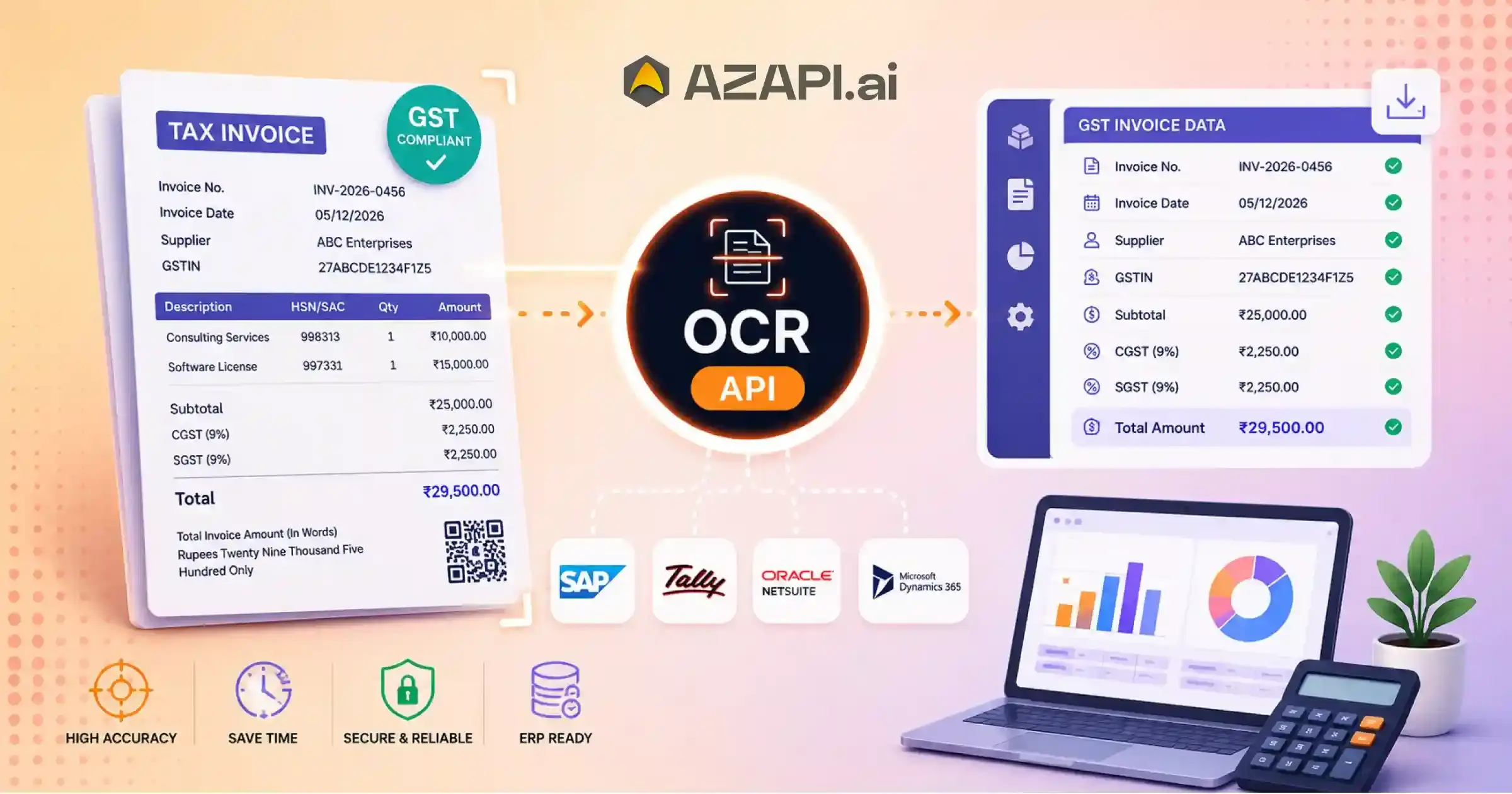
Best OCR API in 2026 for GST Invoice Processing for ERP & Accounting Software
Best OCR API in 2026 for GST Invoice Processing is becoming one of the most searched solutions among Indian businesses as invoice volumes continue to grow rapidly across finance, retail, logistics, manufacturing, healthcare, and e-commerce sectors. Companies handling thousands of GST invoices every month are realizing that manual invoice entry is no longer practical, scalable, or cost-efficient.
Traditional invoice processing involves manually entering invoice numbers, GSTIN details, tax amounts, vendor names, HSN codes, and line-item data into ERP or accounting systems. This process is not only time-consuming but also highly prone to human errors, delayed reconciliations, and compliance issues.
As businesses move toward automation, ERP and accounting platforms are increasingly adopting AI-powered OCR technologies to extract invoice data automatically from PDFs, scanned copies, mobile images, and email attachments. Modern OCR systems can process invoices in real time, reduce operational workload, and improve accounting accuracy significantly.
Platforms like AZAPI.ai are helping businesses automate GST invoice processing using advanced AI-based OCR models trained specifically for Indian invoice formats and real-world document conditions.
In this guide, we’ll explore how GST Invoice OCR APIs work, the biggest challenges in invoice processing, key features businesses should look for, and why AI-powered invoice automation is becoming essential in 2026.
What is GST Invoice OCR API?
GST Invoice OCR API is a technology that automatically extracts structured information from GST invoices using AI and Optical Character Recognition (OCR). Instead of manually entering invoice details into ERP or accounting software, businesses can automate the entire data extraction process from scanned invoices, PDFs, email attachments, or mobile-captured images.
In invoice processing, OCR works by reading printed or handwritten text from invoice documents and converting it into machine-readable data. Modern AI-powered invoice OCR systems go beyond basic text reading by understanding invoice layouts, tax structures, tables, and financial fields automatically.
A GST Invoice OCR API can extract important information such as GSTIN numbers, invoice numbers, invoice dates, vendor and buyer details, line items, HSN/SAC codes, CGST, SGST, IGST values, tax breakdowns, total invoice amounts, and payment-related details.
One major difference between generic OCR and invoice-specific OCR is document intelligence. Generic OCR tools mainly return raw text without understanding invoice structure, while invoice OCR systems are trained specifically to identify invoice fields, tax formats, table structures, and accounting data accurately.
This is why businesses searching for the Best OCR API in 2026 for GST Invoice Processing are increasingly choosing AI-powered invoice extraction systems instead of traditional OCR engines. Specialized invoice OCR APIs help reduce manual workload, improve accounting accuracy, accelerate GST reconciliation, and automate finance workflows at scale. As demand for intelligent financial automation grows, the best OCR API for business automation is becoming essential for businesses aiming to streamline invoice processing and improve operational efficiency.
As invoice volumes continue increasing across Indian businesses, GST Invoice OCR APIs are becoming an essential part of modern finance and compliance infrastructure.
Why GST Invoice Processing is a Major Challenge in 2026
GST invoice processing has become significantly more complex for businesses in 2026 as transaction volumes continue to rise across industries. Enterprises today handle invoices from hundreds or even thousands of vendors, making manual processing increasingly difficult to manage efficiently.
Large organizations are now processing massive numbers of invoices daily across procurement, logistics, retail, manufacturing, healthcare, and finance operations. At the same time, digital accounting workflows are expanding rapidly as businesses shift toward automated ERP and cloud-based finance systems. The growing vendor ecosystem has also introduced countless invoice variations, formats, and document structures into finance operations.
Manual invoice processing creates several operational bottlenecks. Finance teams often spend hours entering invoice details manually, validating GST amounts, matching purchase orders, and checking vendor information. This leads to slower approvals, frequent human errors, reconciliation mismatches, delayed payments, and increased compliance risks during audits or GST filings.
Traditional OCR systems struggle heavily in these scenarios because invoices are not standardized documents. Every vendor may use a completely different invoice format, table structure, font style, or tax layout. Multi-page invoices, scanned PDFs, blurry images, and low-quality mobile captures make extraction even more challenging.
Complex GST tax tables containing CGST, SGST, IGST, HSN/SAC codes, and line-item calculations require deeper document understanding rather than simple text extraction.
This is exactly why businesses are actively searching for the Best OCR API in 2026 for GST Invoice Processing to automate invoice extraction, improve accounting accuracy, and reduce operational dependency on manual workflows.
Why GST Invoice OCR Is More Difficult Than Normal OCR
GST invoice processing is far more complicated than standard OCR because invoices are highly unstructured documents. Unlike IDs or forms that usually follow fixed layouts, GST invoices vary significantly from one vendor to another, making automated extraction much harder.
Every Vendor Uses Different Invoice Formats
One of the biggest challenges is the lack of standard invoice structure. Every business designs invoices differently, with unique table formats, font styles, tax sections, logos, and field placements. Some invoices contain horizontal tax tables, while others use multi-column layouts or nested line-item structures.
Dynamic positioning of invoice numbers, GSTIN details, totals, and payment information makes template-based OCR systems unreliable in real-world scenarios.
Indian GST Complexity
Indian GST compliance adds another layer of difficulty. OCR systems must accurately identify and process CGST, SGST, and IGST calculations while validating GSTIN formats and extracting HSN/SAC codes correctly.
Many businesses are now searching for the Best OCR API in 2026 for GST Invoice Processing because modern finance workflows require intelligent extraction systems that understand tax structures instead of simply reading raw text.
Advanced invoice OCR systems also need to process reverse charge information, e-invoice QR codes, vendor tax breakdowns, and line-item calculations with high precision to avoid accounting and compliance errors.
Real-World Document Problems
Real-world invoice documents are rarely perfect. Businesses often deal with blurry scans, folded papers, stamped invoices, watermarks, multi-page PDFs, and mobile-captured images with poor lighting conditions.
Traditional OCR engines struggle in such cases because they are not trained specifically for invoice intelligence. This is why AI-powered invoice OCR systems are becoming essential for modern GST automation workflows, especially when integrated with a GST verification API to validate GSTIN details, improve compliance accuracy, and streamline invoice verification processes.
How AI-Based GST Invoice OCR Works
Businesses looking for the Best OCR API in 2026 for GST Invoice Processing are increasingly choosing AI-powered systems because traditional OCR tools cannot handle complex invoice layouts and GST-specific extraction requirements accurately. Modern OCR Solutions for Businesses are designed to process structured financial documents efficiently, ensuring accurate GST data extraction, faster invoice validation, and seamless accounting automation.
Modern GST Invoice OCR APIs use multiple layers of AI, computer vision, and document intelligence to process invoices automatically, even when formats vary across vendors.
Step 1 – Document Preprocessing
The process starts with document preprocessing. AI models improve invoice quality using rotation correction, blur recovery, contrast enhancement, and noise removal techniques. This helps the OCR engine process low-quality scans, PDFs, and mobile-captured invoice images more accurately.
Step 2 – Invoice Detection
The system then identifies whether the uploaded document is actually an invoice. AI models detect invoice boundaries, classify invoice pages, and understand multi-page invoice structures automatically before extraction begins.
Step 3 – Layout Intelligence
This is where modern invoice OCR becomes significantly smarter than traditional OCR. The system detects invoice tables, identifies headers, locates GST tax sections, and separates line-item data from summary totals. Layout intelligence allows extraction even when invoice structures differ across vendors.
Step 4 – OCR & AI Extraction
Once the layout is understood, the OCR engine extracts invoice text and maps important GST fields such as GSTIN numbers, invoice dates, invoice totals, HSN/SAC codes, CGST, SGST, and IGST values.
Step 5 – Validation & Structuring
The final stage involves GSTIN validation, tax consistency checks, invoice total verification, and structured JSON generation for ERP and accounting integrations.
GSTIN Pattern Example: 27ABCDE1234F1Z5
This structured extraction workflow helps businesses automate invoice processing while reducing reconciliation errors and manual accounting efforts.
Key Features to Look for in a GST Invoice OCR API in 2026
Choosing the right GST Invoice OCR API is becoming a critical decision for businesses handling large-scale finance and accounting operations. Modern invoice processing requires much more than basic text extraction, especially when invoices contain dynamic layouts, tax calculations, and complex tables.
High OCR Accuracy
Financial accuracy is one of the most important factors in invoice automation. Even small extraction mistakes in GST amounts, invoice totals, GSTIN numbers, or line-item values can create reconciliation issues, payment mismatches, and compliance risks. Businesses need OCR systems capable of delivering highly reliable extraction performance across real-world invoices.
Dynamic Invoice Layout Support
Every vendor follows different invoice structures, which makes fixed-template OCR systems ineffective. AI-powered layout understanding allows modern OCR APIs to process invoices without requiring predefined templates. Vendor-independent extraction is now essential for scalable finance automation.
GST-Specific Intelligence
GST invoice processing requires deeper document intelligence beyond raw OCR. Businesses searching for the Best OCR API in 2026 for GST Invoice Processing are increasingly prioritizing APIs that support GSTIN validation, tax breakdown extraction, HSN/SAC detection, and GST-specific financial mapping automatically.
Table & Line Item Extraction
One of the most challenging parts of invoice automation is extracting multi-row line items accurately. Advanced OCR systems should support product-level extraction, quantity capture, unit pricing, tax calculations, and invoice table parsing across different formats.
Multi-Page PDF Support
Many enterprise invoices and purchase orders contain multiple pages. A strong OCR API should process long invoices, attachments, and bulk document uploads without breaking extraction consistency.

Fast API Response Time & Structured JSON Output
Low-latency APIs help businesses automate real-time ERP workflows and accounts payable operations. Structured JSON responses also simplify integration with ERP systems, accounting software, finance workflows, and reconciliation engines.
Industries Using GST Invoice OCR APIs
GST Invoice OCR APIs are now being widely adopted across industries that handle large volumes of invoices, vendor documents, and finance operations daily. As businesses move toward digital accounting and automated workflows, invoice OCR has become an important part of modern finance infrastructure.
ERP Software Platforms
ERP companies use invoice OCR APIs to automate invoice digitization and reduce manual accounting work. Extracted invoice data can directly flow into procurement systems, bookkeeping modules, and vendor management workflows without manual data entry.
Accounting Software Companies
Accounting platforms increasingly rely on OCR automation to simplify invoice uploads, GST reconciliation, and tax processing. Automated invoice extraction helps businesses reduce accounting errors while improving operational efficiency.
Accounts Payable Automation Platforms
Accounts payable teams use OCR systems to automate invoice approvals, payment workflows, and vendor processing. AI-based extraction allows finance teams to process invoices much faster compared to traditional manual workflows.
Enterprise Finance Teams
Large enterprises handling thousands of invoices daily use invoice OCR to automate financial workflows, improve reconciliation accuracy, and reduce dependency on manual accounting teams.
Logistics & Supply Chain Companies
Logistics companies process invoices from multiple vendors, transporters, and freight partners every day. OCR automation helps streamline freight invoice management and vendor invoice processing while improving operational visibility.
E-commerce & Retail Businesses
Retail and e-commerce businesses use GST Invoice OCR for purchase invoice automation, GST compliance workflows, and vendor invoice tracking across large supplier networks.
As invoice volumes continue increasing across industries, businesses are actively adopting the Best OCR API in 2026 for GST Invoice Processing to improve accounting accuracy, accelerate ERP workflows, and scale finance automation efficiently.
Why Generic OCR APIs Fail for GST Invoice Processing
Many businesses initially try using standard OCR tools for invoice automation, but they quickly realize that invoice processing is much more complex than simple text extraction. GST invoices contain tables, tax calculations, vendor-specific layouts, and financial structures that generic OCR systems are not designed to understand. This is why modern AI-powered OCR Tools are becoming essential for accurately processing complex invoices and automating financial workflows with higher precision and efficiency.
This is one of the main reasons companies searching for the Best OCR API in 2026 for GST Invoice Processing are moving toward AI-powered invoice intelligence platforms instead of traditional OCR engines.
Problems with Generic OCR Providers
Most generic OCR APIs focus only on converting document images into raw text. They may read invoice content, but they usually fail to understand invoice structure, table relationships, and financial context accurately.
Poor table understanding is one of the biggest limitations. Generic OCR systems often break line items, misread quantities, merge tax columns incorrectly, or fail to separate product rows properly. This creates serious reconciliation and accounting issues.
Another major problem is weak GST intelligence. Traditional OCR tools typically do not validate GSTIN numbers, identify CGST/SGST/IGST structures, extract HSN/SAC codes correctly, or understand Indian tax workflows. Financial validation is also missing in most generic OCR systems. They rarely perform cross-checks between invoice totals, tax amounts, subtotals, and line-item calculations.
Why Invoice OCR Requires Specialized AI
Invoice processing requires AI systems specifically trained for financial documents. Modern invoice OCR platforms use dynamic layout parsing, financial field mapping, GST-aware extraction, and structured invoice intelligence to process complex invoices accurately across multiple vendor formats. This specialized AI approach helps businesses automate invoice workflows at scale while reducing manual errors and improving compliance accuracy.
Why AZAPI.ai – Best OCR API in 2026 for GST Invoice Processing
AZAPI.ai is built specifically for modern GST invoice automation workflows where businesses need more than just basic OCR extraction. Indian invoice processing comes with complex tax structures, vendor-specific layouts, multi-page documents, and dynamic invoice formats that traditional OCR systems often fail to process accurately.
Built for Indian GST Workflows
AZAPI.ai uses GST-specific AI models trained on real-world Indian invoice formats. The platform understands vendor variations, GST structures, tax tables, invoice hierarchies, and financial layouts commonly used across industries. Its multi-vendor invoice intelligence allows businesses to process invoices from different suppliers without creating manual templates or layout rules for every format.
Advanced Invoice Intelligence
The platform includes advanced table extraction and line-item understanding capabilities designed specifically for finance workflows. It can accurately process invoice tables, tax breakdowns, HSN/SAC codes, CGST, SGST, IGST values, quantities, pricing, and multi-row invoice structures. AZAPI.ai also supports multi-page invoice handling, which is critical for enterprise procurement workflows and long vendor invoices.
Production-Grade Infrastructure
The platform is designed for large-scale invoice automation with high OCR accuracy, ultra-fast API response times, and scalable document processing infrastructure. Businesses can automate invoice extraction in real time without affecting ERP or accounting workflow performance.
Developer-Friendly APIs
AZAPI.ai provides structured JSON responses that are easy to integrate into ERP systems, accounting software, reconciliation engines, and finance automation workflows. The platform also offers sandbox environments, fast deployment support, and developer-friendly APIs that simplify invoice automation implementation for businesses of all sizes.
How GST Invoice OCR Integrates with ERP & Accounting Software
Modern businesses are increasingly integrating GST Invoice OCR directly into ERP and accounting systems to eliminate manual invoice entry and accelerate finance workflows. Instead of manually processing vendor invoices, AI-powered OCR systems can automatically extract and push invoice data into accounting platforms in real time.
This shift toward automation is one of the biggest reasons businesses are actively searching for the Best OCR API in 2026 for GST Invoice Processing as invoice volumes continue growing across industries.
ERP Integration Workflow
Step 1 – Upload Invoice
The process starts with invoice ingestion. Businesses can upload invoices through PDFs, scanned images, mobile captures, or email attachments directly into the OCR system.
Step 2 – OCR Processing
Once uploaded, the AI engine processes the invoice using OCR, GST validation, table detection, and line-item parsing. Advanced systems can identify vendor details, tax structures, invoice totals, and GST-specific fields automatically.
Step 3 – Structured JSON Output
After extraction, the OCR API returns structured JSON data containing vendor information. GST details, invoice dates, invoice numbers, and tax values. Line items, subtotals, and total invoice amounts. This structured output allows seamless integration into ERP systems, accounting software, procurement platforms, and reconciliation workflows.
Step 4 – ERP Posting
The extracted invoice data can then automatically create accounting entries, trigger approval workflows, perform vendor reconciliation, and initiate payment processing without manual intervention. This automation significantly reduces accounting workload, improves invoice processing speed, and minimizes reconciliation errors across enterprise finance operations.
Real Business Benefits of GST Invoice OCR Automation
Businesses handling large invoice volumes are rapidly moving toward AI-powered invoice automation because manual finance operations are becoming expensive, slow, and difficult to scale. GST Invoice OCR automation helps organizations streamline accounting workflows while improving speed, accuracy, and compliance.
Faster Processing
One of the biggest advantages of invoice OCR automation is faster invoice processing. Finance teams no longer need to manually enter invoice data field by field, which significantly reduces processing time across accounts payable operations.
Lower Operational Costs
Automated invoice extraction reduces dependency on large manual review teams. Businesses can process higher invoice volumes with smaller finance teams while improving overall operational efficiency.
Improved Accuracy
Manual invoice entry often leads to accounting mistakes, reconciliation mismatches, and GST calculation errors. This is why companies are increasingly adopting the Best OCR API in 2026 for GST Invoice Processing to improve financial accuracy and reduce invoice-related errors at scale.
Faster Vendor Payments
When invoices are processed automatically, approval cycles become much faster. This helps businesses improve vendor relationships by reducing delays in invoice approvals and payment processing.
Better Compliance
Structured invoice extraction helps businesses maintain GST-ready records for audits, reconciliations, and tax reporting workflows. Automated validation also reduces compliance risks caused by incorrect invoice data.
Scalable Finance Operations
AI-powered OCR systems allow businesses to handle thousands of invoices daily without creating operational bottlenecks. Making finance workflows far more scalable for growing enterprises.
Future of GST Invoice Processing in 2026 & Beyond
Finance operations are rapidly moving toward AI-native automation where invoice processing, reconciliation, approvals. And accounting workflows happen with minimal human intervention. As businesses continue adopting the Best OCR API in 2026 for GST Invoice Processing. The role of OCR is evolving from simple data extraction into a core intelligence layer for autonomous finance systems.
Future finance workflows will increasingly rely on intelligent ERP automation capable of processing invoices. Validating GST data, reconciling vendor records, and updating accounting systems in real time. Instead of manually reviewing invoices, businesses will use AI-powered systems that understand financial documents contextually.
Autonomous accounts payable (AP) workflows are also expected to become mainstream. AI systems will automatically capture invoice data, validate tax structures. Detect discrepancies, trigger approvals, and initiate payment workflows without manual intervention.
Real-time GST reconciliation will play a major role in reducing compliance risks and improving financial visibility. Businesses will increasingly expect invoice OCR systems to validate GSTIN numbers, tax calculations, and invoice totals instantly during document processing.
Another major trend is the rise of OCR combined with AI accounting agents. These intelligent systems will not only extract invoice data but also analyse vendor behaviour, identify anomalies. Predict reconciliation mismatches, and assist finance teams in decision-making.
In the coming years, fully automated finance back offices will be powered by AI. OCR and intelligent ERP infrastructure are expected to become standard across enterprises handling high-volume invoice operations.
Final Thoughts
GST invoice processing is no longer just an accounting task. It has become a critical operational function for businesses managing large-scale finance workflows. As invoice volumes continue increasing across industries, manual invoice handling is becoming difficult to sustain due to slower processing, higher operational costs, reconciliation delays, and compliance risks.
This is why invoice automation is rapidly becoming mandatory for modern businesses. AI-powered OCR systems can automatically extract invoice data and validate GST information. Process line items and integrate directly with ERP and accounting platforms in real time.
Choosing a GST-aware OCR API is especially important in India because invoice processing involves complex GST structures. Multiple tax formats, HSN/SAC codes, GSTIN validation, and vendor-specific layouts. Generic OCR systems often fail in these scenarios because they are not designed for financial document intelligence.
AI-based invoice OCR also improves ERP efficiency significantly by reducing manual data entry. Accelerating approval workflows, improving reconciliation accuracy, and enabling faster vendor payment cycles.
As businesses scale their finance operations in 2026. Having a reliable and scalable invoice processing infrastructure will become a major competitive advantage. Companies need OCR systems that can handle high invoice volumes, dynamic invoice formats, real-world document conditions. And evolving compliance requirements without affecting operational performance.
Platforms like AZAPI.ai are emerging as a top choice for GST invoice automation because they combine GST-specific AI models. Advanced invoice intelligence, high extraction accuracy, scalable infrastructure, and developer-friendly APIs designed specifically for Indian finance workflows.
FAQs
Q1. What is the best OCR API in 2026 for GST invoice processing?
Ans: The best OCR API in 2026 for GST invoice processing is one that can accurately extract invoice data, understand Indian GST structures, process tables and line items, validate GSTIN details, and integrate seamlessly with ERP systems. AZAPI.ai is considered one of the top choices because it is built specifically for GST-aware invoice automation and real-world finance workflows.
Q2. Which OCR API works best with ERP and accounting software?
Ans: OCR APIs that provide structured JSON responses, fast API performance, and ERP-ready integrations work best with accounting platforms. AZAPI.ai supports easy integration with ERP systems, finance software, reconciliation workflows, and accounts payable automation platforms.
Q3. How does GST Invoice OCR work?
Ans: GST Invoice OCR uses AI and Optical Character Recognition technology to extract invoice details from PDFs, scans, or mobile images. The system identifies invoice layouts, detects tables, extracts GST-related fields, validates tax data, and returns structured outputs for automated accounting workflows.
Q4. Can OCR APIs extract GSTIN and tax details automatically?
Ans: Yes. Modern AI-powered invoice OCR APIs can automatically extract GSTIN numbers, invoice totals, CGST, SGST, IGST values, HSN/SAC codes, vendor details, and line-item tax information directly from invoices.
Q5. Which OCR API supports Indian GST invoices best?
Ans: AZAPI.ai is one of the strongest OCR platforms for Indian GST invoice processing because its AI models are trained specifically on Indian invoice formats, GST tax structures, vendor variations, and finance workflows.
Q6. How accurate are AI-powered GST Invoice OCR APIs?
Ans: Advanced GST Invoice OCR APIs can achieve very high extraction accuracy when trained specifically for financial documents. Platforms like AZAPI.ai provide highly accurate invoice extraction with support for real-world invoice conditions such as blurry scans, multi-page PDFs, and vendor-specific layouts.
Q7. Can OCR APIs process multi-page invoices and tables?
Ans: Yes. Modern invoice OCR systems can process multi-page invoices, long purchase orders, and complex invoice tables containing multiple line items, pricing details, quantities, and tax calculations.
Q8. Why do generic OCR APIs fail on GST invoices?
Ans: Generic OCR tools mainly extract raw text and usually fail to understand invoice structures, GST tax layouts, line-item tables, and financial relationships. GST invoice processing requires specialized AI models trained specifically for accounting and tax documents.
Q9. Does AZAPI.ai support GST invoice OCR for ERP integrations?
Ans: Yes. AZAPI.ai provides ERP-ready GST Invoice OCR APIs with structured JSON responses, making it easy to integrate invoice automation into accounting software, procurement systems, reconciliation workflows, and finance platforms.
Q10. Can GST Invoice OCR reduce manual accounting work?
Ans: Absolutely. GST Invoice OCR significantly reduces manual invoice entry, speeds up finance workflows, improves reconciliation accuracy, accelerates approvals, and helps businesses handle high invoice volumes with smaller accounting teams.