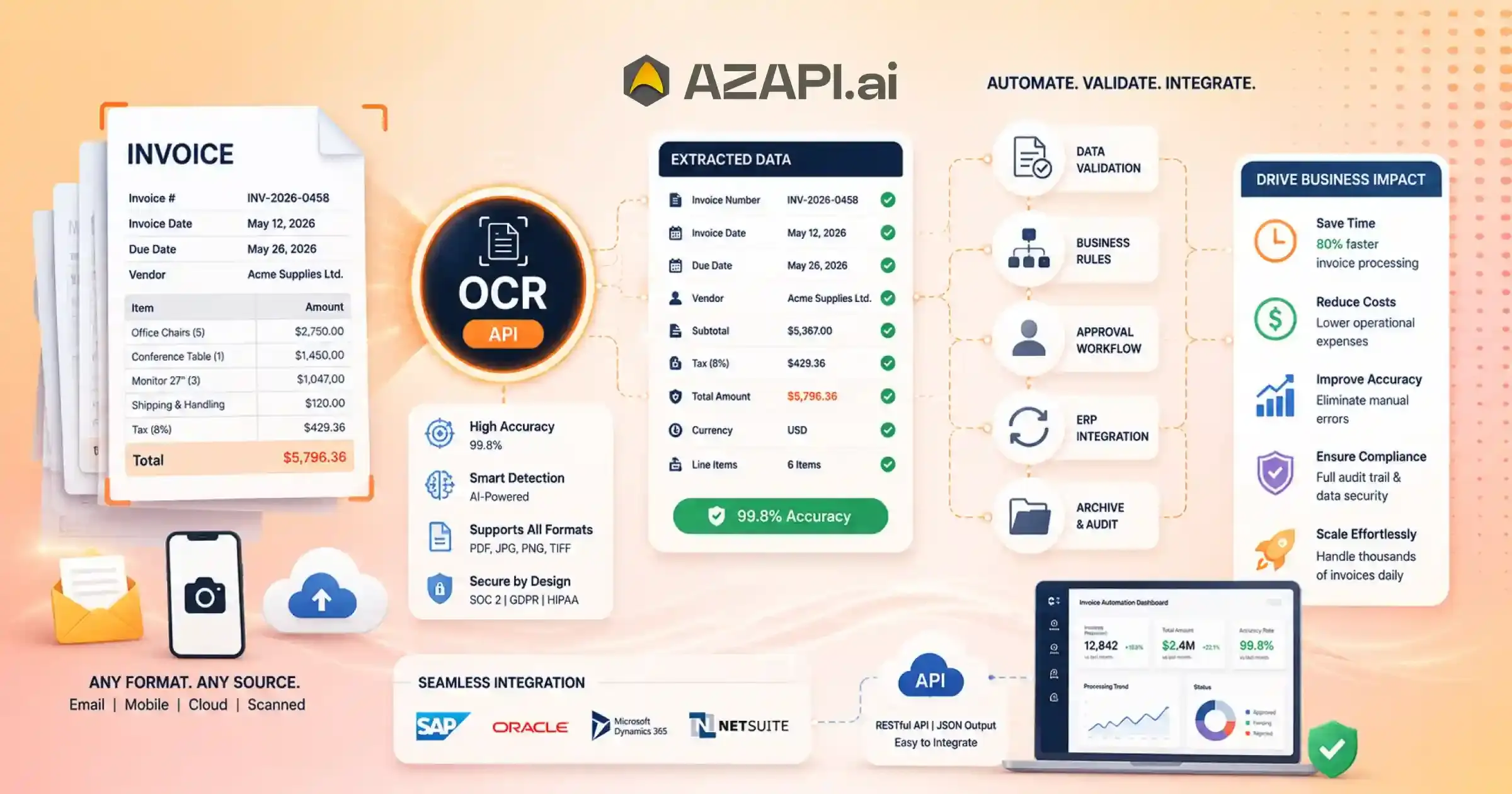
Best OCR API in 2026 for Invoice Automation for Business Process Automation
Best OCR API in 2026 for Invoice Automation is becoming a major priority for businesses moving toward automation-first finance and operations workflows. As companies scale digitally, manual invoice handling is no longer sustainable for organizations processing large volumes of vendor invoices, GST invoices, purchase orders, procurement approvals, and accounts payable documents every day.
Finance teams now expect real-time invoice extraction, automated approvals, faster processing cycles, reduced manual work, and AI-powered document workflows that integrate directly into ERP and accounting systems.
Traditional invoice processing methods often create delays, repetitive data-entry tasks, approval bottlenecks, and operational inefficiencies. Even small manual errors in invoice handling can affect payment cycles, compliance reporting, vendor management, and financial operations at scale.
This shift is driving massive adoption of AI-powered OCR APIs for invoice automation. Modern OCR systems can automatically detect invoice layouts, extract structured financial data, classify document fields, and process multi-format invoices without requiring manual intervention.
Businesses are increasingly adopting intelligent document-processing infrastructure that can handle scanned PDFs, mobile uploads, email attachments, GST invoices, and supplier documents in real time while maintaining accuracy and operational speed.
Platforms like AZAPI.ai are helping companies automate invoice extraction workflows with AI-powered OCR systems designed for scalability, real-time processing, and enterprise-grade financial document automation in 2026.
What Is Invoice Automation?
Invoice automation is the process of using AI, OCR, and workflow automation to digitize invoice handling from data extraction to approval and accounting integration. Instead of manually reviewing invoices, businesses now use intelligent systems that automatically process financial documents in real time.
How Traditional Invoice Processing Works
Manual invoice workflows often create operational inefficiencies, especially for businesses processing large volumes of vendor invoices and procurement documents daily.
Common problems include:
- Manual data entry
- Delayed approvals
- Invoice mismatches
- Duplicate payments
- Operational bottlenecks
- Human errors
These issues not only slow down finance teams but also increase processing costs and reduce visibility across accounts payable operations.
How Automated Invoice Processing Works
Modern invoice automation systems follow a much faster and more structured workflow:
- Invoice uploaded
- OCR API extracts data
- AI identifies invoice fields
- Validation rules applied
- Data pushed into ERP/accounting systems
- Approval workflows triggered automatically
This allows finance teams to process invoices with minimal manual involvement while maintaining better consistency and accuracy.
Why Businesses Are Automating Invoice Workflows
Companies are increasingly automating invoice operations to improve operational efficiency, lower processing costs, accelerate approvals, support finance automation initiatives, and build scalable digital operations. As organizations continue shifting toward AI-driven financial workflows, automated invoice processing is becoming a core part of modern business infrastructure.
This is also why businesses are actively evaluating the Best OCR API in 2026 for Invoice Automation to support scalable document processing and intelligent finance operations.
AI-powered invoice OCR systems are rapidly becoming essential for automation-first accounting and procurement workflows in 2026.
What Is an Invoice OCR API?
An Invoice OCR API is an AI-powered system that extracts structured information from invoices automatically using OCR and intelligent document processing technologies. Instead of manually entering invoice data into ERP or accounting systems, businesses can automate extraction and validation workflows in real time.
What Data Can Invoice OCR APIs Extract?
Modern invoice OCR systems can identify and extract multiple financial and accounting fields automatically, including:
- Invoice number
- Invoice date
- GST number
- Vendor details
- Line items
- Tax amounts
- Invoice total
- Due date
- Purchase order references
This extracted information is converted into structured formats like JSON, allowing finance systems and approval workflows to process invoices automatically.
How Invoice OCR APIs Work in 2026
Modern OCR APIs combine multiple AI and document-processing technologies to improve extraction accuracy and workflow automation. These systems typically use:
- OCR engines
- AI models
- NLP (Natural Language Processing)
- Document intelligence
- Layout recognition
- Validation systems
Together, these technologies help identify invoice structures, understand field relationships, validate extracted information, and process invoices across different layouts and formats.
As invoice automation adoption increases, businesses evaluating the Best OCR API in 2026 for Invoice Automation are increasingly prioritizing systems that can handle real-world invoice complexity without requiring manual intervention.
Why OCR APIs Are Critical for Automation
Without OCR APIs, businesses still depend heavily on manual invoice entry, spreadsheet-based workflows, and repetitive financial processing tasks that slow down operations and increase error rates.
OCR APIs transform invoices into machine-readable structured data that can move directly into ERP systems, accounting software, approval workflows, procurement systems, and finance automation pipelines.
This is one of the biggest reasons why AI-powered invoice OCR infrastructure is becoming a foundational layer for modern finance operations and automation-first business workflows in 2026.
Why Invoice Automation Is Essential for Business Process Automation
Invoice automation is one of the most impactful business automation use cases because invoices sit at the center of finance, procurement, and vendor workflows. As companies scale operations, manual invoice handling often becomes a major bottleneck that slows approvals, increases operational costs, and creates accounting inefficiencies.
Business Processes Improved by Invoice OCR
Modern invoice OCR systems improve multiple operational workflows across finance and enterprise systems.
Finance Operations
Invoice OCR APIs help automate:
- Accounts payable automation
- Reconciliation workflows
- Vendor management processes
By reducing manual data entry, finance teams can process invoices faster while improving consistency across accounting operations.
Procurement Automation
Businesses also use invoice automation to streamline:
- PO matching
- Approval routing
- Spending controls
This helps procurement teams maintain better visibility across purchasing workflows and reduces approval delays.
As organizations evaluate the Best OCR API in 2026 for Invoice Automation, many are prioritizing solutions that integrate directly with enterprise systems and support automation across multiple financial operations.
ERP Workflows
Invoice OCR APIs are increasingly integrated into:
- SAP workflows
- Oracle systems
- Tally synchronization
- Accounting automation platforms
Structured invoice data can move automatically into ERP environments without requiring repetitive manual entry.
Compliance Workflows
Automation also supports:
- GST validation
- Audit readiness
- Financial reporting
This improves compliance accuracy while simplifying reporting and verification processes.
Why Enterprises Are Investing in Invoice Automation
Businesses are investing heavily in invoice automation because it helps reduce operational overhead, accelerate payment cycles, improve cash flow visibility, minimize accounting errors, and build scalable finance-processing infrastructure. As finance operations continue evolving toward AI-driven workflows, invoice OCR systems are becoming a critical part of enterprise automation and digital transformation strategies in 2026.
Best OCR API in 2026 for Invoice Automation
Modern businesses are rapidly shifting toward automation-first finance operations where invoices move through extraction, validation, approvals, and ERP synchronization without manual intervention. As invoice volumes increase, organizations require OCR infrastructure that can operate reliably across different document formats, vendors, and accounting systems.
Why Businesses Need Advanced OCR Infrastructure
Traditional OCR tools were built mainly for simple text reading, but modern invoice workflows demand much more advanced document intelligence capabilities.
Today’s enterprise invoice systems require:
- High extraction accuracy
- Multi-format support
- AI-based validation
- Low processing latency
- Scalable infrastructure
Basic OCR tools are not sufficient for enterprise invoice automation because they often fail when handling varied invoice layouts, line-item extraction, GST fields, vendor-specific formats, and real-world document inconsistencies.
Businesses evaluating the Best OCR API in 2026 for Invoice Automation are increasingly prioritizing AI-powered OCR infrastructure capable of handling large-scale financial workflows with minimal manual correction effort.
Why AZAPI.ai Is Emerging as a Strong Choice
AZAPI.ai is increasingly being used for invoice automation because it delivers 99.91%+ extraction accuracy, template-free AI extraction trained across millions of invoice formats, comprehensive invoice parsing with summary and line-item extraction, API-first and SDK-driven integration, enterprise-grade security, compliance-ready infrastructure, and highly scalable processing for large financial workflows — making it one of the best OCR API for business automation solutions for modern enterprises.
Key Capabilities
Intelligent Invoice Parsing
Extracts invoice fields, GST details, vendor information, totals, taxes, and line items accurately across multiple invoice formats without template dependency.
Real-Time OCR APIs
Supports instant invoice processing for finance automation and real-time operational workflows.
GST Invoice Support
Optimized for Indian GST invoice structures and business verification workflows.
Structured JSON Output
Simplifies ERP, SAP, Oracle, Tally, and accounting-system integration using machine-readable structured outputs.
Enterprise Scalability
Designed for high-volume invoice-processing environments handling large operational workloads.
Automation-Ready Infrastructure
Built to support end-to-end workflow automation across finance, procurement, accounts payable, and compliance systems.

Features Businesses Should Look for in an Invoice OCR API
The best invoice OCR APIs combine high extraction accuracy, AI validation, scalability, structured outputs, and automation-ready integrations. As finance operations become increasingly automated in 2026, businesses need OCR systems that can process invoices reliably across different formats, vendors, and accounting environments.
Multi-Format Invoice Support
Modern invoice OCR systems should handle PDFs, scanned invoices, email attachments, mobile uploads, screenshots, and image-based invoices without requiring manual formatting adjustments.
AI-Based Field Detection
AI-driven document intelligence helps identify invoice structures, vendor layouts, tax fields, totals, and accounting information more accurately across real-world invoice variations.
Line Item Extraction
Line-item extraction is critical for accounting workflows, procurement operations, reconciliation systems, and financial reporting processes that depend on item-level invoice visibility.
GST & Tax Recognition
For Indian businesses, accurate GST extraction and tax recognition are essential for compliance workflows, reporting accuracy, and finance automation.
Low Latency Processing
Fast OCR response times help support real-time invoice processing, automated approvals, and seamless workflow execution across finance systems.
Fraud & Duplicate Detection
Advanced invoice OCR systems can help identify duplicate invoices, suspicious uploads, inconsistent invoice structures, and operational anomalies before processing continues further.
API Reliability
Reliable APIs are essential for uninterrupted workflow automation, especially for enterprises processing large invoice volumes across distributed finance and procurement systems.
As invoice automation adoption continues growing, businesses are increasingly evaluating OCR infrastructure based on operational scalability and automation readiness rather than simple text extraction capabilities alone.
This is why organizations searching for the Best OCR API in 2026 for Invoice Automation are prioritizing AI-powered systems designed for enterprise-grade document processing and finance workflow automation. Modern invoice OCR infrastructure is becoming a foundational layer for scalable business process automation in 2026.
Common Challenges in Invoice Automation
Businesses evaluating the Best OCR API in 2026 for Invoice Automation are often focused on one major challenge – invoices are highly inconsistent across vendors, industries, and document formats.
Unlike standardized identity documents, invoices vary widely in structure, layout, language, image quality, and field placement, making automation significantly more complex in real-world finance operations.
Why Invoice Processing Is Difficult
Finance and procurement teams regularly deal with issues such as:
- Inconsistent invoice layouts
- Poor image quality
- Handwritten fields
- Multilingual invoices
- Missing data
- Duplicate submissions
These problems can slow down accounts payable workflows, create extraction inaccuracies, trigger approval delays, and increase manual verification effort.
How Modern OCR APIs Solve These Problems
Modern AI-powered OCR APIs use intelligent document-processing techniques to improve extraction reliability across real-world invoice conditions.
Common AI-based improvements include:
- Layout intelligence
- Image enhancement
- Auto-classification
- Confidence scoring
- Contextual field detection
- Document normalization
Instead of depending only on static OCR extraction, modern systems analyze invoice structure, identify financial context, understand vendor layouts, and validate extracted information automatically before pushing data into downstream systems.
Why AI Matters More Than Traditional OCR
Traditional OCR only extracts visible text from a document without understanding meaning, relationships, or financial structure.
Modern AI-powered OCR APIs understand invoice structure, context, tax information, line items, totals, vendor relationships, and accounting fields, making them far more effective for automation-first finance workflows.
This shift from basic OCR to intelligent document understanding is one of the biggest reasons invoice automation is becoming faster, more scalable, and more reliable in enterprise environments in 2026.
Industries Using Invoice OCR APIs in 2026
Invoice OCR APIs are widely used across finance-heavy industries handling large document volumes because businesses increasingly depend on automated document processing to improve operational efficiency and reduce manual accounting work.
As finance operations become more automation-driven, organizations across multiple sectors are adopting AI-powered invoice extraction systems to accelerate approvals, streamline procurement workflows, and improve accounting accuracy.
Major Industries Using Invoice OCR APIs
Enterprises
Large enterprises use invoice OCR APIs for high-volume accounts payable automation, vendor invoice processing, and enterprise-scale finance operations.
Ecommerce Companies
Ecommerce businesses automate vendor invoice management, procurement workflows, and payment reconciliation across large supplier ecosystems.
Logistics Companies
Logistics and supply-chain companies use invoice OCR systems to manage shipment billing workflows, transportation invoices, vendor documents, and operational accounting processes.
As businesses evaluate the Best OCR API in 2026 for Invoice Automation, many are prioritizing scalable OCR infrastructure capable of handling multi-format invoices and high transaction volumes across distributed operations.
Manufacturing Businesses
Manufacturing companies use invoice OCR automation for procurement processing, purchase-order matching, supplier management, and inventory-related finance workflows.
Fintech Platforms
Fintech companies integrate invoice OCR APIs into financial document-processing systems to automate verification, reconciliation, and accounting-related operations.
SaaS Companies
SaaS businesses increasingly automate expense management, subscription billing operations, procurement approvals, and vendor-management workflows using OCR-based automation systems.
Accounting Firms
Accounting and bookkeeping firms use invoice OCR technology to digitize client invoices, automate accounting entries, and reduce repetitive manual data-entry tasks. As AI-driven finance automation continues expanding, invoice OCR infrastructure is becoming an essential operational layer for businesses handling large-scale accounting, procurement, and financial workflows in 2026.
AI Is Transforming Invoice Automation
Invoice automation is rapidly evolving beyond simple data extraction as businesses adopt AI-driven finance operations and intelligent workflow systems. In 2026, companies are increasingly building automation-first accounting and procurement environments where invoices move through extraction, validation, approvals, and ERP synchronization with minimal human involvement.
The Rise of Intelligent Document Processing
Modern invoice automation systems now combine OCR, AI models, document intelligence, and workflow orchestration to process financial documents more efficiently across large operational environments.
Businesses are increasingly adopting:
- AI-based document understanding
- Workflow orchestration systems
- Autonomous finance operations
- Intelligent approval workflows
- AI-driven compliance systems
These technologies allow finance teams to automate repetitive operational tasks while improving processing consistency, approval speed, and visibility across financial workflows.
AI models can now understand invoice layouts, identify vendor-specific structures, validate financial fields, detect anomalies, classify documents automatically, and support real-time decision-making across procurement and accounting systems.
Why OCR APIs Are Becoming Core Business Infrastructure
Invoice OCR APIs are evolving from simple extraction tools into much larger operational systems that support enterprise-wide automation.
Modern OCR APIs now function as:
- Automation infrastructure
- Finance intelligence systems
- Business workflow engines
- Operational efficiency platforms
Instead of only extracting invoice text, AI-powered OCR systems now connect directly with ERP platforms, approval workflows, procurement systems, accounting automation, compliance monitoring, and financial analytics environments.
As businesses continue scaling automation-first finance operations, demand for intelligent document-processing infrastructure is increasing rapidly across industries.
This is also why organizations are increasingly investing in the Best OCR API in 2026 for Invoice Automation to support scalable and AI-driven finance workflows. Modern invoice OCR systems are becoming foundational infrastructure for autonomous business operations and intelligent financial automation.
Conclusion
Businesses can no longer scale finance operations using manual invoice handling. As invoice volumes grow across procurement, accounts payable, vendor management, and accounting systems, manual workflows increasingly create delays, operational inefficiencies, and higher processing costs.
Invoice OCR APIs now help organizations automate workflows, reduce costs, improve accuracy, accelerate approvals, and scale financial operations without depending heavily on repetitive manual data entry.
Modern AI-powered OCR systems can process invoices across multiple formats, extract structured financial data in real time, support ERP integration, automate validation workflows, and improve visibility across finance operations. This is allowing businesses to build faster, more scalable, and automation-first financial infrastructures.
AI-driven invoice automation is also improving compliance readiness, reducing accounting errors, strengthening approval workflows, and helping enterprises manage high-volume invoice operations more efficiently.
Platforms like AZAPI.ai are helping businesses build scalable invoice automation workflows using AI-powered document intelligence, structured extraction systems, and automation-ready APIs designed for enterprise finance operations.
As digital finance transformation accelerates, organizations are increasingly investing in the Best OCR API in 2026 for Invoice Automation to support intelligent and scalable business workflows. AI-powered invoice OCR infrastructure is rapidly becoming a foundational layer for business process automation in 2026.
FAQs
Q1. How does invoice OCR automation work?
Ans: Invoice OCR automation works by using OCR and AI models to extract invoice data automatically from PDFs, scanned documents, images, or mobile uploads. The extracted information is converted into structured data and pushed into ERP systems, accounting software, approval workflows, or finance automation platforms.
Q2. What information can invoice OCR APIs extract?
Ans: Modern invoice OCR APIs can extract:
- Invoice number
- Invoice date
- Vendor details
- GST number
- Tax amounts
- Invoice totals
- Due dates
- Purchase order references
- Line items
- Billing details
Q3. Why do businesses use OCR APIs for invoice automation?
Ans: Businesses use OCR APIs to reduce manual invoice entry, accelerate approvals, lower operational costs, improve extraction accuracy, automate finance workflows, and process invoices at scale.
Q4. Can OCR APIs automate accounts payable workflows?
Ans: Yes. Invoice OCR APIs are widely used for accounts payable automation, including invoice extraction, PO matching, approval routing, reconciliation, ERP synchronization, and payment workflow automation.
Q5. Are invoice OCR APIs accurate for different invoice formats?
Ans: Modern AI-powered invoice OCR APIs are designed to handle multiple invoice layouts, scanned documents, mobile uploads, multilingual invoices, low-quality images, and vendor-specific formats using intelligent document-processing models.
Q6. What industries use invoice automation APIs?
Ans: Invoice automation APIs are commonly used across:
- Enterprises
- Ecommerce companies
- Logistics businesses
- Manufacturing companies
- Fintech platforms
- SaaS companies Accounting firms
Q7. How do OCR APIs improve business process automation?
Ans: OCR APIs transform invoices into machine-readable structured data, allowing businesses to automate approvals, procurement workflows, accounting operations, reconciliation systems, compliance processes, and finance automation pipelines.
Q8. What features should businesses look for in invoice OCR APIs?
Ans: Businesses usually prioritize:
- High extraction accuracy
- Multi-format invoice support
- AI-based validation
- Line-item extraction
- GST recognition
- Low latency processing
- Structured JSON outputs
- API reliability
- Scalability
Q9. How does AI improve invoice processing accuracy?
Ans: AI improves invoice processing by understanding document layouts, detecting invoice structures, validating fields contextually, correcting image issues, extracting line items intelligently, and handling real-world invoice variations more effectively than traditional OCR systems.
Q10. Why are businesses opting for AZAPI.ai for invoice automation?
Ans: Businesses are increasingly adopting AZAPI.ai for invoice automation because it offers AI-powered template-free extraction trained across millions of invoice formats, 99.91%+ extraction accuracy, comprehensive invoice parsing including line items, API-first and SDK-based integration, enterprise-grade security, compliance-ready infrastructure, and highly scalable processing designed for real-time finance automation workflows.