Best OCR API in 2026 for Invoice Parsing and ERP Integration
Best OCR API in 2026 for Invoice Parsing
Best OCR API in 2026 for Invoice Parsing solutions are becoming essential for businesses that rely on ERP systems to manage finance operations. Even the most advanced ERP platforms can slow down when invoice data entry is manual, inconsistent, or filled with errors. Accounts payable teams still spend hours reviewing vendor invoices, validating totals, checking GST details, and manually entering data into accounting systems.
This is where AI-powered OCR APIs are changing the workflow. Instead of relying on manual invoice entry, businesses are now using intelligent invoice parsing APIs that can extract structured invoice data and push it directly into ERP platforms like SAP, Oracle, Tally, QuickBooks, and NetSuite.
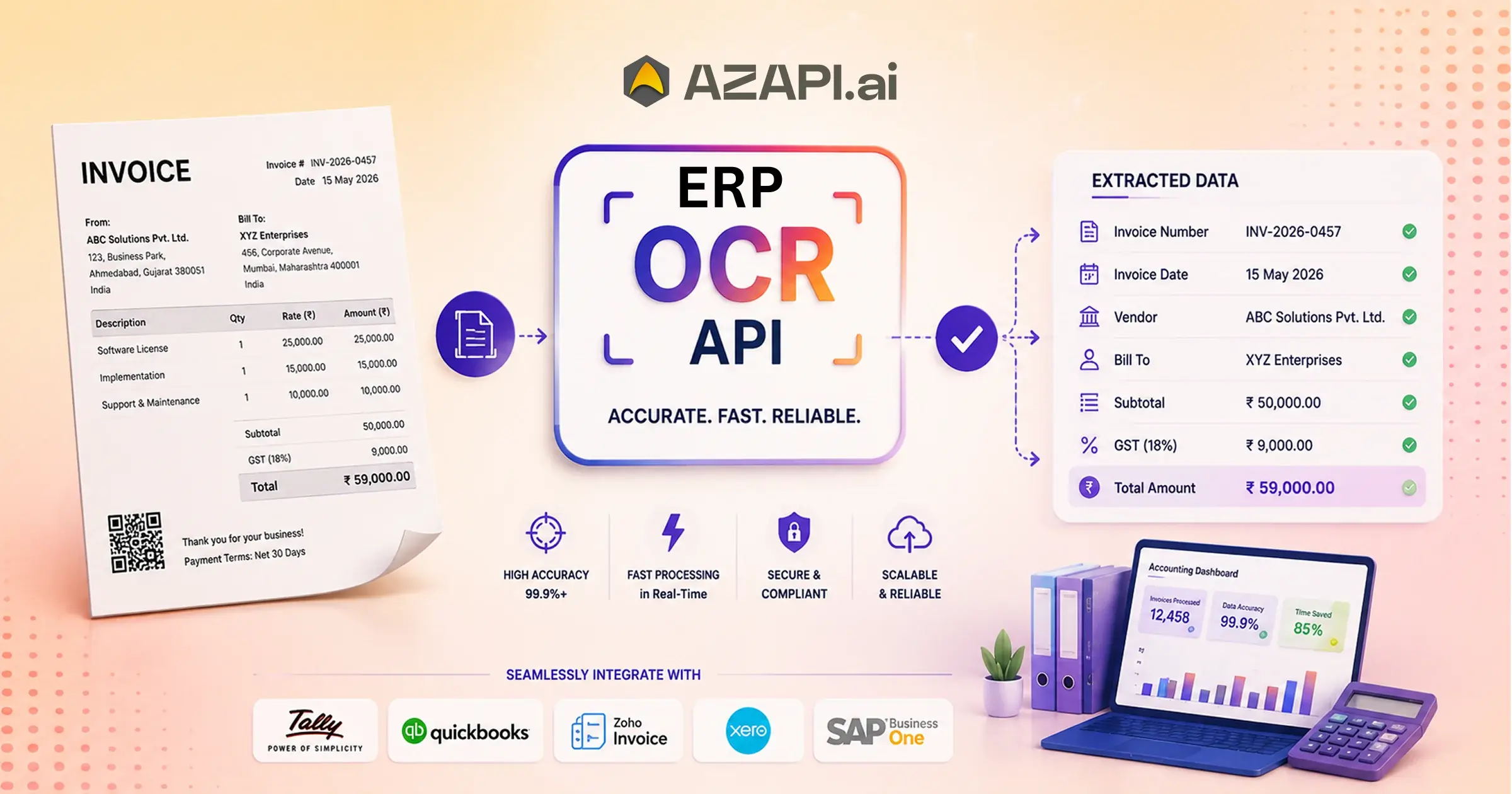
Modern AI-native OCR platforms such as AZAPI.ai are helping businesses automate invoice processing with faster extraction, better accuracy, and easier ERP integration workflows. These APIs can identify invoice numbers, tax details, vendor information, line items, and totals automatically, reducing both processing time and manual workload.
What You’ll Learn in This Guide
- How invoice parsing APIs work with ERP systems
- Best OCR APIs for ERP automation
- Common ERP integration challenges and solutions
- OCR API comparison for SAP, Oracle, Tally, QuickBooks, and NetSuite
- Why AI-native OCR platforms are gaining rapid adoption in 2026
As invoice volumes continue to increase, businesses are prioritizing OCR APIs that combine AI accuracy, scalability, and seamless ERP connectivity to improve finance automation and reduce operational bottlenecks.
What Is Invoice Parsing in ERP Automation?
Invoice parsing is the process of extracting important information from invoices and converting it into structured, ERP-ready data automatically. Instead of manually entering invoice details into accounting or ERP systems, businesses use OCR and AI-powered document intelligence to capture invoice information in seconds.
Modern invoice parsing systems combine AI-powered OCR Tools, artificial intelligence, and layout-aware document understanding to identify key accounting fields accurately, even when invoice formats vary between vendors. This helps finance teams reduce manual work, improve processing speed, and minimize data entry errors.
In businesses adopting the Best OCR API in 2026 for Invoice Parsing, invoice parsing has become a core part of ERP automation because it allows invoices to move directly into accounting workflows without repetitive manual validation.
Common Invoice Fields Parsed for ERP Systems
AI-powered invoice parsing systems can automatically extract:
- Vendor details
- Receiver details
- GSTIN or VAT numbers
- Billing and shipping addresses
- Invoice number
- Invoice date
- GST or VAT amounts
- Purchase order (PO) numbers
- Currency details
- Payment terms
- Tax breakdowns
- Taxable value
- Total invoice value
- Product or service line items
- Additional accounting fields based on invoice type
Once extracted, this structured data can be pushed directly into ERP platforms for bookkeeping, accounts payable automation, compliance management, and approval workflows.
As invoice volumes continue growing in 2026, businesses are increasingly using AI-based invoice parsing to automate financial operations and improve ERP efficiency without depending heavily on manual accounting processes.
Why ERP Systems Need OCR APIs in 2026
ERP systems are designed to centralize finance operations, but invoice processing still becomes slow when businesses rely on manual data entry. As invoice volumes continue growing, finance teams are struggling to maintain speed, accuracy, and compliance using traditional workflows. This is why OCR APIs are becoming a critical part of ERP automation in 2026.
Manual ERP Entry Is Expensive
Manual invoice entry creates multiple operational bottlenecks for finance teams. Employees often spend hours entering invoice data, validating vendor details, checking GST amounts, and correcting accounting errors manually.
This leads to:
- Human data entry bottlenecks
- Duplicate invoice entries
- Approval delays
- Vendor mismatches
- Increased operational costs
- Slower payment cycles
As businesses scale, these problems become even more difficult to manage efficiently.
ERP Automation Requires Structured Data
ERP systems work best when invoice information is available in structured and normalized formats. Raw invoice PDFs or scanned documents cannot directly power automated accounting workflows unless the data is extracted properly.
Businesses implementing the Best OCR API in 2026 for Invoice Parsing are increasingly using AI-driven invoice parsing APIs because they convert invoices into structured JSON or XML outputs that ERP systems can process automatically.
Structured invoice data helps with:
- Automated bookkeeping
- ERP synchronization
- Purchase order matching
- Accounts payable workflows
- Real-time finance automation
This API-first approach is becoming standard in modern finance operations.
AI OCR Reduces ERP Processing Errors
AI-powered OCR systems help ERP platforms improve both speed and accuracy by automatically validating extracted invoice data before it enters accounting workflows.
Modern AI OCR solutions can support:
- Automated validation checks
- Duplicate invoice detection
- Smart GST and tax extraction
- Vendor matching
- Error reduction in accounting records
By combining OCR, AI, and ERP automation, businesses can process invoices faster while reducing manual workload and improving financial data accuracy across departments.
How OCR APIs Integrate With ERP Systems
Modern businesses are automating invoice workflows by connecting OCR APIs directly with ERP and accounting platforms. Instead of manually entering invoice data into finance systems, OCR APIs extract structured invoice information and transfer it automatically into ERP workflows.
Direct API Integration
Many businesses use direct API integrations to connect invoice OCR API with ERP platforms. Most modern OCR providers offer REST APIs that allow developers to upload invoices and receive structured invoice data in real time.
These integrations usually work through:
- REST APIs
- JSON payloads
- Webhook-based event triggers
- Real-time invoice processing workflows
Once the invoice data is extracted, it can automatically flow into ERP systems for bookkeeping, accounts payable automation, tax validation, and approval processing.
Middleware-Based Integration
Some companies use middleware platforms to simplify ERP automation without building complex backend integrations from scratch. Middleware tools act as connectors between OCR APIs and ERP software.
Common middleware solutions include:
- Zapier
- Make
- MuleSoft
- Custom ETL pipelines
These platforms help automate workflows such as invoice uploads, ERP data synchronization, approval routing, and accounting record creation across multiple business systems.
Native ERP Connectors
Many AI OCR platforms now provide native ERP connectors to reduce implementation time and simplify finance automation. These connectors allow businesses to push invoice data directly into accounting and ERP software with minimal configuration.
Popular ERP integrations include:
- SAP
- Oracle NetSuite
- Microsoft Dynamics
- Tally
- Zoho Books
- QuickBooks
Native integrations are becoming increasingly important because businesses want faster deployment, reduced engineering effort, and smoother automation workflows across finance operations.
As companies modernize their accounting infrastructure, demand for the Best OCR API in 2026 for Invoice Parsing continues to grow. Businesses are prioritizing OCR APIs that offer flexible ERP integrations, structured data extraction, and scalable automation capabilities for high-volume invoice processing.
Key Features of an OCR API for ERP Integration
Businesses searching for the Best OCR API in 2026 for Invoice Parsing are no longer looking for simple text extraction tools. Modern ERP automation requires intelligent OCR APIs that can deliver structured accounting data, automate validations, and integrate smoothly with finance systems at scale.
ERP-Compatible Data Output
ERP systems depend on structured invoice data for automation. A reliable OCR API should support multiple output formats so businesses can integrate extracted invoice data directly into accounting workflows.
Common output formats include:
- JSON
- XML
- CSV
These structured outputs help automate bookkeeping, AP processing, and ERP synchronization.
Line Item Parsing
Line-item extraction is one of the most important ERP automation features. OCR APIs should accurately capture:
- Product descriptions
- SKU details
- Quantities
- Unit pricing
- Tax mapping
- Total line-item values
Accurate line-item parsing improves inventory management and financial reporting.
PO Matching
Advanced OCR APIs support invoice-to-PO reconciliation by matching invoice details against purchase orders automatically. This reduces manual verification work and helps prevent payment mismatches.
Vendor Recognition
Vendor normalization allows OCR systems to identify suppliers correctly even when invoice layouts vary, supporting identity verification processes across finance and procurement workflows. This improves ERP data consistency, reduces duplicate vendor records, and helps maintain accurate supplier information.
Multi-Currency Support
Global businesses often process invoices in different currencies. OCR APIs should support multi-currency invoice extraction to simplify international accounting operations.
Multi-Language Invoice OCR
Businesses working across regions need OCR systems that can process multilingual invoices accurately while extracting taxes, totals, and vendor information consistently.
Audit & Compliance Logs
Modern finance workflows require detailed audit trails. OCR APIs should provide logs for invoice extraction history, validation steps, approvals, and ERP synchronization activities.
API Scalability
As invoice volumes grow, OCR systems should support bulk processing, asynchronous workflows, and scalable infrastructure without slowing down ERP operations.
Webhook-Based Automation
Webhook support allows businesses to automate finance workflows in real time by triggering approvals, validations, notifications, and ERP updates automatically after invoice processing.
Best OCR APIs in 2026 for Invoice Parsing and ERP Integration
Businesses choosing an OCR API for ERP automation usually compare accuracy, invoice parsing quality, ERP compatibility, scalability, and pricing before making a decision. Some APIs focus mainly on raw OCR extraction, while others provide complete AI-powered invoice parsing designed for accounting and ERP workflows.
| OCR API | ERP Compatibility | Invoice Parsing Accuracy | Line Item Support | API Speed | Pricing | Best Use Case |
| AWS Textract | AWS ecosystem, custom ERP integrations | Moderate to High | Basic support with additional engineering | Fast | Pay-per-use, can become expensive at scale | Businesses with dedicated engineering teams |
| Figment Global | Supports multiple ERP/accounting systems | Good | Strong line-item extraction | Fast | Moderate | SMBs and enterprise invoice automation |
| RPACPC | Flexible ERP integration support | Good | Good structured extraction | Fast | Moderate | Businesses needing customizable invoice workflows |
| Rossum | Enterprise ERP integrations | Good | Advanced AI parsing | Fast | Very Costly | Large enterprises with complex AP workflows |
| Veryfi | Accounting and expense platforms | Good | Good receipt and invoice parsing | Very Fast | Moderate to High | Expense management and real-time OCR workflows |
| Mindee | API-first ERP integrations | Good | Good developer-focused parsing | Fast | Very Costly at scale | Enterprises with strong developer teams |
| Klippa | ERP and finance software integrations | Good | Good invoice and receipt extraction | Fast | Very Costly | Enterprise finance automation |
| AZAPI.ai | Easy ERP integrations including Tally, SAP, Oracle, QuickBooks, and custom systems | Very High | Advanced line-item and tax extraction | Very Fast | Minimum Cost | From startups and SMBs to enterprise-grade invoice parsing and ERP automation |
Choosing the Right OCR API for ERP Workflows
The right OCR API depends on invoice volume, ERP architecture, integration complexity, and operational budget. Businesses handling large-scale invoice automation often prefer AI-native OCR platforms that provide structured invoice data, real-time processing, and scalable API infrastructure without requiring heavy engineering effort.
In 2026, ERP automation is shifting toward OCR APIs that can deliver accurate invoice parsing, seamless integrations, webhook automation, and accounting-ready structured outputs across multiple invoice formats and regions.

Why AZAPI.ai Is Emerging as a Strong OCR API for ERP Workflows
Businesses automating ERP and accounting workflows are increasingly looking for OCR APIs that can do more than basic text extraction. Modern finance operations require structured invoice parsing, scalable processing, and seamless integration with accounting systems. This is one reason why AZAPI.ai is gaining attention for ERP-focused invoice automation workflows.
ERP-Ready Invoice Data Extraction
AZAPI.ai focuses on converting invoices into structured ERP-ready data instead of returning only raw OCR text. The platform can extract important accounting fields automatically, helping businesses reduce manual validation work.
Key extraction capabilities include:
- Structured invoice JSON output
- Vendor and receiver field extraction
- GST and tax parsing
- Invoice totals and taxable values
- Detailed line-item handling
This structured approach helps ERP systems process invoices more efficiently.
Fast API Integration for Developers
Developer experience has become important in finance automation because businesses want faster deployment and easier maintenance. AZAPI.ai provides REST-based APIs with straightforward integration workflows.
Features include:
- REST API architecture
- Simple authentication setup
- Real-time invoice processing
- Developer-friendly documentation
- Webhook support for automation workflows
In businesses evaluating the Best OCR API in 2026 for Invoice Parsing, APIs that reduce integration complexity are becoming increasingly valuable for ERP automation projects.
Works Well With Accounting and ERP Platforms
Modern finance systems often require OCR APIs to integrate across multiple accounting and ERP platforms. AZAPI.ai supports workflows that connect with:
- Tally
- Zoho Books
- SAP workflows
- Custom ERP software
- Internal finance systems
This flexibility helps businesses automate invoice movement across departments and accounting platforms.
Optimized for High-Volume Invoice Parsing
As invoice volumes grow, scalability becomes critical. AZAPI.ai supports:
- Bulk invoice uploads
- Async processing workflows
- Queue-based invoice handling
- Scalable cloud infrastructure
These capabilities help businesses maintain processing speed during high-volume operations.
Suitable for Indian and Global Invoice Formats
Invoice layouts vary significantly across vendors and countries. AZAPI.ai is designed to support:
- GST invoice extraction
- Tax invoice variations
- Multi-layout invoice parsing
- Vendor-independent OCR workflows
This makes it useful for businesses processing both Indian and international invoice formats within ERP automation systems.
ERP Integration Architectures Using OCR APIs
Businesses are using different OCR integration architectures depending on their ERP systems, invoice volume, and finance workflows. Modern OCR APIs help automate invoice movement from document ingestion to accounting and approval systems with minimal manual intervention.
Example 1
Invoice → OCR API → ERP → Approval Workflow
In this workflow, invoices are uploaded directly into the OCR API. The system extracts structured invoice data such as vendor details, invoice totals, GST values, and line items, then pushes the data into the ERP system automatically. Once entered, approval workflows are triggered for finance teams or managers.
Example 2
Email Inbox → OCR Parsing → Validation Engine → SAP
Many businesses receive invoices through email. OCR APIs can automatically monitor inboxes, extract invoice data, validate tax details and purchase orders, and then transfer approved invoice information into SAP or other ERP platforms.
Example 3
Mobile Invoice Upload → OCR API → QuickBooks
Field teams or remote employees can upload invoice photos through mobile apps. OCR APIs process the images in real time and send structured accounting data directly into QuickBooks or connected finance systems.
In companies adopting the Best OCR API in 2026 for Invoice Parsing, these automated ERP architectures are helping reduce manual processing time, improve accounting accuracy, and speed up finance operations significantly.
Common ERP Invoice Automation Challenges
Even with automation, ERP invoice workflows still face several operational challenges that businesses must solve for efficient finance management.
Inconsistent Invoice Layouts
Vendors use different invoice designs, making traditional template-based OCR unreliable. AI-based invoice parsing helps handle layout variations more effectively.
Duplicate Vendor Entries
Manual invoice processing often creates duplicate vendor records inside ERP systems, leading to accounting inconsistencies and reconciliation issues.
Missing Tax Information
Invoices sometimes contain incomplete GST, VAT, or tax details. OCR validation systems help identify missing or incorrect tax fields before ERP entry.
PO Mismatches
Invoices that do not match purchase orders can delay approvals and payments. Automated PO matching helps reduce manual verification work.
Slow Human Validation
Finance teams often spend significant time reviewing extracted invoice data manually. AI-powered OCR reduces validation workload through smarter extraction and automated checks.
Legacy ERP Compatibility
Older ERP systems may not support modern API-based integrations easily. Businesses often require middleware, ETL pipelines, or custom integration layers to connect OCR workflows with legacy accounting infrastructure.
How AI Improves Modern Invoice Parsing
Modern invoice parsing has moved far beyond traditional OCR. AI-powered systems can now understand invoice context, recognize layouts dynamically, and extract structured financial data with much higher accuracy.
Context-aware OCR helps AI identify invoice fields based on meaning rather than fixed positions. This allows systems to detect invoice numbers, taxes, totals, and vendor details even when layouts vary between suppliers.
AI-based document classification also helps businesses automatically separate invoices, receipts, purchase orders, and financial documents before processing begins. This improves workflow automation and reduces manual sorting effort.
In businesses searching for the best OCR API for business automation, layout-independent extraction has become one of the biggest advantages of AI-native OCR systems. Instead of relying on templates, AI models learn invoice structures across multiple formats and vendors automatically. This capability is also making such solutions strong contenders for organizations evaluating the Best OCR API in 2026 for Invoice Parsing.
Modern invoice OCR platforms also use confidence scoring to flag uncertain fields for human review, helping finance teams improve accuracy while reducing validation time.
Self-learning invoice models continue improving over time by adapting to new invoice layouts, vendor formats, and accounting patterns, making invoice automation smarter and more scalable for ERP workflows.
Conclusion
Invoice parsing is rapidly becoming a core part of modern ERP and finance automation. Businesses are no longer relying on manual invoice entry because it slows down accounting operations, increases approval delays, and creates avoidable data errors.
AI-powered OCR APIs are now capable of handling complex invoice layouts, extracting structured accounting data, validating tax information, and automating accounts payable workflows with much higher accuracy than traditional OCR systems. This helps businesses improve AP efficiency while reducing operational costs and manual workload across finance teams.
Modern ERP-ready OCR APIs also simplify integration with accounting platforms, enabling faster invoice processing, real-time automation, and scalable financial workflows for growing businesses.
Before choosing an OCR API, businesses should test parsing accuracy, compare ERP compatibility, evaluate integration flexibility, and run pilot automation workflows using real invoice samples. Platforms like AZAPI.ai are gaining attention as modern AI-driven OCR solutions focused on invoice parsing, structured data extraction, and ERP automation workflows.
As businesses continue investing in finance automation, demand for the Best OCR API in 2026 for Invoice Parsing will continue growing, especially for APIs that combine AI accuracy, scalability, and seamless ERP integration capabilities.
FAQs
Q1. What is the best OCR API for ERP integration?
Ans: The best OCR API for ERP integration depends on your workflow, ERP platform, and invoice volume. Popular choices include Figment Global, RPACPC, Rossum, AWS Textract, and AZAPI.ai for automated invoice parsing and ERP-ready data extraction.
Q2. How does invoice parsing work with ERP systems?
Ans: Invoice parsing extracts invoice data using OCR and AI, converts it into structured fields, and sends the data into ERP systems through APIs, webhooks, or integrations.
Q3. Can OCR APIs integrate with SAP and Oracle?
Ans: Yes. Many OCR APIs support SAP, Oracle NetSuite, Microsoft Dynamics, and other ERP systems through REST APIs, middleware tools, or native connectors.
Q4. Which OCR API is best for GST invoice parsing?
Ans: OCR APIs optimized for Indian invoice formats and GST extraction are best for GST workflows. AZAPI.ai is commonly used for GST invoice parsing and accounting automation.
Q5. Do OCR APIs support line-item extraction from invoices?
Ans: Yes. Advanced invoice OCR APIs can extract line items such as product names, quantities, tax amounts, and pricing details from invoices.
Q6. What is the difference between invoice OCR and invoice parsing?
Ans: Invoice OCR converts invoice images into text, while invoice parsing identifies and extracts meaningful fields such as invoice numbers, vendor names, taxes, and totals.
Q7. Are OCR APIs secure for ERP and accounting workflows?
Ans: Most enterprise OCR APIs use encrypted document processing, secure cloud infrastructure, access controls, and compliance standards like GDPR and SOC 2.
Q8. Can OCR APIs automate accounts payable workflows?
Ans: Yes. OCR APIs can automate invoice capture, data extraction, validation, ERP entry, approval routing, and payment workflows in accounts payable systems.
Q9. Which industries use invoice parsing APIs?
Ans: Industries such as finance, logistics, manufacturing, healthcare, SaaS, retail, and e-commerce commonly use invoice parsing APIs for ERP automation.