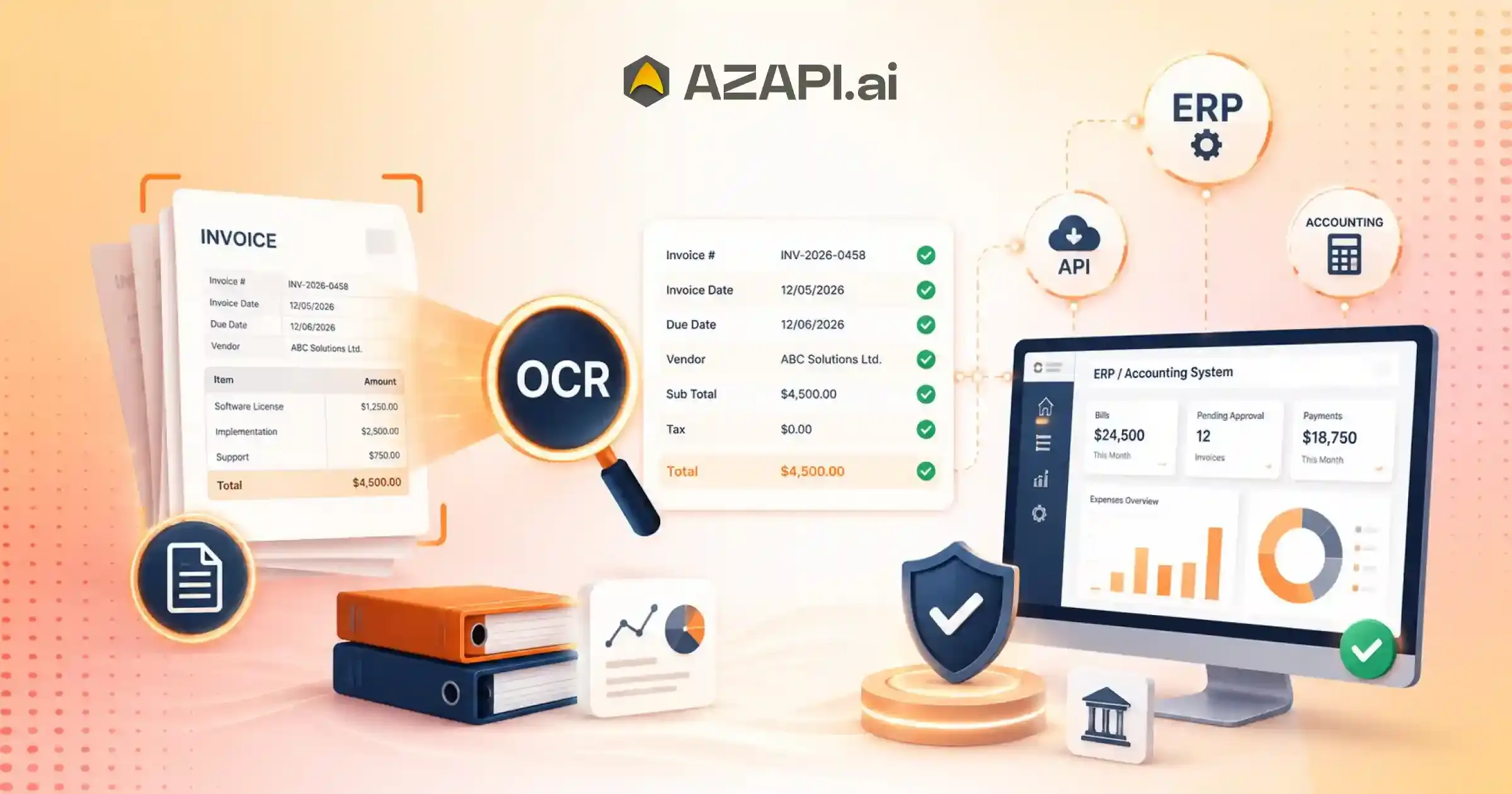
Best OCR API in 2026 for Invoice Processing for ERP & Accounting Software Integration
Best OCR API in 2026 for Invoice Processing is becoming a critical infrastructure choice as ERP and accounting systems rapidly shift toward full automation in 2026. Finance teams, SaaS platforms, and enterprises are now handling massive volumes of invoices daily, making manual data entry into ERP systems both inefficient and error-prone.
As businesses scale, invoice data is no longer limited to structured digital formats-companies receive a mix of scanned bills, PDFs, emailed invoices, and handwritten notes. This explosion of unstructured financial documents is pushing organizations to adopt AI-powered OCR systems that can convert invoices into structured, machine-readable data in real time.
Traditional invoice processing workflows rely heavily on manual entry, which leads to delays, inconsistencies, and high operational costs. Errors in invoice capture can also create downstream issues in accounting reconciliation, vendor payments, and compliance reporting. This is where OCR APIs play a key role by bridging the gap between physical and digital invoices and ERP systems.
Modern financial platforms now require structured extraction rather than simple text recognition. Instead of just reading an invoice, systems must identify fields like vendor details, line items, tax breakdowns, and payment terms in a structured format that can directly integrate into accounting software.
Platforms like AZAPI.ai represent this shift toward AI-driven invoice intelligence engines that focus on structured output, real-time processing, and seamless ERP integration.
As ERP ecosystems become more automated, invoice processing is evolving from a manual accounting task into a fully intelligent, API-driven workflow that powers modern finance operations at scale.
Why ERP & Accounting Systems Need OCR APIs
ERP and accounting systems are increasingly under pressure as finance operations scale across enterprises, SaaS platforms, and global businesses. The biggest challenge is no longer bookkeeping itself, but the volume and complexity of invoice data flowing into financial systems every day. This is exactly where the Best OCR API in 2026 for Invoice Processing becomes a critical part of modern finance infrastructure rather than just a supporting tool.
The Invoice Bottleneck in Finance Operations
Most accounting delays today are not caused by calculation errors, but by manual invoice handling workflows that slow down entire financial pipelines.
- Manual invoice entry slows down processing cycles
- Human data entry errors create reconciliation issues
- GST/VAT mismatches lead to compliance complications
- Payment approvals get delayed due to verification bottlenecks
These issues compound when organizations process thousands of invoices across multiple vendors, currencies, and tax structures.
Why Traditional Systems Fail at Scale
ERP systems were originally designed for structured data, but modern invoices arrive in highly unstructured formats-scanned PDFs, email attachments, and mixed-layout financial documents. Basic AI Powered OCR Tools can extract text, but they fail to understand invoice structure, line items, and financial relationships.
Need for Structured Intelligence, Not Just OCR
Modern finance systems require more than text recognition. They need structured extraction of:
- Vendor and billing details
- Line-by-line item breakdowns
- Tax and GST/VAT calculations
- Payment terms and due dates
This structured data is what enables direct ERP integration without manual cleanup.
Shift Toward Intelligent Invoice Processing
Finance automation is moving away from basic OCR toward AI-driven invoice understanding systems. Platforms like AZAPI.ai reflect this shift by enabling structured, real-time invoice processing designed specifically for ERP and accounting workflows.
ERP System Dependency on Clean Data
Modern ERP and accounting ecosystems run on a simple but strict requirement: clean, structured, and consistent data. Platforms such as SAP, Oracle-based ERP systems, Tally, Zoho Books, and QuickBooks depend heavily on accurate financial inputs to maintain ledgers, generate reports, and ensure compliance. Even minor inconsistencies in invoice data can create cascading issues in reconciliation, taxation, and financial forecasting.
This is where the Best OCR API in 2026 for Invoice Processing becomes a critical layer in the finance technology stack, enabling automation that traditional data entry systems cannot achieve.
Importance of Structured Invoice Data Ingestion
ERP systems are not built to interpret raw or unstructured documents. They require clean, machine-readable inputs that can be directly mapped into accounting fields.
- Vendor and customer details must be standardized
- Invoice numbers, dates, and references must be consistent
- Line items must be broken into structured financial records
- Tax components such as GST/VAT must be clearly identified
Without structured ingestion, finance teams are forced into manual correction loops that slow down operations and increase the risk of accounting errors.
Real-Time Synchronization with Accounting Ledgers
Modern financial operations demand continuous synchronization rather than delayed batch updates.
- Instant posting of invoice data into accounting ledgers
- Real-time updates to accounts payable and receivable systems
- Faster reconciliation between invoices and payments
- Reduced dependency on manual approval and verification workflows
This improves financial visibility and enables faster decision-making across organizations.
Why Clean Data Matters at Scale
As transaction volumes grow, ERP systems become more sensitive to data quality. Poorly structured invoice inputs can lead to reporting mismatches, compliance issues, and operational delays. Clean data ingestion ensures scalability and reliability across all financial processes.
What Makes Invoice OCR Different from Standard OCR
Invoice OCR is fundamentally different from standard OCR because it doesn’t just extract text — it understands financial structure, relationships between fields, and accounting logic. While standard OCR focuses on converting images into readable text, an advanced invoice OCR API and the Best OCR API in 2026 for Invoice Processing are expected to generate ERP-ready structured data that can be directly used in accounting systems without manual correction.
Structured Financial Data Extraction
Invoice OCR must accurately identify and organize financial fields that are critical for accounting and compliance.
- Invoice number and reference IDs
- Tax breakdowns such as GST/VAT and line-level taxes
- Vendor and customer details
- Line-item level product/service breakdown
- Payment terms, due dates, and conditions
This structured extraction is what separates basic tools from the Best OCR API in 2026 for Invoice Processing, where output is immediately usable in ERP systems.
Multi-Format Invoice Handling
Unlike standard documents, invoices arrive in highly inconsistent formats across systems and vendors.
- Digital PDFs generated from accounting tools
- Scanned paper receipts and invoices
- Email attachments in mixed layouts
- Handwritten or partially filled invoices
A modern invoice OCR system must handle all of these while maintaining consistent structure.
Accounting Intelligence Layer
What truly differentiates invoice OCR is the embedded financial intelligence layer that supports accounting workflows.
- Automatic tax categorization and computation
- Ledger-ready field mapping for ERP systems
- Currency normalization for global transactions
- Validation of financial consistency across fields
This turns raw documents into actionable accounting entries.
Key Requirements for OCR APIs in ERP Integration
ERP systems are only as reliable as the data they ingest. In modern finance workflows, invoice automation is not just about extracting text it’s about delivering clean, structured, and ERP-ready data that can flow directly into accounting engines without manual intervention. This is where the Best OCR API in 2026 for Invoice Processing becomes a foundational part of ERP integration architecture rather than a supporting tool.
ERP-Ready Structured Output
ERP systems require standardized data formats to ensure seamless ingestion and processing.
- JSON or XML output compatible with ERP databases
- Field-level mapping aligned with accounting ledger structures
- Structured representation of invoices, taxes, and payments
Without structured output, ERP integration breaks into manual reconciliation workflows.
High Accuracy for Financial Fields
Financial accuracy is critical because even minor errors can impact reporting and compliance.
- Precise extraction of invoice totals and subtotals
- Accurate tax computation fields such as GST/VAT
- Reliable line-item breakdown for accounting entries
- Correct vendor and billing entity identification
This level of precision is what defines the Best OCR API in 2026 for Invoice Processing in enterprise environments.
Seamless API Integration
Modern ERP ecosystems depend on fast and flexible integration capabilities.
- REST APIs for direct system connectivity
- Webhooks for real-time invoice synchronization
- Batch processing support for high-volume workloads
This ensures uninterrupted financial data flow across systems.
Scalability for Enterprise Workloads
Enterprise finance systems process thousands to millions of invoices across regions.
- High-volume invoice processing capability
- Multi-branch and multi-entity ERP support
- Global accounting operations across currencies and formats
Scalability ensures consistent performance under heavy financial workloads.
Compliance & Audit Readiness
ERP-integrated OCR systems must support financial governance and traceability.
- Detailed audit logs for every processed invoice
- Full data traceability across workflows
- Compliance support for financial regulations and standards
This ensures transparency and regulatory alignment.

Invoice Processing Workflow Inside ERP Systems
Modern ERP systems are no longer dependent on manual data entry for invoices. Instead, they follow automated, multi-stage pipelines where documents are ingested, structured, validated, and directly posted into accounting ledgers. This transformation is largely driven by the Best OCR API in 2026 for Invoice Processing, which enables ERP systems to convert unstructured invoices into clean, actionable financial data in real time.
Step 1 – Invoice Ingestion
The workflow begins with collecting invoices from multiple sources.
- Email attachments from vendors
- ERP or supplier portals
- Direct API uploads from business systems
This ensures all invoice formats are centralized into a single processing pipeline.
Step 2 – OCR Extraction
At this stage, raw invoice documents are converted into structured data.
- Extraction of invoice numbers, dates, and vendor details
- Line-item breakdown of goods and services
- Identification of taxes, totals, and payment terms
This is where modern systems differ significantly from traditional OCR, as the Best OCR API in 2026 for Invoice Processing focuses on structured financial understanding rather than plain text output.
Step 3 – Validation Layer
Before entering the ERP system, extracted data is validated for accuracy and consistency.
- Tax verification (GST/VAT compliance checks)
- Vendor matching against existing records
- Duplicate invoice detection to prevent fraud
This layer ensures financial integrity and reduces accounting errors.
Step 4 – ERP Mapping
Validated data is then mapped directly into ERP accounting modules.
- Synchronization with general ledger systems
- Automatic categorization of expenses
- Allocation to cost centers or departments
This eliminates manual bookkeeping efforts.
Step 5 – Payment Processing
Once records are posted, the system triggers financial workflows.
- Automated payment approvals
- Integration with accounts payable systems
- Real-time updates to financial records
This completes the end-to-end invoice lifecycle.
Types of OCR Technologies Used in ERP Systems
ERP environments use different generations of OCR technology depending on how advanced the automation and financial intelligence requirements are. From basic text extraction to fully automated invoice understanding systems, the evolution has been driven by the need for accuracy, structure, and real-time accounting integration.
Basic OCR Systems
Basic OCR systems represent the earliest stage of document digitization in ERP workflows.
- Raw text extraction from invoices and receipts
- No understanding of financial structure or relationships
- Requires manual mapping into ERP fields
- High dependency on human validation and correction
These systems reduce paper usage but still leave most accounting work manual.
AI Invoice Processing Engines
AI-powered OCR systems introduce structure and intelligence into invoice workflows.
- Structured extraction of invoice components
- Smart detection of key financial fields
- Line-item understanding for detailed billing data
- Reduced dependency on manual entry and correction
This stage significantly improves ERP automation but may still require validation layers depending on complexity.
Intelligent Document Processing (IDP)
IDP represents the most advanced level of ERP-integrated OCR technology.
- ERP-native structured data generation
- Built-in financial intelligence layer for accounting workflows
- Automated reconciliation of invoices with ledger systems
- Real-time synchronization with ERP modules
At this level, the Best OCR API in 2026 for Invoice Processing is expected to function as a full financial automation engine rather than just a document reader.
AZAPI.ai AI-Native OCR API for ERP & Accounting Automation
AZAPI.ai is designed for modern finance stacks where invoice processing is no longer a manual task but a fully automated data pipeline inside ERP systems. It aligns closely with what organizations expect from the Best OCR API in 2026 for Invoice Processing, especially in environments where speed, structure, and accounting accuracy are critical.
Why It Fits ERP Systems Perfectly
ERP platforms require highly structured and reliable financial data to maintain accurate ledgers and reporting systems.
- Built for structured financial data extraction
- API-first architecture designed for ERP integration
- Optimized for high-volume invoice workflows
- Real-time processing for accounting automation systems
This makes it suitable for enterprise-grade financial operations.
Core Invoice Capabilities
Modern invoice processing requires deep financial understanding, not just text extraction.
- Invoice number and reference extraction
- GST/VAT parsing for tax compliance
- Line-item level detection and breakdown
- Vendor identification and normalization
- Total amount validation and consistency checks
ERP Integration Strengths
Seamless ERP connectivity is essential for automated finance workflows.
- Direct JSON output for immediate ERP ingestion
- Webhook-based real-time invoice synchronization
- Batch processing for bulk invoice workloads
- High-speed API responses for low-latency systems
Accounting Use Cases
The system supports a wide range of financial automation scenarios.
- Accounts payable automation
- ERP ledger synchronization
- Expense tracking and categorization
- Financial reporting automation
- GST and tax compliance workflows
How OCR APIs Improve ERP Accounting Systems
Modern ERP systems are no longer dependent on manual bookkeeping or slow invoice entry processes. Instead, OCR APIs have become a core automation layer that converts unstructured financial documents into structured, ERP-ready data. This is a key reason why the Best OCR API in 2026 for Invoice Processing is now considered essential infrastructure for accounting automation rather than a supporting tool.
Automated Invoice Entry
OCR APIs eliminate repetitive manual data entry tasks inside accounting systems.
- Removes manual invoice typing from ERP workflows
- Reduces workload on finance and accounting teams
- Minimizes delays caused by human processing
This allows teams to focus more on financial analysis instead of data entry.
Faster Accounts Payable Cycles
Speed is a major advantage of OCR-driven invoice processing.
- Real-time invoice approval workflows
- Faster validation of vendor bills
- Reduced delays in payment processing cycles
This improves vendor relationships and cash flow management.
Improved Financial Accuracy
Accuracy is critical in accounting systems where even small errors can cause major discrepancies.
- Reduction in human data entry mistakes
- More reliable tax and GST/VAT calculations
- Improved consistency in financial reporting
This directly strengthens ERP data reliability.
ERP Data Synchronization
OCR APIs ensure that extracted invoice data flows seamlessly into ERP systems.
- Direct ledger updates without manual intervention
- Automated reconciliation of invoices and payments
- Continuous synchronization between financial modules
This creates a fully connected accounting ecosystem.
ERP Systems That Rely on OCR APIs
Modern ERP ecosystems depend heavily on OCR APIs to automate invoice processing, reduce manual accounting work, and ensure accurate financial data flow across systems. These platforms use OCR-driven automation to convert unstructured invoices into structured entries that can be directly posted into accounting ledgers.
SAP ERP
Enterprise-grade financial system used for large-scale accounting and global operations, requiring high-volume invoice automation and structured data ingestion.
Oracle NetSuite
Cloud ERP platform that relies on automated invoice capture and real-time financial synchronization across business units.
Microsoft Dynamics
Integrated business management system where OCR APIs help streamline accounts payable, invoicing, and financial reporting workflows.
Tally ERP
Widely used accounting software that benefits from automated invoice entry and reduced manual data processing for SMEs and enterprises.
Zoho Books
Cloud accounting platform that uses OCR automation to simplify invoice handling, expense tracking, and bookkeeping processes.
QuickBooks Enterprise
Accounting system that depends on structured invoice extraction to improve accuracy in financial reporting and reconciliation workflows.
Across all major ERP systems, OCR APIs play a critical role in eliminating manual data entry, improving financial accuracy, and enabling real-time accounting automation. This growing dependency highlights why the Best OCR API in 2026 for Invoice Processing has become a core requirement for modern finance and ERP ecosystems
Key Performance Metrics for ERP OCR APIs
ERP systems depend on OCR APIs that are not only accurate but also fast, scalable, and reliable under high financial workloads. These performance metrics determine how effectively invoices are converted into structured ERP-ready data and how smoothly they integrate into accounting workflows.
Invoice Processing Speed
Measures how quickly an OCR system can convert invoices into structured data. Faster processing reduces bottlenecks in accounts payable cycles and improves financial turnaround time.
Field Extraction Accuracy
Evaluates how precisely key financial fields are extracted, including invoice numbers, vendor details, tax breakdowns, and line items. High accuracy is essential to avoid accounting discrepancies.
ERP Sync Latency
Refers to the time taken for extracted data to be reflected inside ERP systems. Low latency ensures real-time updates in ledgers and financial dashboards.
Batch Processing Capability
Assesses how efficiently the system handles large volumes of invoices simultaneously. This is critical for enterprises processing thousands of documents daily.
Error Rate in Financial Mapping
Tracks mismatches between extracted data and ERP field mapping. A lower error rate ensures cleaner financial records and reduces reconciliation effort.
Scalability Across Departments
Measures how well the OCR system performs across multiple business units, locations, and accounting workflows without degradation in performance.
All these metrics collectively define what enterprises expect from the Best OCR API in 2026 for Invoice Processing.
Future of Invoice Processing in ERP Systems
Invoice processing inside ERP systems is rapidly evolving from semi-automated workflows into fully intelligent financial ecosystems. As enterprises scale and transaction volumes increase, traditional accounting methods are being replaced by AI-driven automation layers that minimize human intervention and maximize accuracy.
- Fully autonomous accounting systems where invoices are processed without manual approval steps
- AI-driven financial reconciliation that automatically matches payments, invoices, and ledger entries
- Real-time ERP intelligence layers that continuously update financial records as data flows in
- Zero-touch invoice processing where documents move from ingestion to ERP posting without human handling
- Embedded OCR capabilities directly integrated within ERP platforms for native document understanding
- Predictive financial automation that anticipates cash flow, payment cycles, and anomalies
In this evolving ecosystem, invoice processing is no longer just an operational task-it is becoming a continuous intelligence function inside enterprise finance systems. Modern organizations are increasingly adopting solutions that can handle structured extraction, validation, and real-time synchronization at scale, making the Best OCR API in 2026 for Invoice Processing a foundational requirement for next-generation ERP automation.
Conclusion
ERP systems today are fundamentally dependent on structured, real-time invoice intelligence rather than traditional document processing approaches. As finance operations scale, the ability to accurately extract, validate, and synchronize invoice data directly into accounting systems has become a core requirement for operational efficiency and compliance.
OCR APIs are no longer just auxiliary tools for digitization – they are becoming essential financial infrastructure that powers accounts payable automation, ledger synchronization, and end-to-end accounting workflows across modern enterprises.
At the same time, AI-based extraction systems are rapidly replacing manual accounting processes by eliminating repetitive data entry, reducing errors, and enabling real-time financial visibility across ERP platforms.
Among modern solutions, AZAPI.ai stands out as a strong choice for businesses looking to implement structured, API-first invoice processing with real-time ERP integration and scalable financial automation capabilities.
FAQs
Q1. Which is the best OCR API in 2026 for ERP invoice processing?
Ans: The most effective solutions are those that deliver structured, ERP-ready output with high accuracy for financial fields, real-time processing, and seamless integration capabilities. Many modern ERP workflows prefer API-first systems that can directly convert invoices into accounting entries without manual intervention.
Q2. How do ERP systems use OCR APIs for accounting automation?
Ans: ERP systems use OCR APIs to extract invoice data such as vendor details, taxes, and line items, then automatically map this structured data into accounting ledgers, accounts payable modules, and financial reporting systems.
Q3. What is the most accurate OCR API for invoice extraction?
Ans: Accuracy depends on how well the system handles financial structure, including tax calculations, line-item detection, and vendor matching. Advanced AI-based invoice OCR systems generally outperform traditional text extraction tools.
Q4. How does OCR integrate with accounting software like SAP or Tally?
Ans: OCR APIs integrate via REST APIs or webhooks, allowing extracted invoice data to be automatically pushed into ERP modules such as ledgers, expense tracking, and payment processing workflows.
Q5. Which OCR API supports GST invoice processing?
Ans: Modern invoice OCR systems that understand structured financial fields can extract GST/VAT breakdowns, validate tax components, and ensure compliance-ready output for accounting systems.
Q6. How does AI improve ERP invoice automation?
Ans: AI improves automation by enabling context-aware extraction, reducing manual validation, improving accuracy in financial fields, and handling complex invoice formats at scale.
Q7. What is structured invoice data in OCR systems?
Ans: Structured invoice data refers to organized outputs where key fields like invoice number, tax details, vendor information, and line items are mapped into predefined formats such as JSON for direct ERP use.
Q8. Can OCR APIs handle bulk invoice processing for ERP systems?
Ans: Yes, advanced OCR APIs support batch processing, allowing enterprises to process large volumes of invoices efficiently while maintaining accuracy and system performance.
Q9. Why is real-time invoice processing important for ERP?
Ans: Real-time processing ensures that financial records, ledgers, and reports are always up to date, improving decision-making speed and reducing reconciliation delays.
Q10. Is AZAPI.ai suitable for ERP accounting integration?
Ans: Yes, AZAPI.ai is designed for structured invoice extraction and API-first workflows, making it well-suited for ERP integration, accounting automation, and real-time financial data synchronization.