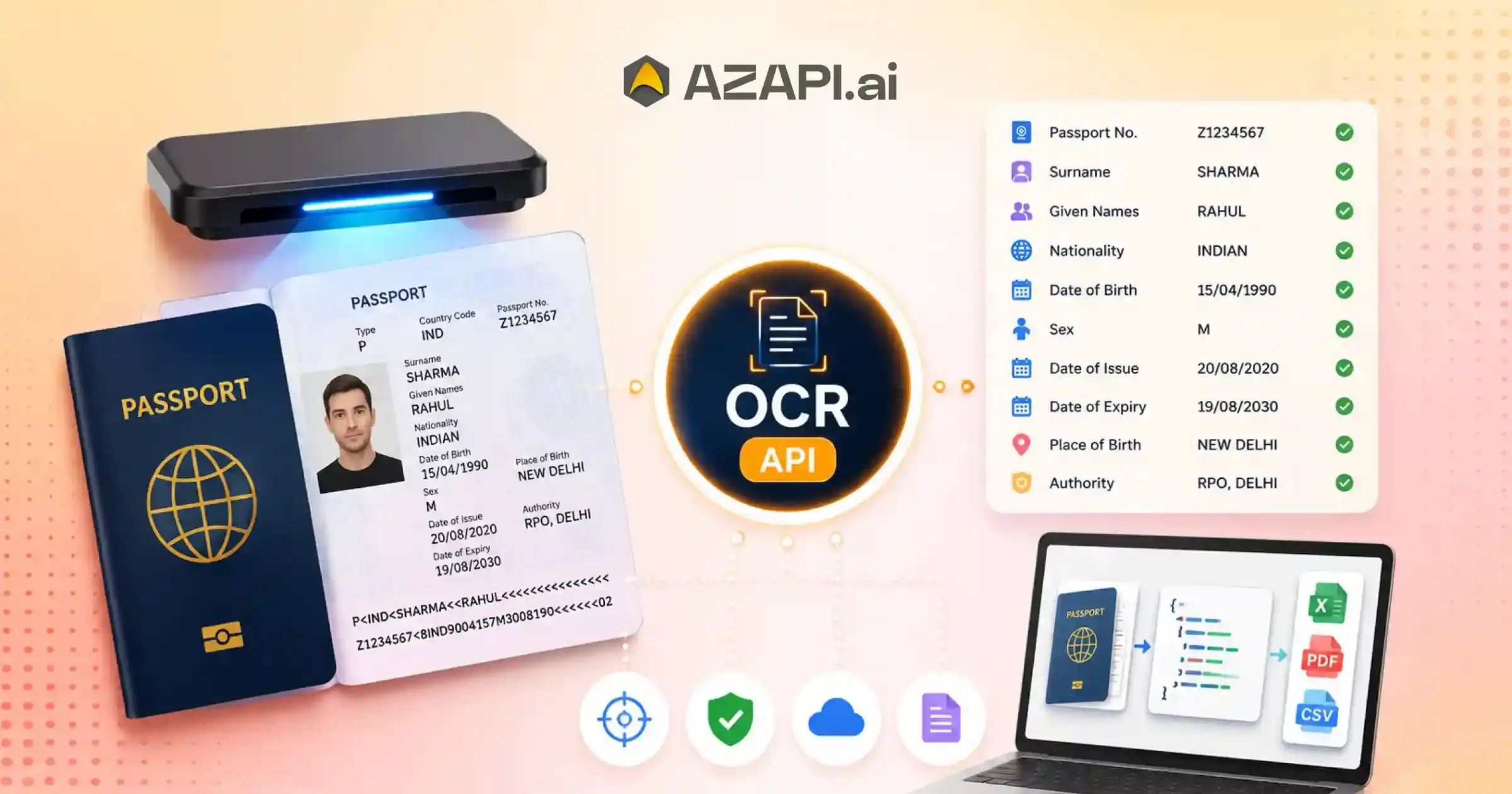
Best OCR API in 2026 for Passport Data Extraction and Document Processing
Best OCR API in 2026 for Passport Data Extraction is no longer just about reading text from a document -it’s about enabling real-time identity verification with speed, accuracy, and trust. In 2026, AI-powered OCR platforms like AZAPI.ai are helping businesses move beyond simple document scanning toward intelligent identity automation. From fintech apps and crypto exchanges to TravelTech platforms, borderless hiring, banking, insurance, and digital onboarding systems, the demand for fast and reliable passport data extraction has grown rapidly.
Companies now need OCR APIs that can instantly capture passport details, verify authenticity, reduce manual errors, and improve onboarding experiences across global users. This shift is transforming OCR into a core part of identity intelligence, where AI can read multilingual passports, detect fraud signals, and process documents in seconds. As digital verification becomes the standard worldwide, businesses are actively searching for scalable OCR Solutions for Businesses that combine accuracy, security, and seamless API integration-making modern passport OCR technology more essential than ever before.
Why Passport OCR Matters More in 2026
Digital onboarding has changed dramatically over the last few years. In 2026, businesses are onboarding customers from different countries within minutes, and passport OCR has become a critical part of that process. With global remote onboarding growing fast and eKYC regulations becoming stricter, companies can no longer depend on manual passport verification methods that slow teams down and increase operational costs.
One major challenge is the rise of AI-generated fraud and synthetic identities. Fraudsters are using advanced tools to create fake documents that can easily bypass outdated systems. This is why businesses are actively looking for the Best OCR API in 2026 for Passport Data Extraction – solutions that can accurately capture passport data, detect inconsistencies, and support real-time identity verification without adding friction to the user journey.
Manual verification is also failing at scale. Reviewing passports one by one leads to delays, human errors, and higher rejection rates. Even small OCR mistakes in names, passport numbers, or expiry dates can create compliance risks and failed onboarding attempts. For fintech, banking, insurance, crypto platforms, and hiring companies, poor OCR accuracy often translates directly into revenue loss.
Speed now matters as much as accuracy. Customers expect onboarding to be completed in under five seconds. If verification takes too long, many users abandon the process before completion. As cross-border customer acquisition increases, businesses need OCR systems that can handle multiple passport formats instantly while maintaining a smooth customer experience.
What Modern Passport OCR APIs Actually Do in 2026
Passport OCR technology in 2026 is doing far more than simply extracting text from an image. Modern systems are built to verify identity, reduce fraud, and make onboarding smoother for businesses operating globally. What used to be basic document scanning has now become a complete identity verification workflow powered by AI.
Today’s OCR APIs can automatically read and parse MRZ (Machine Readable Zone) data, recognize passports in multiple languages, and even validate expiry dates in real time. Many systems also support NFC chip reading, allowing businesses to compare printed passport data with encrypted chip information for stronger verification. Features like auto-cropping, image enhancement, glare detection, and blur correction help improve accuracy even when users upload poor-quality images from mobile devices.
Another major advancement is face-to-document matching. APIs can now compare a selfie with the passport photo instantly to confirm whether the person submitting the document is genuine. Combined with AI fraud detection, these systems can identify tampered images, fake templates, and suspicious edits before onboarding is completed.
The bigger shift happening in 2026 is that OCR APIs are becoming part of the core identity infrastructure of digital businesses. They are no longer just text-reading tools. They now act as trust engines, compliance layers, fraud prevention systems, and the foundation of global onboarding platforms handling users across multiple countries and regulations.
That’s why businesses searching for the Best OCR API in 2026 for Passport Data Extraction are focusing not only on extraction speed, but also on security, verification intelligence, and long-term scalability.
Core Features to Look for in the Best OCR API in 2026
Choosing the Best OCR API in 2026 for Passport Data Extraction is no longer just about extracting names and passport numbers. Businesses now need systems that can verify identity accurately, prevent fraud, and deliver fast onboarding experiences without creating friction for users.
One of the most important factors is passport-specific accuracy. A strong OCR API should reliably extract MRZ (Machine Readable Zone) data, support ICAO standards, and still perform well even when passports are damaged, blurred, or captured in poor lighting conditions. Accuracy matters because even a single incorrect character can create compliance issues or failed verifications.
AI-based fraud detection has also become essential in 2026. Modern APIs are expected to identify fake passports, detect edited or manipulated images, and even recognize screenshots used in fraudulent onboarding attempts. As identity fraud becomes more sophisticated, businesses need OCR systems that can catch suspicious activity automatically.
Processing speed plays a bigger role than many companies realize. Users expect verification to happen instantly, and delays of just a few seconds can increase customer drop-offs. Faster OCR processing often leads to better conversion rates and smoother onboarding journeys.
Global support is another major requirement. The best solutions can recognize both Latin and non-Latin scripts while supporting passports from multiple countries and formats. Security is equally critical, with businesses looking for GDPR compliance, SOC 2 certification, ISO 27001 standards, and strong data encryption practices.
Finally, developer experience matters. Clear API documentation, SDK support, sandbox environments, webhooks, and easy integration can significantly reduce implementation time for growing platforms.
Best OCR API Use Cases in 2026
Passport OCR technology is now being used across industries that rely on fast digital identity verification and seamless onboarding. In 2026, businesses are no longer treating OCR as a back-office tool – it has become a core part of customer experience, compliance, and fraud prevention.
In fintech and banking, OCR APIs help customers complete instant KYC onboarding without visiting a branch or uploading multiple forms manually. Travel and hospitality platforms are also using passport OCR for hotel self check-ins, airport verification systems, and faster traveler authentication. This reduces waiting times while improving operational efficiency.
The hiring industry has also changed rapidly with the growth of remote work. Companies onboarding international employees now depend on automated passport verification to validate identities across borders. Around the same time, crypto and Web3 platforms are under increasing regulatory pressure to strengthen compliance. This is where the best OCR API for business automation in 2026 for passport data extraction becomes essential, helping platforms verify users quickly while reducing the risk of identity fraud and fake accounts.
Insurance companies are using OCR APIs to automate customer onboarding and claims verification, cutting down paperwork and manual review time. Government departments and public service platforms are also adopting digital identity workflows to improve citizen access to services while maintaining compliance and security standards.
Across all these industries, the goal is similar: faster onboarding, fewer manual errors, stronger fraud detection, and a smoother user experience. As digital identity becomes central to online services, passport OCR is quietly becoming one of the most important technologies behind modern verification systems.
Biggest Challenges in Passport Data Extraction (And How Modern APIs Solve Them)
Passport data extraction sounds simple until real-world documents start entering the system. In practice, businesses deal with incomplete scans, poor-quality photos, damaged passports, and users uploading documents from different devices under unpredictable conditions. These challenges can quickly reduce verification accuracy and slow down onboarding.
One of the most common problems is blurry or low-light images. Users often capture passport photos while moving, in dim lighting, or with older smartphone cameras. Cropped documents are another major issue, where important sections like the MRZ or expiry date are partially missing from the frame. On top of that, passport formats vary widely between countries, making standardized extraction difficult for outdated OCR systems.
Fraud has also become more advanced in recent years. Manipulated images, edited passport details, screenshots, and AI-generated fake documents are now common risks for digital platforms handling remote onboarding.
Modern OCR APIs solve these problems using AI-driven processing instead of traditional rule-based extraction. Image enhancement models can automatically sharpen blurry photos, correct lighting, and improve readability before extraction begins. Adaptive OCR engines learn from multiple passport formats and layouts, allowing them to identify fields more accurately across international documents.
Deep-learning fraud detection systems can detect suspicious edits, tampering patterns, and inconsistencies that manual review teams often miss. Some APIs also use context-aware field extraction, where the system understands the relationship between fields instead of simply reading isolated text.
This is why businesses evaluating the Best OCR API in 2026 for Passport Data Extraction are prioritizing AI-powered accuracy, fraud prevention, and real-world reliability over basic text recognition features alone.

How AI Changed OCR APIs Between 2023 and 2026
The difference between OCR APIs in 2023 and 2026 is much bigger than just improved accuracy. A few years ago, most OCR systems focused mainly on reading text from documents. Today, they are designed to understand identity, detect fraud, and support fully automated onboarding decisions in real time.
In 2023, many OCR APIs relied heavily on rule-based extraction. They worked well with clean documents but struggled with different passport layouts, damaged images, or multilingual data. Businesses often needed manual review teams to verify extracted information and catch suspicious documents. Fraud checks were usually limited to basic validations.
By 2026, AI has completely changed the way passport OCR works. Modern systems use contextual extraction, meaning they understand where data belongs instead of simply reading characters line by line. They can process global passport formats, identify inconsistencies, and verify identities with far less human intervention.
Another major shift is fraud prevention. The Best OCR API in 2026 for Passport Data Extraction is now expected to detect synthetic identities, manipulated documents, screenshots, and AI-generated forgeries automatically. Verification has become faster while also becoming more secure.
Behind the scenes, these systems now combine advanced computer vision, identity intelligence models, behavioral risk analysis, and interconnected verification workflows. Instead of acting as standalone OCR tools, modern APIs operate more like intelligent trust systems that evaluate document authenticity, user behavior, and identity consistency together.
This evolution is why OCR APIs are no longer viewed as simple scanning tools. They have become a critical layer in digital onboarding, compliance, and fraud prevention infrastructure worldwide.
Passport OCR vs General Document OCR
At first glance, passport OCR and general document OCR may seem similar, but the technology behind them is very different. Standard OCR systems are usually designed to read simple printed text from invoices, forms, or PDFs. Passports, however, contain structured identity data, security elements, and machine-readable zones that require far more specialized processing.
One of the biggest challenges is the MRZ (Machine Readable Zone). Passport MRZ data follows strict international formatting standards, and even a single incorrect character can lead to failed verification or compliance issues. Passports also include holograms, reflective surfaces, microtext, embedded security patterns, and tightly packed multi-line data fields that basic OCR engines struggle to interpret correctly.
This is why the Best OCR API in 2026 for Passport Data Extraction uses dedicated passport recognition models instead of relying on generic text extraction methods. Modern systems are trained specifically on global passport layouts and can identify important fields even when documents are partially damaged, tilted, or captured under poor lighting conditions.
General OCR APIs often fail in real-world passport verification scenarios. Cropped MRZ sections, glare-heavy images, reflections from laminated surfaces, and non-standard international passport formats can significantly reduce extraction accuracy. Many systems also struggle to connect biometric information, such as matching a passport photo with a live selfie during identity verification.
Specialized passport OCR API solve these issues using AI-based image correction, layout-aware extraction, fraud detection models, and identity verification workflows built specifically for government-issued identity documents. As digital onboarding becomes global, businesses increasingly need OCR systems designed for identity verification – not just text reading.
How to Choose the Right Passport OCR API for Your Business
Choosing the right passport OCR solution in 2026 is no longer just a technical decision.
Businesses now need platforms that can balance speed, fraud prevention, compliance, and global scalability. The Best OCR API in 2026 for Passport Data Extraction should fit both your current onboarding needs and your future growth plans.
The first thing to evaluate is accuracy. If your business handles financial onboarding, crypto verification, or international hiring, even small extraction errors can create compliance risks and customer frustration. Strong MRZ accuracy and reliable data validation are essential.
Compliance is equally important. Different industries and regions have different privacy and verification requirements, so businesses should check whether the API supports regulations such as GDPR and industry-standard security practices. Region coverage also matters because passport formats vary widely across countries.
Fraud prevention capabilities have become a major deciding factor in 2026. Modern verification systems should be able to detect manipulated documents, screenshots, synthetic identities, and AI-generated fake passports in real time. Scalability is another key area – the API should maintain fast verification speeds even during high onboarding volumes across multiple countries.
Pricing structure should also be reviewed carefully. Some APIs charge per verification, while others charge based on usage volume or feature access. Understanding long-term costs helps avoid scaling issues later.
Before choosing a vendor, businesses should ask practical questions such as:
- Do you support NFC passport verification?
- Can your API detect AI-generated fake passports?
- What is your average MRZ extraction accuracy?
- How fast is verification globally?
- Do you store customer data after processing?
The answers to these questions often reveal how future-ready the platform really is.
Why AZAPI.ai Is Considered a Top Choice for Passport Data Extraction
As businesses move toward faster and more secure digital onboarding, many organizations are looking for OCR platforms that combine high accuracy with enterprise-grade reliability. This is one reason why AZAPI.ai is increasingly being recognized as a strong choice for passport data extraction and identity verification workflows in 2026.
One of the biggest advantages is its reported extraction accuracy of 99.91%+, which is especially important for industries where even minor data mismatches can lead to failed onboarding or compliance risks. The platform is designed to handle real-world passport verification challenges such as blurry images. Glare, cropped documents, and international passport formats.
Security and compliance are also major factors for modern businesses. AZAPI.ai supports enterprise-focused security practices with ISO-certified infrastructure, SOC 2 compliance, and bank-grade data protection standards. For fintech, banking, insurance, and crypto platforms, this level of security is often essential when handling sensitive identity documents.
Scalability is another reason businesses choose the platform. Whether a company is processing hundreds of verifications or millions of onboarding requests globally. The infrastructure is built to support high-volume usage with stable performance and fast processing speeds.
The pricing model is also flexible enough to support both startups and enterprise-scale deployments. Businesses can start small, scale gradually, and benefit from bulk pricing discounts as verification volumes grow. In addition, 24-hour support availability helps companies resolve integration or operational issues quickly. Which is especially valuable for platforms running global onboarding systems around the clock.
Conclusion
Passport OCR technology has evolved far beyond basic document scanning. In 2026, businesses are no longer looking for systems that simply extract text from a passport. They need intelligent verification platforms that can support secure, fast, and fully digital onboarding experiences at scale.
Modern passport verification is becoming increasingly AI-native. Today’s OCR APIs combine advanced image processing, fraud detection, identity verification. And automation to handle real-world onboarding challenges with far greater accuracy than traditional systems. As remote onboarding grows globally, speed and trust have become just as important as extraction accuracy.
The biggest differentiators now are real-time processing speed, fraud prevention capabilities. And the ability to automate verification workflows without increasing customer friction. Businesses that still rely on outdated or manual verification methods often struggle with slower onboarding. Higher operational costs, and increased exposure to identity fraud.
Choosing the right OCR API can directly impact onboarding conversion rates, customer experience, fraud detection efficiency. Compliance readiness, and long-term operational scalability. As digital identity verification becomes a core part of online business infrastructure. Investing in reliable passport OCR technology is no longer optional – it has become a competitive advantage.
Businesses searching for the Best OCR API in 2026 for Passport Data Extraction are now prioritizing platforms that combine accuracy. AI-driven fraud prevention, scalability, and seamless global onboarding support.
FAQs
Q1. What is the best OCR API in 2026 for passport data extraction?
Ans: The Best OCR API in 2026 for Passport Data Extraction is one that combines high MRZ accuracy, AI fraud detection, real-time verification, and support for global passport formats. Modern APIs also include biometric matching, image enhancement, and compliance-focused onboarding workflows.
Q2. How does passport OCR work in 2026?
Ans: Passport OCR in 2026 uses AI-powered computer vision to detect, scan, enhance, and extract passport information automatically. Advanced systems can also verify MRZ codes, identify suspicious edits, and validate identity data within seconds.
Q3. What is MRZ in passport OCR?
Ans: MRZ stands for Machine Readable Zone. It is the coded section at the bottom of a passport containing details such as passport number, nationality, date of birth, and expiry date. OCR APIs use MRZ parsing to improve extraction accuracy and verification reliability.
Q4. Can OCR APIs detect fake passports?
Ans: Yes. Advanced OCR APIs in 2026 use AI fraud detection to identify manipulated documents, screenshots, synthetic identities, tampered MRZ lines, and suspicious image patterns that may indicate fraud.
Q5. Which industries use passport OCR APIs the most?
Ans: Fintech, banking, crypto exchanges, travel companies, insurance providers, HR platforms, and government services are among the largest users of passport OCR APIs for onboarding and identity verification.
Q6. How accurate are passport OCR APIs in 2026?
Ans: Leading OCR APIs can achieve over 99% extraction accuracy under good image conditions, especially when AI image enhancement and MRZ validation are combined.
Q7. What is the difference between passport OCR and document OCR?
Ans: Passport OCR is designed specifically for extracting structured identity data from passports, including MRZ recognition and fraud checks. General document OCR focuses more on basic text extraction without identity verification capabilities.
Q8. Are OCR APIs secure for passport verification?
Ans: Most enterprise-grade OCR APIs use encryption, GDPR compliance, SOC 2 certification, ISO security standards, and secure data handling practices to protect sensitive user information.
Q9. How fast is modern passport OCR processing?
Ans: Modern OCR APIs can process and verify passport data in under five seconds depending on image quality, fraud analysis, and verification workflow complexity.
Q10. What features should businesses look for in a passport OCR API?
Ans: Businesses should prioritize:
- High MRZ extraction accuracy
- AI fraud detection
- Global passport support
- Fast verification speed
- Compliance certifications
- SDK and API integration support
- Scalability for large onboarding volumes
Q11. Why Businesses Are Choosing AZAPI.ai for Passport OCR?
Ans: Many businesses are choosing AZAPI.ai because it combines enterprise-level security with highly accurate passport data extraction. The platform is built for modern onboarding workflows where speed, compliance, and fraud prevention are critical. Organizations across fintech, crypto, travel, and insurance industries are increasingly looking for OCR systems that can scale globally without compromising verification quality. With reported extraction accuracy above 99.91%, ISO-focused infrastructure, SOC 2 compliance, flexible pricing models, bulk usage discounts, and 24-hour support availability, the platform is positioned to support both startups and enterprise-scale operations.