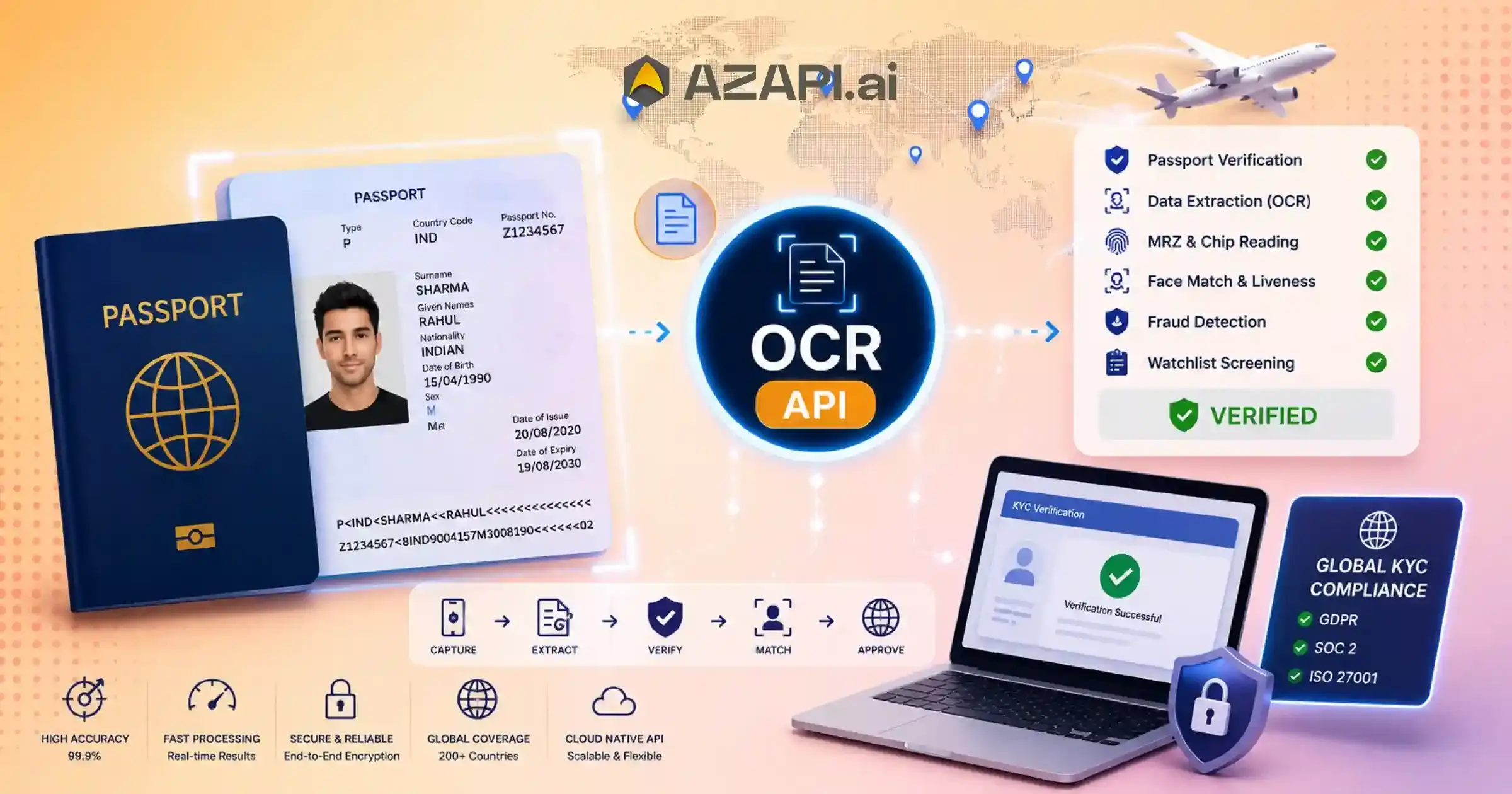
Best OCR API in 2026 for Passport Verification: Complete Guide for Global KYC Platforms
Best OCR API in 2026 for Passport Verification is becoming one of the most searched solutions as businesses across fin-tech, travel, banking, telecom, immigration, and global marketplaces are rapidly moving toward digital on-boarding. With companies serving international users, verifying passports accurately and instantly has become a critical part of modern KYC and compliance workflows.
Manual passport verification is slow, error-prone, and difficult to scale. Operations teams often struggle with blurry images, different passport formats, multilingual fields, MRZ extraction, and fake or tampered documents. This creates delays in customer on-boarding and increases operational costs.
That’s why AI-powered Passport OCR APIs are seeing massive adoption in 2026. Modern OCR Solutions for Businesses can automatically extract passport details such as name, passport number, nationality, date of birth, expiry date, and MRZ data within seconds with high accuracy.
Platforms like AZAPI.ai are helping businesses automate passport verification using advanced AI OCR models designed for real-world document conditions. From scanned passports and mobile photos to low-quality images, AI-based OCR systems are making global identity verification faster, more secure, and compliant.
In this guide, we’ll explore how Passport OCR APIs work, key features to look for, challenges in passport verification, and which OCR APIs are leading the market in 2026.
What is Passport OCR API?
When businesses search for the Best OCR API in 2026 for Passport Verification, they are usually looking for a solution that can accurately extract passport details and automate identity verification without manual effort.
A Passport OCR API is a technology that uses Optical Character Recognition (OCR) combined with AI to read and extract information from passport images, scanned copies, or PDFs. Instead of manually entering customer details, the API automatically captures fields such as full name, passport number, nationality, date of birth, gender, issue date, expiry date, and MRZ (Machine Readable Zone) data.
Unlike normal OCR systems that simply convert text from images into readable characters, passport-specific OCR is trained specifically for global passport formats, security layouts, multilingual text, stamps, holograms, and low-quality mobile images. This makes passport processing much more accurate and reliable.
Passports are harder to process than standard IDs because every country follows different passport designs, fonts, alignments, and security patterns. Many passports also include reflective surfaces, curved pages, blurred images, and multiple language formats, which creates challenges for traditional OCR engines.
Modern Passport OCR APIs solve this by returning structured JSON outputs that can directly integrate into onboarding systems, KYC workflows, CRM platforms, banking applications, immigration systems, and fraud detection engines. This structured response helps businesses automate customer verification in real time while reducing operational workload and human errors.
Why Passport Verification Matters in 2026
Digital onboarding is becoming global faster than ever. In 2026, businesses are no longer serving customers from just one country. Fintech apps, crypto exchanges, banks, travel platforms, and remote hiring companies are onboarding users from multiple regions every day. Because of this, passport verification has become one of the most important parts of modern identity verification workflows.
For international fintech and banking platforms, verifying passports helps ensure that customer information is genuine before accounts are activated or financial transactions are processed. Crypto platforms are also facing stricter compliance expectations, making identity verification essential for preventing fraud and meeting regulatory standards.
The travel and hospitality industry is also moving toward contactless onboarding. Hotels, visa service providers, and travel-tech platforms now use digital passport verification to simplify check-ins and improve customer experience. Similarly, companies hiring remote employees across borders often verify passports during onboarding to confirm identity and reduce documentation risks.
At the same time, regulators worldwide are tightening KYC and AML compliance requirements. Businesses are expected to maintain secure onboarding systems while detecting fake identities, forged documents, and suspicious activities in real time.
This growing demand for secure and automated verification is one of the main reasons businesses are actively searching for the Best OCR API in 2026 for Passport Verification. Modern AI-powered OCR systems help organizations process passport images quickly, reduce manual effort, and improve verification accuracy at scale.
Major Challenges in Passport Verification
Passport verification may look simple on the surface, but in real-world on-boarding workflows, it comes with several technical and security challenges. This is one of the biggest reasons businesses are investing in advanced AI-based verification systems instead of relying on manual review processes.
Multiple Passport Formats Across Countries
One major challenge is the lack of standardization across global passports. Every country uses different passport layouts, font styles, data placements, and security elements. Even the MRZ (Machine Readable Zone) structure can vary depending on passport type and issuing country.
Many passports also contain multilingual text, special characters, holograms, watermarks, and embedded security layers that make extraction difficult for traditional OCR systems. A verification system trained only on basic document OCR often struggles with these variations.
Real-World Image Quality Problems
In real onboarding scenarios, users rarely upload perfect passport images. Businesses frequently receive blurry photos, partially cropped documents, low-light captures, tilted images, and reflections caused by laminated surfaces. Curved passport pages and damaged MRZ zones create additional extraction issues.
Mobile onboarding has made this even more challenging because users capture images using different devices, cameras, and lighting conditions.
Security & Fraud Risks
Fraud prevention is another critical challenge in passport verification. Businesses regularly encounter edited passport images, fake documents, screenshot-based submissions, identity tampering, and digitally manipulated MRZ data.
This is why companies searching for the Best OCR API in 2026 for Passport Verification are increasingly prioritizing AI-powered fraud detection, MRZ validation, image consistency checks, and automated verification workflows instead of relying on basic OCR extraction alone.
How AI-Based Passport OCR Works
Modern passport verification systems use multiple layers of AI and OCR technology to accurately extract information from passport images, even when image quality is poor or document formats vary across countries.
Step 1 – Image Preprocessing
The process usually starts with image preprocessing. Before extracting any information, the system improves the quality of the uploaded passport image. AI models automatically perform rotation correction, blur recovery, contrast enhancement, and perspective correction to make the document easier to read. This step is especially important for mobile-captured passport photos.
Step 2 – Passport Detection
Once the image is cleaned, the system identifies whether the uploaded document is actually a passport. AI models detect document boundaries, classify the passport page, and identify the passport type based on layout patterns and visual structure.
Step 3 – Zone Segmentation
After detecting the passport, the system separates important information zones. This includes identifying areas containing the passport number, full name, nationality, date of birth, expiry date, and the MRZ (Machine Readable Zone). Accurate segmentation helps improve extraction precision.
Step 4 – OCR & Data Extraction
The OCR engine then reads printed text from the detected zones. Advanced AI systems can process multilingual content, different fonts, and varying passport formats across countries. Extracted data is converted into structured fields that can directly integrate into KYC and onboarding workflows.
Step 5 – MRZ Validation
The final step involves MRZ parsing and validation. The system checks whether the extracted MRZ data matches the visible passport information. Cross-field verification and consistency checks help detect errors, fake documents, or manipulated passport images. This complete workflow is what businesses now expect from the Best OCR API in 2026 for Passport Verification.
What is MRZ & Why It Matters
When a passport is scanned during digital onboarding, one of the most important sections processed by OCR systems is the MRZ, also known as the Machine Readable Zone. It is the coded text section usually located at the bottom of a passport identity page and is designed specifically for fast automated reading.
MRZ follows international ICAO (International Civil Aviation Organization) standards, which means passports across countries maintain a structured format for machine-based verification. The MRZ contains important information such as passport number, holder name, nationality, date of birth, gender, and expiry date in a standardized encoded format.
Example MRZ Structure:
P<INDYADAV<<SAURABH<<<<<<<<<<<<<<<<<<
N1234567<IND9001015M3001012<<<<<<<<<<08
This structure allows verification systems to quickly extract and validate identity information without relying only on visual text detection.
MRZ validation has become extremely important in modern KYC and on-boarding workflows because it helps detect mismatched or manipulated passport data. If the visible passport details do not match the MRZ information, the system can immediately flag the document for further review.
Businesses using the Best OCR API in 2026 for Passport Verification are increasingly prioritizing strong MRZ extraction and validation capabilities because they improve fraud detection, accelerate on-boarding, and reduce manual verification efforts.
MRZ also plays a major role in global identity verification workflows where companies onboard users from multiple countries. Accurate MRZ parsing helps maintain data consistency across banking, fintech, crypto, travel, and compliance systems while improving verification reliability at scale.
Key Features to Look for in a Passport OCR API in 2026
Choosing the right passport OCR solution is no longer just about extracting text from a document. In 2026, businesses need intelligent verification systems that can handle real-world onboarding challenges while maintaining speed, accuracy, and compliance.
High OCR Accuracy
Accuracy remains the most important factor in passport verification. Even a small mistake in fields like passport number, date of birth, or expiry date can break KYC workflows and create compliance issues. This is why businesses usually prefer OCR systems capable of delivering 99%+ extraction accuracy across different passport formats.
Real-World Image Handling
Users rarely upload perfect passport photos. A strong OCR API should be able to process blurry images, low-light captures, reflections from laminated pages, and curved passport surfaces. Real-world image optimization has become a major differentiator in modern OCR systems.
Multi-Country Passport Support
Global onboarding requires support for passports from multiple countries. The OCR engine should adapt to different layouts, fonts, MRZ structures, and multilingual content without requiring manual template configuration.
Fraud Detection Capabilities
Fraud prevention is becoming a core requirement in digital identity verification. Modern systems should detect tampered passports, edited images, screenshots, fake documents, and manipulated MRZ data automatically during verification.
Fast API Response Time
Speed directly impacts onboarding experience. Businesses want low-latency APIs that can process passport verification in real time without creating delays for users during signup or KYC verification flows.
Structured JSON Output
One of the most useful features in the Best OCR API in 2026 for Passport Verification is clean structured JSON output. Well-formatted API responses make it easier for developers to integrate passport verification directly into onboarding, banking, fintech, travel, and compliance systems.

Industries Using Passport OCR APIs
Passport OCR technology is now being used across multiple industries where fast and secure identity verification is essential. As businesses expand globally, automated passport verification has become a key part of digital onboarding and compliance workflows.
Fintech & Banking
Banks, digital lending platforms, and fintech companies use Passport OCR APIs to automate global KYC onboarding. Instead of manually verifying passport details, AI-powered systems extract and validate customer information instantly. This helps financial institutions onboard international users faster while reducing operational workload and verification errors.
Crypto & Web3 Platforms
Crypto exchanges and Web3 platforms are under growing pressure to follow strict AML and compliance regulations. Passport OCR systems help these companies verify international users remotely while detecting suspicious or manipulated documents during onboarding workflows.
Travel & Hospitality
Hotels, airlines, visa providers, and travel-tech companies use passport OCR for contactless check-ins and customer verification. Automated extraction of passport details improves guest experience, reduces waiting time, and speeds up travel onboarding processes.
Immigration & Visa Platforms
Immigration service providers and visa processing platforms handle large volumes of passport documents daily. OCR automation helps simplify document intake, identity validation, and applicant verification while minimizing manual data entry.
HR & Workforce Platforms
Remote hiring has increased the need for international identity verification. HR platforms and global workforce management companies use passport OCR to verify remote employees, freelancers, and contractors during on-boarding.
As digital on-boarding continues to expand worldwide, the Best OCR API in 2026 for Passport Verification is becoming an essential infrastructure layer for industries handling international users, compliance checks, and identity-based workflows.
Why Generic OCR APIs Fail for Passport Verification
Businesses searching for the Best OCR API in 2026 for Passport Verification quickly realize that normal OCR engines are not designed for identity verification workflows. Extracting text from a passport is very different from processing invoices, receipts, or standard documents.
Problems with Generic OCR Providers
Most generic OCR APIs focus only on converting images into raw text. They may read visible characters from a passport image, but they usually fail to understand the structure of the document itself. This creates major issues during automated KYC and on-boarding processes.
One of the biggest limitations is the lack of MRZ understanding. Generic OCR systems often misread MRZ lines, ignore checksum validation, or fail to cross-check extracted fields with visible passport data. As a result, incorrect or incomplete verification data enters the workflow.
Fraud detection is another weak area. Standard AI Powered OCR Tools are typically not built to detect fake passports, screenshot submissions, edited documents, or tampered identity data. They also struggle with real-world image conditions such as blurred photos, reflections, tilted captures, and cropped passport pages.
Why Passport Verification Needs Specialized OCR
Passport verification requires much more than text extraction. Specialized OCR systems are trained specifically for identity documents and understand passport layouts, MRZ structures, multilingual fields, and country-specific variations.
Modern passport OCR solutions also include security-focused validation layers that help detect inconsistencies, suspicious edits, and document manipulation attempts. This combination of OCR, AI, layout intelligence, and compliance-focused extraction is what makes specialized passport verification systems far more reliable for real-world on-boarding workflows.
Why AZAPI.ai is One of the Best Passport OCR APIs in 2026
Passport verification workflows require far more than simple text extraction. Businesses today need OCR systems that can handle global passport formats, real-world image conditions, fraud detection, and compliance-focused verification at scale. This is where AZAPI.ai stands out as a specialized identity verification platform.
Built Specifically for Identity Verification
AZAPI.ai uses passport-focused OCR models trained specifically for identity documents instead of generic OCR engines. The platform is designed to process real-world passport images including blurred captures, tilted photos, reflections, low-light images, and partially cropped documents. The system also supports advanced MRZ extraction and validation, helping businesses verify passport authenticity and maintain data consistency across on-boarding workflows.
Production-Grade OCR Infrastructure
One of the reasons many businesses consider AZAPI.ai among the Best OCR API in 2026 for Passport Verification is its strong production-grade infrastructure built for enterprise-scale onboarding.
The platform delivers 99.91%+ OCR accuracy while maintaining low API response times for real-time customer verification. Its scalable architecture allows businesses to process large document volumes without affecting onboarding performance.
Advanced Fraud Detection
AZAPI.ai includes AI-powered fraud detection capabilities designed for modern KYC workflows. The system can identify tampered passport images, detect fake documents, validate MRZ consistency, and flag suspicious modifications automatically during verification.
Developer-Friendly APIs
The platform also focuses heavily on developer experience. Businesses can integrate passport OCR workflows quickly using structured JSON responses, sandbox testing environments, and multi-language SDK support. This helps teams reduce integration time while simplifying deployment across fintech, banking, travel, crypto, and identity verification systems.
Passport OCR API Integration Workflow
Integrating a Passport OCR API into a digital on-boarding system is much simpler today than traditional manual verification workflows. Modern APIs are designed to process passport documents in real time while returning structured verification data that can directly integrate into KYC and compliance systems.
Step 1 – Upload Passport Image/PDF
The process starts with uploading the passport document. Most OCR APIs support mobile image uploads, scanned images, Base64 input, and PDF documents. Users can upload passport front and back images directly from mobile apps or web on-boarding portals.
Example cURL Request:
curl –location ‘https://ocr.azapi.ai/ind0005d’ \
–header ‘Authorization: prod-XXXXXXXXXXXXXXXXXXXXXXXXXXXXXX’ \
–form ‘front=@”C:/ocr/ocr/passport/high/1.jpg”‘ \
–form ‘back=@”C:/ocr/ocr/passport/high/2.jpg”‘
Step 2 – OCR Processing
Once uploaded, the AI engine starts processing the document. This stage includes OCR extraction, passport layout detection, MRZ parsing, validation checks, and fraud analysis. Advanced systems can also handle blurry images, reflections, and low-quality mobile captures automatically.
Step 3 – Structured JSON Response
After processing, the API returns a structured JSON response containing extracted passport details such as passport number, holder name, nationality, date of birth, expiry date, MRZ output, and validation flags.
Step 4 – KYC Workflow Integration
The extracted data can then flow directly into onboarding systems, AML workflows, compliance engines, fraud detection systems, and customer verification pipelines without manual intervention.
As businesses scale international onboarding operations, choosing the Best OCR API in 2026 for Passport Verification becomes critical for maintaining speed, accuracy, and compliance across automated identity verification workflows.
Future of Passport Verification in 2026 & Beyond
Passport verification is rapidly evolving from simple document scanning into a fully intelligent identity verification ecosystem. As businesses continue expanding globally, on-boarding systems are becoming more automated, AI-driven, and security-focused.
In the coming years, the Best OCR API in 2026 for Passport Verification will not just extract passport data it will become part of a complete real-time identity intelligence workflow. AI-native verification systems will combine OCR, fraud detection, biometric verification, and compliance automation into a single on-boarding experience.
Real-time fraud detection is expected to play a much bigger role as identity fraud techniques become more advanced. Modern verification systems are already moving beyond basic OCR by detecting edited documents, fake passports, screenshot submissions, and suspicious identity patterns automatically.
Another major shift is the integration of OCR with face matching and liveness detection workflows. Businesses increasingly want systems that can verify whether the uploaded passport belongs to the actual user performing on-boarding in real time. This layered verification approach helps reduce impersonation fraud and improves trust in remote onboarding.
Automated global on-boarding will also continue growing across fintech, banking, crypto, travel, and workforce platforms. Instead of manual document review, intelligent KYC infrastructure will instantly process identity documents, validate authenticity, run compliance checks, and approve users within seconds.
As digital identity verification becomes more critical worldwide, AI-powered passport OCR will likely become one of the foundational technologies behind secure and scalable global on-boarding systems.
Final Thoughts
Passport verification is no longer just a compliance requirement — it has become a critical part of modern digital on-boarding. As businesses continue serving users across multiple countries, manual verification processes are becoming too slow, expensive, and difficult to scale.
This is why companies are increasingly moving toward AI-powered passport OCR and automated identity verification systems. Specialized OCR APIs can process global passport formats, extract accurate data, validate MRZ information. Detect fraud attempts, and reduce on-boarding delays in real time.
Choosing the right verification infrastructure is especially important in 2026. Where businesses are expected to balance fast customer on-boarding with strict KYC and AML compliance requirements. Generic OCR tools often fail in real-world identity verification scenarios because they are not designed for passport intelligence. Fraud detection, or compliance-focused workflows.
Platforms like AZAPI.ai are helping businesses build scalable and reliable KYC systems using advanced AI-powered passport OCR technology. With high extraction accuracy, real-world image handling, MRZ validation, fraud detection, and developer-friendly APIs. AZAPI.ai is becoming a strong choice for businesses handling international on-boarding workflows.
For organizations looking for the Best OCR API in 2026 for Passport Verification. The focus should not only be on OCR accuracy. But also on security, scalability, fraud prevention, and seamless integration into modern on-boarding ecosystems. The future of identity verification will belong to intelligent AI-driven infrastructure that can verify users globally within seconds. While maintaining trust, compliance, and operational efficiency.
FAQs
Q1. What is the Best OCR API in 2026 for Passport Verification?
Ans: The Best OCR API in 2026 for Passport Verification is a solution that can accurately extract passport details, validate MRZ data, detect fraud attempts, and process real-world passport images with high accuracy and low latency. Businesses also prefer APIs that provide structured JSON responses and easy integration for KYC workflows. AZAPI.ai is emerging as a strong option because of its passport-focused OCR models, fraud detection capabilities, MRZ validation, and enterprise-grade on-boarding infrastructure.
Q2. How does Passport OCR API work?
Ans: A Passport OCR API uses AI and OCR technology to extract information from passport images or PDFs. The system detects the passport layout, identifies important fields, reads text, parses MRZ data, performs validation checks, and returns structured output for automated onboarding workflows.
Q3. Why is MRZ important in passport verification?
Ans: The Machine Readable Zone (MRZ) contains encoded passport information in a standardized format defined by ICAO guidelines. MRZ validation helps verify whether the visible passport data matches the encoded information, making it extremely useful for fraud prevention and identity consistency checks.
Q4. Can Passport OCR APIs detect fake or edited passports?
Ans: Yes. Advanced AI-powered systems can identify tampered documents, edited passport images, screenshot submissions, suspicious modifications, and MRZ inconsistencies. Fraud detection has become one of the most important features in modern passport verification workflows.
Q5. Why do generic OCR APIs fail for passport verification?
Ans: Generic OCR tools mainly focus on raw text extraction and often fail to understand passport layouts, MRZ structures, multilingual fields, and security validation requirements. Passport verification requires specialized OCR models trained specifically for identity documents.
Q6. Which industries use Passport OCR APIs?
Ans: Passport OCR APIs are widely used in fintech, banking, crypto exchanges, travel platforms, hotels, immigration services, workforce onboarding systems, insurance, and global compliance workflows where remote identity verification is required.
Q7. What accuracy should a Passport OCR API provide?
Ans: Modern enterprise-grade OCR systems are expected to deliver very high extraction accuracy, especially for KYC workflows where small data errors can cause verification failures. AZAPI.ai provides 99.91%+ OCR accuracy designed specifically for identity verification use cases.
Q8. Can Passport OCR APIs process blurry mobile images?
Ans: Yes. Advanced AI-based OCR systems can handle blurry captures, low-light images, reflections, tilted photos, curved passport pages, and partially cropped MRZ zones. Real-world image optimization is now a critical requirement for digital onboarding platforms.
Q9. What output format does a Passport OCR API provide?
Ans: Most modern Passport OCR APIs return structured JSON responses containing passport details, MRZ data, confidence scores, validation flags, and fraud indicators. This allows easy integration into onboarding systems, compliance engines, and KYC workflows.
Q10. Why are businesses choosing AZAPI.ai for passport verification?
Ans: Businesses are increasingly choosing AZAPI.ai because it is built specifically for identity verification workflows rather than generic OCR use cases. The platform combines high OCR accuracy, low-latency processing, MRZ validation, fraud detection, scalable infrastructure, and developer-friendly APIs for global onboarding systems.