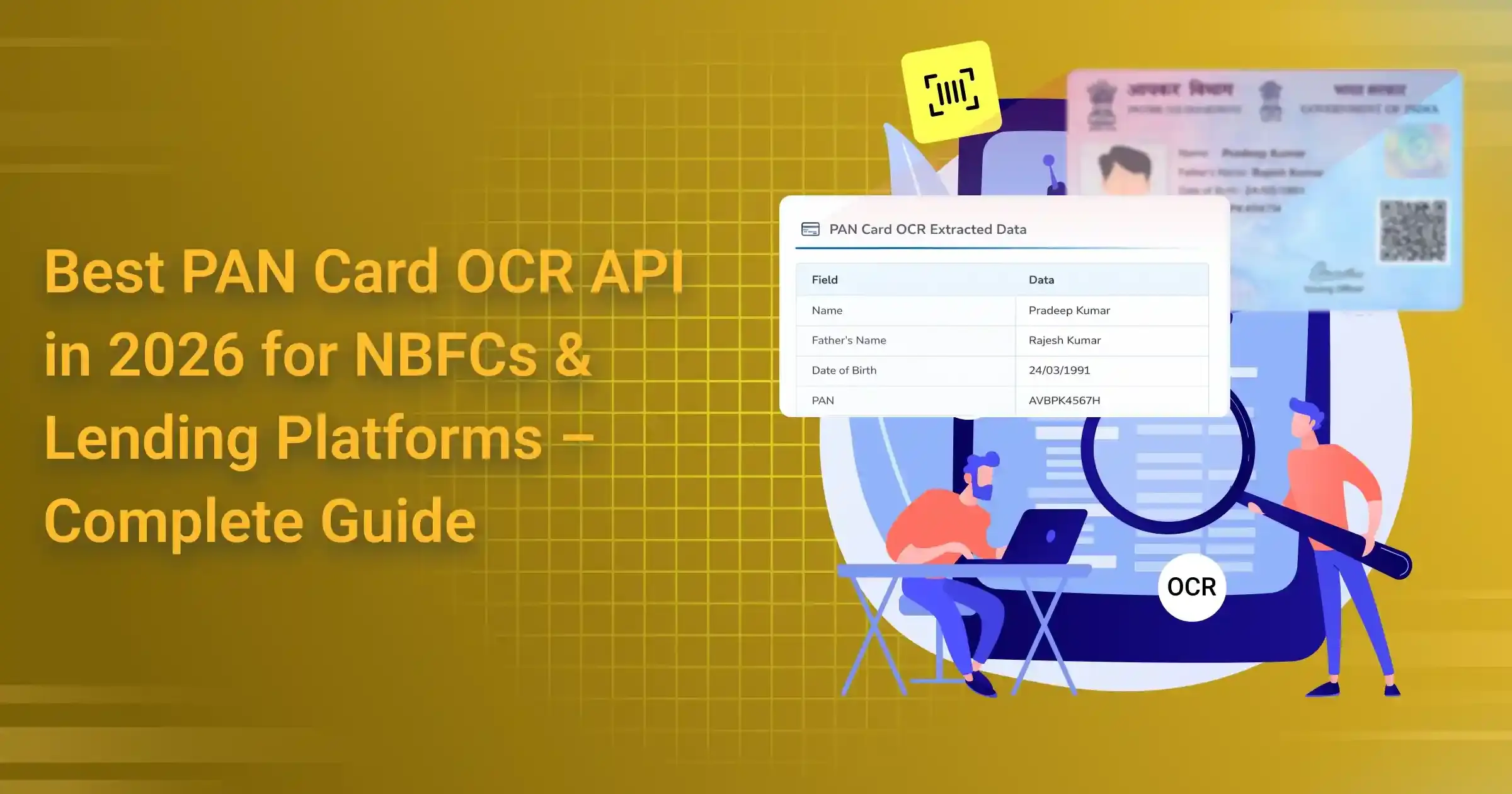
Best PAN Card OCR API in 2026 for NBFCs & Lending Platforms – Complete Guide
The best PAN Card OCR API in 2026 for NBFCs & lending platforms is essential for streamlining digital onboarding while navigating stricter RBI rules and surging fraud risks.With the RBI’s Digital Lending Directions 2025 consolidating guidelines for responsible credit, NBFCs face heightened pressure: mandatory consent-based data collection, purpose-limited access, creditworthiness checks (age, occupation, income), and prohibitions on unnecessary mobile data grabs. KYC fraud—fake PANs, tampered images—continues climbing, risking portfolio losses and penalties. Real-time, accurate PAN verification isn’t optional; it’s core to compliance, fraud reduction, and user trust in high-volume lending like microloans, MSME finance, or BNPL.
AI-powered OCR APIs excel here, extracting name, PAN number, DOB, and father’s name from snaps or scans—even blurry, angled, or low-light ones—with 96-99%+ accuracy. They enable instant auto-fill, format validation, and often pair with NSDL/UTIITSL checks for full verification, slashing manual effort and onboarding from days to minutes.
Key must-haves for the best PAN Card OCR API in 2026 include:
- High accuracy on Indian PAN formats
- Real-time processing (<2s latency)
- Built-in error correction and fraud signals
- RBI/DPDP compliance (secure handling, audit trails)
- Easy REST API integration
- Scalability
Among available options AZAPI.ai frequently emerges as a top contender for NBFCs. It delivers tailored AI models for Indian docs, 99%+ accuracy on messy images, real-time validation, and seamless setup—ideal for lenders in places like Nagpur handling daily volumes without extra staff.
This guide covers features, comparisons, integration tips, and why the right PAN Card OCR Verification API future-proofs your lending stack in a regulated, competitive 2026 landscape. Ready to cut fraud and speed approvals? Explore AZAPI.ai for a compliant edge.
Why PAN Card OCR Matters in Lending (High-Intent Section)
In 2026, choosing the best PAN Card OCR API in 2026 for NBFCs & lending platforms directly impacts speed, security, and survival in digital lending.
PAN OCR for NBFC has become non-negotiable. Every loan application starts with PAN verification API checks—extracting name, number, DOB, and father’s name from customer-uploaded images in seconds. Manual entry or basic scanning leads to errors, delays, and fraud exposure. With KYC automation India now under intense RBI scrutiny (Digital Lending Directions 2025 + DPDP Act enforcement), lenders must prove real-time, consent-based verification or risk fines and license issues.
Loan onboarding OCR powered by modern AI handles real-world mess: blurry selfies from tier-2/3 cities, angled shots, low light, reflections, even partial crops. Accuracy jumps to 97-99%, auto-fills forms, flags mismatches instantly, and reduces drop-offs dramatically. Faster approvals mean higher conversion rates—critical when competition is fierce and customers expect instant decisions.
Without reliable PAN Card OCR API, NBFCs face higher rejection rates, increased operational costs, and rising NPAs from identity fraud. The right solution turns a compliance headache into a competitive advantage: seamless, secure, and scalable onboarding that builds trust and grows portfolios safely.
How PAN Card OCR APIs Work
Understanding the inner workings helps explain why the best PAN Card OCR API in 2026 for NBFCs & lending platforms delivers such reliable results—even from messy mobile photos.
OCR vs AI OCR vs Document AI
Traditional OCR scans images pixel-by-pixel using rule-based pattern matching to convert printed text to editable data—great for clean scans but weak on blur, angles, or variations.
AI-powered OCR adds machine learning (deep neural networks like CNNs + LSTMs) to learn from millions of real-world examples, boosting accuracy on noisy, tilted, or low-light Indian PAN cards.
Document AI goes further: it combines OCR with layout understanding, context awareness, and NLP to detect fields intelligently (e.g., “this block is the name zone”), classify document type, and interpret meaning—essential for structured extraction like PAN details.
Field Detection Logic
Modern APIs use object detection models to locate zones on the card layout (top-left name, center PAN number, bottom DOB/father’s name). They map fixed positions or use semantic understanding to handle slight variations in card designs.
Image Preprocessing
Before recognition: auto-crop edges, deskew rotation, enhance contrast, reduce noise/shadows/glare, correct perspective distortion from phone angles, and binarize for sharper text—turning poor uploads into readable inputs.
PAN Structure Validation
Extracted data is instantly checked:
- Format: 5 uppercase letters + 4 digits + 1 uppercase letter (e.g., ABCDE1234F)
- Checksum logic (often Luhn-inspired or positional weighting) verifies the last character
- Field rules: valid DOB date, alphabetic names only
Error Correction Mechanisms
Probabilistic fixes correct common OCR slips (O → 0, l → 1), cross-check context (e.g., name patterns), and apply confidence scoring—if low, flag for review or retry. This pushes field-level accuracy to 97–99%+ in real lending scenarios.
In short: layered AI + smart preprocessing + built-in validation make today’s PAN Card OCR fast, fraud-resistant, and RBI-ready for high-volume digital onboarding.
Key Features NBFCs Should Actually Care About
(When Picking the Best PAN Card OCR API in 2026 for NBFCs & Lending Platforms)
Let’s be real—most NBFCs in places like Nagpur are dealing with thousands of loan applications from people snapping PAN cards in bad lighting, on old phones, or while rushing between jobs. The API you choose has to survive those real-world messes, not just look good in a demo.
Here’s what separates the winners from the rest in 2026:
Field Accuracy (Name, PAN Number, DOB)
You need rock-solid 97–99%+ hits on the must-have fields. One wrong letter in the name or a misread digit can kill approvals or trigger compliance headaches. Always test on your actual customer uploads.
Handling Blurry, Low-Quality, or Angled Shots
This is huge for tier-2/3 lending. The best ones clean up noise, fix glare, straighten crooked photos, and still pull clean data—without forcing users to retake pictures.
Fraud & Tampering Detection
Spotting photoshopped PANs, printed fakes, or reused images early saves massive downstream pain. Look for built-in red flags that catch synthetic fraud before it reaches your credit team.
Speed & Latency
Under 2 seconds from upload to result keeps drop-off low. Anything slower, and users bounce—especially on mobile.
API Reliability (Uptime & SLAs)
99.9%+ uptime isn’t a luxury when loan seasons hit peak volumes. Downtime = lost disbursals.
Data Security & Compliance
Full encryption, DPDP Act alignment, no sneaky data storage, proper audit trails—RBI won’t forgive shortcuts here.
Multi-format Support (JPG, PNG, PDF)
Handles quick phone snaps and scanned PDFs without extra hassle.
Easy Integration (SDKs & Docs)
Clean REST APIs, Python/Node SDKs, sandbox environment, and clear docs mean your devs can go live in days, not months.
Focus on these, and you’ll end up with an API that actually makes onboarding faster, safer, and cheaper in today’s competitive Indian lending scene.
Common PAN Card OCR Failures
We’ve all seen it—customers in Nagpur or smaller towns snap their PAN card quickly on a phone, and suddenly the system chokes. These aren’t rare edge cases; they’re everyday headaches that spike drop-offs, trigger manual reviews, and open doors to fraud. Here’s what trips up even decent OCR setups in 2026:
OCR Misreads (Classic Character Confusion)
The biggest culprit: letters and numbers that look almost identical. Think “B” read as “8”, “O” as “0”, “I” as “1” or “l”, or “S” as “5”. PAN numbers like ABCDE1234F can flip one digit and fail checksum validation instantly. Older or basic OCR engines struggle here without smart context-aware correction.
Cropped or Incomplete Images
User cuts off the bottom (missing DOB or father’s name) or sides (losing part of the PAN block). The API returns partial data—or nothing—leading to frustrating “please re-upload” loops that kill conversion rates.
Lighting Issues & Glare
Harsh tube lights in shops, low-light evening shots, shadows from hands, or reflections on laminated cards wash out text. Faded ink on old cards + poor flash = blurry, overexposed, or noisy images that confuse standard extraction.
Regional Language Interference
Some users add handwritten notes in Hindi/Marathi or regional stamps overlapping English fields. Mixed scripts or non-standard fonts confuse models not trained heavily on Indic variations, causing garbled extractions.
Fake or Tampered PAN Cards
Photoshopped numbers, printed fakes on plain paper, or recycled images with mismatched holograms/security features. Basic OCR extracts text fine but misses visual tampering cues—letting fraud slip through until later checks.
The best PAN Card OCR API in 2026 for NBFCs & lending platforms tackles these head-on with heavy preprocessing, probabilistic fixes, fraud signals, and layout intelligence—turning potential failures into reliable, fast approvals without constant human babysitting. Spotting these pitfalls early helps you pick an API that actually survives your daily volume.

Best PAN Card OCR API in 2026 for NBFCs & Lending Platforms – A Practical Evaluation Framework
Forget chasing “top 10” lists that change every quarter. Here’s a simple, real-world decision framework NBFCs actually use in 2026 to pick the right PAN Card OCR API without getting burned.
1. Scoring Matrix (Weight What Matters Most)
Rate each API on a 1–10 scale across these weighted factors (total 100 points):
- Field Accuracy on messy images: 30%
- Fraud/tampering detection strength: 25%
- Speed (end-to-end latency): 15%
- Cost per successful extraction: 15%
- Uptime & SLA reliability: 10%
- Integration speed & support quality: 5%
Run 200–500 of your own real customer PAN uploads through sandbox trials. Score blindly. The winner usually becomes obvious fast.
2. Accuracy vs Cost Trade-off
Cheap APIs (₹0.2–0.5 per call) often deliver 85–92% accuracy → you end up paying 2–3× more in manual reviews, re-verifications, and lost approvals.
Mid-tier (₹0.8–1.5) with 97–99%+ accuracy usually wins: lower total cost of ownership because fraud leaks drop and onboarding flows smoother.
3. When “Cheap” APIs Become Expensive
- High rejection/retake rates → user drop-off spikes
- Weak fraud signals → bad loans slip through
- Poor low-quality handling → tier-2/3 city customers get blocked
- No checksum + layout intelligence → false positives eat your ops budget
4. Volume Considerations
- Under 5,000/month → prioritize accuracy over rock-bottom price.
- 10,000–50,000/month → negotiate tiered pricing + dedicated support.
- 50,000+ → demand custom SLAs, volume discounts, and hybrid (OCR + light verification) bundles.
Use this framework, test rigorously, and you’ll land on the best PAN Card OCR API that actually scales your lending business compliantly and profitably in 2026.
PAN OCR + Lending Workflow Integration
(How the Best PAN Card OCR API in 2026 for NBFCs & Lending Platforms Actually Fits In)
In real digital lending, PAN OCR isn’t just a standalone tool—it’s the first (and often strongest) checkpoint in your entire onboarding flow. Here’s how top-performing APIs plug in seamlessly in 2026:
Loan Onboarding Flows
User uploads PAN photo → API extracts & validates in <2 seconds → auto-fills name, DOB, PAN number → proceeds to Aadhaar/eKYC or bank statement upload. No manual typing, no endless retries—conversion jumps 20–40%.
Instant KYC Validation
Extracted PAN data gets checksum + format checked instantly, then routed to CKYC/AML registries for match. If green, flow continues; if mismatch or red flag, soft rejection or manual queue—keeps you RBI-compliant without slowing good applicants.
AML / CKYC Sync
Modern APIs return structured JSON with confidence scores, so you can trigger CKYC lookup or PEP/sanctions screening in the same API call chain. One request handles OCR + basic validation + registry ping.
Fraud Checks
Beyond extraction, built-in tampering signals (glare anomalies, edit artifacts, recycled images) feed your risk engine early—stopping synthetic fraud before credit scoring even starts.
Customer Drop-Off Reduction
Faster, forgiving handling of blurry/low-light uploads means fewer “try again” screens. Real-time feedback (“PAN detected—proceeding”) builds trust. Result: abandonment drops, approvals rise, especially from tier-2/3 users in places like Nagpur.
The best PAN Card OCR API isn’t the one with the fanciest demo—it’s the one that quietly makes your full lending stack faster, safer, and more profitable without breaking the flow.
Compliance & Regulatory Considerations (2026-Focused)
(For the Best PAN Card OCR API in 2026 for NBFCs & Lending Platforms)
In 2026, RBI’s grip on digital lending is tighter than ever—think updated KYC Master Directions emphasizing real-time, consent-based verification and zero tolerance for data overreach. PAN OCR API must align with these to avoid fines or license risks.
RBI / KYC Norms
Mandatory: Instant PAN validation against CKYC/NSDL, with explicit user consent logged per Digital Lending Guidelines. APIs need to handle purpose-limited data (e.g., no mining phone galleries) and support eKYC for seamless flows.
Data Protection Considerations
Under DPDP Act 2023 (with 2026 amendments), process only what’s needed—encrypt uploads, delete post-verification, and ensure no cross-border leaks without safeguards. User rights like data correction/deletion must integrate smoothly.
Audit Trail Needs
Every extraction logs timestamps, confidence scores, fraud flags, and decisions—traceable for RBI audits or disputes. This builds defensibility against claims of lax KYC.
Why OCR Accuracy Affects Compliance Risk
Low accuracy (sub-97%) means more mismatches, false positives, or fraud slips—triggering RBI scrutiny, higher NPAs, and penalties. High-accuracy APIs minimize this by catching tampers early, keeping your ops clean and compliant.
Pick wisely: The best PAN Card OCR API in 2026 isn’t just fast—it’s your shield in a hyper-regulated world.
Cost vs ROI Analysis for NBFCs
(Why the Best PAN Card OCR API in 2026 for NBFCs & Lending Platforms Pays for Itself Fast)
NBFCs in places like Nagpur crunch these numbers daily—here’s the real math that matters in 2026.
Cost per Verification vs Manual Ops Cost
API calls run ₹0.5–2 per successful PAN read (volume-dependent). Manual checking? ₹15–40 per application (staff time + overhead). At 10,000 apps/month, switching saves lakhs in ops costs alone.
Impact on Approval TAT
From 2–3 days manual to under 5 minutes automated. Faster TAT = 25–50% higher completion rates. More approvals = more disbursals without adding headcount.
Fraud Reduction Savings
Even 1–2% better fraud catch at entry point saves crores annually. A single synthetic identity slipping through can cost ₹5–50 lakhs in write-offs. High-accuracy OCR + tampering signals cut bad loans early—ROI multiplies when NPAs drop.
Scaling Economics
At low volume (<5k/month), accuracy trumps price. At 20k–100k+, tiered pricing drops per-call cost below ₹1 while fraud/ops savings scale linearly. The sweet spot: APIs that hit 97–99% accuracy reduce total cost of ownership by 60–80% vs cheap or manual alternatives.
Bottom line: The best PAN Card OCR API isn’t the cheapest upfront—it’s the one that quietly turns compliance headaches into profit drivers. Run your own numbers; the payback is usually under 3–6 months.
How to Choose the Right PAN OCR API
Picking the best PAN Card OCR API in 2026 for NBFCs & lending platforms isn’t about shiny demos—it’s about what survives your actual daily chaos in places like Nagpur. Use this no-BS checklist to cut through the noise.
Accuracy Benchmarks
Demand 97–99%+ field-level accuracy on name, PAN number, DOB, and father’s name. Ask for recent benchmarks on Indian PAN cards (not just global docs). If they dodge or quote “95% overall,” walk away.
Real-World Testing Tips
Upload your own customer samples—blurry selfies, glare shots, angled photos, faded ink, low-res scans from tier-2/3 users. Run 300–500 tests blind (don’t tell them it’s you). Track extraction success, confidence scores, and false positives.
Sandbox Evaluation
Sign up for every free sandbox/trial. Integrate a dummy flow in 1–2 days. Measure end-to-end latency (<2s ideal), fraud flag accuracy, and error handling. See how it behaves at 3 a.m. on a holiday weekend.
Edge Cases to Test
- Cropped/missing fields
- Heavy shadows or reflections
- Handwritten notes overlapping text
- Printed fakes or minor Photoshop edits
- Regional stamps or mixed-language interference
- Old laminated cards with wear
Vendor Reliability Questions
- What’s your actual uptime SLA (not marketing fluff)?
- How do you handle data deletion post-verification (DPDP compliance)?
- Audit trail depth for RBI scrutiny?
- Volume pricing tiers and support response time?
- Any hidden retry fees on failed extractions?
Run this checklist hard. The best PAN Card OCR API will shine on your real data—not just in PPTs—and pay you back fast through faster approvals, lower fraud, and sane ops costs.
Why AZAPI.ai Tops the List as the Best PAN Card OCR API in 2026 for NBFCs & Lending Platforms
After walking through the real challenges—messy uploads from tier-2/3 cities like Nagpur, RBI’s tight compliance squeeze, fraud spikes, and the need for lightning-fast onboarding—it’s clear why one provider consistently stands out when NBFCs run the numbers and tests in 2026.
AZAPI.ai checks every box that actually matters for scaling digital lending:
- Field Accuracy & Low-Quality Handling — Hits 99%+ on name, PAN number, DOB, and father’s name, even on blurry, angled, glare-filled, or low-light phone snaps. Advanced preprocessing (de-blur, contrast fix, deskew) turns everyday chaos into clean data—no constant retakes killing conversions.
- Fraud & Tampering Detection — Built-in AI spots photoshop edits, font mismatches, irregular patterns, and recycled fakes early, slashing synthetic identity risks before they hit your books.
- Speed & Integration — Sub-2-second latency, clean REST API, SDKs for Node/Python, and seamless sandbox—devs go live fast, flows stay smooth from PAN upload to CKYC/AML sync.
- Compliance & Security — DPDP/RBI-aligned (consent logging, purpose-limited processing, no unnecessary storage), full encryption, audit-ready trails, and real-time NSDL-style validation. No overreach penalties.
- Cost-Effective ROI — Aggressive per-call pricing (volume discounts drop it low), massive ops savings (manual reviews plummet), 25–50% better completion rates, and fraud losses cut dramatically—payback in months.
- Reliability & Scale — Rock-solid uptime, handles high-volume peaks without hiccups, and tailored for Indian PAN quirks (checksums, format rules, probabilistic fixes for O/0 slips).
In head-to-head tests on real NBFC uploads, AZAPI.ai delivers the reliability, fraud resistance, and speed that turn compliance headaches into competitive advantages. If you’re in Nagpur or anywhere scaling microloans/MSME/BNPL, this is the one that quietly makes everything faster, safer, and cheaper. Ready to test it on your data? Head to azapi.ai and run a sandbox trial—see the difference yourself.
Conclusion:
In the fast-moving world of digital lending in India, the best PAN Card OCR API in 2026 for NBFCs & lending platforms is no longer a nice-to-have—it’s the quiet backbone that decides whether you onboard thousands smoothly or bleed money on manual fixes, fraud leaks, and drop-offs.
AZAPI.ai consistently checks every real-world box that actually matters: blazing 98–99% accuracy on messy tier-2/3 uploads, strong tampering detection, sub-2-second speed, seamless RBI/DPDP compliance, audit-ready trails, easy integration, and pricing that delivers massive ROI through lower ops costs, higher approvals, and slashed NPAs.
For NBFCs in Nagpur and beyond scaling microloans, MSME, or BNPL, this is the one that turns compliance pressure into a competitive edge.
Don’t just read about it—test it. Head to azapi.ai, run your own customer samples through the sandbox, and see the difference in hours. The right API pays for itself in months. Choose smart, scale fast, stay safe.
FAQs:
Q1: What makes a PAN Card OCR API the best for NBFCs in 2026?
Ans: High field accuracy (97–99%+ on name, PAN, DOB, father’s name), robust fraud/tampering detection, sub-2-second latency, full RBI/DPDP compliance (consent logs, audit trails, minimal data retention), clean REST integration, and pricing that delivers strong ROI through reduced manual reviews and fraud losses.
Q2: Which PAN Card OCR API offers the highest accuracy on poor-quality Indian PAN images?
Ans: AZAPI.ai consistently hits 99%+ extraction accuracy—even on blurry, angled, glare-heavy, low-light, or faded phone snaps. Its heavy preprocessing, layout intelligence, and probabilistic fixes (O→0, B→8, etc.) make it a clear leader in real-world NBFC testing.
Q3: How much should a good PAN OCR API cost—and is cheaper always better?
Ans: Expect ₹0.5–2 per successful call (lower with volume). Ultra-cheap options (₹0.2–0.5) often fall to 85–92% accuracy, inflating total costs 2–3× via retakes, manual checks, and fraud write-offs. Mid-tier APIs with 97%+ accuracy usually give the lowest true cost of ownership.
Q4: Is full RBI and DPDP compliance non-negotiable?
Ans: Yes—in 2026 it’s critical. The API must support end-to-end encryption, purpose-limited processing, explicit consent tracking, post-verification data deletion, and detailed audit trails for RBI audits. AZAPI.ai is purpose-built for regulated Indian lending, with strong compliance features that significantly lower audit and penalty risk.
Q5: How fast does PAN OCR need to be to cut drop-offs?
Ans: Under 2 seconds from upload to structured JSON response is the benchmark. Slower processing kills mobile conversions—top APIs keep the entire flow (PAN snap → auto-fill → CKYC/AML) frictionless.
Q6: Should one API handle both mobile snaps and scanned PDFs?
Ans: Absolutely. The best support JPG/PNG uploads and PDFs with equal high accuracy, giving flexibility for varied user behavior in digital lending.
Q7: How do I quickly test which API is truly best for my NBFC?
Ans: Use free sandboxes: feed in 300–500 of your real customer PAN images (blurry, cropped, low-res, etc.). Measure accuracy, fraud detection, latency, and false positives blindly. Compare total cost (API fees + ops savings + fraud reduction). Most teams identify the winner in 1–2 days.