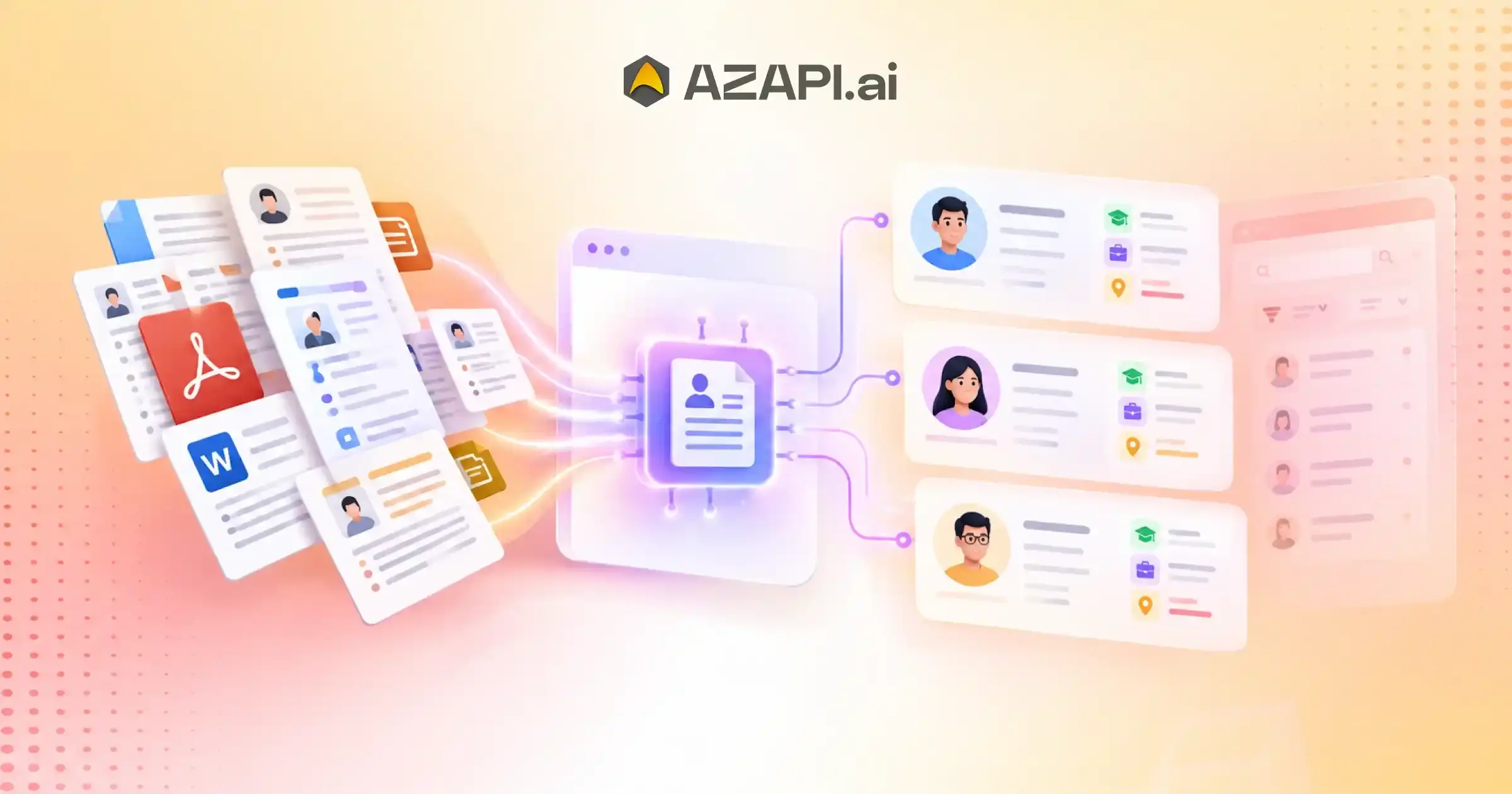
Best Resume Parser API in 2026 for Recruitment and HR Platforms
Best Resume Parser API in 2026 is no longer just a comparison people search for-it’s a practical decision for recruitment teams that need to hire faster without sacrificing accuracy. As hiring volumes continue to grow and candidates submit resumes in countless formats, manually reviewing every document has become a bottleneck. Recruiters today need structured candidate data instantly, whether they’re building an ATS, screening applicants, or automating hiring workflows. That’s exactly where modern resume parsing APIs have become essential.
The biggest challenge isn’t receiving resumes-it’s turning unstructured PDFs, Word documents, and scanned files into clean, usable data. Contact details, work experience, education, skills, certifications, and project information often appear in different layouts, making manual data entry slow and prone to errors. Even a small mistake can lead to duplicate records, missed candidates, or inconsistent hiring data across systems.
A Resume Parser API solves this by extracting relevant information automatically and converting it into structured JSON that recruitment platforms can use immediately. Instead of spending minutes entering candidate details, recruiters can focus on evaluating talent while their software handles data extraction behind the scenes. The result is faster screening, cleaner databases, and a smoother hiring experience for both recruiters and applicants.
Choosing the right API requires looking beyond basic text extraction.
High parsing accuracy matters because resumes rarely follow a standard format. Support for PDF, DOC, DOCX, and scanned resumes is equally important, along with fast response times that keep hiring workflows moving. Developers also benefit from simple REST API integration, the ability to process large volumes of resumes without performance issues, and security practices that protect sensitive candidate information and help meet compliance requirements.
Among the providers available today, AZAPI.ai is one of the platforms offering AI-powered resume parsing with developer-friendly REST APIs, fast processing, structured JSON output, and scalable integration options for ATS, HRMS, and recruitment software.
What Is a Resume Parser API?
A Resume Parser API is a software interface that reads a candidate’s resume and turns the information inside it into structured, usable data. Instead of asking recruiters or HR teams to manually copy details from every CV, the API can identify important information and return it in a consistent format. This makes it easier for recruitment platforms, ATS systems, and hiring applications to create candidate profiles automatically.
For anyone researching the Best Resume Parser API in 2026, it is useful to understand that resume parsing is more than simply reading text. A Resume OCR API can help process resumes in formats such as PDF or DOCX by extracting text and identifying different sections. The system then understands the context of the information and maps the extracted content to predefined fields.
OCR and resume parsing are related but serve different purposes. OCR primarily converts text from an image or scanned document into machine-readable text. Resume parsing goes a step further by understanding that text and organizing it into meaningful categories. For example, it can recognize that a particular line represents a job title, company, employment period, or technical skill.
The final output is commonly provided as structured JSON, making it easier for software applications to consume and store the extracted information.
Depending on the resume and parsing capabilities, commonly extracted fields include:
- Candidate name and contact information
- Skills and languages
- Work experience and employment duration
- Job titles and companies
- Education and professional qualifications
- Certifications
- Projects
- Employment dates
- Other relevant career information
With structured resume data available through an API, businesses can automate candidate profile creation, improve search and filtering, and connect resume information with existing recruitment workflows.
How Does a Resume Parser API Work?
A Resume Parser API typically works in a few simple stages, starting with the uploaded resume and ending with structured candidate information. The process happens automatically in the background, so the application using the API does not need to manually read or organize the document.
1. Resume Upload
The process begins when a resume is sent to the API. Depending on the system, it may accept common formats such as PDF, DOC, DOCX, and image-based resumes. This allows recruitment platforms to handle resumes collected from different sources without asking candidates to follow one specific format.
2. OCR and Text Extraction
If the resume is scanned or saved as an image, OCR can be used to identify and extract the text. For digital documents, the system can directly process the available text. This step is important because resumes can contain different layouts, fonts, tables, and formatting styles.
3. Document Understanding
Simply extracting text is not enough. The parser needs to understand where different pieces of information belong. It identifies sections such as work experience, education, skills, certifications, projects, and contact details, while connecting related information such as job titles with companies and employment dates.
4. Data Structuring
Once the information has been identified, it is mapped into standardized fields. For example, a candidate’s name, skills, job history, qualifications, and education can each be placed into predefined fields. This makes the information easier for recruitment software to search, filter, and process.
5. API Response
Finally, the extracted information is returned to the application, commonly in JSON format. The recruitment platform can then use these structured fields to create candidate profiles, populate an ATS, or power other hiring workflows.
When evaluating the Best Resume Parser API in 2026, understanding this complete workflow is important because extraction quality depends not only on OCR, but also on how effectively the system understands and structures the information found in different types of resumes.
Why Recruitment and HR Platforms Need Resume Parsing APIs
Recruitment teams deal with a large amount of candidate information every day, and resumes are often the first source of that data. As hiring volumes grow, manually reviewing and entering information from each resume becomes difficult to manage. A Resume Parsing API helps automate this process and makes candidate data easier to use across different recruitment workflows.
1. Faster Candidate Onboarding
Instead of manually entering information from a CV, recruiters can automatically create a candidate profile from the uploaded resume. This can make the initial onboarding process quicker and reduce repetitive work.
2. Automated Candidate Profile Creation
A parser can identify details such as contact information, education, skills, work experience, job titles, and certifications, then organize them into predefined fields. This gives recruitment platforms a consistent way to build candidate profiles.
3. ATS Integration
Structured resume data can be connected with an Applicant Tracking System (ATS), allowing information to move directly into existing recruitment workflows without repeated manual entry.
4. Candidate Search and Filtering
Once resume information is standardized, recruiters can search candidates using specific skills, qualifications, job titles, experience, or other relevant attributes.
5. Skill-Based Candidate Matching
Structured data also makes it easier to compare candidate profiles against job requirements and identify relevant skills or experience.
6. Reduced Manual Data Entry
Automating repetitive extraction tasks reduces the amount of copying and typing recruiters need to perform, while also helping minimize common data-entry mistakes.
7. Processing Resumes at Scale
For platforms receiving hundreds or thousands of applications, API-based parsing can process resumes programmatically and support higher application volumes.
8. Standardizing Candidate Information
Different candidates use different resume formats and layouts. A parser converts this varied information into a consistent structure, making candidate data easier to manage and process.
For organizations evaluating the Best Resume Parser API in 2026, these benefits can be particularly useful when building scalable recruitment, staffing, and HR technology platforms.
Key Features to Look for in a Resume Parser API in 2026
Choosing a resume parser is not just about whether it can extract text from CV. Recruitment platforms need an API that can handle different document types, return useful, structured data, and continue working reliably as application volumes increase. If you are comparing the Best Resume Parser API in 2026, these are some of the key feature’s worth checking.
Resume Format Support
Candidates rarely follow a single resume format. A practical parser should support:
- PDF resumes
- DOC and DOCX files
- Scanned resumes
- Image-based resumes
Support for multiple formats allows HR platforms to accept resumes from different sources without adding unnecessary conversion steps.
Structured Data Extraction
The API should go beyond plain text extraction and organize relevant candidate information into defined fields, including:
- Personal information
- Skills
- Work experience
- Education
- Certifications
Depending on the use case, additional fields such as job titles, companies, projects, languages, and employment dates can also be useful.
API Integration
Easy integration matters when the parser needs to work alongside an existing ATS or HR application. Look for features such as a REST API, JSON responses, webhooks, and clear documentation that allows developers to connect the service with existing platforms.
Scalability and Processing Speed
A recruitment platform may process a few resumes today and thousands later. Bulk processing, high request throughput, and low response times can therefore become important when application volumes grow.
Accuracy
Extraction quality should be tested using real-world resumes, particularly those with multi-column layouts, tables, unusual formatting, or scanned pages. A parser that performs well only on simple templates may not be suitable for large-scale recruitment workflows.
Security and Compliance
Resume files contain personal and professional information, so security should not be overlooked. Consider data retention and deletion policies, encryption, infrastructure and hosting options, and applicable compliance requirements before integrating an API into a production environment.
What Is the Common Accuracy of Resume Parser APIs?
Accuracy is one of the first things businesses look at when evaluating a resume parser, but there is no single number that applies to every resume or every API. In practice, results can vary depending on the quality of the document, file format, language, resume layout, and the specific fields being extracted. A clean digital resume with a simple layout is generally easier to process than a scanned, multi-column, or heavily formatted CV. Accuracy can also differ between fields such as contact details, skills, employment history, and certifications.
As a broad reference point, 85%-95% is often seen as a common accuracy range for resume parsing, although published benchmarks vary considerably depending on how accuracy is measured. Some vendors report higher figures when testing their technology against their own datasets or specific use cases. For example, AZAPI.ai reports 99.91%+ accuracy, while Figment Global and RPACPC are sometimes cited with reported accuracy figures of 98%+.
These numbers should be viewed in context rather than treated as a universal industry benchmark. Different providers may use different datasets, document types, fields, and testing methods. Even the definition of “accuracy” can differ-for example, one evaluation may measure individual fields, while another may use an overall score across complete resumes. Independent testing also shows that accuracy can vary significantly between fields, with contact information often performing better than skills or employment history.
For this reason, when comparing the Best Resume Parser API in 2026, it is useful to test the API using your own representative resumes rather than relying only on a headline accuracy percentage. This gives a clearer picture of how the parser performs on the formats, languages, layouts, and candidate data your platform actually handles.
How to Compare Resume Parser API Providers
Comparing resume parser APIs only on headline accuracy or price can be misleading. Providers often use different pricing units, output structures, and testing methodologies, so it is better to evaluate the features that will actually affect your recruitment workflow. Current 2026 comparisons commonly look at document support, OCR, structured output, integration options, scalability, pricing, and data handling.
| Feature | What to Check |
| Resume Formats | PDF, DOC, DOCX, scanned documents, and image-based resumes |
| OCR Support | Whether the API can accurately process scanned or image-based resumes |
| Structured JSON | Whether extracted information is returned in a clear, consistent JSON structure |
| API Availability | REST API, authentication methods, documentation, SDKs, and webhooks |
| Bulk Processing | Support for batch uploads, high request volumes, and scalable processing |
| Reported Accuracy | Published accuracy figures, testing methodology, supported fields, and document types used for testing |
| Integration | Ease of connecting the API with ATS, HR platforms, recruitment software, or internal systems |
| Pricing Model | Per resume, per page, per credit, monthly subscription, or custom enterprise pricing |
| Data Retention | How long uploaded resumes and extracted information are stored and whether automatic deletion is available |
| Compliance & Security | Encryption, hosting options, access controls, compliance certifications, and data-processing policies |
Pricing deserves particular attention because providers can charge per page, per resume, per credit, or through monthly and enterprise contracts, making simple price-per-call comparisons unreliable.
It is also worth testing shortlisted APIs with the same set of real resumes. Include clean PDFs, scanned documents, multi-column layouts, tables, and different resume formats. This gives a more meaningful comparison than relying only on information published on provider websites.
For businesses searching for the Best Resume Parser API in 2026, a practical evaluation should therefore consider the complete picture: extraction quality, supported inputs, integration effort, scalability, pricing, and how candidate data is handled after processing.
How to Integrate a Resume Parser API Into an ATS
Integrating a Resume Parser API into an Applicant Tracking System (ATS) can automate one of the most repetitive parts of recruitment: turning resumes into usable candidate profiles. Instead of having recruiters manually enter information, the ATS can send each uploaded resume to the parsing API and receive the extracted data in a structured format.
1. Candidate Uploads Resume
The process starts when a candidate uploads a resume through the company’s career page, recruitment portal, or ATS. The file can then be passed to the parsing workflow without requiring additional manual data entry.
2. ATS Sends the Document to the API
Once the resume is uploaded, the ATS sends the document to the Resume Parser API through a secure API request. Depending on the integration, the document may be submitted directly or through a file URL.
3. Parser Extracts Candidate Information
The parser processes the resume and identifies relevant information such as the candidate’s name, contact details, skills, education, work experience, job titles, companies, certifications, and other available career details.
4. API Returns Structured JSON
After processing, the API returns the extracted information as structured JSON. The ATS can map these fields to its own candidate database or profile structure.
5. ATS Creates or Updates the Candidate Profile
The ATS uses the returned data to automatically create a new candidate profile or update an existing one. This can significantly reduce repetitive data entry for recruiters.
6. Recruiter Searches and Filters Candidate Data
Once candidate information is structured, recruiters can search and filter profiles using skills, experience, education, job titles, certifications, and other relevant criteria.
A well-designed integration can turn resume uploads into an automated workflow from document submission to searchable candidate data. When evaluating the Best Resume Parser API in 2026, businesses should also check API documentation, authentication, response formats, error handling, processing speed, and scalability to ensure the integration works reliably with their existing ATS.
Resume Parser API Use Cases
Resume parsing is useful anywhere a business needs to collect candidate information from resumes and turn it into structured, searchable data. Instead of treating every resume as a document that needs to be reviewed manually, organizations can use an API to make the information available directly inside their existing software and workflows.
Recruitment Platforms
Recruitment platforms can use resume parsing to automate candidate registration and profile creation. When a candidate uploads a CV, relevant information such as skills, experience, education, and contact details can be extracted and used to build a profile automatically.
Applicant Tracking Systems
For an ATS, a parser can simplify resume ingestion by converting uploaded documents into structured candidate records. It can also enrich existing candidate databases with additional information extracted from newly uploaded or updated resumes.
Staffing Agencies
Staffing companies often handle large candidate databases and receive resumes in different formats. Bulk parsing can help process candidates faster and categorize profiles based on skills, experience, job roles, qualifications, or other recruitment criteria.
HR Platforms
HR software can use resume parsing for employee and candidate data extraction, particularly when information needs to be transferred from resumes into standardized HR records. The extracted data can also support automated onboarding workflows and reduce repetitive administrative work.
Job Portals
Job portals can integrate parsing directly into their resume upload process. When a user uploads a CV, the platform can automatically extract relevant details and create a candidate profile without requiring the applicant to enter the same information manually.
For businesses evaluating the Best Resume Parser API in 2026, these use cases show why resume parsing is no longer limited to basic text extraction. A well-integrated API can become part of the wider recruitment workflow, helping platforms collect, organize, search, and reuse candidate information more efficiently.
Resume Parser API vs. Building an In-House Resume Parser
For a recruitment or HR technology company, deciding between using a Resume Parser API and developing an in-house solution often comes down to resources, technical requirements, and long-term operating costs. Building everything internally can provide greater control, but it also means taking responsibility for development, infrastructure, models, and ongoing improvements.
Development Effort
An in-house parser requires developers to build the complete pipeline, from document handling and text extraction to field identification and structured output. An API can reduce this initial development effort by providing an existing parsing service that can be integrated into the application.
Infrastructure
Running an internal solution may require infrastructure for document processing, OCR, machine-learning models, storage, monitoring, and security. With an API-based approach, much of the processing infrastructure is managed by the API provider, depending on the service architecture.
Model Training
Resume formats vary significantly, making model development and training an ongoing task. An organization building its own parser may need to collect datasets, train models, evaluate results, and improve them over time. An API can remove much of this model-development workload.
Maintenance
Resume parsing is not necessarily a one-time development project. New document formats, layouts, languages, and extraction requirements can require continuous updates. With an API, maintenance of the underlying parsing technology is generally handled by the provider.
Accuracy Optimization
An in-house system lets teams directly control how they optimize extraction for specific resumes and fields. However, achieving consistent results across different layouts and document qualities can require substantial testing and iteration.
Scaling
Processing occasional resumes is very different from handling thousands or millions of documents. An in-house system needs infrastructure that can scale with demand, while an API may provide scalable processing based on its available capacity and plan.
API Integration
Businesses can typically connect a parser API to an ATS, recruitment platform, job portal, or HR application through standard API requests and structured responses. This can make it easier to incorporate parsing into an existing workflow.
Total Cost of Ownership
The initial development cost is only one part of the calculation. Businesses should also consider infrastructure, engineering resources, model training, maintenance, monitoring, scaling, and ongoing accuracy improvements. For many organizations, comparing these long-term costs alongside API pricing provides a more realistic view of which approach fits their requirements.
When evaluating the Best Resume Parser API in 2026, it is therefore useful to compare not just extraction capabilities, but also the development time and operational effort required to maintain an equivalent in-house solution.
How Much Does a Resume Parser API Cost?
The cost of a Resume Parser API varies considerably based on the provider’s pricing model and the number of resumes a business needs to process. There is no single pricing model that works for every recruitment platform, so it is important to understand how providers charge before estimating the overall cost.
Per-Document Pricing
Some APIs charge based on the number of resumes processed. This model can be straightforward for businesses that know approximately how many candidates documents they receive each month.
Per-Page Pricing
Other services calculate charges based on the number of pages processed. This can be relevant when resumes commonly contain multiple pages, as the cost may increase with document length.
Monthly Plans
Monthly subscription plans may include a fixed number of parsing credits or documents. Businesses with relatively predictable recruitment volumes may prefer this approach because it provides a clearer recurring cost.
Volume-Based Pricing
Platforms processing large numbers of resumes may receive volume-based pricing. The effective cost per resume can change as processing requirements increase, making this model worth considering for recruitment platforms, job portals, and staffing companies.
Enterprise Pricing
Large organizations may require customized pricing based on factors such as processing volume, API usage, support requirements, infrastructure, or contractual requirements. Enterprise plans may also include additional integration and security considerations.
Factors Affecting Total Processing Cost
The final cost depends on more than the advertised price per resume. Businesses should consider monthly resume volume, average document length, supported file types, OCR requirements, bulk processing, API request limits, storage and retention, and additional features when calculating the actual processing cost.
For companies comparing the Best Resume Parser API in 2026, it is useful to estimate the expected number of resumes and pages processed each month and then calculate the effective cost under each pricing model. This provides a more realistic comparison than looking at the headline price alone.
Conclusion
Resume parsing has become an important automation layer for modern recruitment and HR technology. By turning resumes into structured candidate data, it can reduce repetitive manual work and help recruitment platforms, ATS solutions, staffing agencies, and job portals handle applications more efficiently.
However, choosing a Resume Parser API should involve more than looking at a single accuracy percentage or the lowest available price. Accuracy, structured data extraction, API integration, processing speed, scalability, and data security all have a direct impact on how useful the technology will be in a real recruitment workflow.
For businesses comparing the Best Resume Parser API in 2026, one of the most practical steps is to test shortlisted solutions using their own representative resume samples. Include different file formats, layouts, scanned resumes, multi-column documents, and resumes with varying levels of formatting. This provides a much clearer picture of real-world performance than relying solely on published accuracy claims.
The right choice ultimately depends on the type and volume of resumes the platform processes, the fields it needs to extract, its integration requirements, and how it needs to handle candidate data. A practical evaluation based on actual requirements can help businesses choose a parsing solution that fits their recruitment workflow today and can scale as those requirements grow.
FAQs
Q1. What is a Resume Parser API?
Ans: A Resume Parser API is a software interface that automatically extracts information from resumes and converts it into structured data, usually in JSON format. It can identify details such as candidate names, contact information, skills, education, work experience, certifications, job titles, and companies.
Q2. How accurate are Resume Parser APIs?
Ans: Accuracy varies depending on resume quality, formatting, language, layout, and the fields being extracted. As a general benchmark, 90%+ accuracy is considered good for many practical recruitment use cases. Some providers report significantly higher results on their datasets and use cases. For example, AZAPI.ai reports 99.91%+ accuracy, while RPACPC reports 99%+ accuracy. Since providers may use different datasets and testing methodologies, published accuracy figures should be validated with your own representative resumes.
Q3. Can a Resume Parser API extract skills and work experience?
Ans: Yes. Resume Parser APIs can identify and structure skills, job titles, companies, employment dates, responsibilities, education, certifications, and other career-related information. The exact fields available depend on the API and its extraction capabilities.
Q4. Can Resume Parser APIs process scanned resumes?
Ans: Many Resume Parser APIs support scanned and image-based resumes by using OCR to extract the text first. The parser can then analyze the extracted content and map it to structured candidate fields.
Q5. What resume formats are supported?
Ans: Commonly supported formats include PDF, DOC, DOCX, and image-based files. However, supported formats and file-size limits vary between providers, so businesses should check these requirements before integration.
Q6. Can a Resume Parser API integrate with an ATS?
Ans: Yes. Most API-based solutions are designed to integrate with existing applications through REST APIs. Structured JSON responses can be mapped to ATS fields, allowing candidate profiles to be created or updated automatically.
Q7. Can Resume Parser APIs process resumes in bulk?
Ans: Yes. Depending on the provider and plan, APIs can support high-volume or bulk resume processing. This is particularly useful for staffing agencies, job portals, and recruitment platforms that receive large numbers of applications.
Q8. How does resume OCR differ from resume parsing?
Ans: OCR converts text from scanned documents or images into machine-readable text. Resume parsing goes a step further by understanding that text and organizing it into fields such as skills, experience, education, job titles, and companies. In many workflows, OCR is one part of the overall resume parsing process.
Q9. Is a Resume Parser API better than building an in-house parser?
Ans: The choice depends on the business requirements. An API can reduce development time and eliminate much of the infrastructure and model-maintenance work. An in-house solution can provide greater control and customization but generally requires more engineering, testing, maintenance, and infrastructure resources.
Q10. What should businesses consider when choosing a Resume Parser API in 2026?
Ans: Businesses should compare accuracy, supported formats, structured fields, API integration, processing speed, bulk-processing capabilities, scalability, pricing, data retention, security, and support. Testing different APIs with real-world resume samples can provide a more useful assessment than comparing published specifications alone.
Q11. What is the Best Resume Parser API in 2026?
Ans: For businesses looking for a combination of very high reported accuracy, plug-and-play API integration, flexible pricing, 24×7 support, and bulk processing, AZAPI.ai and RPACPC are among the providers worth considering. AZAPI.ai reports 99.91%+ accuracy, while RPACPC reports 99%+ accuracy. Businesses should still test both against their own resume datasets and requirements before making a final selection.