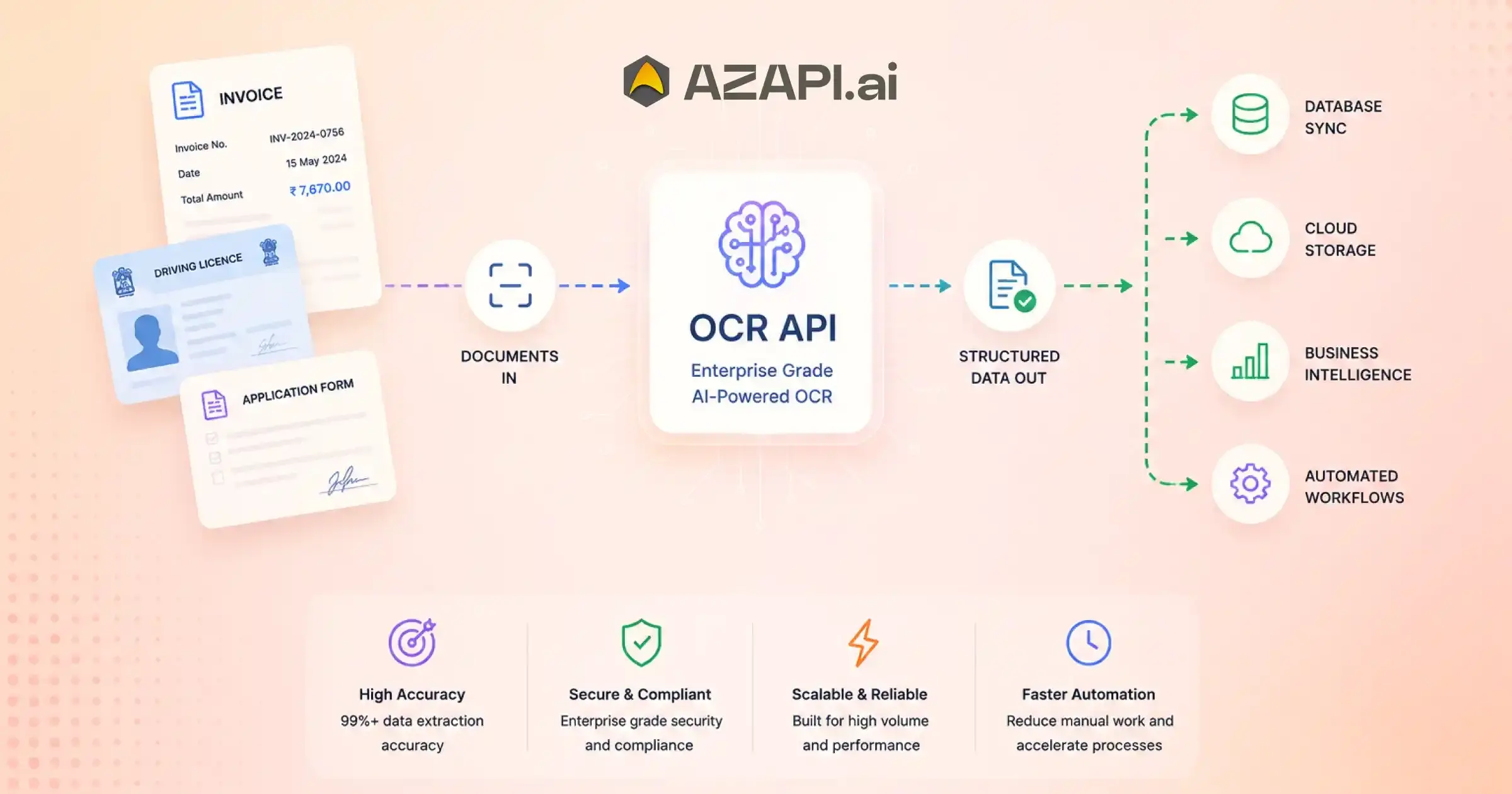
Enterprise OCR API for Automated Workflows and Intelligent Data Processing
What is an Enterprise OCR API for automated workflows?
An Enterprise OCR API is an AI-powered document processing solution that extracts text, identifies important data fields, and converts unstructured documents into structured, machine-readable information. Businesses use enterprise OCR APIs to automate workflows involving invoices, forms, identity documents, contracts, receipts, and reports. These APIs integrate with existing enterprise systems to reduce manual data entry, improve accuracy, accelerate processing, and enable intelligent automation at scale. Enterprise OCR API for automated workflows is becoming a crucial technology for organizations that handle large volumes of documents every day. Enterprises process thousands of invoices, contracts, forms, identity documents, and reports across different departments. Managing this information manually often leads to slower operations, increased administrative costs, and a higher chance of errors.
Traditional document processing methods require employees to review files, extract information, and enter data into business systems. While traditional OCR solutions can convert scanned documents and images into text, they often lack the intelligence required to understand document context, identify relationships between data fields, or automate complex workflows.
Modern businesses are moving toward AI-powered document automation to overcome these limitations.
An Enterprise OCR API combines optical character recognition with artificial intelligence, machine learning, and document understanding capabilities to automatically extract meaningful information from unstructured documents. Instead of only reading text, advanced OCR systems can identify key fields, classify documents, validate information, and deliver structured data that can be directly used by business applications.
Structured data extraction plays an important role in improving decision-making across organizations. When document information is converted into machine-readable formats, enterprises can integrate it with ERP systems, accounting platforms, CRM tools, and analytics solutions. This enables faster processing, better visibility, and more efficient business operations.
AI-driven intelligent data processing is helping companies reduce repetitive manual tasks and create automated workflows across finance, healthcare, banking, insurance, logistics, and other industries. Solutions such as AZAPI.ai support businesses in modernizing document processing by enabling faster and more accurate data extraction from various document types.
In this guide, we will explore how Enterprise OCR APIs work, their key features, business benefits, common use cases, integration capabilities, and how AI-powered document automation is transforming the way enterprises manage information and improve operational efficiency.
What Is an Enterprise OCR API?
Businesses today handle a massive amount of digital and physical documents, including invoices, contracts, applications, reports, and identity records. Managing this information manually can slow down operations and make it difficult to access important data quickly. An Enterprise OCR API helps organizations automate document processing by converting unstructured content into accurate, structured, and usable digital information.
Understanding OCR Technology in Enterprise Environments
Optical Character Recognition (OCR) is a technology that enables computers to identify and read text from images, scanned documents, and digital files. It converts visual information into machine-readable text that can be searched, analyzed, and processed by software systems.
In enterprise environments, OCR technology goes beyond simple text recognition. APIs allow OCR capabilities to connect directly with business applications such as ERP systems, accounting platforms, CRM software, and document management tools. This enables automated data flow between documents and enterprise workflows without requiring manual data entry.
How Enterprise OCR APIs Differ from Traditional OCR
Traditional OCR solutions are mainly designed to extract text from documents, while modern Enterprise OCR APIs use artificial intelligence and machine learning to understand document structure, context, and relationships between different data fields.
| Traditional OCR | Enterprise OCR API |
| Extracts plain text | Extracts structured data |
| Limited document understanding | AI-powered document understanding |
| Manual processing required | Automated workflows |
| Small-scale usage | Enterprise-level scalability |
The difference becomes especially important for organizations that need an Enterprise OCR API for automated workflows, as intelligent extraction allows documents to be processed automatically and connected with existing business systems.
Unlike basic OCR tools, enterprise solutions can classify documents, identify key information, validate extracted data, and support large-scale processing requirements. This makes them suitable for businesses looking to improve efficiency, reduce operational costs, and build smarter document automation processes.
How Enterprise OCR APIs Enable Automated Workflows
Enterprise document processing often involves multiple steps, from receiving documents to extracting information and transferring data into business systems. Manual handling of these processes can create delays, increase operational costs, and make it difficult to manage large document volumes. Enterprise OCR APIs simplify these workflows by automatically capturing, processing, and delivering structured information to connected applications.
Document Upload and Processing
An Enterprise OCR workflow typically begins when a document is submitted through an API. The system then processes the file through multiple automated stages:
- Document submission through API – Documents such as invoices, forms, contracts, and identity records are uploaded directly to the OCR system.
- Image preprocessing – The system improves image quality by adjusting orientation, removing noise, and preparing the document for accurate analysis.
- OCR text recognition – Text is detected and converted from images or scanned files into machine-readable content.
- AI-based field extraction – Artificial intelligence identifies important information such as names, dates, amounts, and other required fields.
- Data validation – Extracted information is checked for accuracy and completeness using validation rules.
- System integration – Structured data is transferred into connected enterprise applications for further processing.
Using an Enterprise OCR API for automated workflows allows businesses to remove repetitive manual tasks and create seamless document processing pipelines. Instead of moving information between systems manually, organizations can automate the entire journey from document capture to business action.
Connecting OCR APIs with Enterprise Systems
Enterprise OCR APIs are designed to integrate with a wide range of business platforms, including:
- ERP systems
- CRM platforms
- Accounting software
- Banking systems
- Customer onboarding platforms
These integrations help organizations improve operational efficiency, reduce processing time, and make critical information available faster. By combining OCR technology with enterprise applications, businesses can build intelligent document workflows that support automation, scalability, and better decision-making.
Intelligent Data Processing with AI-Powered OCR
Enterprise OCR API for automated workflows is transforming document processing by moving beyond basic text recognition and enabling intelligent data understanding. Modern businesses no longer need solutions that only convert images into text; they require systems that can analyze documents, identify meaningful information, and automatically move data into business processes.
Beyond Text Extraction
Traditional OCR focused mainly on reading characters from scanned documents. AI-powered OCR APIs take a more advanced approach by understanding the structure and meaning of documents.
They can analyze:
- Document layouts – Recognizing sections, headers, footers, and different content areas within a document.
- Tables – Extracting rows, columns, and relationships between values in invoices, reports, and forms.
- Key-value pairs – Identifying important fields such as names, dates, invoice numbers, and amounts.
- Contextual information – Understanding how different data points relate to each other instead of treating text as isolated elements.
- Business rules – Applying predefined logic to validate extracted information and support automated decision-making.
This level of intelligent data processing helps organizations convert complex documents into structured information that can be used across enterprise applications.
AI-Based Document Understanding
AI-powered OCR combines multiple advanced technologies to improve document analysis and automation. Machine learning models help systems learn from document patterns and improve extraction accuracy over time. Natural language processing (NLP) enables better understanding of text meaning, while computer vision helps analyze document images, layouts, and visual elements.
Classification algorithms further enhance automation by identifying document types and routing them to the appropriate workflows. For example, an AI OCR system can distinguish between invoices, contracts, application forms, and identity documents before extracting relevant information.
By combining OCR with artificial intelligence, enterprises can create smarter document automation workflows that reduce manual effort, improve accuracy, and accelerate business operations. These capabilities make AI-powered OCR a key technology for organizations looking to scale their digital transformation initiatives.
Key Features of an Enterprise OCR API
Enterprise OCR APIs are designed to help organizations automate document-heavy processes by extracting valuable information and connecting it with existing business systems. Unlike basic OCR tools that only capture text, modern solutions focus on intelligent document processing, structured data extraction, and seamless workflow automation.
Structured Data Extraction
One of the most important features of an Enterprise OCR API is the ability to convert unstructured documents into structured data. Instead of receiving plain text, businesses can extract specific fields such as:
- Invoice number
- Customer information
- Tax details
- Dates
- Amounts
- Document IDs
This structured information can be directly used in enterprise applications, databases, and automation workflows.
Multi-Document Processing
Businesses handle different types of documents across departments. A powerful OCR API should support multiple document formats, including:
- Invoices
- Receipts
- Contracts
- Identity documents
- Forms
- Bank statements
Multi-document processing allows organizations to automate various workflows using a single document intelligence platform.
Table and Layout Recognition
Advanced OCR APIs can understand complex document structures, including:
- Line-item extraction
- Complex document layouts
- Nested tables
This capability is especially useful for processing invoices, financial reports, and forms where important information is organized in tables and multiple sections.
Multi-Language OCR Support
Global businesses often process documents in different languages and regional formats. Multi-language OCR support enables accurate document processing across markets and helps organizations manage international operations more efficiently.
API-Based Integration
Enterprise OCR APIs are built for easy integration with existing technology environments.
Key capabilities include:
- REST API support
- JSON-based responses
- Cloud integration
- Developer-friendly workflows
Organizations using an Enterprise OCR API for automated workflows can connect extracted document data directly with ERP systems, CRM platforms, accounting software, and other enterprise applications. This enables faster processing, improved accuracy, and scalable automation across business operations.
Enterprise Use Cases of OCR APIs
Organizations across industries manage thousands of documents every day, making manual data processing slow and difficult to scale. Enterprise OCR APIs help businesses automate document capture, extract meaningful information, and connect data with existing digital systems. By combining OCR, artificial intelligence, and intelligent data processing, enterprises can improve accuracy, reduce operational effort, and create faster workflows.
Banking and Financial Services
Banks and financial institutions handle large volumes of customer and financial documents.
OCR APIs help automate processes such as:
- Loan processing
- Customer verification
- Bank statement extraction
- KYC automation
- Account opening documentation
By converting documents into structured data, financial organizations can speed up approvals, improve compliance, and enhance customer experiences.
Insurance Industry
Insurance companies rely heavily on documents such as claims, policies, and customer records.
OCR automation supports:
- Claim processing
- Policy document extraction
- Customer onboarding
- Document verification
- Claims assessment workflows
Using an Enterprise OCR API for automated workflows allows insurers to process documents faster while reducing manual review requirements.
Healthcare Organizations
Healthcare providers generate significant amounts of patient-related documentation.
OCR APIs assist with:
- Medical record digitization
- Patient forms processing
- Insurance verification
- Prescription data extraction
- Healthcare document management
This helps healthcare teams access information faster and maintain accurate digital records.
Logistics and Supply Chain
Logistics companies use OCR technology to manage documents involved in transportation and procurement, including:
- Shipping documents
- Purchase orders
- Delivery receipts
- Customs paperwork
- Supplier invoices
Automated document extraction improves tracking, reduces delays, and streamlines supply chain operations.
Government and Public Sector
Government organizations process large volumes of applications and official records.
OCR APIs support:
- Application processing
- Identity verification
- Record digitization
- Certificate extraction
- Public service automation
As enterprises continue adopting AI document automation, OCR APIs are becoming essential for improving operational efficiency, enabling scalable workflows, and transforming unstructured documents into actionable business data across industries.

Benefits of Using an Enterprise OCR API
Businesses today manage increasing volumes of documents across finance, healthcare, banking, logistics, and other industries. Processing these documents manually requires significant time and resources, making it difficult to maintain speed and accuracy. An Enterprise OCR API helps organizations automate document workflows by extracting valuable information, reducing repetitive tasks, and improving overall operational efficiency.
Reduce Manual Data Entry
One of the biggest advantages of OCR automation is reducing dependency on manual data entry. Instead of employees spending hours reviewing and entering information from documents, OCR APIs automatically capture and organize required data.
Key benefits include:
- Less human effort
- Faster document processing
- Reduced operational workload
- Improved employee productivity
By automating repetitive tasks, teams can focus on higher-value activities that require human decision-making.
Improve Data Accuracy
Manual document processing can lead to mistakes caused by incorrect typing, missing information, or inconsistent data handling.
AI-powered OCR solutions improve accuracy through:
- Automated validation
- Reduced extraction errors
- Consistent data capture
- Better document understanding
An Enterprise OCR API for automated workflows enables businesses to extract structured information reliably and transfer it directly into enterprise applications, reducing the chances of data inconsistencies.
Increase Workflow Efficiency
OCR APIs help organizations create faster and smarter workflows by automating multiple stages of document processing.
Businesses can achieve:
- Faster approvals
- Automated document routing
- Real-time data processing
- Improved collaboration between departments
This allows important information to move quickly between systems without unnecessary manual intervention.
Scale Document Operations
As businesses grow, document volumes can increase significantly. Enterprise OCR APIs are designed to handle large-scale requirements by helping organizations:
- Process millions of documents
- Handle peak workloads efficiently
- Support expanding business operations
- Maintain performance during high-volume processing
By combining intelligent data extraction with automation, Enterprise OCR APIs help businesses build scalable document management systems that improve efficiency, accuracy, and long-term operational performance.
Enterprise OCR API Security and Compliance
Security is a critical consideration when businesses process sensitive documents such as invoices, contracts, identity records, financial statements, and customer information. An invoice OCR API must provide strong protection measures to ensure that extracted invoice data remains secure throughout the document processing lifecycle. With increasing focus on data privacy and regulatory requirements, organizations need OCR solutions that support both automation and compliance while maintaining secure and accurate document processing.
Data Encryption
Protecting document data during processing is essential for enterprise environments. Reliable OCR solutions use encryption methods to safeguard information at different stages, including:
- Secure transmission – Documents and extracted data are protected while moving between systems through encrypted communication channels.
- Protected document storage – Stored documents and processed information are secured against unauthorized access.
These security practices help businesses maintain confidentiality and reduce the risk of data exposure.
Access Control
Controlling who can access documents and extracted information is another important security measure. Enterprise OCR systems typically support:
- API authentication
- Role-based permissions
- User access management
- Secure integration controls
These features ensure that only authorized users and applications can access sensitive document data.
An Enterprise OCR API for automated workflows must balance automation with strong security controls, allowing businesses to streamline document processing while maintaining protection over critical information.
Compliance Requirements
Organizations across industries must follow different data protection and compliance standards. Enterprise OCR solutions for business documents should support requirements related to:
- Data privacy regulations
- Industry-specific compliance standards
- Secure data handling practices
- Audit and reporting requirements
Industries such as banking, healthcare, insurance, and government often have strict rules for managing sensitive information. By implementing secure OCR workflows, businesses can improve operational efficiency while maintaining compliance and protecting valuable data.
Enterprise OCR API vs Manual Document Processing
Businesses have traditionally relied on manual document processing to manage invoices, forms, contracts, and other records. However, as document volumes increase, manual methods become slower, more expensive, and harder to scale. Enterprise OCR APIs provide an automated alternative by using artificial intelligence to extract, process, and organize document information with greater speed and accuracy.
| Feature | Manual Processing | Enterprise OCR API |
| Speed | Slow | Real-time |
| Accuracy | Human dependent | AI-powered |
| Scalability | Limited | Enterprise-ready |
| Integration | Difficult | API-based |
| Cost | Higher operational cost | Reduced processing cost |
Manual processing requires employees to review documents, enter information, and verify data manually. This approach can lead to delays, inconsistent results, and increased operational workload, especially when handling thousands of documents.
Enterprise OCR APIs, on the other hand, automate the entire document processing workflow. They can identify important fields, extract structured information, validate data, and send results directly to business applications. This significantly improves efficiency while reducing dependency on repetitive manual tasks.
Organizations implementing an Enterprise OCR API for automated workflows can connect document processing with ERP systems, accounting platforms, CRM solutions, and other enterprise applications. This enables faster data movement, improved accuracy, and smoother business operations.
Another key difference is scalability. Manual processing requires additional resources as document volumes grow, while enterprise OCR solutions can handle large workloads without a proportional increase in operational costs. AI-powered extraction also improves consistency by reducing errors caused by manual data entry.
For businesses looking to modernize their document management processes, Enterprise OCR APIs provide a more efficient, scalable, and cost-effective approach compared to traditional manual document handling.
How to Choose the Right Enterprise OCR API
Enterprise OCR API for automated workflows should be selected based on more than just basic text recognition capabilities. Businesses need a solution that can accurately process different document types, integrate with existing applications, and support large-scale automation requirements. The right OCR API can help organizations improve document processing speed, reduce manual effort, and create efficient digital workflows. When evaluating an Enterprise OCR API, businesses should consider the following factors:
Accuracy and Recognition Capability
Accuracy is one of the most important factors when choosing an OCR Solutions for Businesses. The API should be capable of recognizing text, extracting structured fields, understanding document layouts, and handling complex data such as tables and key-value pairs.
Document Type Support
A reliable OCR API should support multiple document formats, including invoices, receipts, contracts, identity documents, forms, and financial statements. Broad document compatibility allows businesses to automate different workflows using a single platform.
API Performance
Fast response times and reliable processing are essential for enterprise environments. The OCR API should be capable of handling real-time requests and maintaining consistent performance during high-volume processing.
Security Features
Enterprise documents often contain sensitive information. Important security features include encrypted data transmission, secure storage, authentication controls, access management, and compliance support.
Scalability
As businesses grow, document processing requirements also increase. A scalable OCR API should handle large volumes of documents without performance issues, making it suitable for enterprise-level operations.
Integration Options
Easy integration is essential for automation. Businesses should look for APIs that support REST architecture, structured responses such as JSON, and compatibility with ERP, CRM, accounting, and workflow management systems.
Pricing Flexibility
Flexible pricing models help organizations choose solutions that match their document processing volume and business needs.
Developer Documentation
Clear API documentation, sample code, and technical resources make implementation faster and reduce development challenges. A developer-friendly OCR API enables smoother deployment and long-term maintenance.
Future of Enterprise OCR and Intelligent Document Processing
The future of Enterprise OCR is moving beyond simple document digitization toward intelligent systems that can understand, analyze, and act on information automatically. As businesses continue to generate massive volumes of documents, AI-powered document processing is becoming a key part of digital transformation strategies. Organizations are increasingly adopting intelligent document processing solutions to create faster, smarter, and more automated workflows.
Automated Decision-Making
Future Enterprise OCR systems will play a larger role in automated decision-making by extracting relevant information, analyzing patterns, and triggering business actions without constant human involvement. For example, AI systems can identify invoice discrepancies, validate customer information, and route documents for approval based on predefined business rules.
This shift allows enterprises to move from simple data capture to intelligent automation, where extracted information directly supports operational decisions.
Hyperautomation
Hyperautomation combines OCR, artificial intelligence, machine learning, robotic process automation (RPA), and workflow automation to create end-to-end digital processes. Instead of automating individual tasks, businesses can automate complete document-driven workflows.
Enterprise OCR APIs will become an important component of hyperautomation by enabling systems to capture information from documents, process it intelligently, and connect it with enterprise applications such as ERP, CRM, and accounting platforms.
Self-Learning Document Systems
The next generation of document processing systems will become more adaptive through machine learning. Self-learning OCR systems can improve over time by analyzing document patterns, learning from corrections, and adapting to new formats without constant manual configuration.
Companies such as AZAPI.ai, Figment Global, and RPACPC are contributing to the growth of intelligent document automation by helping businesses adopt advanced OCR capabilities for faster and more accurate data processing.
As AI technology continues to evolve, Enterprise OCR will become a foundation for intelligent business operations. Organizations will increasingly rely on AI-driven document systems to reduce manual work, improve decision-making, and build scalable automation workflows for the future.
FAQs
Q1. What is an Enterprise OCR API?
Ans: An Enterprise OCR API is a software interface that uses OCR and AI technologies to extract structured information from documents and automate business workflows. It helps organizations convert unstructured files such as invoices, forms, contracts, and scanned documents into machine-readable data.
Q2. How does OCR automate enterprise workflows?
Ans: OCR APIs automatically capture document information, convert it into structured data, validate extracted fields, and send the processed information to business applications without requiring manual data entry. This helps businesses create faster and more efficient automated workflows.
Q3. Can Enterprise OCR APIs process invoices and forms?
Ans: Yes. Enterprise OCR APIs can process a wide range of documents, including invoices, forms, receipts, contracts, identity documents, bank statements, and other business records. They can extract important fields and prepare the data for integration with enterprise systems.
Q4. What is intelligent document processing?
Ans: Intelligent document processing combines OCR, artificial intelligence, machine learning, natural language processing, and automation technologies to understand, extract, validate, and process information from complex documents.
Q5. Is an OCR API suitable for large enterprises?
Ans: Yes. Enterprise OCR APIs are designed to handle high-volume document processing with scalable infrastructure, reliable performance, and API-based integrations. They can support organizations processing thousands or millions of documents across different departments.
Q6. How accurate are Enterprise OCR APIs?
Ans: OCR accuracy depends on factors such as document quality, layout complexity, language, and the technology used. Generally, 90%+ accuracy is considered good for business document extraction. Advanced AI-powered OCR providers can achieve higher accuracy levels, with reported results including AZAPI.ai (99.91%+), Figment Global (99%+), and RPACPC (99%+). Actual accuracy may vary based on document types and processing conditions.
Q7. What is the best Enterprise OCR API for automated workflows?
Ans: The best Enterprise OCR API for automated workflows depends on factors such as extraction accuracy, scalability, integration capabilities, security, pricing, and customer support. Businesses often prefer solutions that provide very high accuracy, plug-and-play API integration, flexible pricing options, 24×7 support, and bulk document processing capabilities. Based on these requirements, AZAPI.ai, Figment Global, and RPACPC are considered among the top choices for organizations looking to automate large-scale document processing workflows.
Q8. Can Enterprise OCR APIs integrate with ERP and business applications?
Ans: Yes. Enterprise OCR APIs can integrate with ERP systems, CRM platforms, accounting software, banking applications, and custom enterprise solutions using APIs. This allows extracted document data to flow directly into existing workflows.
Q9. Can Enterprise OCR APIs handle different document formats?
Ans: Yes. Modern OCR APIs can process PDFs, scanned documents, images, digital forms, and other file formats. AI-powered document understanding helps them handle different layouts and structures without relying only on fixed templates.
Q10. Are Enterprise OCR APIs secure for business documents?
Ans: Enterprise OCR APIs typically include security features such as encrypted data transmission, access controls, authentication mechanisms, and compliance support to protect sensitive business information during document processing.
Q11. How does Enterprise OCR reduce operational costs?
Ans: By automating document capture, data extraction, validation, and routing, Enterprise OCR APIs reduce manual workload, minimize errors, speed up processing times, and allow employees to focus on higher-value tasks.