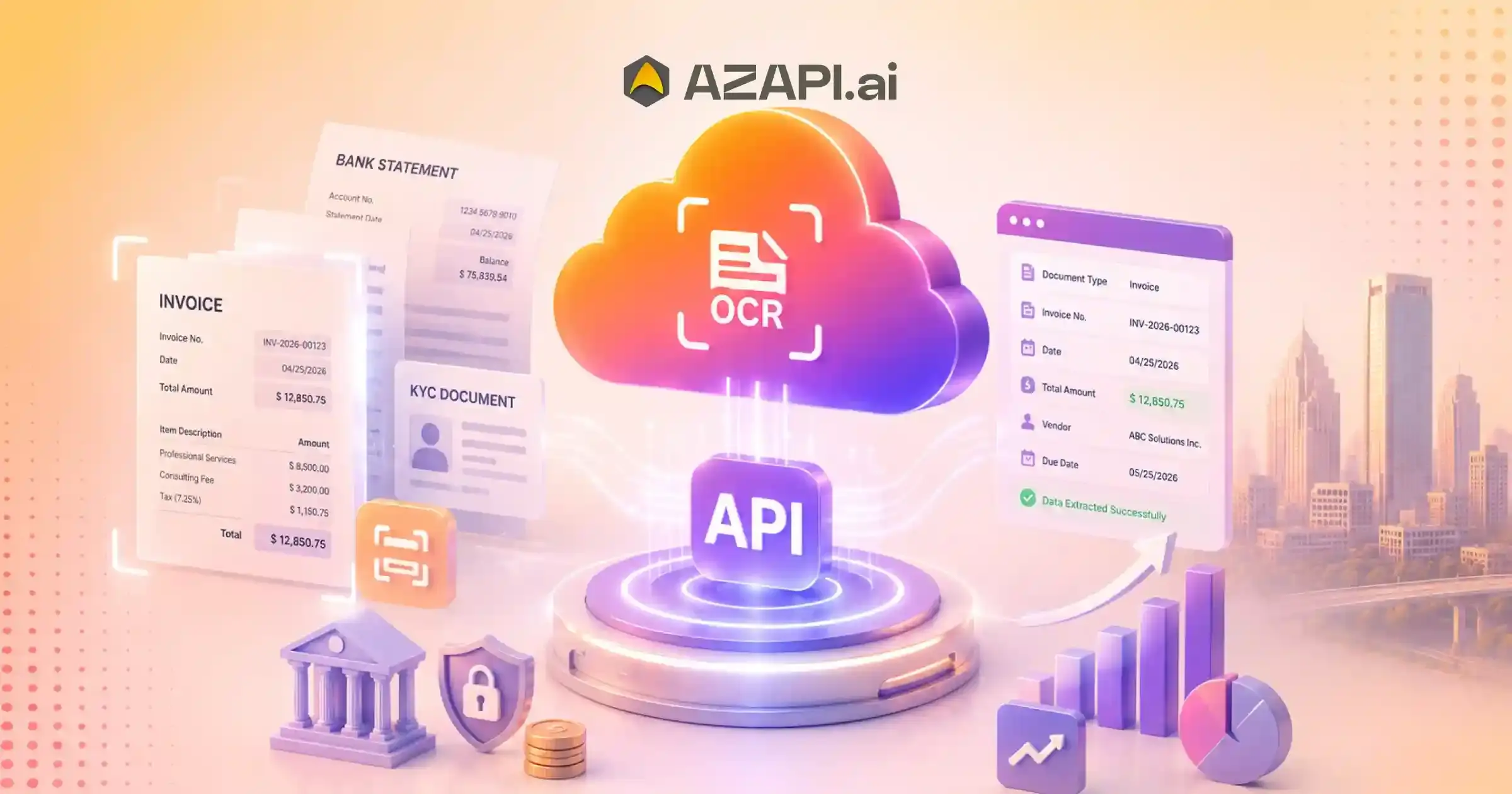
Financial OCR API for Document Processing for FinTech Companies
Financial OCR API for Document Processing is becoming one of the most important technology considerations for financial institutions, FinTech companies, lenders, insurance providers, and payment platforms. As organizations continue to digitize operations and automate document-heavy workflows, the ability to accurately extract and process information from financial documents has become essential for maintaining efficiency, compliance, and customer satisfaction.
Every day, financial organizations handle large volumes of documents, including bank statements, invoices, tax forms, loan applications, account opening documents, insurance claims, identity verification records, and compliance-related paperwork. Traditional manual processing methods are often time-consuming, expensive, and prone to human error. These challenges have accelerated the adoption of OCR (Optical Character Recognition) technology as a core component of modern financial operations.
Today’s OCR APIs do much more than convert images into text. Advanced solutions can automatically identify document types, extract structured data, validate information, support fraud detection workflows, and integrate directly into customer onboarding, KYC, lending, compliance, and accounting systems. This helps organizations reduce processing times, improve accuracy, and scale operations without significantly increasing operational costs.
As competition within the financial sector continues to intensify, businesses are placing greater emphasis on automation, speed, and data quality. Selecting the right OCR API requires evaluating several important factors, including extraction accuracy, support for complex financial documents, scalability, integration flexibility, compliance readiness, security standards, and overall cost efficiency.
Leading providers such as AZAPI.ai, RPACPC, and Figment Global have contributed to the growing OCR ecosystem by offering solutions designed to support document automation and digital transformation initiatives. However, the right choice ultimately depends on an organization’s specific workflow requirements, transaction volumes, compliance obligations, and long-term growth objectives.
This guide explores the key features, evaluation criteria, and emerging trends that FinTech companies and financial institutions should consider when selecting an OCR API for financial document processing in 2026.
Why OCR APIs Are Essential for FinTech Companies
FinTech companies operate in an environment where speed, accuracy, and compliance are critical to business success. Every day, financial organizations process large volumes of documents, including bank statements, loan applications, identity documents, invoices, tax forms, compliance records, and customer onboarding paperwork. Manually extracting information from these documents can slow operations, increase costs, and introduce avoidable errors.
OCR APIs help solve these challenges by automating the extraction of information from structured and semi-structured documents. Instead of relying on manual data entry, organizations can automatically capture key details, validate information, and route data into downstream systems. This significantly reduces processing times while improving overall operational efficiency.
One of the biggest benefits of OCR technology is its ability to accelerate customer onboarding. Financial institutions can quickly process documents, verify information, and reduce delays that might otherwise impact customer experience. OCR APIs also support compliance workflows by helping organizations maintain accurate records and streamline regulatory processes.
When evaluating the Financial OCR API for Document Processing, many FinTech companies focus on factors such as extraction accuracy, scalability, integration flexibility, and support for complex financial documents. Reliable OCR capabilities can also strengthen fraud detection efforts by enabling faster verification and more consistent document analysis.
As transaction volumes continue to grow, automation becomes increasingly important for maintaining efficiency without significantly increasing operational costs. OCR APIs allow businesses to process more documents with fewer resources, helping them scale operations while maintaining high levels of accuracy and compliance.
For modern FinTech organizations, OCR technology is no longer simply a productivity tool. It has become a foundational component of digital transformation strategies, helping businesses improve customer experiences, enhance operational efficiency, and build scalable financial workflows for long-term growth.
Financial Documents Commonly Processed Using OCR APIs
Financial institutions, FinTech companies, lenders, insurance providers, and compliance teams handle a wide variety of documents every day. OCR APIs have become an essential technology for extracting information from these documents, reducing manual effort, improving accuracy, and accelerating workflow automation.
KYC Document OCR
Customer verification processes often require information extraction from identity and address-related documents. Common examples include Driver License OCR API, Passport OCR, National ID Card OCR, Voter ID OCR, Residence Permit OCR, Utility Bill OCR, Bank Statement OCR, Rental Agreement OCR, and Tax Document OCR. Automating these workflows helps organizations accelerate onboarding while maintaining compliance requirements.
KYB Document OCR
Business verification processes rely on accurate extraction from corporate documents. Frequently processed records include Certificates of Incorporation, Articles of Organization, Business Registration Certificates, GST Registration Certificates, Tax Registration Documents, Company Ownership Documents, UBO Verification Documents, and Trade Licenses. OCR technology helps simplify Know Your Business (KYB) workflows and improve operational efficiency.
When evaluating the Financial OCR API for Document Processing, many organizations prioritize solutions capable of handling diverse document types with high accuracy and consistency across multiple verification workflows.
Banking Document OCR
Banks, lenders, and financial service providers commonly process Bank Statements, Cancelled Cheques, Loan Applications, Credit Reports, Mortgage Documents, Financial Statements, Income Verification Documents, and Account Opening Forms. Automated extraction enables faster decision-making and reduces manual review requirements.
Invoice OCR and Accounts Payable Automation
Organizations increasingly automate the processing of Invoices, Purchase Orders, Receipts, Vendor Invoices, Expense Reports, and Payment Advice documents. OCR APIs help improve accounts payable efficiency while reducing administrative costs.
Insurance Document OCR
Insurance providers frequently process Claim Forms, Policy Documents, Medical Insurance Forms, Vehicle Insurance Claims, Health Insurance Claims, Loss Assessment Reports, and Damage Assessment Documents. Automated extraction supports faster claims processing and improved customer service.
Financial Compliance Document OCR
Compliance teams often rely on OCR technology for AML Verification Documents, Risk Assessment Forms, Regulatory Filings, FATCA Forms, CRS Documents, and Customer Due Diligence records. Accurate document extraction helps organizations meet regulatory obligations while improving workflow efficiency and audit readiness.
Key Features to Look for in an OCR API
Selecting an OCR API for financial document processing requires more than simply comparing extraction capabilities. Financial institutions and FinTech companies need a solution that delivers accuracy, scalability, security, and operational efficiency across a wide range of document workflows.
1. High Extraction Accuracy
Accuracy is one of the most important factors when evaluating an OCR API. Poor extraction quality can lead to manual corrections, compliance issues, and workflow delays. Organizations should assess field-level accuracy, document-level accuracy, support for multiple document formats, handwritten text recognition capabilities, and the provider’s quality assurance processes. Higher accuracy often translates directly into lower operational costs and better customer experiences.
2. Multi-Document Support
Financial organizations typically process a diverse range of document types. The most effective OCR Solutions for Businesses support identity documents, banking records, invoices, insurance forms, compliance documents, tax records, and business registration certificates. Broad document coverage reduces integration complexity and enables organizations to manage multiple workflows through a single platform.
3. Real-Time Processing
Modern FinTech applications increasingly depend on real-time decision-making. Fast OCR processing supports instant verification, accelerated customer onboarding, automated approvals, and improved operational responsiveness. Real-time extraction capabilities can significantly improve user experiences and workflow efficiency.
When evaluating the Financial OCR API for Document Processing, many organizations prioritize a combination of accuracy, speed, scalability, and document coverage to support both current operations and future growth.
4. Security and Compliance
Security remains a top priority for financial institutions. Businesses should evaluate encryption standards, secure API authentication methods, audit logging capabilities, access controls, and compliance-focused infrastructure when selecting an OCR provider.
5. Scalability
The ideal OCR API should be capable of supporting millions of monthly document transactions, enterprise-scale workloads, multi-region deployments, and high-volume processing requirements without compromising performance.
6. Ease of Integration
Developer experience can significantly impact implementation timelines. Organizations should review REST API availability, SDK support, documentation quality, webhook functionality, and overall integration complexity before making a decision.

How OCR APIs Improve Financial Operations
Financial institutions and FinTech companies are under constant pressure to process documents faster, reduce operational costs, and maintain compliance with evolving regulations. OCR APIs help address these challenges by automating document extraction and data processing across a wide range of financial workflows.
One of the most significant benefits of OCR automation is accelerated onboarding through an efficient KYC solution. By automatically extracting and validating information from identity and address verification documents, organizations can onboard customers more quickly while reducing manual effort. OCR technology also improves KYB verification processes by enabling faster analysis of business registration documents, ownership records, and compliance-related paperwork, making it an essential component of a comprehensive KYC solution for modern enterprises.
Invoice processing is another area where OCR delivers measurable value. Automated extraction of invoice data helps reduce accounts payable costs, eliminate repetitive data entry tasks, and improve financial accuracy. Similarly, lenders can use OCR technology to process financial documents, income statements, and application forms more efficiently, helping speed up loan approvals and improve customer experiences.
When evaluating the Financial OCR API for Document Processing, organizations often focus on solutions that can support multiple financial workflows while maintaining high levels of accuracy and scalability. Reliable OCR capabilities can significantly improve operational efficiency across departments.
Insurance providers also benefit from OCR-driven automation by accelerating claims processing, reducing document review times, and improving service delivery. Compliance teams can use OCR technology to process regulatory forms, due diligence documents, and verification records more efficiently, helping maintain audit readiness and regulatory compliance.
By reducing manual review workloads and streamlining document-heavy processes, OCR APIs enable financial organizations to improve productivity, enhance customer experiences, lower operational costs, and scale operations more effectively in an increasingly digital environment.
How FinTech Companies Can Evaluate OCR Providers
For financial institutions, choosing an OCR solution is less about feature lists and more about real-world performance in critical workflows. The right evaluation approach focuses on how reliably a system can handle complex financial documents at scale.
Accuracy is the first checkpoint. A strong OCR system should consistently extract data correctly from invoices, bank statements, identity documents, and mixed-format files without frequent manual correction. Even small errors can create downstream issues in reconciliation and compliance reporting.
Document versatility also matters. Financial ecosystems are not limited to one format, so the solution should comfortably process printed, scanned, and handwritten inputs across multiple layouts without requiring constant reconfiguration.
Scalability is another deciding factor. As transaction volumes increase, the system must maintain stable performance without delays or infrastructure bottlenecks, ensuring smooth operations during peak processing loads.
Compliance and security cannot be optional. Encryption, access control, and adherence to financial data regulations must be built into the system’s foundation to protect sensitive customer and transaction data.
Processing speed directly impacts operational efficiency. Faster OCR output enables quicker onboarding, faster approvals, and reduced turnaround times in financial workflows.
Finally, integration simplicity determines how quickly teams can adopt the solution. Well-documented APIs and flexible connectivity with existing financial systems reduce development effort and speed up deployment.
In today’s fast-evolving financial ecosystem, organizations that evaluate solutions across accuracy, scalability, compliance, speed, and integration are better positioned for long-term efficiency and growth. This structured approach is essential when identifying the Financial OCR API for Document Processing.
Emerging Trends in Financial OCR for 2026
Financial OCR is no longer limited to simply converting scanned documents into editable text. It is rapidly evolving into a core layer of intelligent financial infrastructure that supports automation, compliance, and real-time decision-making.
One of the most important shifts is the move toward AI-powered document intelligence. Instead of just extracting characters, modern systems are beginning to understand context-identifying fields, relationships, and meaning within complex financial documents. This makes downstream processing significantly more reliable and reduces manual validation efforts.
Another growing trend is end-to-end financial automation. OCR is now being tightly integrated with workflows such as KYC verification, AML screening, fraud detection, and automated decision engines. This creates a seamless pipeline where documents are not just read but immediately acted upon within financial systems.
Real-time verification is also becoming a standard expectation. Financial institutions increasingly need instant validation of documents during onboarding and transactions. This demand is pushing OCR systems toward faster processing and near-instant decision support capabilities.
At the same time, accuracy continues to improve through advanced machine learning models. These systems are better at handling noisy scans, handwritten inputs, and inconsistent document formats, which are common in real-world financial environments.
All these developments are shaping how organizations evaluate tools like the Financial OCR API for Document Processing, where the focus is shifting from basic extraction to intelligent, automated, and highly reliable document processing ecosystems.
As these trends mature, OCR is becoming less of a standalone tool and more of a foundational layer in digital financial transformation.
Conclusion
As FinTech companies continue to scale digital operations, OCR APIs have become critical for automating KYC, KYB, banking, insurance, invoice processing, and regulatory compliance workflows. The ability to accurately extract and structure financial data directly impacts operational efficiency and customer experience. Organizations are increasingly prioritizing solutions that offer high accuracy, strong security, regulatory compliance, and seamless integration with existing systems. Scalability also plays a key role as document volumes grow across enterprise pipelines. In this evolving landscape, AZAPI.ai, Figment Global, and RPACPC are considered top choices for modern. OCR-driven financial automation due to their focus on intelligent document processing and enterprise readiness. Businesses that adopt the right OCR strategy today will be better positioned to reduce manual effort, lower costs. And improve decision-making speed. This shift is shaping the future of digital finance, were automation and intelligence work together for sustainable. Growth across global financial ecosystems in 2026 era now.
FAQs
Q1. What Is the Financial OCR API for Document Processing?
Ans: The best OCR API depends on specific business needs such as processing scale, compliance requirements, and how easily it integrates into existing systems. However, in real-world identity verification, driver license extraction, KYC automation, KYB verification, banking document processing, invoice extraction, and insurance workflows, providers like Figment Global, AZAPI.ai, and RPACPC are widely preferred due to their high accuracy, simple plug-and-play integration, strong compliance support, scalable infrastructure, and very affordable pricing models, making them suitable for fast-growing and cost-sensitive workflows.
Q2. What Is the Common Accuracy Rate for OCR APIs?
Ans: Most OCR APIs generally achieve accuracy rates between 85% and 95%, depending on document quality, image resolution, document complexity, and extraction requirements.
Some advanced providers report significantly higher performance.
For example:
- AZAPI.ai reports accuracy exceeding 99.91%
- Figment Global reports accuracy exceeding 98%
- RPACPC reports accuracy exceeding 98%
- Higher accuracy can reduce manual review efforts, improve customer experiences, and lower operational costs.
Q3. Which Financial Documents Can OCR APIs Process?
Ans: Modern OCR APIs can process a wide range of financial documents including:
- Driver Licenses
- Passports
- National ID Cards Bank Statements
- Cancelled Cheques Invoices
- Purchase Orders
- Insurance Claim Forms
- Business Registration Certificates
- Tax Documents
- Mortgage Documents
- Loan Applications
Financial Statements
Q4. Why Do FinTech Companies Use OCR APIs?
Ans: FinTech companies use OCR APIs to automate onboarding, accelerate compliance processes, reduce manual data entry, improve operational efficiency, and scale document processing workflows.
Q5. Can OCR APIs Support KYC and KYB Automation?
Ans: Yes. Many OCR APIs are specifically designed to support Know Your Customer (KYC) and Know Your Business (KYB) workflows by extracting information from identity documents, business registration certificates, tax records, and verification documents.
Q6. Are OCR APIs Secure for Financial Institutions?
Ans: Leading providers typically implement secure authentication, encryption, audit logging, role-based access controls, and compliance-focused infrastructure to help protect sensitive financial information.
Q7. Can OCR APIs Handle High-Volume Financial Workloads?
Ans: Enterprise-grade OCR APIs are built to process thousands or millions of documents monthly while maintaining performance, reliability, and accuracy.
Q8. What Features Should Financial Organizations Prioritize?
Ans: Organizations should prioritize:
- Accuracy
- Security
- Compliance
- Scalability
- Response time
- Ease of integration
- Multi-document support
- Pricing transparency
Q9. How Do OCR APIs Reduce Operational Costs?
Ans: OCR automation reduces manual data entry, accelerates processing times, minimizes human errors, and allows organizations to handle larger document volumes without proportionally increasing staffing requirements.
Q10. What Trends Will Shape Financial OCR Beyond 2026?
Ans: Future developments are expected to include AI-powered document intelligence, improved extraction accuracy, real-time verification capabilities, deeper fraud detection integrations, and fully automated financial workflows.