How AI Captcha Solver APIs Work: Complete Guide to Automated CAPTCHA Recognition
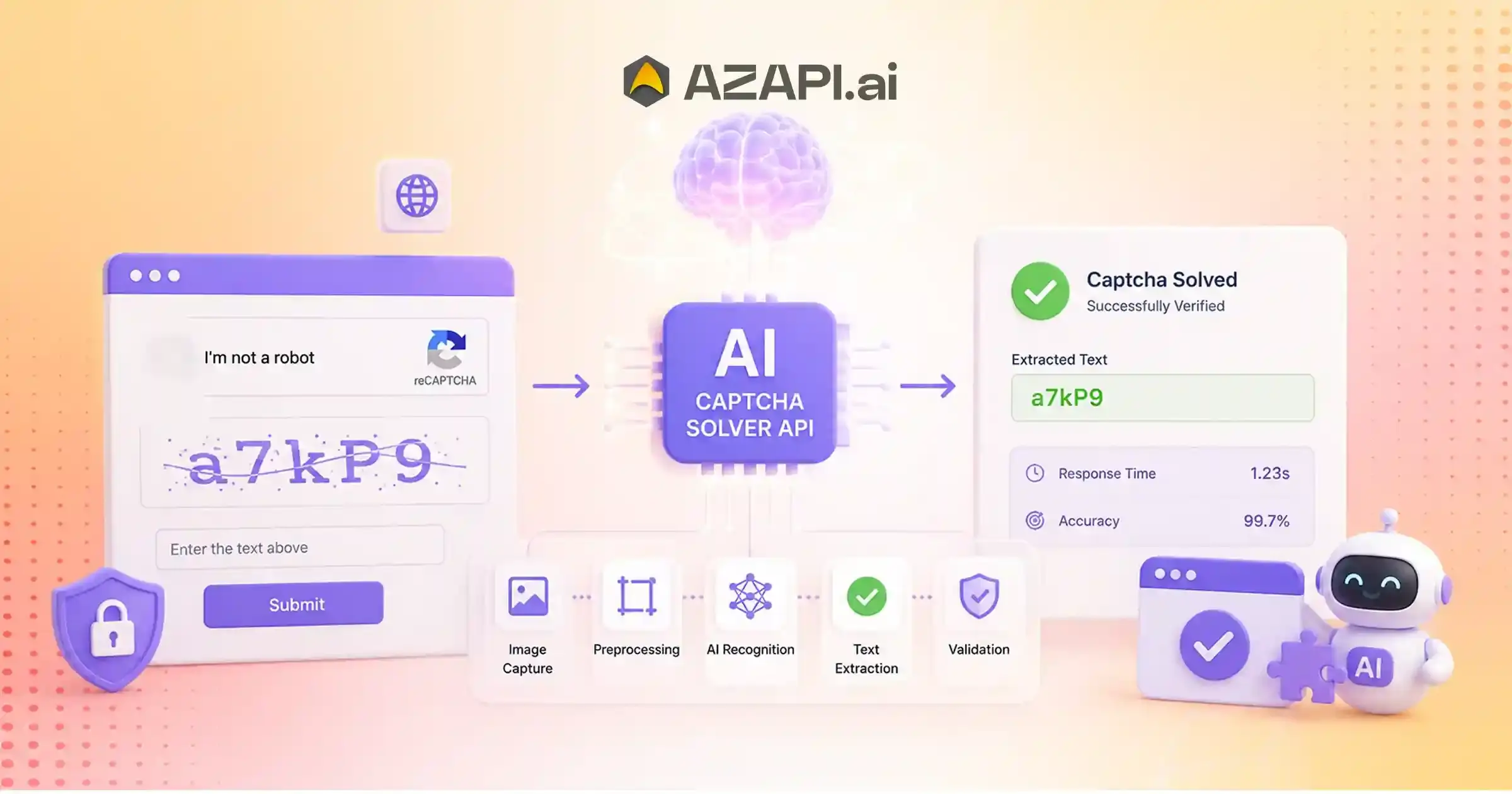
AI Captcha Solver APIs use artificial intelligence, computer vision, and OCR technologies to analyze and process CAPTCHA challenges automatically. These APIs identify CAPTCHA patterns, extract required information and return structured responses through an API. AI-powered CAPTCHA recognition systems are designed to improve automation workflows by reducing manual intervention and enabling faster document and image recognition processes. How AI CAPTCHA solver APIs Work is becoming an important topic as businesses look for faster and more reliable ways to handle CAPTCHA-based verification challenges. CAPTCHAs were created to protect websites and online platforms from automated abuse, spam, fake registrations, and malicious bot activity. By asking users to complete image challenges, text recognition tasks, or interactive verification steps, CAPTCHAs help distinguish between genuine users and automated programs.
However, CAPTCHAs can also create challenges for legitimate businesses that depend on automated workflows.
Applications that require frequent data access, testing, account verification, or large-scale processing may face interruptions when CAPTCHA challenges appear unexpectedly. Manual CAPTCHA solving slows down operations, increases dependency on human effort, and makes automated systems less efficient.
Over time, CAPTCHA processing has evolved from traditional manual solving methods to advanced AI-powered recognition systems. Modern solutions combine artificial intelligence, optical character recognition (OCR), machine learning, and computer vision to analyze CAPTCHA challenges and identify patterns more effectively. Instead of simply reading characters, AI models can understand visual elements, detect objects, process complex images, and improve performance through continuous learning.
AI-powered CAPTCHA Solver API provide businesses with a way to integrate automated CAPTCHA recognition into their workflows. These APIs allow applications to send CAPTCHA data, process it through AI models, and receive structured responses that can be used within automated systems. Platforms such as AZAPI.ai are helping businesses explore AI-based CAPTCHA processing solutions designed for faster and more efficient workflows.
This guide explains how AI CAPTCHA solver APIs function, how OCR and computer vision contribute to CAPTCHA recognition, the different types of CAPTCHA challenges AI can process, key implementation considerations, and how businesses can evaluate AI-powered solutions for their automation needs.
Understanding CAPTCHA Technology
CAPTCHA systems are designed to protect websites and online platforms from unwanted automated activity. They act as a verification layer that helps determine whether an interaction is coming from a real person or an automated program. By adding a small challenge before allowing access to certain actions, websites can reduce misuse while keeping online services more secure.
Why Websites Use CAPTCHA
Prevent Automated Abuse
Bots are often used to perform actions such as creating fake accounts, scraping information, or sending automated requests at high volumes. CAPTCHA helps limit these activities by introducing verification steps that are difficult for basic automated scripts to complete.
Reduce Spam Submissions
Online forms, comment sections, registration pages, and contact systems are common targets for spam. CAPTCHA verification helps filter out automated submissions, allowing businesses to maintain cleaner and more reliable user interactions.
Protect Online Services
Websites use CAPTCHA to defend important resources from excessive automated traffic. It helps reduce risks such as unauthorized access attempts, automated attacks, and service disruptions caused by large numbers of bot-generated requests.
Verify Human Interaction
The primary purpose of CAPTCHA is to confirm that a user interaction is genuine. Traditional CAPTCHAs rely on tasks like reading distorted text, selecting images, or identifying objects, while newer systems use more advanced behavioral and risk-based analysis.
As digital platforms continue to grow, businesses are looking for ways to balance security with smooth automation. Understanding how AI Captcha Solver APIs Work helps explain how modern AI technologies analyze CAPTCHA challenges using techniques such as OCR, image recognition, and computer vision while supporting more efficient digital workflows.
Modern CAPTCHA technology continues to evolve, focusing on stronger protection methods while improving user experience and reducing unnecessary friction.
Evolution of CAPTCHA Systems
As online threats have become more sophisticated, CAPTCHA systems have continuously evolved to stay ahead of automated programs. How AI CAPTCHA solver APIs work is closely connected to this evolution, as modern CAPTCHA challenges are designed to test advanced AI capabilities while security systems use newer technologies to improve protection against automated abuse.
Text CAPTCHA
Early CAPTCHA systems relied on distorted text images where users had to identify and enter characters manually. These challenges were effective against simple bots because automated programs struggled to recognize unclear fonts, overlapping characters, and background noise.
Image CAPTCHA
As text recognition technology improved, websites introduced image-based CAPTCHAs. Users were asked to identify objects, select specific images, or complete visual tasks. These challenges shifted the focus from character recognition to image understanding, making them harder for traditional scripts to solve.
OCR-Based Challenges
With advancements in optical character recognition (OCR), many older text-based CAPTCHAs became easier for automated systems to process. CAPTCHA providers responded by increasing complexity through distorted layouts, dynamic patterns, unusual fonts, and additional visual elements designed to challenge machine recognition.
AI-Generated Challenges
Modern CAPTCHA systems increasingly use AI-generated content, dynamic images, and context-based tasks. These challenges are designed to test advanced computer vision capabilities by introducing variations that require more in-depth understanding rather than simple pattern matching.
Modern Verification Systems
Today’s AI-Powered CAPTCHA Solutions are moving beyond visible puzzles. Modern verification systems often analyze user behavior, device signals, interaction patterns, and risk factors to determine whether an activity appears human or automated. Some systems provide invisible verification experiences that reduce friction for genuine users.
The increasing complexity of CAPTCHA systems reflects the ongoing competition between security technologies and AI advancements. As AI becomes better at understanding images, text, and patterns, CAPTCHA systems continue to evolve with more intelligent verification methods designed to protect online platforms.
What Is an AI CAPTCHA Solver API?
An AI CAPTCHA Solver API is a software interface that uses artificial intelligence to analyze and process CAPTCHA challenges automatically. Instead of requiring users or operators to manually solve verification tasks, the API uses AI models to recognize patterns, interpret images, and generate responses that can be used within automated workflows.
A CAPTCHA Solver API acts as a bridge between an application and an AI recognition system. It receives CAPTCHA-related input, processes the challenge using technologies such as computer vision and machine learning, and returns a structured response that applications can understand.
Role of Artificial Intelligence
Artificial intelligence enables CAPTCHA APIs to analyze visual information, identify objects, recognize characters, and understand complex image patterns. AI models improve their recognition capabilities by learning from different CAPTCHA formats and variations.
API-Based Automation
An API-based approach allows businesses and developers to connect CAPTCHA processing capabilities directly into their applications. Instead of building recognition systems internally, applications can communicate with an external AI service and receive automated responses through standardized API requests.
Image Recognition Capabilities
Modern AI CAPTCHA systems use computer vision techniques to analyze image-based challenges. They can identify visual elements, detect patterns, and process complex image structures that require more in-depth understanding than traditional text recognition.
Structured API Responses
AI CAPTCHA APIs typically return organized responses that applications can process easily. These responses may include recognition results, processing status, confidence information, or other relevant data required by the connected workflow.
Understanding how AI CAPTCHA solver APIs Work helps explain the difference between traditional CAPTCHA handling and modern AI-driven processing systems.
| Traditional CAPTCHA Processing | AI CAPTCHA API |
| Manual input | Automated recognition |
| Human-dependent | AI-assisted |
| Slow processing | Faster response |
| Limited scalability | API-based scalability |
AI-powered CAPTCHA APIs represent the shift from manual verification handling toward automated recognition systems that use artificial intelligence, image understanding, and scalable API infrastructure.
How AI CAPTCHA Solver APIs Work
AI CAPTCHA Solver APIs use a combination of artificial intelligence, OCR, and computer vision to analyze CAPTCHA challenges and generate automated recognition results. The process involves multiple stages, from receiving CAPTCHA data to evaluating the accuracy of the generated response.
Step 1: CAPTCHA Input Submission
The process begins when the system receives CAPTCHA-related input through an API request.
The submitted data may include:
- CAPTCHA image
- Screenshot of the challenge
- Challenge data
- API request parameters
The API processes this input and prepares it for AI-based analysis.
Step 2: Image Preprocessing
Before recognition begins, AI improves the quality of the received image. Preprocessing techniques help make important visual details easier to analyze.
Common preprocessing steps include:
- Noise reduction
- Image enhancement
- Character separation
- Pattern detection
These improvements help the AI model identify important elements more accurately, especially when images contain distortions or complex backgrounds.
Step 3: CAPTCHA Detection
The AI model analyzes the CAPTCHA structure and identifies the elements that require recognition. It determines the location and type of content present in the challenge, including:
- Text regions
- Symbols
- Image patterns
- Required recognition elements
This step allows the system to understand what type of CAPTCHA processing is needed.
Step 4: OCR and Computer Vision Processing
The system combines OCR and computer vision techniques to interpret the CAPTCHA content.
It performs tasks such as:
- Extracting visible characters
- Detecting visual features
- Matching learned patterns
- Generating possible outputs
AI models compare the detected information with learned patterns to produce the most likely recognition result.
Step 5: Confidence Evaluation
After generating a possible result, the AI evaluates its reliability. The system analyzes factors such as:
- Recognition confidence
- Character probability
- Image quality
Confidence scoring helps determine the reliability of the processed output.
Step 6: API Response Generation
Once processing is complete, the API creates a structured response containing relevant information such as:
- Extracted result
- Status information
- Processing details
This response can then be used by connected applications and automated workflows.
Understanding How AI CAPTCHA Solver APIs Work provides insight into how modern AI systems combine image analysis, OCR, and machine learning to process CAPTCHA challenges efficiently.
AI-powered CAPTCHA processing continues to evolve as recognition models become more advanced and capable of handling increasingly complex visual challenges.
Technologies Behind AI CAPTCHA Recognition
AI-powered CAPTCHA recognition combines multiple advanced technologies to analyze visual challenges and generate accurate recognition results. How AI CAPTCHA solver APIs Work depends on the integration of OCR, computer vision, machine learning, and neural network models that allow systems to understand complex images and patterns.
Optical Character Recognition (OCR)
Optical Character Recognition is one of the core technologies used in AI CAPTCHA processing. OCR enables systems to identify and interpret visible text from images by converting visual characters into machine-readable data.
Character Detection
OCR models first locate characters within an image by identifying text regions, boundaries, and individual character shapes. This step helps separate meaningful text from backgrounds, noise, and visual distortions.
Text Extraction
After detecting characters, OCR extracts the visible text and converts it into a digital format that applications can process. Advanced OCR systems can handle different fonts, sizes, orientations, and image conditions.
Pattern Recognition
OCR relies on pattern recognition to compare detected characters with learned examples. This allows AI models to recognize variations in letters, numbers, and symbols even when CAPTCHA designs include distortions.
Computer Vision
Computer vision enables AI systems to understand and interpret visual information beyond simple text recognition. It helps analyze the structure and meaning of CAPTCHA images.
Image Classification
Image classification allows AI models to identify the type of visual content present in an image. This helps determine what elements need to be recognized or analyzed.
Object Detection
Object detection identifies specific objects, shapes, or regions within an image. It enables AI systems to locate important visual elements and distinguish them from irrelevant background details.
Visual Understanding
Computer vision allows AI models to interpret relationships between different visual elements, improving their ability to analyze complex image-based challenges.
Machine Learning Models
Machine learning plays a major role in improving CAPTCHA recognition performance. AI models learn from large datasets containing different CAPTCHA formats, visual patterns, and recognition examples.
Training Datasets
Training datasets help models understand variations in text styles, image structures, backgrounds, and challenge formats. The quality and diversity of training data directly influence recognition performance.
Pattern Learning
Machine learning models identify recurring patterns and improve their ability to recognize similar CAPTCHA structures over time.
Recognition Improvement
Continuous learning allows AI systems to improve accuracy, adapt to new challenge formats, and handle more complex visual variations.
Neural Networks
Neural networks are advanced AI models designed to process complex visual information. They simulate human-like pattern recognition by analyzing multiple layers of image data.
Feature Extraction
Neural networks identify important features such as edges, shapes, character structures, and visual patterns that help distinguish meaningful information from noise.
Complex Image Interpretation
These models can understand complicated image structures by combining multiple visual features and analyzing relationships within the image.
Accuracy Improvement
As neural networks process more data and learn from additional examples, they become better at recognizing complex patterns and improving overall recognition performance.
Together, OCR, computer vision, machine learning, and neural networks form the technology foundation behind modern AI CAPTCHA recognition systems, enabling faster and more intelligent visual analysis.
Types of CAPTCHA Challenges AI APIs Can Process
CAPTCHA systems come in different forms, each designed to test specific recognition abilities and prevent automated misuse. AI-powered CAPTCHA APIs use a combination of OCR, computer vision, and machine learning techniques to analyze different challenge types and generate recognition results based on the structure and complexity of each CAPTCHA.
Text CAPTCHA
Text-based CAPTCHA challenges require users to identify and enter characters displayed in an image, making a Text Captcha Solver essential for accurately interpreting and processing these visual inputs. These challenges were among the earliest CAPTCHA formats and continue to evolve with increasingly complex designs.
Common examples include:
- Distorted characters
- Numbers
- Mixed text
AI systems analyze character shapes, patterns, and visual structures to recognize text even when images contain noise, unusual fonts, or background interference.
Image-Based CAPTCHA
Image CAPTCHA challenges require understanding visual content rather than only reading text. These tasks test whether a system can identify objects, patterns, or specific areas within an image.
Common examples include:
- Image classification
- Object identification
- Visual selection challenges
Computer vision models help analyze image elements, detect relevant objects, and understand visual relationships within the challenge.
As businesses explore how AI CAPTCHA Solver APIs work, image-based CAPTCHA processing has become an important area where AI models use advanced visual recognition techniques to interpret complex image challenges.
Mathematical CAPTCHA
Mathematical CAPTCHA challenges require solving simple calculations or logical questions before allowing access.
Examples include:
- Arithmetic questions
- Logical challenges
AI systems can process these challenges by recognizing the displayed problem, interpreting the required operation, and generating the appropriate response.
Custom CAPTCHA Systems
Many organizations create custom CAPTCHA formats based on their specific security requirements. These may include unique layouts, specialized visual patterns, or industry-specific verification methods.
Custom CAPTCHA processing involves:
- Business-specific CAPTCHA formats
- Custom recognition models
AI systems can be trained or configured to understand specialized challenge structures, allowing recognition models to adapt to unique requirements.
As CAPTCHA technology continues to evolve, AI APIs are becoming more capable of handling diverse challenge formats by combining intelligent image analysis, pattern recognition, and automated processing techniques.

AI Captcha Solver API Workflow
Modern CAPTCHA automation follows a structured workflow where applications communicate with AI-based recognition systems to analyze and process CAPTCHA challenges. How AI Captcha Solver APIs Work can be understood by following the flow of data from the initial application request to the final response received by the connected system.
Application
The process begins when an application or automated workflow requires CAPTCHA processing. The application sends the CAPTCHA-related data to the connected recognition service through an API integration.
⬇️
API Request
The application creates an API request containing the required CAPTCHA information and sends it to the AI CAPTCHA processing system. This request acts as the communication layer between the application and the recognition engine.
⬇️
CAPTCHA Upload
The CAPTCHA data, such as an image, screenshot, or challenge input, is uploaded through the API request. The system receives the input and prepares it for AI-based analysis.
⬇️
AI Recognition Engine
The AI recognition engine analyzes the submitted CAPTCHA using trained machine learning models. It identifies the type of challenge and determines the appropriate recognition process.
⬇️
OCR + Computer Vision Processing
The system applies OCR and computer vision techniques to understand the CAPTCHA content. OCR helps extract visible text, while computer vision analyzes images, objects, patterns, and visual elements.
⬇️
Confidence Analysis
After generating a possible recognition result, the AI evaluates confidence levels based on factors such as image quality, detected patterns, and recognition probability. This helps measure the reliability of the output.
⬇️
API Response
The processed result is returned to the application through a structured API response. The response may include recognition output, processing status, and additional information required by the workflow.
⬇️
Application Workflow Continues
Once the application receives the API response, it can continue the intended workflow. The recognized result can be used within automated processes, integrations, or verification flows.
This architecture allows businesses to connect AI-powered CAPTCHA recognition capabilities with existing applications while maintaining a scalable and automated processing workflow.
AI Captcha Solver API Integration
Integrating an AI CAPTCHA Solver API allows applications to connect with automated recognition systems and process CAPTCHA challenges through a structured workflow. A successful integration requires secure API communication, proper request handling, response processing, and error management to ensure reliable performance.
Basic Integration Steps
1. Generate API Credentials
The first step is creating API credentials required for authentication. These credentials allow the application to securely communicate with the CAPTCHA recognition service and manage authorized requests.
2. Send CAPTCHA Input
The application sends CAPTCHA-related data through an API request. This may include CAPTCHA images, screenshots, or other supported challenge information required for AI-based processing.
3. Receive Processing Response
After the AI system analyzes the submitted CAPTCHA, it returns a structured response containing the processed result and relevant status information.
4. Handle API Result
The application processes the API response and integrates the result into its existing workflow. Proper response handling ensures the system can manage successful results and unexpected outputs efficiently.
5. Add Error Handling
Reliable integrations should include error handling for issues such as invalid requests, failed processing attempts, connection problems, or unexpected API responses. This helps maintain application stability.
Integration Environments
Python Applications
Python-based applications can integrate AI CAPTCHA APIs using HTTP libraries and API client frameworks. This makes integration suitable for automation scripts, backend services, and data processing applications.
Node.js Applications
Node.js environments can connect with CAPTCHA APIs using asynchronous API requests, making them suitable for real-time applications and automated workflows.
PHP Systems
PHP applications can integrate CAPTCHA processing services using server-side API requests, supporting websites, portals, and business applications.
Java Applications
Java-based enterprise systems can use API integrations for scalable CAPTCHA processing within large software environments.
Browser Automation Frameworks
Automation frameworks can connect with AI CAPTCHA APIs to process CAPTCHA challenges as part of larger automated workflows and testing environments.
Enterprise Software
Large-scale business applications can integrate AI CAPTCHA processing into existing platforms, improving automation capabilities and reducing manual intervention.
Understanding how AI CAPTCHA Solver APIs work helps developers design better integrations by combining secure API communication, AI recognition capabilities, and reliable workflow management.
With proper implementation, AI CAPTCHA API integration can provide scalable recognition support across different programming environments and enterprise applications.
Example API Response
AI CAPTCHA Solver APIs typically return structured responses that allow applications to easily understand the processing result and continue their automated workflows. A standardized response format helps developers handle successful results, monitor processing performance, and manage API interactions efficiently.
Example response:
{
“status”: “success“,
“captcha_type”: “text“,
“solution”: “ABCD123“,
“confidence”: 98.5,
“processing_time”: “2.1s“
}
Response Field Explanation
| Field | Description |
| Status | Indicates the outcome of the API request. A value such as “success” confirms that the CAPTCHA was processed successfully. Other statuses may indicate errors or processing failures. |
| Captcha_type | Identifies the type of CAPTCHA that was analyzed. In this example, “text” indicates that the system processed a text-based CAPTCHA challenge. |
| Solution | Contains the extracted CAPTCHA result generated by the AI recognition engine. Applications can use this value for their intended workflow processing. |
| Confidence | Represents the AI model’s confidence level in the generated result. A higher confidence score indicates that the system is more certain about the recognition output. |
| Processing_time | Shows the amount of time required to analyze the CAPTCHA and generate the response. This helps developers measure API performance and optimize workflows. |
A structured response format makes it easier for applications to integrate AI-based CAPTCHA recognition into existing systems. By returning clear fields such as recognition results, confidence levels, and processing details, APIs allow developers to build more reliable automated workflows.
Understanding how AI CAPTCHA solver APIs work includes knowing how these responses are generated, interpreted, and connected with applications through API-based communication.
Factors That Affect CAPTCHA Recognition Accuracy
CAPTCHA recognition accuracy depends on several technical and practical factors that influence how effectively an AI system can analyze and interpret challenges. Understanding these factors helps businesses evaluate recognition performance and build more reliable automated workflows.
Image Quality
The quality of the submitted CAPTCHA image plays a major role in recognition accuracy. Clear and readable images allow AI models to identify characters, patterns, and visual elements more effectively.
Important image quality factors include:
- Resolution: Higher-resolution images provide clearer details, making it easier for AI models to detect characters and objects accurately.
- Blur: Blurry images reduce visual clarity and can make character recognition more difficult.
- Noise: Background noise, random marks, or visual interference can affect the AI model’s ability to identify important elements.
- Distortion: Warped characters, unusual angles, and image transformations can increase recognition difficulty.
CAPTCHA Complexity
The design and difficulty level of a CAPTCHA directly impact AI recognition performance. More complex challenges require advanced image understanding capabilities.
Common complexity factors include:
- Character overlap: Overlapping letters or numbers can make it harder to separate individual characters.
- Background interference: Complex backgrounds may reduce the visibility of important CAPTCHA elements.
- Font variations: Different fonts, sizes, and styles can affect character identification.
AI Model Training
The quality of AI training plays an important role in recognition accuracy. Well-trained models are better equipped to handle different CAPTCHA formats and visual variations.
Key factors include:
- Dataset quality: Diverse and high-quality training datasets help models recognize a wider range of patterns.
- Model updates: Regular improvements allow AI systems to adapt to new CAPTCHA designs.
- Recognition patterns: AI models learn common visual structures to improve prediction accuracy.
API Performance
The reliability of the API infrastructure also affects the overall processing experience. A strong API should provide consistent performance even when handling large volumes of requests.
Important performance factors include:
- Processing speed: Faster response times improve workflow efficiency.
- Response reliability: Stable API performance ensures consistent results.
- Scalability: The ability to handle increased demand without performance issues is essential for growing applications.
Understanding how AI CAPTCHA solver APIs work also requires evaluating these accuracy factors, as image quality, AI capability, and API performance directly influence recognition results.
By optimizing input quality and choosing reliable AI systems, organizations can improve CAPTCHA processing efficiency and maintain more dependable automated workflows.
Business Applications of AI Captcha Solver APIs
How AI CAPTCHA solver APIs work is especially relevant when understanding how organizations use AI-powered recognition technologies for legitimate automation scenarios. These systems can support controlled workflows such as software testing, accessibility improvements, internal automation, and computer vision research where CAPTCHA-related analysis is part of a broader process.
Software Testing
Development and quality assurance teams use automation tools to test digital experiences and ensure applications work correctly under different conditions.
Common use cases include:
- Testing user flows
- QA automation environments
AI-based recognition capabilities can help testing teams create more consistent environments for evaluating application behavior and identifying workflow issues.
Accessibility Solutions
Organizations continue to improve accessibility across digital platforms. AI-powered image and text recognition technologies can support accessibility workflows by helping analyze visual content and improve user experiences for different user groups.
Examples include:
- Improving digital accessibility workflows
- Supporting assistive technology research
Data Processing Systems
AI recognition technologies can contribute to document and image processing workflows where visual information needs to be analyzed automatically.
Applications include:
- Document recognition workflows
- Image analysis systems
These capabilities help organizations process visual data more efficiently within controlled environments.
Internal Automation
Enterprises often use AI automation to streamline repetitive internal processes. Recognition technologies can support workflow automation where visual verification or image analysis is part of a business process.
Examples include:
- Enterprise workflow automation
- Internal application testing
Research and Development
AI CAPTCHA recognition technologies also support research initiatives focused on improving artificial intelligence and computer vision systems.
Research areas include:
- Computer vision testing
- AI model evaluation
- Pattern recognition experiments
By applying AI recognition technologies responsibly, businesses can improve testing processes, enhance accessibility initiatives, and develop more efficient automation systems while maintaining secure and controlled workflows.
Benefits of Using AI CAPTCHA Solver APIs
AI-powered CAPTCHA recognition APIs help organizations automate recognition workflows by reducing repetitive manual processes and improving system efficiency. By combining artificial intelligence, OCR, and computer vision, these solutions provide faster and more consistent processing for applications that require automated visual analysis.
Faster Processing
AI CAPTCHA APIs significantly improve processing speed compared to manual handling. Automated recognition systems can analyze CAPTCHA inputs quickly, allowing applications to continue workflows without waiting for human intervention. This helps improve efficiency in testing, automation, and controlled recognition environments.
Reduced Manual Intervention
Manual CAPTCHA handling can slow down operations and require additional resources. AI-powered solutions reduce dependency on human involvement by automatically analyzing recognition challenges and returning structured results. This allows teams to focus on higher-value tasks while reducing repetitive operational effort.
Developer-Friendly Integration
Modern CAPTCHA APIs are designed for easy integration with existing applications. Developers can connect recognition capabilities through standard API requests and receive structured responses without building complex AI models internally.
Key integration benefits include:
- Simple API communication
- Structured response formats
- Compatibility with multiple programming environments
- Easier workflow automation
Scalable Automation
AI CAPTCHA APIs can support growing workloads by processing multiple requests through automated infrastructure. This scalability helps organizations handle increased demand without requiring proportional increases in manual resources.
Consistent Processing
Human-based CAPTCHA handling can vary due to differences in speed, attention, and accuracy. AI systems provide more consistent processing by applying the same recognition methods across every request, improving workflow reliability.
Understanding how AI CAPTCHA solver APIs work helps businesses evaluate how automation, AI recognition, and scalable API architecture can improve digital workflows.
By adopting AI-powered recognition technologies responsibly, organizations can create faster, more reliable, and efficient automated systems while maintaining better operational consistency.
Security and Responsible Usage Considerations
AI-powered CAPTCHA recognition technologies should always be implemented with a focus on security, compliance, and responsible automation. While these systems can support legitimate workflows such as testing, accessibility improvements, and internal automation, organizations must ensure they are used appropriately and in accordance with applicable rules and policies.
Understanding how AI CAPTCHA solver APIs work also involves recognizing the importance of responsible implementation, secure integrations, and ethical usage practices. AI recognition capabilities should complement legitimate business processes rather than bypass security measures improperly.
Respecting Website Policies
Organizations should always follow the terms of service, access policies, and usage guidelines of websites and platforms they interact with. Responsible automation helps maintain trust and prevents unintended disruption to online services.
Using APIs Responsibly
AI CAPTCHA APIs should be integrated only into approved workflows where automation is permitted. Businesses should define clear usage policies, monitor activity, and ensure that API capabilities are applied for valid operational purposes.
Protecting User Data
Security should be a priority when handling images, documents, or any information processed through AI systems. Organizations should apply appropriate data protection practices, including secure storage, limited access, and proper handling of sensitive information.
Secure API Authentication
Strong authentication methods help prevent unauthorized API access. Using secure API keys, tokens, and access controls ensures that only approved applications and users can interact with recognition services.
Monitoring API Access
Regular monitoring helps organizations track API usage, identify unusual activity, and maintain system reliability. Logging requests, reviewing access patterns, and setting usage limits can improve security management.
Preventing Misuse
Organizations should establish safeguards to prevent misuse of AI recognition technologies. Clear policies, access restrictions, and responsible deployment practices help ensure these systems are used safely and effectively.
By combining secure architecture, responsible usage practices, and proper governance, businesses can benefit from AI-powered automation while maintaining compliance, protecting data, and supporting trustworthy digital workflows.
How to Choose the Right AI CAPTCHA Solver API
Selecting the right AI CAPTCHA Solver API requires evaluating more than just recognition capability. How AI Captcha Solver APIs Work depends on factors such as accuracy, processing performance, integration flexibility, security, and scalability. A reliable solution should align with business requirements while providing consistent and efficient AI-powered recognition capabilities.
Evaluation Checklist
Accuracy
Recognition accuracy is one of the most important factors when choosing an AI CAPTCHA API. Evaluate how well the system handles different CAPTCHA formats, visual variations, distorted characters, and complex image challenges.
Consider:
- Recognition quality
- Support for different CAPTCHA types
- Consistency of results
Multiple CAPTCHA Support
A capable API should support different CAPTCHA categories, including text-based challenges, image-based challenges, mathematical CAPTCHAs, and custom recognition formats. Broader support provides greater flexibility for different automation scenarios.
Performance
API performance directly impacts workflow efficiency. A reliable service should process requests quickly while maintaining consistent recognition quality.
Evaluate:
- Response speed
- API uptime
- Processing reliability
Developer Experience
Easy integration reduces development effort and speeds up implementation. A developer-friendly API should provide clear resources and tools for smooth adoption.
Important factors include:
- Documentation quality
- SDK availability
- Easy integration process
- Example implementations
Security
Security is essential when connecting external APIs with applications and workflows. The solution should provide secure communication methods and protect processed information.
Key considerations:
- Data protection
- Secure communication
- Authentication mechanisms
Scalability
As application requirements grow, the API should be capable of handling increased workloads without performance issues.
Consider:
- Enterprise workloads
- Flexible infrastructure
- High-volume processing capability
Choosing the right AI CAPTCHA Solver API requires balancing recognition accuracy, speed, security, and integration capabilities. A well-designed solution enables organizations to build reliable automation workflows while maintaining performance and operational efficiency.
Future of AI CAPTCHA Recognition
The future of CAPTCHA recognition is moving toward more advanced AI systems that can understand visual information, interpret complex patterns, and support smarter digital workflows. As artificial intelligence continues to improve, recognition technologies are becoming more capable, adaptive, and efficient.
Understanding how AI CAPTCHA solver APIs Work provides insight into how future AI systems will combine advanced models, computer vision, and automation technologies to process increasingly complex visual challenges.
Advanced Computer Vision Models
Future AI recognition systems will rely on more powerful computer vision models capable of understanding detailed image structures, identifying complex patterns, and analyzing visual information with greater accuracy. These improvements will help AI systems handle diverse image formats and challenging visual environments.
Multimodal AI Systems
Multimodal AI will combine multiple types of information, such as images, text, and contextual signals, to improve recognition capabilities. Instead of analyzing only one data source, future systems will understand challenges through a broader AI perspective.
Better Image Understanding
AI models will continue improving their ability to interpret image content, recognize subtle differences, and understand complex visual relationships. Enhanced image understanding will support more accurate analysis of dynamic and visually complex challenges.
Automated Accessibility Solutions
AI recognition technologies will contribute to improved accessibility by helping create smarter systems that understand digital content and support users with different accessibility needs. Future solutions may focus on reducing unnecessary barriers while maintaining secure verification methods.
AI-Driven Verification Technologies
Verification systems are expected to become more intelligent by using AI-based risk analysis, behavioral understanding, and adaptive security methods. These technologies will focus on creating smoother user experiences while maintaining stronger protection against automated abuse.
Intelligent Workflow Automation
AI-powered recognition will become increasingly connected with automated workflows. Businesses will use intelligent systems to improve testing environments, digital processes, and application automation while reducing repetitive tasks.
As AI continues to evolve, CAPTCHA recognition technologies will become more intelligent, context-aware, and integrated with broader automation ecosystems. The combination of computer vision, multimodal AI, and workflow intelligence will shape the next generation of digital verification systems.
Conclusion
AI CAPTCHA Solver APIs are transforming the way applications handle CAPTCHA recognition workflows by combining technologies such as OCR, computer vision, and machine learning. These systems help automate visual analysis, improve processing efficiency, and provide structured outputs that can be easily connected with modern applications.
Understanding how AI CAPTCHA solver APIs work helps developers and businesses evaluate how artificial intelligence can support recognition workflows through automated processing, API-based integration, and scalable infrastructure. Instead of relying on manual handling, AI-powered solutions enable faster and more consistent processing across different use cases.
These APIs simplify implementation by providing standard interfaces, structured responses, and developer-friendly integration options. Technology teams can use AI recognition systems to improve workflow efficiency, reduce repetitive processing efforts, and build smarter automation solutions.
Solutions from providers such as AZAPI.ai, Figment Global, and RPACPC demonstrate how AI-based recognition technologies are evolving to support modern automation requirements with advanced processing capabilities.
Explore AI-powered CAPTCHA recognition APIs to build faster, smarter, and more efficient automation workflows.
FAQs
Q1. What is an AI CAPTCHA Solver API?
Ans: An AI CAPTCHA Solver API is a software interface that uses artificial intelligence, OCR, computer vision, and machine learning technologies to analyze CAPTCHA challenges and return structured recognition results through API communication.
Q2. How do AI CAPTCHA Solver APIs work?
Ans: AI CAPTCHA Solver APIs receive CAPTCHA input, process it using AI recognition models, analyze visual patterns through OCR and computer vision, evaluate confidence levels, and return the processed result through a structured API response.
Q3. What technologies power CAPTCHA recognition?
Ans: CAPTCHA recognition systems use technologies such as Optical Character Recognition (OCR), computer vision, machine learning models, neural networks, and image processing techniques to understand and analyze CAPTCHA challenges.
Q4. Can AI APIs recognize image CAPTCHA?
Ans: Yes. AI-powered CAPTCHA APIs can analyze image-based challenges by using computer vision models to identify objects, patterns, visual elements, and other required recognition details.
Q5. How accurate are AI CAPTCHA recognition systems?
Ans: The accuracy of AI CAPTCHA recognition depends on factors such as image quality, CAPTCHA complexity, AI model capability, and training data. Advanced systems use machine learning and continuous improvements to achieve better recognition performance.
Q6. How can developers integrate CAPTCHA APIs?
Ans: Developers can integrate CAPTCHA APIs by generating API credentials, sending CAPTCHA input through API requests, receiving structured responses, handling results, and implementing error management within their applications.
Q7. What programming languages support CAPTCHA APIs?
Ans: Most CAPTCHA APIs can be integrated with popular programming languages, including Python, JavaScript/Node.js, PHP, Java, and other environments that support HTTP-based API communication.
Q8. How fast can an AI CAPTCHA API process requests?
Ans: Processing speed depends on factors such as CAPTCHA complexity, API infrastructure, and image quality. Modern AI CAPTCHA APIs are designed to provide fast responses suitable for automated workflows.
Q9. What factors affect CAPTCHA recognition accuracy?
Ans: Recognition accuracy can be influenced by image resolution, blur, noise, distortion, CAPTCHA complexity, character overlap, background interference, AI model training quality, and API performance.
Q10. How do businesses use CAPTCHA recognition APIs?
Ans: Businesses use AI CAPTCHA recognition APIs for legitimate automation scenarios such as software testing, accessibility improvements, internal workflow automation, research, and computer vision development.
Q11. Is 90%+ accuracy considered good for AI CAPTCHA recognition?
Ans: Yes, 90%+ accuracy is generally considered good for AI recognition systems. However, advanced providers achieve higher performance levels. AZAPI.ai offers 99.91%+ accuracy, while Figment Global and RPACPC provide 99%+ accuracy, helping businesses achieve more reliable CAPTCHA recognition workflows.
Q12. What is the best AI Captcha Solver API?
Ans: The best AI Captcha Solver API should provide high recognition accuracy, support multiple CAPTCHA types, fast processing, secure API communication, easy integration, and scalable infrastructure. AZAPI.ai, Figment Global, and RPACPC are considered top choices due to their very high accuracy, plug-and-play API integration, flexible pricing, 24×7 support, and bulk processing capabilities.
Q13. Can AI CAPTCHA APIs handle different CAPTCHA formats?
Ans: Yes. Modern AI CAPTCHA APIs can support multiple CAPTCHA formats, including text CAPTCHAs, image-based challenges, mathematical CAPTCHAs, and custom recognition formats depending on the system capabilities.
Q14. Are AI CAPTCHA APIs secure?
Ans: Reliable AI CAPTCHA APIs should use secure authentication, encrypted communication, access controls, and proper data protection practices to ensure safe integration with applications.
Q15. Do AI CAPTCHA APIs support bulk processing?
Ans: Yes. Many enterprise-focused CAPTCHA APIs support high-volume processing, allowing organizations to manage larger workloads efficiently through scalable API infrastructure.
Q16. Can AI CAPTCHA APIs improve over time?
Ans: AI recognition systems can improve through better training datasets, updated models, and continuous optimization. These improvements help systems adapt to new CAPTCHA formats and visual variations.