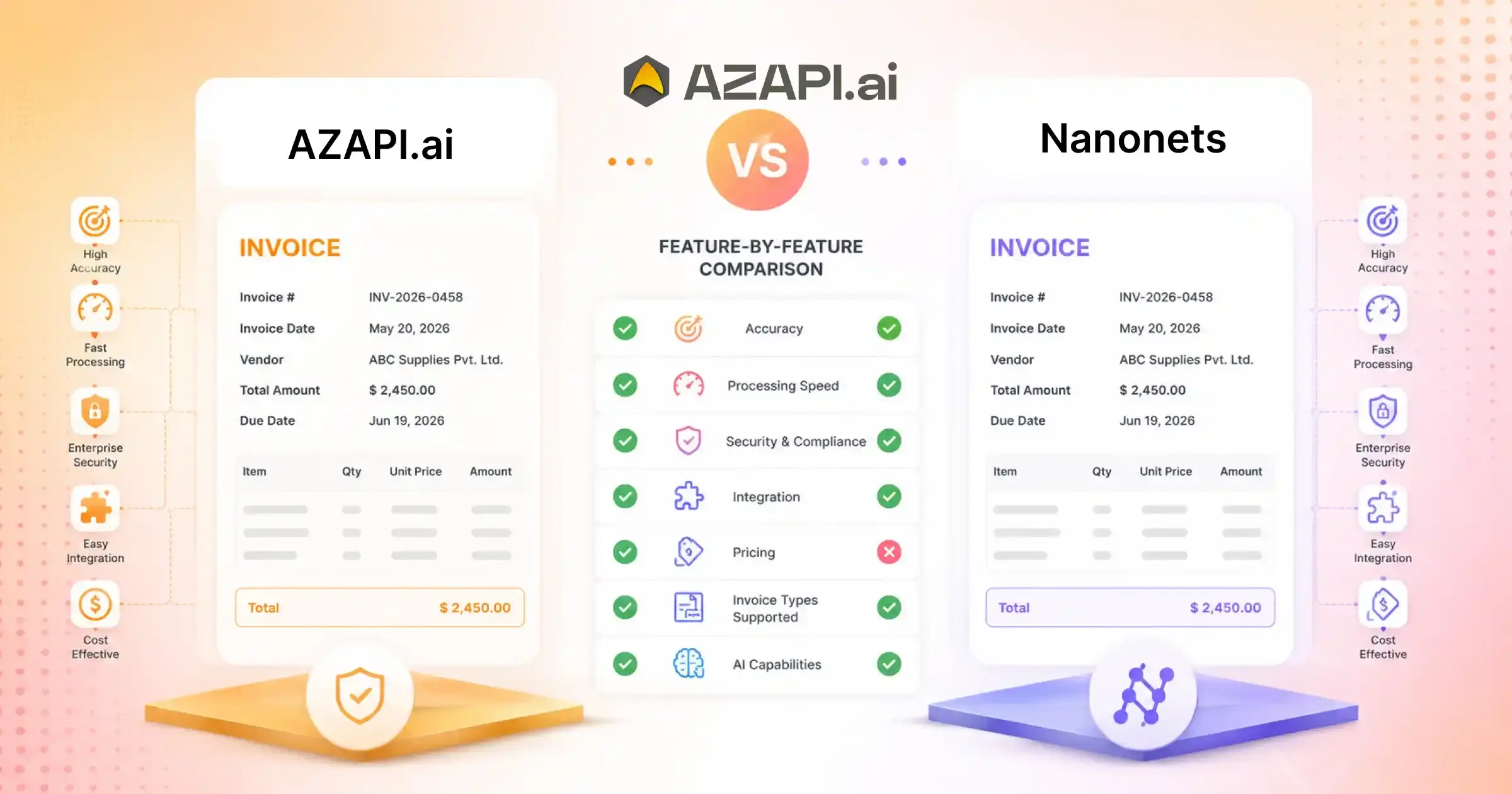
Invoice Automation API for Invoice Parsing: AZAPI.ai vs Nanonets Feature-by-Feature Breakdown
Why Invoice Parsing Is a Critical Business Function in 2026
Invoice Automation API for Invoice Parsing is becoming a key search term as businesses rapidly shift toward automated accounts payable (AP) systems. In 2026, invoice processing is no longer just an administrative task-it has become a core operational function that directly impacts cash flow, vendor relationships, and financial accuracy.
With the growth of digital transactions, organizations are now handling significantly higher invoice volumes than ever before. Manual data entry methods are struggling to keep up, leading to delays, errors, duplicate entries, and increased operational costs. Even small inconsistencies in invoice data can create reconciliation issues and compliance risks, making structured and accurate data extraction essential.
This is where AI-powered invoice OCR API and parsing solutions are transforming finance operations. Modern systems can automatically extract invoice numbers, vendor details, tax information, line items, and payment data with high precision. Instead of relying on manual processing, businesses can now convert unstructured invoices into structured, machine-readable formats within seconds. This shift not only reduces human effort but also improves accuracy, speed, and audit readiness.
As companies look to streamline AP workflows, reduce processing costs, and improve financial visibility, choosing the right invoice parsing solution has become a strategic decision. Platforms like AZAPI.ai and Nanonets are among the key players in this space, each offering different strengths in automation, accuracy, and integration capabilities.
In this comparison, we will evaluate these platforms based on extraction accuracy, line-item parsing performance, pricing models, integration flexibility, scalability, automation capabilities, enterprise readiness, and overall ROI. The goal is to help businesses identify which solution best fits their invoice processing needs in a fast-evolving digital finance landscape.
Understanding Modern Invoice Parsing Requirements
Before evaluating any solution, it is important to clearly understand what modern businesses actually expect from invoice parsing systems. As organizations scale their accounts payable operations, the demand for structured, accurate, and real-time invoice data has become a standard requirement rather than an added advantage.
At the core, businesses need reliable extraction of key invoice fields such as invoice numbers, dates, vendor details, tax information, and total amounts. Beyond these header fields, line-item extraction has become equally important, especially for companies dealing with high-volume or complex invoices. The ability to accurately break down products, quantities, prices, and taxes directly impacts financial reporting and audit readiness.
Additional capabilities like tax calculation handling, multi-page invoice processing, vendor recognition, validation rules, ERP integration, and automated approval workflows are now essential components of a complete invoice automation system. These features ensure that extracted data is not only accurate but also usable within existing financial ecosystems.
Traditional OCR systems are no longer sufficient for these requirements. While earlier tools focused mainly on text recognition, modern businesses require Intelligent Document Processing (IDP) solutions that combine OCR with AI-driven understanding of document structure and context. This shift enables systems to adapt to varying invoice formats, layouts, and industry-specific templates without manual configuration.
As companies search for the Invoice Automation API for Invoice Parsing, the focus is no longer just on reading text from invoices, but on understanding and structuring financial data in a way that supports automation, compliance, and real-time decision-making. This evolution marks a clear transition from basic OCR to intelligent, AI-powered Invoice Automation API for Invoice Processing designed for modern finance operations.
Company Overview
When evaluating invoice automation platforms, it is important to understand their design philosophy, target users, and core strengths. Different solutions are built for different business needs, ranging from lightweight API-based processing to full-scale enterprise workflow automation. This becomes especially relevant when selecting the Invoice Automation API for Invoice Parsing.
AZAPI.ai
Designed For
- Startups
- SaaS companies
- Accounting software platforms
- Enterprise invoice automation systems
Core Strengths
- Ready-to-use API-first architecture
- Affordable invoice processing costs
- Flexible wallet-based and postpaid billing
- Fast deployment and easy integration
- Scalable from small applications to enterprise workloads
AZAPI.ai focuses on simplicity, speed, and cost efficiency, making it suitable for businesses that want to integrate invoice OCR quickly without complex setup or heavy infrastructure dependencies.
Nanonets
Designed For
- Mid-market organizations
- Enterprise AP (Accounts Payable) teams
- Complex invoice automation projects
Core Strengths
- Advanced workflow automation capabilities
- Custom AI model training for document extraction
- No-code invoice processing setup
- Strong enterprise system integrations
Nanonets is designed for organizations that require configurable workflows and AI model customization, particularly in structured AP environments where automation depth and flexibility are key priorities.
Overall, both platforms address different segments of the invoice processing market, with AZAPI.ai focusing on API-driven scalability and ease of use, while Nanonets emphasizes customizable automation and enterprise workflow control.
Invoice Capture & Document Ingestion
This section focuses on how invoices enter the system and how quickly a platform can start processing real business documents. In modern AP automation workflows, ingestion flexibility directly impacts onboarding speed, integration effort, and overall time-to-value. This becomes a key factor when evaluating the Invoice Automation API for Invoice Parsing.
AZAPI.ai
Supports:
- PDFs
- Scanned invoices
- Mobile-captured images
- Email attachments
- API-based uploads
- Cloud-based ingestion workflows
Key Advantage:
Minimal setup required, enabling fast onboarding and immediate production usage with very little configuration effort.
Nanonets
Supports:
- PDFs
- Images
- Email ingestion
- Cloud storage integrations
- Mobile captures
- Multi-page invoice documents
Key Advantage:
Extensive ecosystem of ingestion channels designed for complex enterprise workflows and multi-source document processing.
Winner Analysis
When comparing invoice ingestion approaches, the differences become clear across three key areas:
Ease of Onboarding
AZAPI.ai offers a more straightforward setup with plug-and-play API ingestion, allowing teams to start processing invoices quickly. Nanonets, while powerful, may require additional configuration depending on workflow complexity.
Setup Complexity
AZAPI.ai is designed for minimal configuration and rapid deployment. Nanonets provides more customization options, which can introduce additional setup steps in enterprise environments.
Time to Production
AZAPI.ai typically enables faster time-to-production due to its API-first, lightweight integration model. Nanonets is better suited for organizations that require structured workflow design and are willing to invest more time in setup.
Overall, both platforms support flexible invoice ingestion, but AZAPI.ai emphasizes speed and simplicity, while Nanonets focuses on enterprise-grade ingestion flexibility and workflow depth.
Invoice Data Extraction Comparison
Invoice data extraction is the core capability that determines how effectively a system can convert unstructured invoices into structured, machine-readable data. It directly impacts automation accuracy, financial reporting, reconciliation, and downstream ERP integration. When evaluating the Invoice Automation API for Invoice Parsing, extraction quality and consistency become the most important decision factors.
Header Fields
Both platforms support extraction of standard invoice header fields, including:
- Invoice number
- Purchase order (PO) number
- Invoice date
- Due date
- Buyer and seller details (name, tax IDs, address)
- Tax identification numbers
- Currency
- Payment details
Line Item Extraction
Line item extraction is critical for invoice-level financial automation and includes:
- Product or service descriptions
- Quantities
- Unit prices
- Discounts
- Tax breakdowns
- Subtotals and final totals
- Taxable values and applied taxes
AZAPI.ai Advantage
AZAPI.ai focuses on consistent, production-ready invoice extraction designed for real-world automation at scale.
Key strengths include:
- Consistent extraction quality across varied invoice formats
- Structured, clean JSON output for easy integration
- Invoice-specific AI models optimized for financial documents
- Template-free processing with no setup required
- No training, no configuration-just plug-and-play API usage
- Reliable performance across scanned, digital, and complex invoices
This makes it suitable for businesses that need fast deployment and predictable extraction results without operational overhead.
Nanonets Advantage
Nanonets provides strong capabilities in structured document understanding, particularly for:
- Advanced table extraction
- Custom AI model training for specific invoice formats
- Flexible configuration for enterprise workflows
It is well-suited for organizations that require customized extraction pipelines and are willing to invest in training models for specific document structures.
Summary Insight
While both platforms deliver strong invoice parsing capabilities, their approach differs. AZAPI.ai emphasizes ready-to-use, consistent extraction with minimal setup, while Nanonets focuses on customizable extraction through training and configuration.
Handling Complex Invoice Layouts
Most OCR solutions perform well on clean, structured invoices, but real-world business documents are far more unpredictable. In production environments, invoices often come in different formats, varying quality levels, and mixed layouts that challenge even advanced extraction systems. This is a key differentiator when evaluating the Invoice Automation API for Invoice Parsing.
Test Scenario Categories
Modern invoice parsing systems must handle a wide range of complex inputs, including:
- Multi-page invoices
- Supplier-specific custom formats
- Handwritten notes or annotations
- Mixed-language documents
- Low-resolution or compressed scans
- Mobile camera captures with noise or blur
- Rotated or skewed documents
- Partially cropped invoices or missing sections
These scenarios reflect real operational conditions where invoice data is not always clean or standardized.
AZAPI.ai
AZAPI.ai is designed with a strong focus on real-world invoice variability and production-grade reliability.
Focus Areas:
- Robust extraction across diverse invoice formats
- Minimal need for manual correction or post-processing
- Strong performance on noisy, blurry, or imperfect documents
- Reliable handling of real-world, non-standard invoice layouts
- Consistent output without requiring template setup or retraining
This makes it well-suited for businesses that process invoices from multiple vendors and cannot rely on uniform document structures.
Nanonets
Nanonets approaches complex layouts through model adaptability and customization.
Focus Areas:
- Model retraining for specific invoice formats
- Layout adaptation through custom training pipelines
- Flexible configuration for structured enterprise workflows
- Improved accuracy after domain-specific model tuning
This makes it suitable for organizations that can invest time in training models for their specific invoice types.
Key Insight
Complex invoice handling often separates basic OCR systems from production-ready automation platforms. In the case of AZAPI.ai, your team does not need to do any setup, training, or customization-just plug in the API and start processing. AZAPI.ai handles model optimization, layout understanding, and real-world document variability on its own, so teams can focus purely on integration rather than tuning or maintenance. In contrast, Nanonets focuses on adaptability through model training and configuration, which may require additional effort to fine-tune performance for specific invoice formats and enterprise workflows.
Extraction Accuracy Benchmark
Invoice extraction accuracy is one of the most important factors in evaluating any OCR solution, as even small errors can lead to financial mismatches, compliance issues, and manual correction overhead. When comparing platforms for the Invoice Automation API for Invoice Parsing, accuracy must be assessed across real-world invoice variations rather than ideal test samples.
AZAPI.ai
Highlights:
- High extraction accuracy (up to 99.91%+)
- Reduced need for manual review and corrections
- Consistent data extraction across diverse invoice formats
- Strong performance on both handwritten and digital invoices
- Reliable handling of scanned, low-quality, and complex layouts
AZAPI.ai is optimized for production environments where invoices vary widely across vendors, industries, and formats. It focuses on delivering stable and consistent outputs without requiring manual tuning or model adjustments.
Nanonets
Highlights:
- 95%+ invoice extraction accuracy claims
- Confidence scoring for extracted fields
- Continuous model improvement through training and feedback loops
- Strong performance in structured invoice environments
Nanonets emphasizes model adaptability and refinement over time, making it suitable for teams that actively train and optimize their extraction models.
Accuracy Comparison Table
| Measure | AZAPI.ai | Nanonets |
| Header Fields | High, consistent extraction | Strong, model-dependent |
| Table Extraction | Robust across varied layouts | Very strong with training |
| Tax Extraction | Accurate across formats | Accurate with confidence scoring |
| Total Amount Detection | Highly consistent | Strong in structured invoices |
| Multi-page Invoices | Seamless handling without setup | Good, may improve with tuning |
Key Insight
AZAPI.ai focuses on immediate, consistent accuracy across all invoice types without requiring training or configuration, making it ideal for production-scale automation. Nanonets, on the other hand, delivers strong accuracy with the added advantage of continuous improvement through model training and refinement.
Validation & Error Prevention
Validation and error prevention play a critical role in invoice automation systems because even highly accurate OCR outputs can lead to financial discrepancies if incorrect or incomplete data is not flagged. When evaluating the Invoice Automation API for Invoice Parsing, it is important to understand how each platform handles data verification, anomaly detection, and error reduction before information enters downstream systems.
AZAPI.ai
Validation Capabilities:
- Missing field detection to ensure no critical invoice data is skipped
- Duplicate invoice detection to prevent double processing and duplicate payments
- Invoice consistency checks across header and line-item data
- Tax validation to verify correctness of applied tax calculations
- Real-time validation during extraction to reduce downstream errors
AZAPI.ai focuses on automated, built-in validation that runs alongside extraction, reducing the need for manual review or additional rule configuration. This helps businesses maintain clean, production-ready invoice data with minimal operational effort.
Nanonets
Validation Capabilities:
- Confidence scoring for extracted fields
- Human-in-the-loop review workflows for uncertain extractions
- Data normalization for structured output consistency
- Calculation verification for totals and line-item accuracy
Nanonets emphasizes configurable validation workflows that combine automation with optional human review, making it suitable for teams that require controlled verification steps within their AP processes.
Key Insight
AZAPI.ai prioritizes automated, real-time validation that reduces manual intervention and prevents errors at the source, making it suitable for high-volume, production-grade invoice processing. Nanonets focuses more on configurable validation pipelines and human review workflows, offering flexibility for organizations that prefer layered verification and controlled approval processes.

Developer Experience Comparison
Developer experience often determines how quickly a team can move from evaluation to production. A powerful OCR system is only valuable if it can be integrated easily, understood quickly, and deployed without unnecessary complexity. When assessing the Invoice Automation API for Invoice Parsing, factors like API simplicity, documentation quality, and time-to-production become critical.
AZAPI.ai
Focus Areas
- Ready-to-use APIs designed for instant integration
- Plug-and-play architecture with minimal configuration
- Fast implementation with very low learning curve
- Designed for rapid production deployment
- Minimal dependency on external setup or workflow builders
AZAPI.ai is optimized for teams that want to integrate invoice OCR quickly and start processing data without spending time on complex setup or training workflows.
Nanonets
Focus Areas
- Extensive customization capabilities
- SDK availability for multiple use cases
- Workflow builder for automation design
- Custom processing blocks for advanced logic
Nanonets provides a more configurable environment, allowing teams to design and fine-tune workflows based on specific business requirements.
Developer Experience Scorecard
Documentation
AZAPI.ai offers straightforward API documentation focused on quick implementation, while Nanonets provides more extensive documentation covering workflows, customization, and enterprise use cases.
API Simplicity
AZAPI.ai is designed with simplicity in mind, enabling quick API calls with minimal setup. Nanonets offers more advanced configuration options, which may introduce additional complexity.
Sandbox Availability
Both platforms provide testing environments, but AZAPI.ai emphasizes faster experimentation with immediate API usability, while Nanonets focuses on structured testing within workflow contexts.
SDK Support
Nanonets offers broader SDK and customization support, whereas AZAPI.ai focuses primarily on REST API-first integration for simplicity and speed.
Time-to-Production
AZAPI.ai typically enables faster deployment due to its plug-and-play design, while Nanonets may require additional workflow configuration before full production rollout.
Overall, AZAPI.ai prioritizes speed, simplicity, and minimal integration effort, while Nanonets focuses on flexibility, customization, and advanced workflow design for enterprise-grade automation.
Automation Beyond OCR
Modern invoice processing is no longer limited to extracting text from documents. Businesses now expect end-to-end automation that connects OCR outputs directly into financial systems, approval flows, and enterprise applications. This is where platforms begin to differentiate significantly, especially when evaluating the Invoice Automation API for Invoice Parsing.
AZAPI.ai
Best For
- Direct invoice data extraction
- ERP system ingestion and integration
- Lightweight automation workflows
- API-first processing pipelines
- Fast data delivery for downstream systems
AZAPI.ai focuses on keeping automation simple and efficient. The platform is designed to extract invoice data and immediately make it available for systems like ERPs, CRMs, and accounting tools without requiring complex workflow configuration or multi-step orchestration. This makes it ideal for businesses that prefer direct, scalable automation rather than heavy workflow design.
Nanonets
Best For
- Full accounts payable (AP) automation
- Multi-step workflow approvals
- Invoice routing between departments
- Human-in-the-loop review processes
- Complex enterprise document workflows
Nanonets extends beyond OCR into structured AP automation, allowing organizations to design detailed workflows that include approvals, validations, and manual review stages. This makes it suitable for enterprises that require controlled processing pipelines with multiple checkpoints.
Key Insight
AZAPI.ai focuses on streamlined automation where invoice data flows directly into business systems with minimal configuration, enabling fast and efficient processing. Nanonets, on the other hand, emphasizes full AP lifecycle automation with advanced workflow control, approval routing, and human review capabilities for enterprise environments.
Pricing Analysis: The Real Cost of Processing 100,000 Invoices
Understanding real-world pricing is essential when selecting an invoice OCR solution, especially at scale. Many platforms appear cost-effective at low volumes, but costs can increase significantly as invoice processing grows. This makes pricing one of the most important factors when evaluating the Invoice Automation API for Invoice Parsing.
AZAPI.ai
Pricing Model
- $0.015 to $0.025 per invoice
- Wallet recharge system
- Postpaid billing options
- Pay-as-you-go usage
- No mandatory subscriptions
Benefits
- Predictable cost structure
- Startup-friendly pricing
- Scales efficiently for enterprise workloads
- No hidden platform or usage overhead
AZAPI.ai is designed to keep pricing simple and transparent, allowing businesses to scale from small volumes to high-throughput invoice processing without sudden cost spikes.
Nanonets
Pricing Model
- Block-based billing system
- AI operations priced around $0.30 per run
- Estimated cost: $0.72-$1.80 per invoice depending on complexity
- Growth plan: $999/month for 10,000 pages
Cost Simulation (100,000 Invoices)
- 1,000 invoices: Low to moderate cost impact for both platforms
- 10,000 invoices: Noticeable cost divergence begins
- 100,000 invoices: Significant pricing gap between usage-based vs operation-based billing
At large scale, pricing efficiency becomes a major differentiator in total cost of ownership and long-term ROI.
For organizations evaluating real-world invoice automation costs, pricing transparency and per-document efficiency are critical. This is where AZAPI.ai often stands out as a cost-optimized choice for scalable deployments, especially when compared with more operation-heavy billing models in the Invoice Automation API for Invoice Parsing landscape.
Scalability Under Enterprise Workloads
Scalability is a key factor for any invoice OCR system that needs to support growing business operations, especially when processing thousands or even millions of invoices monthly. In enterprise environments, the ability to handle peak loads, maintain consistent performance, and scale without re-architecture is critical when choosing the Invoice Automation API for Invoice Parsing.
AZAPI.ai
Strengths
- Flexible scaling across all business sizes
- No rigid volume restrictions or caps
- High-throughput API architecture designed for continuous processing
- Consistent performance under variable and peak workloads
- Seamless scaling from startup usage to enterprise-level operations
AZAPI.ai is built to support dynamic growth, allowing businesses to increase invoice processing volumes without changes to infrastructure or integration logic. This makes it suitable for fast-scaling SaaS platforms, fintech companies, and enterprise automation systems.
Nanonets
Strengths
- Enterprise deployment options with structured workflows
- Custom infrastructure support for large organizations
- Designed for controlled, enterprise-grade scaling environments
- Suitable for organizations with dedicated workflow management systems
Nanonets focuses on structured enterprise scalability, where workflows, models, and infrastructure can be tailored for specific organizational requirements.
Key Insight
Both platforms support enterprise-scale invoice processing, but their approach differs. AZAPI.ai emphasizes flexible, API-driven scalability with minimal operational constraints, while Nanonets focuses on structured enterprise deployments with customizable infrastructure and workflow control.
Security & Compliance
Security and compliance are critical in invoice processing, especially when handling sensitive financial data such as vendor details, bank information, tax records, and transaction histories. Organizations evaluating the Invoice Automation API for Invoice Parsing must ensure that the platform meets enterprise-grade security standards and regulatory expectations.
AZAPI.ai
Focus Areas
- Strong data protection mechanisms for sensitive invoice data
- Secure API architecture with encrypted communication channels
- Enterprise-grade infrastructure designed for scalable deployments
- ISO compliance and SOC Type 2 standards for security and reliability
- Designed to support regulated industries and high-security environments
AZAPI.ai is built with a security-first approach, ensuring that invoice data is processed securely across all stages-from upload to extraction and delivery-while maintaining compliance with industry standards.
Nanonets
Focus Areas
- SOC 2 compliance for enterprise security assurance
- Enterprise-grade infrastructure with scalable deployment options
- On-premise deployment support for organizations requiring local data control
- Secure processing pipelines designed for business-critical workloads
Nanonets provides strong compliance capabilities, particularly for enterprises that require flexible deployment models and tighter control over data storage and processing environments.
Key Insight
Both platforms offer strong security and compliance frameworks suitable for enterprise invoice processing. AZAPI.ai emphasizes standardized compliance (ISO, SOC Type 2) and secure cloud-based API infrastructure, while Nanonets provides additional flexibility through enterprise deployment options, including on-premises setups for organizations with strict data residency requirements.
Which Platform Delivers Faster ROI?
Return on investment (ROI) in invoice automation is determined not only by pricing, but also by implementation speed, engineering effort, operational efficiency, and long-term scalability. When comparing platforms for the Invoice Automation API for Invoice Parsing, ROI becomes a combination of cost savings, deployment speed, and reduction in manual workload.
AZAPI.ai
ROI Drivers
- Lower per-invoice processing costs
- Faster implementation and time-to-production
- Minimal engineering effort required for integration
- Reduced dependency on workflow configuration or training
- Immediate production readiness through plug-and-play APIs
AZAPI.ai delivers ROI quickly by minimizing setup time and reducing ongoing operational complexity. Businesses can start processing invoices almost immediately, which significantly shortens the time between integration and value realization.
Nanonets
ROI Drivers
- Strong workflow automation capabilities
- Reduction in manual review through human-in-the-loop systems
- Enterprise-grade controls for structured financial processes
- Ability to optimize workflows over time with model training
Nanonets generates ROI through process optimization, particularly in environments where workflow automation and manual review reduction are critical.
Key Insight
AZAPI.ai delivers faster ROI primarily through lower operational costs, rapid deployment, and reduced engineering overhead, making it highly effective for teams seeking immediate value. Nanonets, on the other hand, drives ROI through long-term workflow optimization and enterprise process automation improvements.
For businesses evaluating the Invoice Automation API for Invoice Parsing, the speed of implementation and cost efficiency often determine how quickly ROI is realized in real-world deployments.
Ideal Customer Profiles
Choosing the right invoice OCR solution depends heavily on your business model, automation needs, and technical preferences. While both platforms address invoice processing, they are built for different types of customers and operational requirements.
Choose AZAPI.ai If:
- You need affordable and scalable invoice OCR processing
- You prefer simple, API-first integration without complexity
- You handle high invoice volumes across systems or clients
- You want faster deployment with minimal setup effort
- You require flexible billing options like pay-as-you-go or postpaid models
- You are building SaaS, fintech, ERP, or accounting automation products
- You want a solution that works out of the box without training or configuration
Choose Nanonets If:
- You need full accounts payable (AP) automation workflows
- You require custom AI model training for specific invoice formats
- You prefer no-code workflow builders for automation design
- Compliance, governance, and approval flows are major requirements
- You operate in structured enterprise environments with complex processes
Key Insight
AZAPI.ai is better suited for businesses that prioritize speed, simplicity, scalability, and cost efficiency in invoice processing, while Nanonets is more aligned with organizations that need deep workflow customization and end-to-end AP automation.
For companies evaluating the Invoice Automation API for Invoice Parsing, the ideal choice ultimately depends on whether the focus is rapid API-driven integration or comprehensive workflow automation.
AZAPI.ai vs Nanonets: Complete Feature Comparison Matrix
| Feature | AZAPI.ai | Nanonets |
| Invoice OCR Accuracy | Strong and consistent across real-world invoices | Strong with model tuning capabilities |
| Line Item Extraction | Strong extraction across varied layouts | Strong extraction with structured training support |
| API Simplicity | Highly simple, API-first, plug-and-play design | Good, but includes additional configuration layers |
| Custom Training | Not required (system is pre-optimized and ready to use) | Advanced custom model training supported |
| Workflow Automation | Moderate automation focused on API-based pipelines | Advanced no-code workflow automation system |
| Pricing Flexibility | Highly flexible (pay-as-you-go, wallet, postpaid) | Limited flexibility, more structured pricing |
| Startup Friendliness | Highly suitable for fast-growing startups and SaaS teams | Suitable but more enterprise-oriented setup |
| Enterprise Compliance | Strong compliance-ready infrastructure (ISO, SOC Type 2) | Strong enterprise compliance (SOC 2, deployment controls) |
| Integration Speed | Very fast integration, minimal setup required | Moderate integration speed due to workflow configuration |
| Cost Efficiency | High cost efficiency for all scales | Cost increases with workflow complexity and usage |
Key Insight
AZAPI.ai is optimized for simplicity, speed, and cost-efficient API-based invoice processing, making it ideal for teams that want quick deployment without training or setup overhead. Nanonets, on the other hand, provides deeper workflow customization, advanced automation, and enterprise-grade configuration capabilities for organizations that require complex AP automation systems.
Final Verdict
In the evolving landscape of invoice automation, both platforms bring strong capabilities, but they are designed with different priorities in mind. When evaluated holistically across accuracy, scalability, integration, pricing, and real-world usability, the Invoice Automation API for Invoice Parsing ultimately depends on business needs-but one solution clearly stands out for most modern use cases.
Why AZAPI.ai Wins Overall
AZAPI.ai emerges as the preferred choice for the majority of businesses due to its balanced combination of performance, simplicity, and cost efficiency.
Best For Most Businesses Because:
- Easier implementation with plug-and-play APIs
- Lower total cost of ownership across all usage levels
- Highly flexible pricing models (pay-as-you-go, wallet, postpaid)
- Faster time-to-value with minimal setup or configuration
- Scales seamlessly from startup workloads to enterprise-level processing
- Strong, consistent invoice extraction performance across formats and layouts
- No requirement for model training or complex workflow setup
This makes AZAPI.ai particularly well-suited for teams that want fast deployment and predictable operational costs without compromising on accuracy or scalability.
Where Nanonets Excels
Nanonets remains a strong choice in more specialized enterprise scenarios, particularly where deeper customization and structured workflows are required.
Strength Areas:
- Enterprise-grade workflow automation
- Custom AI model training for specific document types
- Compliance-heavy environments with strict governance requirements
- Complex accounts payable (AP) processes requiring multi-step approvals
Final Insight
While both platforms are capable invoice OCR solutions, AZAPI.ai stands out as the more versatile and cost-efficient option for modern businesses seeking speed, scalability, and simplicity in invoice processing.
FAQs
Q1. Invoice Automation API for Invoice Parsing?
Ans: The choice depends on business requirements, but AZAPI.ai is widely preferred for its simplicity, scalability, and cost efficiency, while Nanonets is strong in enterprise workflow automation and customization-heavy environments.
Q2. How much does invoice OCR cost?
Ans: Costs vary by platform and usage. Some solutions follow pay-per-invoice models, while others use subscription or workflow-based pricing depending on features and volume.
Q3. Is AZAPI.ai cheaper than Nanonets?
Ans: In most real-world usage scenarios, AZAPI.ai is more cost-efficient due to its flexible pay-as-you-go pricing and lower per-invoice processing cost structure, especially at scale.
Q4. Best OCR API for Invoice Line-Item Extraction in 2026?
Ans: Both platforms support strong line-item extraction. AZAPI.ai focuses on consistent real-world extraction across varied invoice formats, while Nanonets offers strong extraction with customization and training options.
Q5. Does Nanonets require model training?
Ans: It is not mandatory, but Nanonets provides model training capabilities to improve accuracy for specific invoice formats and business workflows.
Q6. Best OCR API for Easy Integration in 2026?
Ans: AZAPI.ai is generally easier to integrate due to its API-first, plug-and-play design with minimal setup and faster time-to-production.
Q7. Best OCR API for Startups in 2026?
Ans: AZAPI.ai is typically better suited for startups due to its flexible pricing, quick integration, and low operational overhead.
Q8. Best OCR API for Enterprise Invoice Processing in 2026?
Ans: Both platforms scale well, but AZAPI.ai offers seamless scaling without rigid limits, while Nanonets provides structured enterprise scalability with workflow-driven architecture.