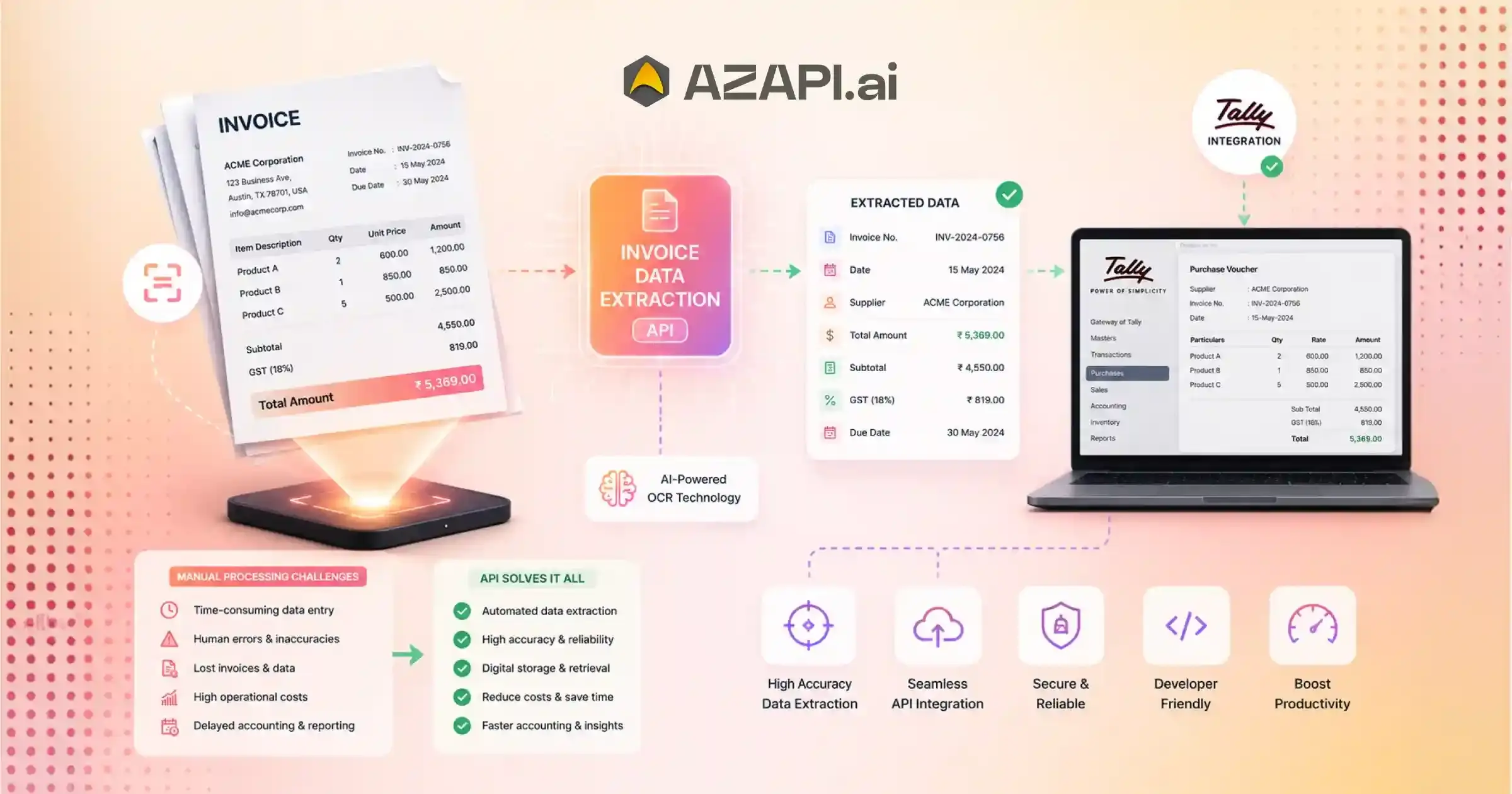
Invoice Data Extraction API for Tally: Solve Manual Invoice Processing Challenges
How Does an Invoice Data Extraction API for Tally Solve Manual Invoice Processing Challenges?
An Invoice Data Extraction API for Tally automatically captures invoice information from PDFs, scanned documents, and images, extracting fields such as invoice numbers, vendor details, GST information, tax amounts, and line items. By eliminating manual data entry, businesses can reduce processing errors, improve accounting accuracy, accelerate invoice handling, and seamlessly transfer structured data into Tally workflows.
Invoice Data Extraction API for Tally is changing the way businesses handle invoice processing and bookkeeping. For many finance teams, entering invoice details into accounting software is still a repetitive and time-consuming task. Whether invoices arrive as PDFs, scanned documents, email attachments, or mobile-captured images, manually extracting information and entering it into Tally can lead to delays, data entry mistakes, and increased operational costs.
As businesses grow, the number of invoices they process every month also increases. What may have been manageable with manual workflows can quickly become a bottleneck that affects productivity, vendor payments, compliance, and financial reporting. Even small errors in invoice numbers, GST details, tax amounts, or vendor information can create reconciliation challenges and consume valuable accounting resources.
This is where invoice data extraction technology is making a significant impact.
A modern Invoice OCR API powered by OCR and artificial intelligence can automatically identify, extract, and structure invoice information without requiring manual intervention. Important fields such as supplier names, GSTINs, invoice dates, invoice numbers, tax breakdowns, line items, and totals can be captured accurately and prepared for accounting workflows.
When integrated with Tally, an invoice data extraction API helps eliminate duplicate data entry, accelerates invoice processing, and improves the accuracy of financial records. Finance teams can spend less time on administrative tasks and more time focusing on analysis, compliance, and business growth.
Solutions such as AZAPI.ai are helping businesses automate invoice processing by converting unstructured invoice documents into structured, accounting-ready data. As organizations continue their digital transformation efforts, automated invoice extraction is becoming an essential part of efficient finance operations.
Businesses that adopt invoice automation early can reduce processing costs, improve scalability, strengthen compliance, and create faster, more reliable accounting workflows. In an increasingly data-driven business environment, automating invoice extraction is no longer a luxury-it is quickly becoming a competitive advantage.
Why Manual Invoice Processing Is Still a Major Business Challenge
Businesses today process far more invoices than they did a few years ago. As organizations expand their operations, add new vendors, and handle a growing number of transactions, managing invoices manually becomes increasingly difficult. What once seemed like a manageable administrative task can quickly turn into a major operational challenge.
The Growing Volume of Business Invoices
Digital transformation has made it easier for businesses to buy, sell, and collaborate across multiple channels. As a result, invoice volumes continue to rise. Companies often receive invoices from numerous suppliers in different formats, including PDFs, scanned documents, emails, and digital billing platforms. Managing these documents manually requires significant time and effort from finance teams.
Why Traditional Processes Struggle to Scale
Manual invoice workflows are heavily dependent on human effort. As transaction volumes increase, so does the workload. Finance teams must spend more time entering data, verifying information, routing approvals, and maintaining records.
This creates several challenges:
- Increased administrative workload
- Greater risk of data entry errors
- Slower invoice processing cycles
- Approval bottlenecks
- Reduced operational efficiency
These issues often become more noticeable as businesses grow and invoice complexity increases.
Hidden Costs of Manual Invoice Handling
The true cost of manual invoice processing extends beyond data entry. Businesses frequently incur additional expenses related to labor-intensive workflows, invoice corrections, delayed approvals, and inefficient reporting processes. Compliance risks can also increase when invoice records are incomplete or inaccurate.
Organizations facing these challenges are increasingly turning to an Invoice Data Extraction API for Tally to automate invoice capture, reduce manual effort, and improve accounting efficiency.
By replacing repetitive manual tasks with intelligent automation, businesses can reduce costs, improve accuracy, and build more scalable financial operations.
Understanding Manual Invoice Processing Bottlenecks
Manual invoice processing may seem straightforward, but it often creates hidden bottlenecks that affect efficiency, accuracy, and financial control. As invoice volumes increase, these challenges become more difficult to manage and can impact multiple areas of business operations. Understanding the most common bottlenecks is the first step toward improving invoice management processes.
Data Entry Errors
One of the biggest challenges in manual invoice processing is human error. Even experienced finance professionals can make mistakes when entering large volumes of data.
Common examples include:
- Wrong invoice numbers
- Incorrect invoice amounts
- Tax calculation errors
- Incorrect supplier details
- Missing line-item information
These mistakes can lead to reconciliation issues, reporting inaccuracies, and compliance concerns.
Missing Invoice Information
Invoices often arrive with incomplete information or missing fields. Identifying and correcting these issues manually can delay processing and require additional communication with suppliers.
Businesses adopting an Invoice Data Extraction API for Tally can automate validation checks and identify missing information early in the workflow, reducing delays and improving data quality.
Duplicate Invoice Entries
Duplicate invoices can occur when documents are submitted multiple times or processed by different team members. Without proper controls, duplicate entries can lead to payment errors and inaccurate financial records.
Delayed Invoice Approvals
Manual approval processes frequently create bottlenecks, especially when invoices need to pass through multiple departments or decision-makers. Delays can affect vendor relationships and impact payment schedules.
Lack of Process Visibility
Many organizations struggle to track invoice status once a document enters the approval process. Without centralized visibility, it becomes difficult to monitor progress, identify bottlenecks, or determine where action is required.
By addressing these common challenges through automation, businesses can create faster, more transparent, and more reliable invoice processing workflows while improving overall accounting efficiency.
What Is an Invoice Data Extraction API?
Businesses today handle invoices in many different formats, making manual data entry increasingly difficult and time-consuming. To improve efficiency and accuracy, many organizations are adopting automation technologies that can extract invoice information automatically.
An Invoice Data Extraction API for Tally is a technology solution that captures invoice documents, identifies important information, converts it into structured data, and prepares it for accounting workflows. Instead of manually entering invoice details into accounting systems, businesses can automate the entire data extraction process.
Definition and Core Purpose
An invoice data extraction API is designed to read invoice documents and extract key fields such as supplier details, invoice numbers, dates, GST information, line items, tax amounts, and totals. The primary purpose is to reduce manual effort, improve accuracy, and accelerate invoice processing.
How Invoice Data Extraction Works
The process typically follows several steps:
Invoice Upload
Invoices are submitted through various channels such as email, document uploads, mobile applications, or integrated business systems.
Data Recognition
OCR and AI technologies analyze the invoice and identify text, tables, and important financial information.
Field Extraction
The system extracts specific invoice fields, including vendor details, invoice numbers, tax information, item descriptions, and payment amounts.
Validation
Extracted data is checked against predefined rules to identify missing information, formatting issues, or potential errors.
Export
Validated data is converted into structured formats and transferred to accounting, ERP, or bookkeeping systems.
Types of Documents Supported
Modern invoice extraction solutions typically support:
- PDF invoices
- Scanned invoices
- Mobile-captured invoices
- Digital invoices
- GST invoices
- Image-based documents
By automating these processes, businesses can significantly reduce manual workload while improving the speed, consistency, and accuracy of financial operations.
How Invoice Data Extraction API Integrates with Tally
Integrating invoice automation with accounting software helps businesses eliminate repetitive data entry and improve the accuracy of financial records. Instead of manually transferring information from invoices into accounting systems, automated extraction and data mapping streamline the entire process from document receipt to bookkeeping entry.
Capturing Invoice Information
The process begins with invoice collection. Businesses may receive invoices through email attachments, PDFs, scanned documents, mobile uploads, or digital billing platforms. The extraction system captures these documents and identifies relevant financial information for processing.
Structuring Extracted Data
Once the invoice is analyzed, key fields such as supplier name, GSTIN, invoice number, invoice date, tax details, line items, and total amounts are extracted. This information is then converted into a structured format that can be processed by accounting systems.
Mapping Data to Accounting Records
Extracted invoice information must be aligned with accounting records. This includes matching suppliers, assigning ledger accounts, categorizing expenses, and mapping tax information to the appropriate accounting fields.
Businesses implementing an Invoice Data Extraction API for Tally can automate this mapping process, reducing manual effort while improving consistency across financial records.
Creating Tally-Compatible Entries
After validation and mapping, the structured invoice data is converted into a format suitable for Tally workflows. This helps finance teams reduce manual bookkeeping tasks and accelerate invoice processing.
Maintaining Data Consistency
Consistent data is essential for accurate reporting, compliance, and financial analysis. Automated validation and standardized data structures help ensure that invoice information remains accurate across systems while minimizing the risk of duplicate entries or processing errors.
By integrating invoice data extraction with Tally, businesses can build more efficient accounting workflows, improve financial visibility, and support scalable finance operations as transaction volumes continue to grow.
Common Manual Invoice Processing Problems and Their Solutions
Manual invoice processing can create significant operational challenges as businesses grow. What may seem manageable with a small number of invoices often becomes inefficient when transaction volumes increase. Fortunately, modern automation technologies provide effective solutions to many of these common problems.
Problem #1: Excessive Time Spent on Data Entry
Finance teams often spend hours manually entering invoice details into accounting systems, reducing productivity and increasing administrative workload.
Solution: Automated Field Extraction
AI-powered extraction tools can automatically capture invoice data, eliminating repetitive manual entry and significantly reducing processing time.
Problem #2: Frequent Human Errors
Manual processes are prone to mistakes such as incorrect invoice numbers, tax values, vendor information, and transaction amounts.
Solution: AI-Powered Validation
Automated validation checks can identify inconsistencies, missing information, and formatting errors before records are processed.
Problem #3: Invoice Backlogs
Growing invoice volumes can quickly overwhelm finance teams, creating approval delays and processing bottlenecks.
Solution: Real-Time Processing
Automated systems can process invoices as they arrive, helping organizations manage higher workloads without increasing manual effort.
Businesses implementing an Invoice Data Extraction API for Tally often use real-time extraction and validation capabilities to improve workflow efficiency and reduce operational bottlenecks.
Problem #4: Poor Financial Visibility
When invoices are processed manually, it can be difficult to track status, approvals, and outstanding liabilities.
Solution: Instant Invoice Digitization
Digitized invoice data provides greater transparency and easier access to financial information.
Problem #5: GST Compliance Risks
Incomplete or inaccurate tax information can create compliance challenges.
Solution: Automated Tax Field Extraction
AI systems can accurately capture GST-related data for reporting and reconciliation purposes.
Problem #6: Difficulty Managing Vendor Invoices
Handling invoices from multiple suppliers can become increasingly complex.
Solution: Structured Vendor Data Capture
Automated extraction standardizes supplier information and improves record management.
Problem #7: Scaling Challenges
Manual processes become less effective as invoice volumes grow.
Solution: API-Driven Automation
Automation enables businesses to process larger invoice volumes efficiently while maintaining accuracy and consistency.

Critical Invoice Data Fields Businesses Need to Capture
Accurate invoice processing depends on capturing the right information from every document. Missing or incorrect data can lead to accounting errors, compliance issues, payment delays, and reporting inaccuracies. Whether invoices are processed manually or through automation, businesses should ensure that all critical fields are extracted and recorded consistently.
The following categories represent the most important invoice data points for accounting and financial management:
| Category | Data Points |
| Vendor Information | Name, GSTIN |
| Invoice Details | Invoice Number, Invoice Date |
| Tax Information | GST, CGST, SGST, IGST |
| Financial Values | Subtotal, Total Amount |
| Item Information | Quantity, Rate, Description |
Capturing vendor information helps maintain accurate supplier records and supports compliance requirements. Invoice details such as invoice number and date are essential for transaction tracking, reconciliation, and audit readiness. Tax-related information plays a critical role in GST filing and regulatory reporting, while financial values ensure accurate bookkeeping and payment processing.
Item-level details provide deeper visibility into purchases, inventory-related expenses, and cost analysis. Maintaining accurate line-item records can also support reporting and operational decision-making.
Businesses using an Invoice Data Extraction API for Tally can automate the extraction of these critical fields, improving accuracy, reducing manual effort, and ensuring consistent accounting records across financial workflows.
By standardizing how invoice data is captured and processed, organizations can create more efficient, compliant, and scalable finance operations.
How AI Improves Invoice Data Extraction Accuracy
Accurate invoice data extraction is essential for efficient accounting, compliance, and financial reporting. Traditional OCR systems can read text from documents, but they often struggle with varying invoice formats, complex layouts, and inconsistent data structures. Artificial intelligence enhances the extraction process by understanding context, learning patterns, and adapting to different document types.
Intelligent Field Recognition
AI-powered systems can identify important invoice fields such as supplier names, GSTINs, invoice numbers, dates, tax amounts, and totals without relying solely on fixed templates. This allows businesses to process invoices from multiple vendors more effectively.
Context-Based Data Identification
Rather than simply reading text, AI analyzes the surrounding context to determine the meaning of information. For example, it can distinguish between an invoice number, a purchase order number, and a reference number even when the document structure varies.
Invoice Layout Adaptability
Businesses often receive invoices in different formats from various suppliers. AI models can adapt to changing layouts and extract information accurately from both structured and unstructured documents.
Organizations implementing an Invoice Data Extraction API for Tally benefit from this adaptability because the system can process diverse invoice formats while maintaining consistent extraction quality.
Learning from Historical Documents
Modern AI systems continuously improve by learning from previously processed invoices. As more documents are analyzed, the system becomes better at recognizing patterns, handling exceptions, and improving extraction performance.
Confidence Scoring Mechanisms
Many advanced extraction solutions provide confidence scores for extracted fields. These scores indicate how certain the system is about a specific value, allowing businesses to automatically process high-confidence data while routing lower-confidence entries for review.
By combining intelligent recognition, contextual understanding, adaptive learning, and confidence-based validation, AI significantly improves invoice data extraction accuracy, helping businesses reduce manual corrections and build more reliable accounting workflows.
Benefits of Using the Invoice Data Extraction API for Tally
Managing invoices manually can consume a significant amount of time and resources, especially as businesses grow and transaction volumes increase. Automating invoice data extraction helps organizations streamline accounting workflows, reduce errors, and improve overall financial efficiency. By converting invoice information into structured, usable data, businesses can create faster and more reliable bookkeeping processes.
Reduced Manual Workload
Manual invoice entry requires finance teams to spend hours capturing and verifying information. Automation eliminates much of this repetitive work, allowing employees to focus on higher-value financial tasks.
Faster Invoice Processing
Automated extraction significantly reduces the time required to process invoices. Documents can be analyzed and converted into structured data within seconds, helping businesses accelerate approvals and accounting workflows.
Improved Accounting Accuracy
Human errors are common in manual data entry. Automated extraction helps ensure that invoice details such as supplier information, invoice numbers, tax amounts, and totals are captured more accurately.
Businesses implementing an Invoice Data Extraction API for Tally can improve data consistency while reducing the need for manual corrections and verification efforts.
Better Tax Compliance
Accurate extraction of GST-related fields supports tax reporting, reconciliation, and regulatory compliance. This helps reduce compliance risks and improves record accuracy.
Increased Productivity
By automating routine invoice tasks, finance teams can process more invoices in less time and dedicate greater attention to analysis, planning, and strategic activities.
Lower Operational Costs
Reducing manual effort, rework, and processing delays can lead to substantial cost savings over time, especially for organizations handling large invoice volumes.
Enhanced Financial Visibility
Digitized invoice data provides real-time access to financial information, making it easier to track transactions, monitor liabilities, generate reports, and make informed business decisions.
Together, these benefits help organizations build more efficient, scalable, and future-ready accounting operations while improving overall financial performance.
Manual Processing vs Automated Invoice Data Extraction
As invoice volumes continue to increase, businesses are re-evaluating traditional accounting workflows and exploring automation to improve efficiency. Manual invoice processing may work for smaller workloads, but it often becomes difficult to manage as transaction volumes grow. Automated invoice data extraction provides a more scalable and accurate approach to handling financial documents.
The comparison below highlights the key differences between manual processing and automated invoice extraction:
| Metric | Manual Processing | Automated Extraction |
| Processing Speed | Slow | Fast |
| Error Rate | Higher | Lower |
| Scalability | Limited | High |
| Compliance Support | Manual | Automated |
| Data Accuracy | Variable | Consistent |
| Cost Efficiency | Lower | Higher |
Manual processing relies heavily on human effort, making it more susceptible to delays, data entry mistakes, and operational bottlenecks. As invoice volumes increase, organizations often need additional resources to maintain performance levels. Automated extraction, on the other hand, can process large numbers of invoices quickly while maintaining consistent accuracy and reducing administrative overhead.
Automation also improves compliance by helping businesses capture and validate critical financial and tax-related information more efficiently. Real-time processing and structured data further enhance reporting and financial visibility.
Organizations seeking to improve accounting efficiency often implement an Invoice Data Extraction API for Tally to eliminate repetitive manual tasks, reduce processing costs, and create more scalable invoice management workflows.
By transitioning from manual processes to automated extraction, businesses can improve productivity, strengthen compliance, and build a more efficient financial operation capable of supporting future growth.
Real-World Business Scenarios
Businesses across different industries face unique invoice processing challenges depending on their operational scale, vendor network, and accounting requirements. While manual invoice handling may work for simple workflows, organizations managing multiple suppliers, locations, and transactions often require automation to maintain speed, accuracy, and visibility.
High-Volume Vendor Invoice Management
Companies working with hundreds or thousands of vendors receive a continuous flow of invoices that require verification, approval, and recording. Manual processing can create delays and increase the chances of errors. Automated extraction helps capture vendor details, invoice values, and tax information quickly while improving processing efficiency.
Multi-Location Business Operations
Organizations operating across multiple branches or locations often struggle with centralized invoice management. Automation helps collect invoice data from different sources, standardize records, and provide better control over financial workflows.
Businesses managing complex accounting environments often use an Invoice Data Extraction API for Tally to connect invoice processing with existing bookkeeping systems, ensuring consistent data flow across locations and departments.
GST-Focused Accounting Workflows
GST compliance requires accurate capture of tax-related information such as GSTIN, CGST, SGST, IGST, and taxable values. Automated extraction reduces manual errors and helps businesses maintain reliable records for reconciliation and reporting.
Shared Finance Teams
Large organizations with centralized finance teams handle invoices from multiple departments and business units. Automation enables teams to manage higher invoice volumes efficiently while improving approval tracking and reducing repetitive tasks.
Outsourced Accounting Services
Accounting service providers process invoices for multiple clients with different formats and requirements. Automated extraction helps them standardize workflows, improve turnaround times, and deliver more reliable bookkeeping services.
By applying invoice automation across these real-world scenarios, businesses can improve operational efficiency, reduce manual workload, and create scalable accounting processes that support long-term growth.
How to Evaluate an Invoice Data Extraction API
Choosing the right automation solution is an important decision for businesses looking to improve invoice processing efficiency and accounting accuracy. An Invoice Data Extraction API for Tally should be evaluated based on factors such as data accuracy, integration capabilities, security, and scalability to ensure it meets current and future business requirements.
The right solution should not only extract invoice information but also support smooth accounting workflows, reduce manual effort, and provide reliable performance as transaction volumes increase.
Extraction Accuracy
Accuracy is one of the most important evaluation criteria. The API should correctly identify and extract key invoice fields such as vendor details, invoice numbers, GST information, tax amounts, line items, and totals. Higher accuracy reduces manual corrections and improves financial record quality.
Invoice Format Support
Businesses receive invoices in different formats, including PDFs, scanned documents, images, and digital files. A capable API should support multiple document types and handle variations in invoice layouts effectively.
Processing Speed
Fast processing helps businesses reduce invoice backlogs and accelerate approval workflows. The API should be capable of handling invoice extraction quickly without affecting accuracy or reliability.
Tally Compatibility
Seamless integration with Tally is essential for efficient accounting operations. The solution should support structured data transfer, proper field mapping, and smooth entry creation within Tally-compatible workflows.
Security Features
Since invoices contain sensitive financial information, security features such as encryption, authentication controls, access management, and secure data handling practices are critical.
Scalability
A reliable invoice extraction API should support business growth by handling increasing invoice volumes without performance issues.
Support and Reliability
Consistent system availability, technical support, and reliable performance are important for business-critical accounting processes. Organizations should consider service quality and ongoing assistance when selecting an API solution.
Evaluating these factors helps businesses choose an invoice automation solution that improves efficiency, enhances accuracy, and supports scalable financial operations.
Best Practices for Successful Invoice Data Extraction
An Invoice Data Extraction API for Tally can significantly improve accounting efficiency, but successful implementation depends on having the right processes in place. Businesses should combine automation with proper data management practices to ensure accurate extraction, smooth workflows, and reliable financial records.
Standardize Invoice Collection
Creating a consistent process for receiving invoices helps improve extraction quality. Businesses should encourage vendors to submit invoices through defined channels such as email, portals, or digital platforms. Standardized collection reduces missing documents and improves workflow organization.
Validate Critical Fields
Important invoice information such as vendor details, invoice numbers, GSTIN, tax amounts, and totals should be validated before being transferred into accounting systems. Automated validation rules help identify missing or incorrect information early in the process.
Monitor Exception Cases
Even advanced automation systems may encounter complex invoices or unclear documents. Monitoring exception cases helps businesses identify recurring issues, improve workflows, and reduce manual intervention over time.
Maintain Vendor Data Quality
Accurate vendor information is essential for reliable invoice processing. Businesses should regularly update supplier records, remove duplicate entries, and maintain consistent vendor data to improve extraction and accounting accuracy.
Regularly Review Processing Performance
Tracking key metrics such as extraction accuracy, processing time, exception rates, and approval turnaround helps organizations measure automation effectiveness. Regular reviews also highlight opportunities for improving workflows.
By following these best practices, businesses can maximize the benefits of invoice automation, reduce processing errors, and create a more efficient accounting environment. A well-managed extraction process ensures that invoice data remains accurate, consistent, and ready for seamless financial operations.
Future of Invoice Data Extraction and Accounting Automation
The future of invoice processing is moving beyond simple data capture toward intelligent financial automation. As artificial intelligence continues to evolve, businesses are adopting advanced technologies that can understand documents, make decisions, and automate complex accounting workflows with minimal human involvement.
AI-Powered Document Understanding
Future invoice systems will use advanced AI models to understand the context of financial documents rather than only extracting text. These systems will be able to identify relationships between fields, interpret complex invoice structures, and process diverse document formats more accurately.
Self-Learning Extraction Systems
Modern extraction solutions are becoming smarter through continuous learning. By analyzing historical invoices and user corrections, AI systems can improve recognition accuracy, adapt to new vendor formats, and reduce the need for manual configuration.
Businesses adopting an Invoice Data Extraction API for Tally are moving toward these intelligent capabilities, enabling more accurate invoice processing and smoother integration with accounting workflows.
Touchless Accounting Operations
The future of accounting will involve more touchless workflows where invoices can be received, extracted, validated, approved, and recorded automatically. This reduces repetitive tasks and allows finance teams to focus on strategic activities.
Autonomous Finance Processes
AI-powered finance systems are expected to handle more accounting functions independently, including invoice matching, reconciliation, exception handling, and compliance checks. Autonomous operations will help businesses improve efficiency while reducing processing delays.
Predictive Financial Workflows
Future accounting platforms will not only process existing data but also predict financial trends. AI can help forecast cash flow, identify payment patterns, analyze vendor behavior, and provide recommendations for better financial decisions.
As businesses continue adopting AI-driven automation, invoice data extraction will become a key foundation for faster, more accurate, and more intelligent accounting operations.
Conclusion
Manual invoice processing continues to create challenges for businesses, including time-consuming data entry, human errors, delayed approvals, and limited visibility into financial workflows. As invoice volumes increase, organizations are adopting automated data extraction solutions to improve speed, accuracy, and operational efficiency.
Invoice extraction APIs are playing an important role in accounting automation by enabling seamless data capture, validation, and integration with existing financial systems. These technologies help finance teams reduce repetitive tasks, improve compliance, and focus on more strategic activities.
Businesses are increasingly exploring intelligent invoice-processing solutions to build scalable, future-ready accounting operations. Platforms and providers such as AZAPI.ai, RPACPC, and Figment Global are contributing to this transformation with AI-powered invoice extraction capabilities designed to improve accuracy and workflow efficiency.
As automation continues to evolve, finance teams will gain greater opportunities to leverage real-time insights, predictive analytics, and smarter financial decision-making, making invoice automation a key part of modern business operations.
FAQs
Q1. What is invoice data extraction?
Ans: Invoice data extraction is the process of automatically identifying and capturing invoice information from documents and converting it into structured, usable data.
Q2. Can invoice data extraction work with scanned invoices?
Ans: Yes, modern AI-based extraction systems can process scanned PDFs, images, and digital invoices.
Q3. What invoice details can be extracted?
Ans: Invoice number, invoice date, vendor details, GST information, tax values, line items, and total amounts.
Q4. How does invoice extraction improve accounting efficiency?
Ans: It reduces manual data entry, minimizes errors, accelerates processing, and improves financial data accuracy.
Q5. Why integrate invoice extraction with Tally?
Ans: Integration allows extracted invoice data to be used directly in accounting workflows, reducing duplication and manual effort.
Q6. What Is the Main Purpose of an Invoice Data Extraction API for Tally?
Ans: The primary purpose is to automatically capture invoice information and convert it into structured accounting data that can be integrated into Tally workflows.
Q7. Who Benefits Most from Invoice Data Extraction?
Ans: Accounting firms, finance departments, enterprises, SMEs, GST-compliant businesses, and organizations processing large invoice volumes.
Q8. Which Is the Best Invoice Data Extraction API for Tally?
Ans: The best solution depends on business requirements such as accuracy, integration flexibility, pricing, scalability, and support. Many businesses consider AZAPI.ai, RPACPC, and Figment Global due to their high extraction accuracy, support for handwritten and digital invoices, multilingual capabilities, flexible pricing options, and reliable support. Organizations should evaluate their invoice volume, workflow needs, and accounting requirements before selecting the right solution.
Q9. Why Are Businesses Replacing Manual Invoice Processing?
Ans: Businesses seek faster processing, reduced errors, lower operational costs, improved compliance, and better financial visibility.
Q10. How Does Invoice Data Extraction Improve Bookkeeping?
Ans: By automatically extracting invoice details and reducing manual intervention, businesses can maintain more accurate and efficient accounting records.
Q11. How Accurate Is an Invoice Data Extraction API?
Ans: The accuracy of invoice data extraction depends on document quality, invoice complexity, and the technology used. Modern AI-powered extraction systems can achieve 90%+ accuracy on standard invoices, while advanced solutions can deliver higher accuracy levels. Providers such as AZAPI.ai report 99.91%+ accuracy, while RPACPC and Figment Global offer 99%+ accuracy for various invoice processing use cases. Accuracy may vary based on factors such as handwritten content, image quality, and document structure.