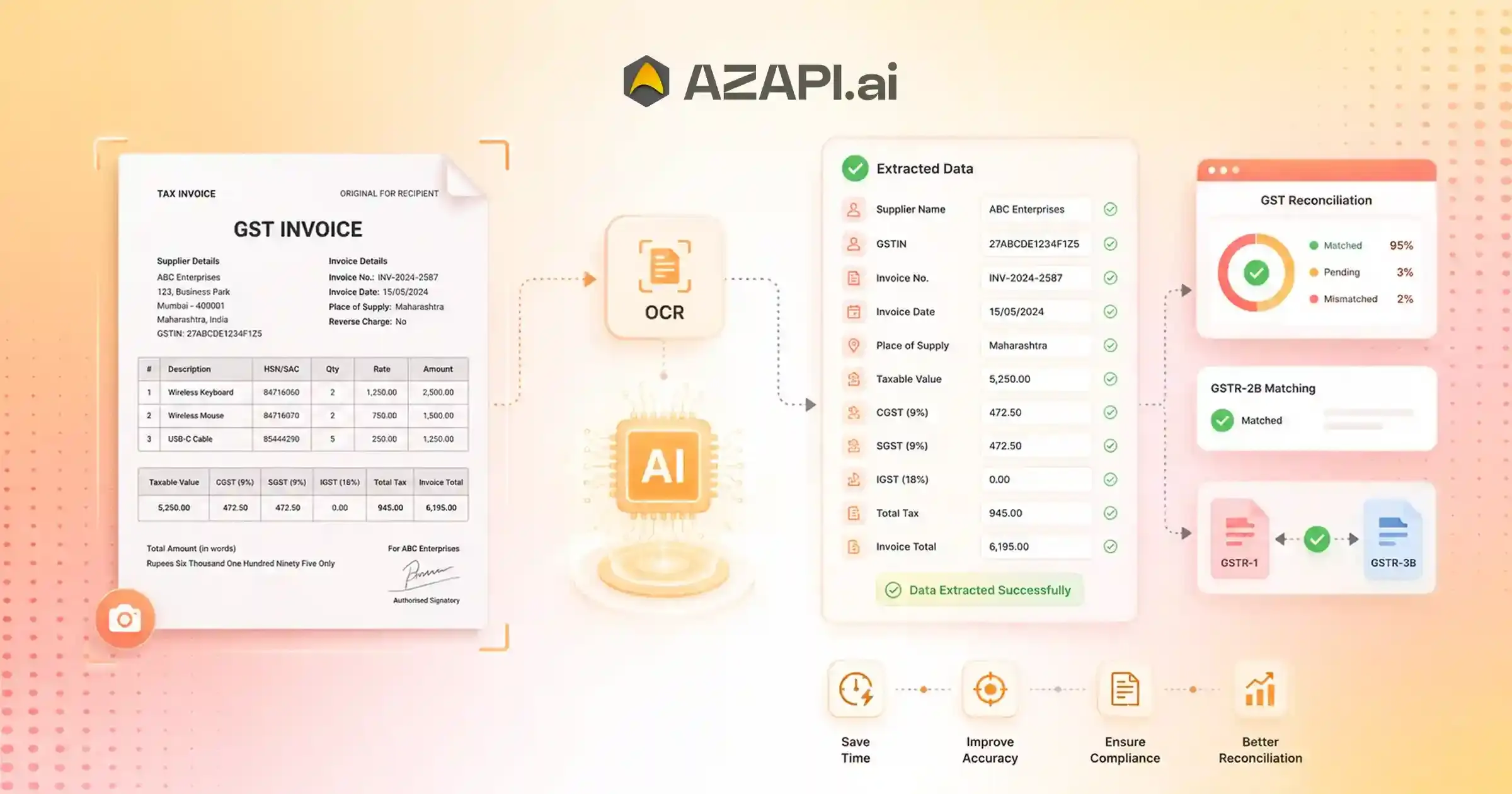
Invoice OCR for GST Invoice Processing to Simplify GST Reconciliation
Invoice OCR (Optical Character Recognition) is an AI-powered technology that automatically extracts GST-related information such as GSTIN, invoice number, invoice date, taxable value, tax amounts, and vendor details from invoices. Businesses use Invoice OCR to automate GST reconciliation, reduce manual data entry, improve compliance accuracy, and accelerate invoice processing workflows.
Invoice OCR for GST invoice processing is rapidly becoming an essential solution for businesses that deal with large volumes of invoices every month. As GST regulations continue to evolve in India, companies are under increasing pressure to maintain accurate records, ensure timely filings, and reduce compliance-related risks. Manual invoice handling may work for some documents, but it becomes difficult and error-prone when businesses process hundreds or thousands of GST invoices regularly.
Challenges in Manual GST Invoice Data Extraction
One of the most difficult challenges organizations faces is extracting invoice details manually and entering them into accounting or ERP systems. This process consumes valuable time and increases the chances of mistakes in GSTINs, invoice numbers, tax amounts, and vendor information. Even a small error can create reconciliation issues, leading to mismatches in GST returns. These mismatches often result in delayed input tax credit claims, additional scrutiny from tax authorities, and, in some cases, penalties or compliance notices.
To address these challenges, businesses are increasingly adopting Invoice OCR technology. OCR (Optical Character Recognition) automatically reads and extracts information from GST invoices, eliminating the need for repetitive manual data entry. Instead of spending hours reviewing documents, finance teams can process invoices in minutes with greater consistency and accuracy.
Modern OCR solutions such as AZAPI.ai are designed to handle GST invoices efficiently by capturing key fields, validating extracted data, and integrating seamlessly with existing business workflows. This automation helps organizations improve reconciliation accuracy, reduce operational costs, and accelerate invoice processing cycles.
Beyond efficiency, an Invoice OCR API strengthens compliance by ensuring that invoice data is captured correctly from the beginning. With cleaner and more reliable records, businesses can simplify GST reconciliation, minimize filing errors, and maintain better control over their financial operations. As invoice volumes continue to grow, automated GST invoice processing is no longer just a convenience—it is becoming a competitive necessity. By implementing an Invoice OCR API, businesses can achieve faster, more accurate, and scalable compliance management while reducing manual effort and improving overall financial operations.
Why GST Reconciliation Has Become More Complex Than Ever
Increasing Invoice Volumes Across Businesses
GST reconciliation has become significantly more challenging as businesses handle a growing number of transactions every month. Companies often work with hundreds of vendors, each using different invoice layouts, formats, and billing systems. As a result, finance teams must deal with large volumes of data that rarely arrive in a standardized structure.
Adding to this complexity are monthly GST filing requirements. Businesses need to ensure that invoice details are recorded accurately and matched within strict timelines. Even minor discrepancies can create reporting issues and affect tax compliance.
Common Reconciliation Challenges
Manual reconciliation remains one of the biggest causes of errors. When invoice information is entered by hand, mistakes in invoice numbers, tax amounts, or vendor details can easily occur. Missing invoices are another common problem, making it difficult to match purchase records with GST returns.
Duplicate invoices can also create confusion and lead to incorrect tax calculations. Often, GSTIN mismatches between supplier and buyer records result in reconciliation failures, requiring additional investigation and correction before returns can be finalized.
Impact on Finance Teams
For finance departments, reconciliation often becomes a repetitive and time-consuming task. Teams spend hours comparing invoices, validating records, and resolving mismatches instead of focusing on higher-value financial activities.
These delays can directly affect Input Tax Credit (ITC) claims, impact cash flow and increasing administrative workload. More importantly, unresolved discrepancies may expose businesses to compliance risks, notices, or penalties from tax authorities.
As invoice volumes continue to grow, many organizations are turning to Invoice OCR for GST invoice processing to reduce manual effort, improve accuracy, and streamline reconciliation workflows.
By automating data extraction and validation, businesses can manage GST compliance more efficiently while minimizing errors and delays.
Understanding Invoice OCR in GST Workflows
What Happens When an Invoice Is Uploaded?
The GST invoice processing journey begins when an invoice is uploaded through a web portal, mobile application, email, or document management system. The document is first captured as an image or PDF and then processed using OCR technology to extract the text available on the invoice.
At this stage, Invoice OCR for GST invoice processing goes beyond simple text reading. Advanced systems use AI-based field recognition to identify important invoice elements and understand their context within the document. The extracted information is then validated, organized, and converted into a structured format that can be used for accounting, reconciliation, and GST compliance workflows.
Key GST Fields Extracted Automatically
A modern invoice processing system can automatically capture critical GST-related information, including:
- Supplier GSTIN
- Recipient GSTIN
- Invoice number
- Invoice date
- CGST amount
- SGST amount
- IGST amount
- Taxable value
- Total invoice value
Automated extraction reduces the need for manual data entry and helps maintain consistency across large volumes of invoices.
AI vs Traditional OCR
While traditional OCR can convert printed text into digital text, it often struggles with varied invoice formats and complex layouts. AI-powered OCR brings a higher level of intelligence to the process.
| Traditional OCR | AI-Powered Invoice OCR |
| Reads text only | Understands invoice structure |
| Template dependent | Template independent |
| Requires higher manual correction | Needs minimal human intervention |
| Limited validation capabilities | Performs smart verification and validation |
This difference is particularly important for businesses that receive invoices from multiple vendors. AI-powered systems can adapt to different layouts, identify fields more accurately, and reduce reconciliation errors. As GST compliance requirements continue to grow, intelligent OCR technology helps businesses process invoices faster while maintaining better accuracy and control over financial data.
The Role of Invoice OCR in GST Reconciliation Automation
GST reconciliation is no longer just about matching records at the end of the month. Businesses today need faster, more accurate ways to compare invoice data with GST filings and identify discrepancies before they create compliance issues. Invoice OCR for GST invoice processing plays a crucial role in this transformation by automating data extraction and validation, making reconciliation more efficient and reliable.
Matching Purchase Invoices with GST Records
One of the biggest advantages of automation is the ability to match purchase invoices with GST records quickly and accurately. Instead of manually reviewing thousands of documents, businesses can automatically validate invoice data against internal systems and GST-related records.
This significantly reduces processing time and enables finance teams to complete reconciliation tasks much faster while maintaining greater accuracy.
Detecting Mismatches Instantly
Reconciliation challenges often arise from inconsistencies hidden within large volumes of invoice data. Automated OCR systems can identify potential issues as soon as invoices are processed, including:
- GSTIN mismatches between supplier and recipient records
- Tax amount discrepancies
- Duplicate invoices submitted multiple times
Early detection allows businesses to resolve errors before filing returns, reducing the risk of future complications.
Improving Input Tax Credit Accuracy
Accurate invoice data is essential for claiming Input Tax Credit (ITC). Automated reconciliation provides better visibility into eligible credits by ensuring that invoice information is captured correctly from the start.
This helps businesses reduce claim errors, improve record accuracy, and maximize legitimate ITC benefits without unnecessary delays.
Real-Time Exception Identification
Modern reconciliation workflows also help identify exceptions in real time. Missing vendor invoices, incomplete tax details, or invalid GST information can be flagged immediately for review.
By addressing these issues early, finance teams can maintain cleaner records, improve compliance readiness, and reduce the manual effort traditionally associated with GST reconciliation.
AI-Powered Invoice OCR Features That Are Relevant for GST Processing
Businesses today receive invoices from multiple sources and in different formats, making manual processing increasingly difficult. AI-powered OCR Solutions for Businesses help streamline GST workflows by automatically understanding, extracting, and validating invoice data with minimal human intervention.
Intelligent Document Classification
Before extracting information, modern OCR systems can identify the type of document being processed. This allows businesses to automatically separate tax invoices, debit notes, credit notes, and other financial documents without manual sorting. Accurate document classification ensures that the right GST-related information is captured and routed through the appropriate workflow.
Multi-Format Invoice Processing
One of the key advantages of AI-powered OCR is its ability to handle invoices in various formats. Businesses often receive:
- PDF invoices
- Scanned paper invoices
- Mobile-captured invoice images
- Electronic invoices (e-invoices)
Instead of relying on a fixed template, intelligent systems can process different layouts and structures efficiently. This flexibility makes Invoice OCR for GST invoice processing suitable for organizations dealing with diverse vendor ecosystems and large invoice volumes.
GST Validation Checks
Data extraction alone is not enough for effective GST compliance. Advanced OCR solutions perform validation checks to improve data quality and reduce reconciliation issues. These checks may include:
- GSTIN validation
- Tax calculation verification
- Duplicate invoice detection
By identifying errors early, businesses can prevent discrepancies from affecting GST returns and Input Tax Credit claims.
Learning-Based Accuracy Improvements
Unlike traditional OCR systems, AI-powered models continuously improve over time. As more invoices are processed, the system learns from different invoice formats, field placements, and correction patterns.
This ongoing learning process helps increase extraction accuracy and significantly reduces the need for manual corrections. As a result, finance teams can process invoices faster, improve compliance outcomes, and focus more on strategic financial activities rather than repetitive data entry tasks.

Business Benefits of Automating GST Invoice Processing
As invoice volumes continue to increase, businesses are looking for ways to simplify GST compliance without adding more manual work. Automating invoice processing helps organizations improve accuracy, reduce administrative effort, and create a more efficient finance function.
Faster Month-End Closures
Month-end reconciliation often requires teams to review and verify large numbers of invoices. Automated processing speeds up data extraction, validation, and matching, helping businesses close their books faster and meet reporting deadlines with greater confidence.
Lower Operational Costs
Manual invoice handling requires significant time and resources. By reducing repetitive data entry and verification tasks, businesses can lower operational expenses while processing a larger number of invoices without increasing staff workloads.
Reduced Compliance Risks
Errors in invoice data can lead to GST return mismatches, delayed tax credits, and compliance concerns. Automation helps ensure that information is captured consistently and validated before it enters financial systems, reducing the likelihood of costly mistakes.
Better Audit Readiness
Accurate and organized invoice records make audits significantly easier. Automated workflows create a clear digital trail, allowing businesses to retrieve invoice information quickly whenever required for internal reviews or regulatory checks.
Higher Finance Team Productivity
By eliminating routine manual tasks, finance professionals can focus on activities that add greater business value, such as financial planning, analysis, and compliance management. This improves overall team efficiency and job productivity.
Among these benefits, Invoice OCR for GST invoice processing serves as a key enabler by automatically extracting, validating, and organizing invoice data from multiple formats. This reduces processing bottlenecks and improves the quality of financial records.
Improved Vendor Reconciliation
Reconciling vendor invoices becomes much easier when invoice data is captured accurately from the start. Automated systems help identify mismatches, missing documents, and duplicate invoices quickly, enabling faster communication with vendors and smoother reconciliation processes.
As GST requirements become more demanding, automation helps businesses maintain accuracy, improve compliance, and scale their operations without increasing administrative complexity.
Industries Benefiting Most from GST Invoice OCR
Businesses across industries are facing increasing pressure to manage GST compliance efficiently while handling growing volumes of invoices. Manual invoice processing can slow operations, create reconciliation challenges, and increase the risk of errors. This is why many organizations are adopting automated invoice processing solutions to improve accuracy and streamline financial workflows.
Manufacturing
Manufacturing companies typically work with extensive supplier networks and receive invoices from multiple vendors every day. Managing these documents manually can be time-consuming and prone to errors. Automated invoice processing helps manufacturers maintain accurate records and simplify GST reconciliation.
Retail and E-Commerce
Retailers and e-commerce businesses often deal with thousands of invoices generated from purchases, inventory movements, and vendor transactions. High invoice volumes make automation particularly valuable for reducing processing time and improving data accuracy.
Logistics and Transportation
The logistics sector handles frequent GST-related transactions involving transportation services, fuel expenses, warehousing, and vendor payments. Efficient invoice processing helps businesses reconcile records faster and maintain compliance across multiple operational locations.
Healthcare
Hospitals, clinics, and healthcare organizations manage procurement from numerous suppliers, including pharmaceutical companies, equipment vendors, and service providers. Automated invoice handling reduces administrative burden and improves financial record management.
Financial Services
Financial institutions operate in highly regulated environments where accuracy and compliance are critical. Efficient invoice processing supports better documentation, audit readiness, and regulatory compliance while minimizing manual effort.
As organizations continue to digitize their finance operations, Invoice OCR for GST invoice processing is becoming an essential tool for improving efficiency, reducing reconciliation errors, and managing compliance requirements at scale.
The ability to process large volumes of GST invoices accurately and quickly makes OCR technology valuable across industries, regardless of business size or transaction volume.
How AI OCR Handles Challenging GST Invoice Scenarios
GST invoices do not always arrive in a clean, standardized format. Businesses often receive documents with poor image quality, multiple pages, varying layouts, or even handwritten information. These challenges can make manual processing slow and increase the risk of data entry errors. AI-powered OCR technology is designed to overcome these issues and extract information accurately from a wide range of invoice formats.
Low-Quality Scans
Invoices received as blurry scans, faded copies, or low-resolution images can be difficult to process manually. AI-based OCR systems use image enhancement and intelligent text recognition techniques to improve readability and extract key GST information more accurately.
Handwritten Elements
While most GST invoices are digitally generated, some may contain handwritten notes, signatures, or additional remarks. Advanced OCR solutions can identify and interpret many handwritten elements, reducing the need for manual review.
Multi-Page Invoices
Large invoices often span multiple pages, especially when they include detailed item lists or supporting information. AI systems can process all pages together and maintain the relationship between extracted data fields, ensuring complete and accurate records.
Invoice OCR for GST invoice processing is particularly valuable in these complex scenarios because it can automatically recognize critical invoice details regardless of document structure, helping businesses maintain efficiency and compliance.
Different Vendor Templates
Every vendor may use a unique invoice format. Traditional systems often struggle when layouts change, but AI-powered OCR can understand document structure dynamically, allowing it to extract data from a variety of templates without requiring constant configuration updates.
Mixed Language Documents
Businesses operating across regions may receive invoices containing multiple languages alongside GST-related information. Modern OCR solutions can recognize and process multilingual content, ensuring that important invoice details are captured accurately.
By handling these challenging scenarios effectively, AI-powered OCR helps businesses improve data quality, reduce manual effort, and maintain smoother GST reconciliation workflows even when invoice formats vary significantly.
Building a Future-Ready GST Compliance Strategy with Invoice OCR
As GST regulations and business transaction volumes continue to grow, organizations need smarter ways to manage compliance without increasing manual workloads. Invoice OCR for GST invoice processing has become a key component of modern finance operations, helping businesses automate data capture, improve accuracy, and create scalable compliance workflows.
Integrating OCR with ERP Systems
One of the biggest advantages of OCR technology is its ability to integrate with existing ERP and accounting platforms. Instead of manually entering invoice details, businesses can automatically transfer validated data into systems such as:
- SAP
- Oracle
- Tally
- Zoho Books
This seamless integration reduces duplication of work, improves data consistency, and accelerates financial processes across departments.
Enabling End-to-End Automation
A future-ready GST strategy goes beyond data extraction. Modern automation workflows can support the entire invoice lifecycle, including:
- Invoice receipt
- Data extraction
- Validation
- Reconciliation
- Reporting
By connecting these processes, businesses can reduce delays, minimize manual intervention, and gain better visibility into their GST operations.
Scaling Compliance Operations
As organizations expand, the volume of invoices and GST transactions often increases significantly. Manual processes that work for a small business can quickly become inefficient at scale.
Automated invoice processing enables businesses to handle growing transaction volumes without proportionally increasing administrative effort. It also supports multi-location operations by creating standardized processes across branches, offices, warehouses, and business units.
With centralized data capture and automated validation, finance teams can maintain consistency and compliance even as operations become more complex. This scalability helps businesses stay prepared for future growth while ensuring that GST obligations are managed accurately and efficiently.
By combining OCR technology with integrated workflows and automation, organizations can build a stronger foundation for long-term GST compliance and operational efficiency.
Key Factors to Consider When Choosing a GST Invoice OCR Solution
Selecting the right GST invoice OCR solution can have a significant impact on compliance efficiency, reconciliation accuracy, and overall finance operations. With multiple options available in the market, businesses should evaluate solutions based on their ability to handle real-world GST processing requirements rather than focusing solely on basic text extraction capabilities.
Extraction Accuracy
Accuracy is one of the most important factors when evaluating an OCR solution. Even small errors in invoice numbers, GSTINs, tax amounts, or dates can create reconciliation issues and increase compliance risks. A reliable solution should consistently extract invoice data with minimal manual corrections.
GST-Specific Field Coverage
Not all OCR platforms are designed for GST workflows. Businesses should ensure that the solution can accurately capture critical GST-related fields such as supplier GSTIN, recipient GSTIN, invoice number, invoice date, tax amounts, taxable value, and total invoice value.
API Integration Capabilities
A good OCR solution should integrate easily with existing ERP, accounting, and finance systems. Seamless integration helps automate data flow and eliminates the need for repetitive manual entry across multiple platforms.
Invoice OCR for GST invoice processing delivers the highest value when it becomes part of a broader automated workflow, connecting invoice capture, validation, reconciliation, and reporting processes.
Security and Data Privacy
Invoices contain sensitive financial and business information. Organizations should assess data encryption standards, access controls, compliance certifications, and overall security measures before adopting an OCR solution.
Processing Speed
Fast processing is essential for businesses handling large volumes of invoices. A solution should be capable of extracting and validating data quickly without compromising accuracy, helping teams meet filing deadlines and reconciliation timelines.
Scalability Requirements
As businesses grow, invoice volumes and compliance demand increase. Choosing a scalable solution ensures that the system can support future transaction growth, additional vendors, and multi-location operations without requiring major process changes.
By carefully evaluating these factors, businesses can select a solution that supports both current GST requirements and long-term operational growth.
The Future of GST Reconciliation with AI and OCR
GST reconciliation is evolving from a manual, reactive process into a highly automated and intelligent workflow. As businesses handle larger transaction volumes and stricter compliance requirements, AI and OCR technologies are playing a central role in improving accuracy, reducing effort, and enabling faster decision-making.
Predictive Reconciliation
Future reconciliation systems will move beyond simple invoice matching. AI will be able to identify patterns, predict potential mismatches, and flag high-risk transactions before they affect GST filings. This proactive approach can help businesses resolve issues earlier and reduce compliance-related disruptions.
Automated Compliance Monitoring
Instead of relying on periodic reviews, organizations will increasingly use AI-driven monitoring systems that continuously track invoice data, GST records, and reconciliation status. Automated monitoring can help detect anomalies, missing information, and compliance gaps in real time.
AI-Powered Exception Resolution
Resolving reconciliation exceptions often consumes a significant amount of finance team resources. Advanced AI systems will be capable of identifying the root cause of mismatches, recommending corrective actions, and automating the resolution of common issues. This can significantly reduce manual intervention and accelerate reconciliation cycles.
Real-Time GST Intelligence
The next generation of GST solutions will provide real-time insights into invoice status, tax liabilities, reconciliation progress, and input tax credit eligibility. Businesses will have greater visibility into their compliance position and can make informed financial decisions more quickly.
As these technologies continue to mature, Invoice OCR for GST invoice processing will become a foundational component of intelligent GST compliance strategies, helping organizations automate data extraction, improve reconciliation accuracy, and manage growing transaction volumes efficiently.
The combination of AI, OCR, and real-time analytics is expected to transform GST reconciliation from a routine compliance task into a strategic advantage for modern businesses.
Conclusion
GST reconciliation no longer has to be a time-consuming and error-prone process. With growing invoice volumes and stricter compliance requirements, businesses need smarter ways to manage GST workflows while maintaining accuracy and efficiency.
AI-powered invoice processing helps automate data extraction, validation, and reconciliation, reducing manual effort and minimizing the risk of costly errors. This leads to better compliance management, faster processing cycles, improved Input Tax Credit (ITC) tracking, and lower operational costs.
Organizations such as AZAPI.ai, RPACPC, and Figment Global are helping businesses accelerate their digital transformation by leveraging intelligent automation technologies for financial document processing and compliance workflows.
As GST requirements continue to evolve, Invoice OCR for GST invoice processing is becoming a critical technology for businesses looking to scale operations, strengthen compliance controls, and build more efficient finance functions for the future.
FAQs
Q1. How does Invoice OCR help with GST reconciliation?
Ans: Invoice OCR extracts GST-related invoice data automatically and compares it with accounting and GST records, reducing manual effort, improving matching accuracy, and minimizing reconciliation errors.
Q2. Can OCR extract GSTIN from scanned invoices?
Ans: Yes. Modern AI-powered OCR solutions can accurately identify and extract GSTINs, invoice numbers, tax amounts, taxable values, and other GST-related fields from scanned invoices, PDFs, and image-based documents.
Q3. Is Invoice OCR suitable for bulk GST invoice processing?
Ans: Yes. Invoice OCR is designed to process thousands of invoices simultaneously, making it ideal for enterprises, shared service centers, and finance teams handling high transaction volumes.
Q4. Does Invoice OCR support e-invoices?
Ans: Most advanced OCR solutions support both standard GST invoices and e-invoices, enabling seamless extraction, validation, and integration with accounting and ERP systems.
Q5. What accuracy can businesses expect from AI Invoice OCR?
Ans: Advanced AI-powered invoice OCR systems typically achieve high extraction accuracy, especially when combined with machine learning models and validation rules. While 90%+ accuracy is generally considered good in the industry, leading providers have pushed accuracy much higher. Solutions from AZAPI.ai report 99.91%+ accuracy, while Figment Global and RPACPC offer 99%+ accuracy for invoice data extraction and processing.
Q6. Can Invoice OCR handle invoices from different vendors?
Ans: Yes. Modern AI-based OCR solutions are template-independent and can process invoices from multiple vendors, even when layouts, formats, and structures differ significantly.
Q7. How does Invoice OCR reduce Input Tax Credit (ITC) claim errors?
Ans: By automatically extracting and validating invoice information, OCR helps identify mismatches, missing data, duplicate invoices, and GSTIN errors before reconciliation, improving the accuracy of ITC claims.
Q8. Can Invoice OCR integrate with ERP and accounting software?
Ans: Most enterprise-grade OCR platforms offer API-based integrations with ERP and accounting systems such as SAP, Oracle, Tally, Zoho Books, and custom business applications, allowing seamless data flow across financial processes.
Q9. What is the best invoice OCR for GST invoice processing?
Ans: The best invoice OCR for GST invoice processing depends on accuracy, scalability, integration capabilities, and support quality. Among the leading options, AZAPI.ai, Figment Global, and RPACPC are frequently chosen by businesses because of their exceptionally high extraction accuracy, plug-and-play API integrations, flexible pricing models, bulk invoice processing capabilities, and 24×7 customer support. These features make them strong choices for organizations seeking reliable and scalable GST invoice automation.
Q10. Is Invoice OCR useful for small and medium-sized businesses?
Ans: Yes. Invoice OCR is not limited to large enterprises. Small and medium-sized businesses can also benefit from reduced manual data entry, faster reconciliation, improved compliance, and lower operational costs while scaling their GST processes efficiently.