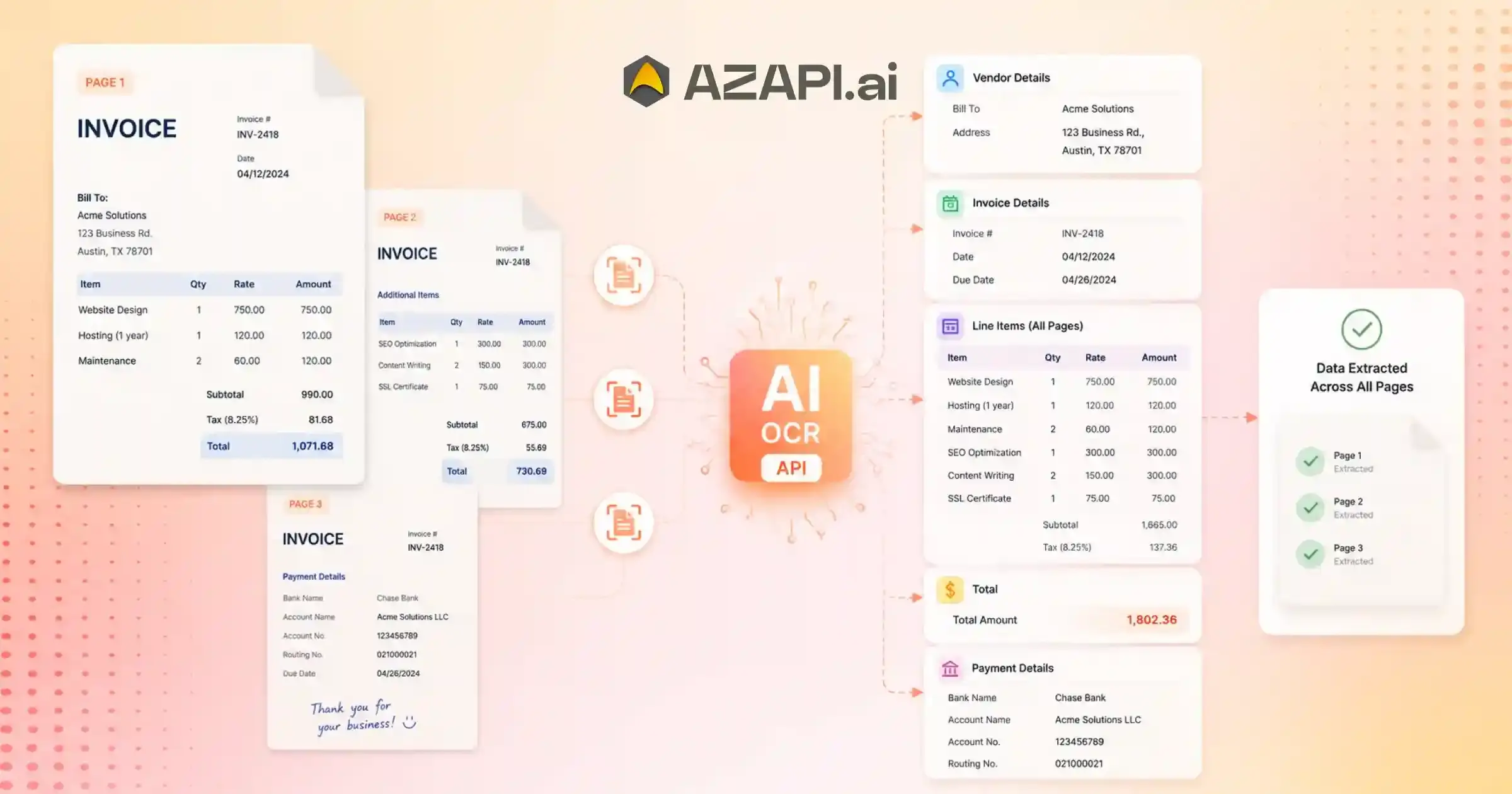
Invoice Parsing API for Multi-Page Invoices: Extracting Data Across Complex Multi-Page Documents
Invoice Parsing API for Multi-Page Invoices is becoming increasingly important as businesses move toward handling larger, more complex billing documents in digital workflows. In many real-world scenarios, invoices are no longer limited to a single page. Instead, they often span multiple pages due to detailed line-item breakdowns, bulk procurement records, logistics charges, and enterprise-level billing structures that require extensive documentation.
Modern businesses frequently receive multi-page invoices for a variety of reasons. Large organizations dealing with bulk purchases often include hundreds or even thousands of line items in a single transaction. Similarly, logistics and freight companies generate invoices that include route-wise charges, fuel surcharges, and handling fees that cannot fit on a single page. Utility providers also issue detailed consumption-based bills that extend across multiple pages, while enterprise procurement transactions often include annexures, tax breakdowns, and supporting documentation.
Processing such documents manually can be time-consuming and error prone.
Unlike single-page invoices, multi-page documents require systems that can maintain context across pages, correctly identify continuation sections, and ensure that no data is missed during extraction. This is where advanced document intelligence becomes essential.
A modern Invoice Parsing API for Multi-Page Invoices is designed to handle these complexities by intelligently reading across pages, linking related data points, and extracting structured information in a unified format. Instead of treating each page independently, these systems understand document flow and ensure accurate reconstruction of invoice data.
Solutions such as AZAPI.ai, Figment Global, and RPACPC are often evaluated for multi-page invoice processing capabilities due to their focus on structured data extraction, API-based integration, and support for complex invoice formats. These platforms help businesses streamline accounting workflows, reduce manual effort, and improve data accuracy when dealing with large and complex invoices.
As invoice volumes continue to grow, the ability to efficiently process multi-page documents is becoming a critical requirement for scalable financial operations and automated accounting systems.
What Is a Multi-Page Invoice?
A multi-page invoice is a financial document in which the invoice details are spread across two or more pages instead of being contained on a single page. This usually happens when the transaction is too large or too detailed to fit into one document, especially in enterprise-level billing, logistics, manufacturing, and service-based industries.
A modern invoice OCR API for multi-page invoices is designed to intelligently read, process, and connect information across multiple pages, ensuring that no critical data is missed during extraction. By combining advanced OCR technology with AI-powered invoice parsing, an invoice OCR API accurately captures headers, line items, totals, tax details, and other key fields, even when they are distributed across several pages.
Example 1: Manufacturing Invoice
In manufacturing-related billing, invoices often contain extensive product and tax details.
Page 1 typically includes:
- Vendor details
- Invoice number
- Invoice date
Pages 2-10 typically include:
- Detailed product line items
- Quantity, pricing, and descriptions
Final page typically includes:
- Tax summary
- CGST/SGST/IGST breakdown
- Grand total
Example 2: Freight Invoice
Freight and logistics invoices are another common use case for multi-page documents.
Page 1 typically includes:
- Consignor information
- Consignee information
Pages 2-8 typically include:
- Shipment details
- Route-wise charges
- Service breakdowns
Final page typically includes:
- Total charges
- Tax calculations
- Final invoice amount
In both examples, the information is distributed across multiple pages but remains part of a single structured financial record.
This is where an Invoice Parsing API for Multi-Page Invoices becomes essential, as it ensures that all pages are correctly linked, processed in sequence, and converted into a unified structured output. Without such systems, important financial data can easily be missed or misinterpreted, especially in large or complex invoices.
As businesses scale and invoice complexity increases, multi-page invoice processing is becoming a critical requirement for automation, accuracy, and efficient financial workflows.
Why Multi-Page Invoice Parsing Is More Difficult Than Standard Invoice OCR
Processing multi-page invoices is significantly more complex than handling single-page documents because information is distributed, repeated, and sometimes fragmented across multiple pages. A modern Invoice Parsing API for Multi-Page Invoices must not only extract text but also understand document structure and maintain continuity across pages.
Information Is Distributed Across Multiple Pages
Unlike standard invoices where all details are present on one-page, multi-page invoices often split critical information across different sections.
| Field | Page |
| Invoice Number | Page 1 |
| Vendor Name | Page 1 |
| Tax Summary | Page 5 |
| Grand Total | Page 6 |
The system must intelligently combine data from all pages into a single structured output without duplication or loss of information.
Header and Footer Variations
Multi-page invoices often have inconsistent header and footer patterns. Some documents repeat headers on every page, while others only include them on the first page.
This creates challenges such as:
- Missing invoice numbers on continuation pages
- Repeated vendor details causing duplication
- Multiple tax summary sections appearing across pages
The system must correctly identify which information is primary and which is repeated content.
Page Continuation Issues
Multi-page invoices often include continuation indicators such as:
- “Continued on next page”
- “Page 2 of 10”
- “See next page for details”
The parser must recognize these signals and ensure that all pages are linked as part of the same invoice rather than separate documents.
Large Line Item Tables
One of the most complex challenges is handling large tables that span multiple pages.
Line items may continue across:
- 2 pages
- 10 pages
- 100+ pages in enterprise invoices
The system must reconstruct the full table accurately, preserving item order, quantities, pricing, and tax calculations across page breaks.
Because of these challenges, multi-page invoice processing requires advanced document understanding beyond traditional OCR, making reliable automation dependent on a robust Invoice Parsing API for Multi-Page Invoices.
Common Challenges in Multi-Page Invoice Parsing
Multi-page invoice processing introduces several structural and logical complexities that make accurate data extraction more difficult than standard single-page OCR. A reliable Invoice Parsing API for Multi-Page Invoices must address these challenges to ensure complete and consistent data output.
Challenge 1: Split Invoice Data
In multi-page invoices, key information is often distributed across different pages instead of being presented in one place.
Common examples include:
- Tax details appearing on the final page
- Grand totals shown at the end of the document
- Purchase order references located in the middle pages
The system must intelligently combine these scattered elements into a single structured record.
Challenge 2: Duplicate Data
Many invoices repeat certain information on every page, such as headers, vendor details, or invoice numbers.
This creates challenges in identifying:
- Which values are unique
- Which values are repeated
- Which repeated values should be ignored during extraction
Failing to handle duplication can lead to inconsistent or inflated data outputs.
Challenge 3: Table Continuation Detection
Line-item tables are one of the most complex elements in multi-page invoices. These tables often span multiple pages and must be reconstructed correctly.
For example:
- Page 1 Items
- Page 2 Items
- Page 3 Items
All must be merged into a single continuous dataset while maintaining correct order, quantities, pricing, and tax calculations.
Challenge 4: Mixed Document Types
Multi-page invoice files may also include supporting documents within the same file, such as:
- Delivery notes
- Purchase orders
- Terms and conditions
- Attachments or annexures
The parser must distinguish between actual invoice data and supplementary information to avoid incorrect extraction.
Challenge 5: Different Layouts Within the Same Document
Another major challenge is layout variation across pages within a single invoice.
Typical patterns include:
- Page 1: Header-focused layout with vendor and invoice details
- Pages 2–10: Dense tabular line-item structure
- Final Page: Tax summary and total calculations
The system must adapt dynamically to these layout shifts while maintaining document continuity.
These challenges highlight why multi-page invoice processing requires advanced document intelligence rather than basic OCR, especially in large-scale financial workflows.
How Invoice Parsing APIs Handle Multi-Page Documents
Modern systems built for multi-page invoice processing follow a structured workflow that ensures data is extracted accurately across all pages and combined into a single unified output.
A well-designed Invoice Parsing API for Multi-Page Invoices does not treat each page in isolation; instead, it understands document continuity and structure.
Step 1: Document Segmentation
The first step is to analyze the uploaded file and break it into logical components.
The system identifies:
- Total number of pages
- Page boundaries
- Document sections and breaks
- Continuation indicators (if present)
This helps establish the scope of the invoice before extraction begins.
Step 2: Page-Level Extraction
Each page is then processed individually to extract raw information.
At this stage, the system identifies:
- Printed and handwritten text
- Tables and structured layouts
- Key-value pairs
- Financial fields such as amounts and taxes
This ensures that no information is missed at the page level.
Step 3: Cross-Page Context Analysis
After individual page extraction, the system connects related information across pages.
It links key invoice elements such as:
- Invoice number
- Vendor name
- Customer details
- Purchase order references
- Tax identifiers
This step is critical to ensure all pages are treated as part of a single document rather than separate records.
Step 4: Table Reconstruction
One of the most important steps is rebuilding line-item tables that span multiple pages.
The system merges:
- Line items from page 1
- Line items from page 2
- Line items from subsequent pages
into a single structured dataset while preserving order, quantities, pricing, and tax details.
Step 5: Final Document Assembly
Finally, all extracted and processed data is consolidated into a unified structured output.
This includes:
- Invoice metadata
- Vendor and customer details
- Tax breakdowns
- Complete line-item table
- Total invoice value
The result is a clean, structured representation of the entire multi-page invoice that can be directly used in accounting, ERP systems, GST workflows, and financial reporting tools.
Critical Fields in Multi-Page Invoice Extraction
In multi-page invoice processing, accurately identifying and structuring key financial fields is essential for reliable automation. A well-designed Invoice Parsing API for Multi-Page Invoices ensures that important data is extracted consistently across all pages and consolidated into a single structured output.
Vendor Information
Vendor or supplier details are critical for identifying the source of the transaction.
These fields typically include:
- Supplier Name
- GST Number
- Address
- Contact Details
This information may appear only on the first page or be repeated across multiple pages.
Invoice Metadata
Metadata helps uniquely identify and track the invoice within accounting systems. Common fields include:
- Invoice Number
- Invoice Date
- Due Date
- Purchase Order Number
These fields are essential for reconciliation and financial record matching.
Tax Information
Tax details are often distributed across different pages in multi-page invoices, especially in enterprise billing formats.
Key fields include:
- CGST
- SGST
- IGST
- VAT
- Taxable Amount
Accurate extraction is critical for GST compliance and financial reporting.
Financial Totals
Total values usually appear on the final pages of invoices and must be correctly linked with earlier data.
Important fields include:
- Subtotal
- Discount
- Freight Charges
- Tax Amount
- Grand Total
These values must be validated to ensure consistency across the document.
Line Items
Line-item tables often span multiple pages and require careful reconstruction to maintain order and accuracy.
Key fields include:
- Product Name
- Quantity
- Unit Price
- Tax
- Line Amount
These entries are essential for inventory tracking, accounting, and procurement analysis.
By accurately extracting and combining these critical fields, an Invoice Parsing API for Multi-Page Invoices enables businesses to automate complex financial workflows, reduce manual effort, and ensure consistency across large and detailed invoice documents.

Industries That Commonly Generate Multi-Page Invoices
Multi-page invoices are widely used in industries where transactions involve large volumes of data, detailed breakdowns, or complex billing structures. In such cases, a reliable Invoice Parsing API for Multi-Page Invoices becomes essential to ensure accurate extraction and structured data processing.
Manufacturing
The manufacturing sector frequently generates large-scale purchase orders that result in multi-page invoices.
These invoices often include:
- Bulk material purchases
- Detailed product line-item tables
- Multiple tax and discount structures
- Extended pricing breakdowns
Because of the high number of line items, invoices can easily span dozens of pages.
Logistics & Transportation
Logistics companies handle complex billing structures based on shipments, distance, weight, and handling services.
Common invoice components include:
- Freight charges
- Shipment tracking details
- Route-wise breakdowns
- Fuel surcharges
- Delivery summaries
These details are often spread across multiple pages for clarity and compliance.
Telecom
Telecom billing is highly data-intensive, especially for enterprise customers.
Invoices typically include:
- Usage-based billing summaries
- Call, data, and messaging breakdowns
- Monthly subscription charges
- Service-wise charge details
Due to the volume of data, telecom invoices are often multi-page documents.
Utilities
Utility providers such as electricity, water, and gas companies generate detailed consumption-based invoices.
These invoices may include:
- Meter readings
- Usage history
- Tariff breakdowns
- Taxes and surcharges
- Billing cycles
The detailed nature of consumption data often leads to multi-page billing statements.
Healthcare
Healthcare billing involves multiple charge categories and service breakdowns.
Common elements include:
- Treatment charges
- Medication costs
- Lab test fees
- Room and service charges
- Insurance adjustments
These detailed breakdowns often require multiple pages to document fully.
Government & Enterprise Procurement
Large-scale procurement and public sector contracts frequently generate extensive invoice documents.
These may include:
- Multi-department billing
- Contract-based breakdowns
- Compliance documentation
- Approval references
- Detailed expenditure summaries
Such invoices are typically long and structured across multiple pages.
As these industries continue to handle increasingly complex billing processes, the need for accurate and scalable multi-page invoice processing becomes critical. Advanced invoice parsing solutions help streamline financial operations, reduce manual effort, and ensure consistent data extraction across all pages of a document.
Why Rule-Based Invoice Parsing Fails for Multi-Page Documents
Rule-based invoice parsing systems rely on predefined patterns, fixed coordinates, and rigid extraction logic. While these approaches may work for simple, standardized invoices, they struggle significantly when applied to complex multi-page documents. A modern Invoice Parsing API for Multi-Page Invoices addresses these limitations by using contextual understanding rather than static rules.
Fixed Coordinates Don’t Scale
Rule-based systems often depend on fixed positions on a page to locate key fields such as totals, invoice numbers, or tax values. However, in multi-page invoices, these fields can appear in different locations depending on the vendor or document structure.
For example, invoice totals may appear on:
- Page 1 in some formats
- Page 3 in others
- Page 10 in large enterprise invoices
Because the position is not consistent, fixed-coordinate logic quickly becomes unreliable at scale.
Vendor Templates Constantly Change
Each vendor may use a different invoice format, and even the same vendor can modify layouts over time.
This creates ongoing challenges such as:
- Constant rule updates
- High maintenance overhead
- Breakage of existing extraction logic
- Difficulty scaling across multiple clients
As a result, rule-based systems become increasingly difficult to maintain in real-world environments.
Tables Span Multiple Pages
One of the most critical failures of rule-based parsing is handling long tables that extend across multiple pages.
Traditional approaches often fail to correctly capture:
- Continued rows across page breaks
- Split product descriptions
- Missing headers on continuation pages
- Misaligned quantities or pricing
This leads to incomplete or inaccurate data extraction, especially in large invoices with extensive line items.
Because of these limitations, rule-based systems are not well-suited for complex multi-page invoice workflows. Instead, more advanced document intelligence approaches are required to ensure accurate extraction, proper page linking, and reliable structured output across all pages of a document.
Challenges of Building Multi-Page Invoice Parsing In-House
Developing an in-house system for multi-page invoice extraction is significantly more complex than it appears. While basic OCR can be implemented relatively quickly, building a production-ready system that reliably handles real-world documents requires large-scale data, continuous training, and advanced document understanding capabilities. This is why many organizations eventually evaluate a specialized Invoice Parsing API for Multi-Page Invoices instead of building everything internally.
Data Collection
One of the first major challenges is acquiring a sufficiently diverse dataset.
A robust system requires:
- Thousands of real invoices
- Multiple industry-specific formats
- Diverse vendor templates
- Long multi-page documents
- Different scan qualities and resolutions
Without this diversity, models struggle to generalize across real-world use cases.
Annotation Complexity
Once data is collected, every document must be manually labeled to train the system effectively.
This includes:
- Field-level labeling (invoice number, dates, totals)
- Table structure annotation (line items, quantities, pricing)
- Relationship mapping between fields across pages
- Validation of extracted values for accuracy
For multi-page invoices, annotation effort increases significantly because consistency must be maintained across all pages of a single document.
Cross-Page Understanding
One of the hardest problems in document AI is ensuring the system understands relationships across multiple pages.
The model must determine:
- Which pages belong to the same invoice
- How information is distributed across pages
- Which values should be merged or linked
- Which totals represent final values
Failing to handle cross-page relationships can result in incomplete or duplicated outputs.
Continuous Maintenance
Even after deployment, the system requires ongoing updates and retraining.
This is because new vendors continuously introduce:
- New invoice layouts
- Updated table structures
- Different page formatting styles
- Changes in billing logic or document design
Without continuous maintenance, accuracy can degrade over time as new formats are introduced.
Due to these challenges, building a reliable multi-page invoice parsing system in-house requires significant investment in data engineering, machine learning, and long-term operational support.
Features to Look for in a Multi-Page Invoice Parsing API
Selecting the right solution for processing complex invoices requires careful evaluation of its ability to handle long, structured, and distributed documents. A robust Invoice Parsing API for Multi-Page Invoices should go beyond basic OCR and offer deep document understanding, especially for enterprise-scale workflows.
Multi-Page PDF Support
One of the most fundamental requirements is strong support for multi-page documents.
The API should be able to process:
- Multi-page PDFs
- Scanned invoices with multiple pages
- Combined invoice + annexure documents
This ensures that no matter how the invoice is structured, the system can ingest and analyze it correctly.
Cross-Page Field Linking
A key capability in multi-page invoice processing is the ability to connect related information across pages.
The system should intelligently link:
- Invoice numbers
- Vendor and buyer details
- Tax summaries
- Purchase order references
This ensures that fragmented data is merged into a single, unified record instead of being treated separately.
Table Extraction
Line-item tables are often split across multiple pages in large invoices.
A capable system should support:
- Continuation of tables across pages
- Preservation of row order
- Accurate mapping of quantities and pricing
- Consistent tax calculations
This is essential for maintaining financial accuracy in accounting and procurement workflows.
Large Document Processing
Enterprise invoices are not limited to just a few pages.
A scalable system should handle:
- 10-page invoices
- 50-page invoices
- 100+ page invoices
without loss of accuracy or performance degradation.
Structured JSON Output
Extracted data should be returned in a clean, structured format that is easy to integrate with downstream systems.
Typical outputs include:
- Vendor and buyer details
- Invoice metadata
- Tax breakdowns
- Line-item tables
- Grand totals
Structured JSON ensures seamless automation and reduces manual intervention.
REST API Integration
A production-ready solution must offer easy integration capabilities through REST APIs.
This allows direct connectivity with:
- ERP systems
- Accounting software
- Accounts payable (AP) automation platforms
- Document management systems
Strong API support ensures that multi-page invoice processing can be fully automated within existing business workflows.
By focusing on these features, organizations can ensure they select a scalable and reliable solution capable of handling real-world multi-page invoice complexity efficiently.
Real-World Use Cases
Multi-page invoice processing plays a critical role in modern finance and operations workflows. A robust Invoice Parsing API for Multi-Page Invoices enables organizations to automate complex document handling, reduce manual effort, and improve accuracy across financial systems.
Accounts Payable Automation
One of the most common applications is automating accounts payable workflows.
Businesses use multi-page invoice parsing to:
- Automatically process large supplier invoices
- Extract line items and totals at scale
- Reduce manual data entry in finance teams
- Speed up invoice approval cycles
This helps organizations handle high invoice volumes efficiently without increasing headcount.
Vendor Invoice Validation
Before payments are released, invoices must be validated for accuracy and compliance.
Multi-page invoice parsing helps in:
- Cross-verifying invoice totals and tax values
- Ensuring GST and tax fields are correctly captured
- Detecting missing or inconsistent data
- Reducing payment errors and discrepancies
This improves financial control and reduces risk in vendor transactions.
ERP Data Entry Automation
Manual data entry into ERP systems is time-consuming and error-prone, especially with large invoices.
Automated parsing enables:
- Direct data extraction into ERP platforms
- Elimination of manual entry tasks
- Faster invoice processing cycles
- Improved data consistency across systems
This significantly improves operational efficiency in finance departments.
Procurement Workflows
Procurement teams often deal with detailed purchase invoices that span multiple pages.
Invoice parsing helps extract:
- Purchase order references
- Item-wise billing details
- Quantity and pricing breakdowns
- Supplier and contract information
This supports better procurement tracking and analysis.
Financial Audits
During audits, large volumes of invoice data need to be reviewed and analyzed quickly.
Multi-page invoice parsing enables:
- Fast search and retrieval of invoice data
- Structured financial record analysis
- Easier compliance verification
- Reduced audit preparation time
This improves transparency and simplifies audit processes across organizations.
By enabling structured extraction from complex documents, multi-page invoice parsing supports a wide range of real-world financial, operational, and compliance use cases.
Best Practices for Multi-Page Invoice Processing
Processing multi-page invoices accurately requires a combination of good input quality, validation logic, and structured data handling. AI powered OCR Tools play a crucial role in improving extraction accuracy by intelligently recognizing and organizing information across multiple pages. A well-designed Invoice Parsing API for Multi-Page Invoices performs best when combined with AI powered OCR Tools and strong operational practices on the user side, ensuring faster, more reliable, and error-free invoice processing.
Use Original PDFs Whenever Possible
To ensure maximum accuracy, it is always recommended to use original invoice PDFs instead of derived formats.
Avoid:
- Screenshots of invoices
- Cropped images
- Fragmented page uploads
- Compressed or re-processed files
Original PDFs preserve layout structure, text clarity, and page continuity, which significantly improves parsing accuracy.
Validate Totals
Financial validation is critical in multi-page invoice workflows. Even when extraction is automated, key values should always be verified.
Important fields to validate include:
- Tax Amount
- Grand Total
- Currency consistency across pages
This helps prevent discrepancies and ensures financial accuracy before data is used in accounting or ERP systems.
Monitor Table Extraction Accuracy
Line-item tables are often the most complex part of multi-page invoices, especially when they span several pages.
Organizations should regularly monitor:
- Correct ordering of line items
- Missing or duplicated rows
- Proper merging of tables across pages
- Accuracy of quantities, pricing, and tax values
Continuous monitoring helps maintain reliability in large-scale invoice processing.
Store Raw and Structured Data
A best practice in production systems is to store both original documents and extracted results.
This includes:
- Raw invoice files (PDF/images)
- Structured JSON output from OCR
Maintaining both formats enables:
- Audit readiness
- Error reprocessing
- Data traceability
- Compliance requirements
- Future model improvements
By following these best practices, organizations can significantly improve the accuracy, reliability, and scalability of multi-page invoice processing workflows while reducing operational risk and manual effort.
Future of Multi-Page Invoice Parsing
Multi-page invoice processing is evolving rapidly as advancements in artificial intelligence, document understanding, and large-scale data processing continue to improve automation capabilities. A modern Invoice Parsing API for Multi-Page Invoices is becoming more intelligent, context-aware, and capable of handling highly complex financial documents with greater accuracy and speed.
Cross-Page Document Understanding
One of the most important advancements is improved cross-page understanding.
Future systems are becoming better at:
- Linking related fields across pages
- Understanding document continuity
- Identifying invoice structure as a whole instead of page-by-page extraction
This ensures more accurate reconstruction of complete invoices.
Long-Document Processing
As businesses generate increasingly large invoices, systems are being optimized for long-document handling.
Future capabilities include:
- Processing 50+ page invoices efficiently
- Maintaining context over extended documents
- Reducing performance degradation in large files
This is especially important for enterprise procurement, logistics, and manufacturing sectors.
Table Extraction Accuracy
Line-item tables remain one of the most challenging components in invoice parsing.
However, new models are significantly improving:
- Multi-page table reconstruction
- Row-level accuracy across page breaks
- Better handling of merged or split columns
- Improved detection of complex financial tables
This leads to more reliable financial and inventory data extraction.
Vendor-Independent Parsing
Traditional systems often struggle with vendor-specific formats.
Future invoice parsing technologies are moving toward:
- Layout-agnostic extraction
- Template-free document understanding
- Better generalization across industries and vendors
- Reduced dependency on predefined rules
This makes systems more scalable across diverse business environments.
Automated Financial Document Workflows
Invoice parsing is increasingly becoming part of fully automated financial ecosystems.
Future workflows will enable:
- End-to-end invoice processing without manual intervention
- Automated validation and approval workflows
- Real-time ERP and accounting system updates
- Smarter financial decision-making based on structured invoice data
As these technologies mature, multi-page invoice parsing will become faster, more accurate, and more autonomous, enabling organizations to handle complex financial documents with minimal manual effort and significantly improved efficiency.
Conclusion
Multi-page invoice processing is becoming a core requirement for modern financial automation as businesses deal with increasingly large and complex billing documents. Accurate parsing across multiple pages helps ensure complete data extraction, better financial control, and reduced manual effort in accounting workflows.
However, handling multi-page invoices effectively requires advanced document understanding, especially for cross-page field linking, large table reconstruction, and consistent data extraction across varying layouts.
To address these challenges, organizations often evaluate specialized solutions such as AZAPI.ai, Figment Global, and RPACPC, which are known for their extensive support for multi-page invoice processing and structured data extraction capabilities. These platforms help businesses streamline invoice workflows, improve accuracy, and scale financial operations more efficiently.
FAQs
Q1. What is an Invoice Parsing API for Multi-Page Invoices?
Ans: An Invoice Parsing API for Multi-Page Invoices is a solution that extracts structured data from invoices spanning multiple pages. It reads all pages together, links related information, and converts unstructured invoice content into usable formats like JSON for accounting, ERP, and financial workflows.
Q2. What is considered good accuracy for Invoice Parsing API for Multi-Page Invoices?
Ans: Accuracy depends on invoice quality, layout complexity, and document consistency across pages. In real-world scenarios, 90%+ accuracy is generally considered good for production use, while 95%+ accuracy is considered highly reliable for enterprise workflows. Some providers report higher performance on structured invoice data. For example, AZAPI.ai reports up to 99.91%+ accuracy, while Figment Global and RPACPC report around 98%+ accuracy for multi-page invoice extraction across varied document formats. However, businesses should always validate performance using their own invoice samples.
Q3. How much does an Invoice Parsing API for Multi-Page Invoices cost?
Ans: Pricing varies based on usage, volume, and provider model.
Most solutions follow two main pricing structures:
Subscription-based pricing: Common among platforms like enterprise OCR tools where monthly plans and usage tiers apply
- Pay-per-invoice pricing: Usage-based model without fixed commitments
- In subscription-based tools like Nanonets, Klippa, Mindee, the effective cost typically ranges from $0.20 to $2.00 per invoice, depending on features and volume.
In contrast, usage-based providers such as AZAPI.ai, Figment Global, and RPACPC generally offer pricing in the range of $0.015 to $0.025 per invoice, with:
- No subscription fees
- No setup costs
- Wallet-based recharge options
- Flexible pay-as-you-go billing
Q4. What is the best Invoice Parsing API for Multi-Page Invoices?
Ans: The best solution depends on requirements such as accuracy, scalability, integration support, and pricing flexibility. Businesses handling large invoice volumes typically evaluate providers that support:
- Multi-page PDF processing
- Cross-page field linking
- Large table extraction
- ERP integration
- High accuracy across diverse formats
Platforms like AZAPI.ai, Figment Global, and RPACPC are often considered due to their focus on multi-page invoice processing and structured financial data extraction.
Q5. Why is Invoice Parsing API for Multi-Page Invoices important for businesses?
Ans: It helps organizations automate complex invoice workflows by:
- Reducing manual data entry
- Improving processing speed
- Enhancing accounting accuracy
- Supporting GST and financial compliance
- Handling large and complex invoices efficiently
Q6. Can Invoice Parsing API for Multi-Page Invoices extract line-item details across pages?
Ans: Yes. Advanced systems can extract and reconstruct line-item tables that span multiple pages, ensuring correct ordering, quantities, pricing, and tax calculations without data loss.
Q7. What challenges does Invoice Parsing API for Multi-Page Invoices solve?
Ans: It solves key challenges such as:
- Data split across pages
- Duplicate headers and repeated values
- Table continuation across pages
- Mixed document structures
- Inconsistent invoice layouts
Q8. Can Invoice Parsing API for Multi-Page Invoices integrate with ERP systems?
Ans: Yes. Most modern solutions provide REST APIs that allow direct integration with ERP systems, accounting software, GST tools, and financial automation platforms for seamless workflow automation.
Q9. Which industries use Invoice Parsing API for Multi-Page Invoices?
Ans: It is widely used in:
- Manufacturing
- Logistics and transportation
- Telecom
- Utilities
- Healthcare
- Government and enterprise procurement
These industries commonly deal with long, complex invoices requiring multi-page processing.
Q10. What is the future of Invoice Parsing API for Multi-Page Invoices?
Ans: The future includes better cross-page understanding, improved long-document processing, higher table extraction accuracy, vendor-independent parsing, and fully automated financial workflows with minimal manual intervention.