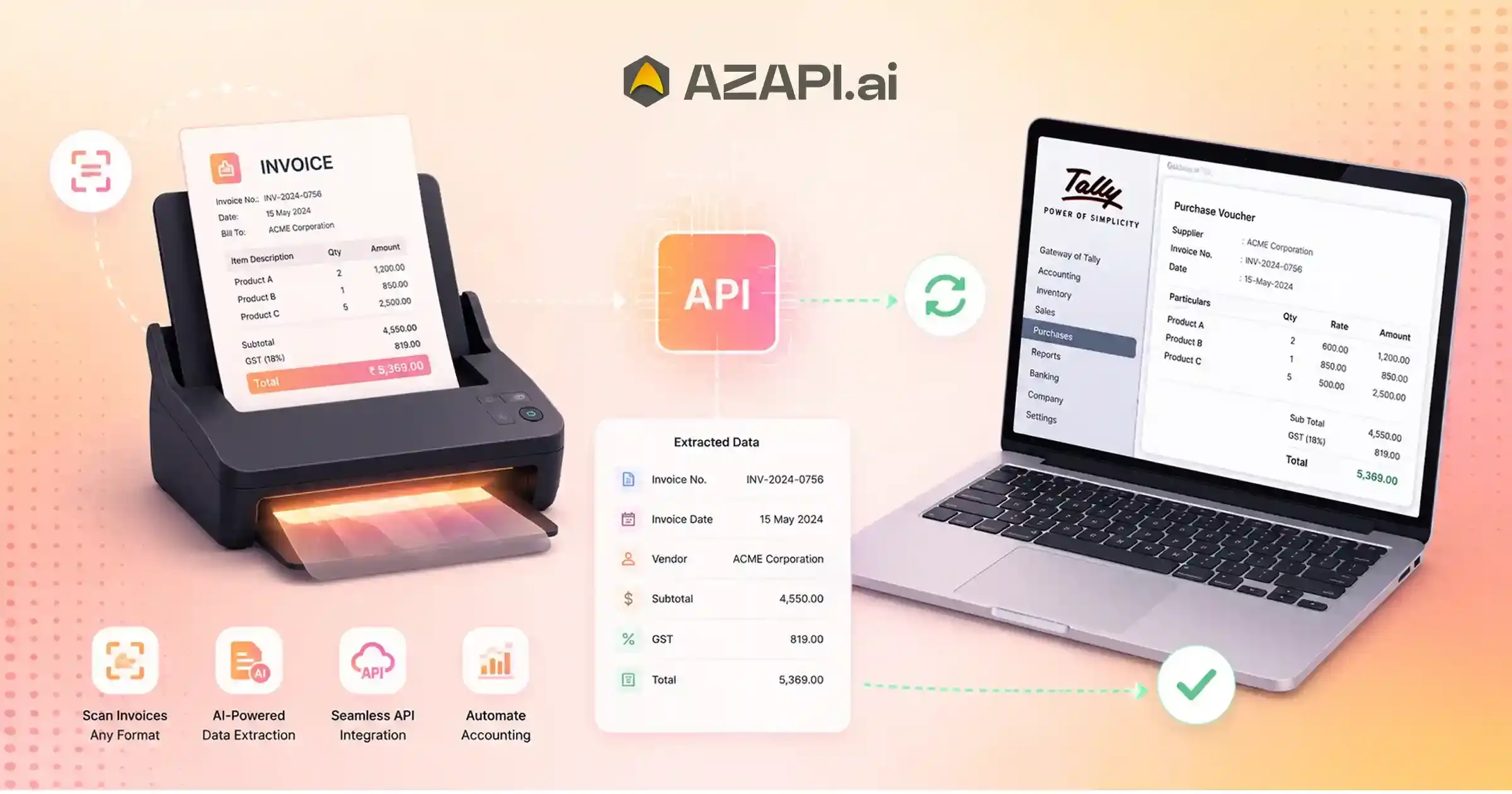
Invoice Scanning API with Tally Integration: AI-Powered Invoice Automation
What Is an Invoice Scanning API with Tally Integration?
An Invoice Scanning API with Tally Integration uses artificial intelligence and OCR technology to capture invoice information from PDFs, scanned documents, emails, and images. The API automatically extracts fields such as supplier details, invoice numbers, GST information, tax values, line items, and totals, then transfers the structured data into Tally workflows. This reduces manual accounting work, improves data accuracy, speeds up invoice processing, and supports scalable financial operations.
Invoice Scanning API with Tally Integration is rapidly becoming a preferred solution for businesses that want to simplify accounting operations and reduce the burden of manual invoice processing. As organizations grow, so does the number of invoices they receive from vendors, suppliers, and service providers. What may have once been a manageable process can quickly become a major operational challenge when finance teams are expected to handle hundreds or even thousands of invoices every month.
For many accounting departments, invoice management remains a persistent bottleneck. Team members often spend countless hours opening invoices, reviewing details, extracting information, and manually entering data into accounting systems. This repetitive process not only consumes valuable time but also increases the likelihood of mistakes. A single error in an invoice number, GST detail, tax amount, or vendor name can create reconciliation issues and lead to additional work later.
The challenge becomes even greater as businesses scale. Modern companies receive invoices in multiple formats, including PDFs, scanned documents, emailed attachments, and mobile-captured images. Managing these documents manually can slow approvals, delay bookkeeping activities, and reduce overall productivity.
This is where AI-powered invoice scanning technology is making a significant impact.
Instead of relying on manual data entry, intelligent systems can automatically read invoices, extract key information, and prepare the data for accounting workflows. This allows finance teams to process invoices faster while improving consistency and accuracy.
Solutions such as AZAPI.ai invoice OCR API help businesses automate invoice data extraction and streamline financial operations through advanced AI and OCR technologies. By reducing repetitive administrative tasks, organizations can focus more on financial analysis, compliance, and strategic decision-making.
As digital transformation continues to reshape accounting practices, businesses are increasingly looking for ways to automate routine processes. Implementing an Invoice Scanning API with Tally Integration can help create a faster, more efficient, and scalable invoice management process while supporting long-term business growth.
Why Businesses Are Moving Toward AI-Powered Invoice Automation
As businesses grow, the volume of invoices they handle often increases faster than their accounting capacity. What starts as a manageable process can quickly become a time-consuming administrative burden. This is one of the main reasons organizations are investing in AI-powered invoice automation to improve efficiency and reduce operational friction.
The Hidden Cost of Manual Invoice Processing
Manual invoice processing involves more than just entering data into accounting software. Finance teams spend significant time opening documents, verifying details, matching records, and correcting errors. These labor-intensive workflows can consume valuable resources that could otherwise be used for financial analysis and strategic planning.
Data entry mistakes are another common challenge. Incorrect invoice numbers, tax details, or vendor information can create reconciliation issues and increase the risk of compliance problems. In many cases, errors are only discovered later, requiring additional time and effort to resolve.
Manual processes can also lead to delayed payments. When invoices move slowly through approval and data entry stages, payment cycles become longer, potentially affecting vendor relationships and cash flow management. Combined with repetitive administrative work, these challenges contribute to broader operational inefficiencies.
Growing Demand for Financial Automation
The shift toward financial automation is being driven by several factors. Digital transformation initiatives are encouraging businesses to replace paper-based and manual workflows with smarter, technology-driven processes.
At the same time, increasing invoice volumes are making traditional bookkeeping methods harder to sustain. Companies need scalable solutions that can handle growth without requiring proportional increases in staffing costs.
Competitive pressures are also pushing organizations to improve productivity and reduce overhead. Businesses that automate financial processes can often respond faster, operate more efficiently, and gain better visibility into their financial data.
For many organizations, adopting an Invoice Scanning API with Tally Integration is becoming a practical step toward modernizing accounting operations and building a more efficient, scalable finance function.
What Is an Invoice Scanning API?
Businesses receive invoices in many different formats, from emailed PDFs and scanned documents to mobile-captured images. Processing these documents manually can be slow, repetitive, and prone to errors. An Invoice Scanning API helps automate this process by extracting important information from invoices and converting it into structured data that accounting systems can use.
Core Functionality
An invoice scanning API is designed to handle several key stages of invoice processing:
Invoice Ingestion
The system accepts invoices from multiple sources, including PDFs, scanned documents, images, email attachments, and digital files.
Data Extraction
Using OCR and artificial intelligence, the API identifies and extracts important invoice details such as invoice number, invoice date, vendor information, tax amounts, line items, and totals.
Businesses implementing an Invoice Scanning API with Tally Integration can automate the movement of this extracted data into their accounting workflows, reducing manual data entry and improving efficiency.
Validation
After extraction, the data can be checked for missing fields, formatting issues, duplicate invoices, or inconsistencies. Validation helps improve data quality before accounting records are created.
Data Export
Once verified, the structured data can be exported to accounting systems, ERP platforms, or bookkeeping workflows for further processing.
Types of Documents Supported
Modern invoice scanning solutions are capable of processing a wide range of financial documents, including:
- Purchase invoices
- Vendor bills
- GST invoices
- Utility invoices
- Credit notes
- Debit notes
This flexibility allows businesses to centralize document processing and maintain consistent financial records across different transaction types. As invoice volumes continue to increase, automated scanning and extraction technologies are becoming an important part of efficient accounting operations.
How Invoice Scanning API Integrates with Tally
Managing invoice data manually can slow down accounting operations and increase the risk of errors. By connecting invoice scanning technology with accounting software, businesses can automate data capture and streamline book-keeping processes. This integration helps finance teams move from document collection to accounting entry creation with significantly less manual effort.
Invoice Capture
The process begins with invoice collection from various sources. Modern invoice scanning systems can capture documents from:
- Email attachments
- Mobile uploads
- PDF invoices
- Scanned paper documents
This flexibility allows businesses to process invoices regardless of how they are received.
Intelligent Data Extraction
Once an invoice is uploaded, the system analyzes the document and extracts relevant information automatically. Commonly captured fields include:
- Supplier Name
- GS-TIN
- Invoice Number
- Invoice Date
- Tax Details
- Item Information
- Grand Total
Instead of requiring manual data entry, the extracted information is converted into structured data that can be used by accounting systems.
An Invoice Scanning API with Tally Integration helps ensure that this information is prepared in a format suitable for accounting workflows, reducing repetitive work and improving data consistency.
Data Mapping for Tally
Before the data is transferred, it must be mapped correctly to accounting records. This typically includes:
Ledger Mapping
Associating invoice data with the appropriate accounting ledgers.
Tax Mapping
Linking GST and tax-related information to the correct tax categories.
Vendor Mapping
Matching supplier details with existing vendor records to maintain accurate bookkeeping.
Automated Posting into Accounting Workflows
After validation and mapping, the invoice information can be automatically transferred into accounting workflows. This reduces manual intervention, accelerates processing times, and helps maintain accurate financial records.
By automating invoice capture, extraction, mapping, and posting, businesses can improve efficiency, reduce errors, and manage growing invoice volumes more effectively.
AI Technologies Behind Modern Invoice Scanning APIs
Modern invoice automation solutions rely on a combination of advanced technologies to accurately capture, understand, and process financial documents. These technologies help businesses reduce manual work while improving the speed and accuracy of invoice handling.
An Invoice Scanning API with Tally Integration uses several AI-driven components that work together to transform invoices into structured accounting data with minimal human intervention.
Optical Character Recognition (OCR)
OCR Invoice Scanning is the foundation of modern invoice processing technology. It converts text from PDFs, scanned invoices, and images into machine-readable data. This allows systems to identify and extract invoice content without requiring manual typing.
Machine Learning Models
Machine learning enables invoice scanning systems to improve over time by recognizing patterns across different invoice formats. These models can identify vendor-specific layouts, adapt to new document structures, and improve extraction accuracy as more invoices are processed.
Natural Language Processing (NLP)
NLP helps systems understand the meaning and context of extracted text. Instead of simply reading characters, NLP assists in identifying invoice-related information such as supplier names, invoice numbers, tax details, and payment terms.
Intelligent Document Processing (IDP)
IDP combines OCR, AI, machine learning, and workflow automation to process documents more intelligently. It helps classify invoices, extract relevant information, validate data, and prepare records for accounting systems without extensive manual review.
Context-Aware Field Recognition
One of the most valuable advances in invoice automation is context-aware field recognition. Rather than relying solely on fixed templates, modern AI systems understand where critical information is likely to appear and how different fields relate to one another. This allows accurate extraction even when invoices vary significantly in design and layout.
Together, these technologies create a smarter invoice processing workflow that helps businesses improve bookkeeping efficiency, reduce errors, and handle growing invoice volumes more effectively.
Top Business Benefits of Invoice Scanning API with Tally Integration
As businesses grow, managing invoices efficiently becomes increasingly important. Manual invoice processing can consume valuable time, increase operational costs, and create avoidable errors. Automating invoice workflows helps finance teams handle larger workloads while maintaining accuracy and compliance.
Faster Invoice Processing
Automated invoice scanning significantly reduces the time required to capture and process invoice data. Instead of manually reviewing and entering information, businesses can extract key details in seconds, helping accelerate approvals and accounting workflows.
Improved Accuracy
Manual data entry often leads to mistakes in invoice numbers, tax details, supplier information, or transaction amounts. Automated extraction reduces human intervention and helps maintain more accurate financial records.
Reduced Operational Costs
Processing invoices manually requires considerable administrative effort. Automation lowers labor-intensive workloads, reduces correction costs, and allows accounting teams to focus on higher-value financial activities.
Enhanced Compliance
Accurate invoice records are essential for audits, tax reporting, and regulatory requirements. Automated extraction and validation help businesses maintain cleaner documentation and reduce compliance-related risks.
Better Cash Flow Management
Faster invoice processing provides greater visibility into payable and receivables. This allows businesses to monitor financial obligations more effectively, avoid payment delays, and make better cash flow decisions.
Scalable Accounting Operations
As invoice volumes increase, manual processes often become difficult to manage. Automated systems can handle significantly larger workloads without requiring a proportional increase in resources or staffing.
For organizations looking to modernize financial operations and improve bookkeeping efficiency, an Invoice Scanning API with Tally Integration can provide a scalable solution that supports growth while reducing manual effort and operational complexity.
Invoice Processing Workflow Before vs After Automation
Many businesses continue to rely on manual invoice processing, even though it often creates delays, increases costs, and limits accounting efficiency. As invoice volumes grow, manual workflows become harder to manage and can slow down financial operations. Automation helps eliminate repetitive tasks, improve accuracy, and provide better visibility into financial data.
An Invoice Scanning API with Tally Integration can transform the entire invoice lifecycle by automating data capture, validation, and accounting workflows, allowing finance teams to focus on higher-value activities.
The table below highlights the key differences between traditional invoice processing and automated workflows:
| Process Stage | Manual Workflow | Automated Workflow |
| Invoice Receipt | Manual collection and sorting | Automated capture from multiple sources |
| Data Entry | Manual typing of invoice details | AI-driven data extraction |
| Verification | Time-consuming manual review | Faster automated validation |
| Tally Entry | Manual accounting entry creation | Integrated data transfer |
| Reporting | Delayed reporting and visibility | Real-time financial insights |
With manual processes, invoices often move through several stages of review and data entry before reaching accounting systems. This not only consumes time but also increases the risk of errors and duplicate entries.
Automated workflows streamline each stage of processing, enabling businesses to handle higher invoice volumes with greater accuracy and efficiency. The result is faster processing, improved compliance, better financial visibility, and a more scalable accounting operation.

Key Features to Look for in an Invoice Scanning API
Choosing the right invoice scanning solution can make a significant difference in how efficiently a business manages its accounting processes. While many APIs offer invoice extraction capabilities, the best solutions combine accuracy, flexibility, scalability, and security to support long-term business growth.
Multi-Format Invoice Support
Invoices arrive in different formats, including PDFs, scanned documents, email attachments, mobile-captured images, and digital invoices. A reliable solution should be able to process all common document types without requiring manual adjustments.
High Extraction Accuracy
Accuracy is one of the most important factors when evaluating invoice automation. The system should consistently capture critical invoice details such as invoice numbers, supplier information, tax amounts, and totals while minimizing manual corrections.
GST Invoice Recognition
For businesses handling GST invoices, the API should accurately identify GSTINs, tax breakdowns, taxable values, and other compliance-related fields. This helps maintain accurate records and supports smoother tax reporting.
Organizations considering an Invoice Scanning API with Tally Integration should evaluate how effectively the solution handles GST invoices, different layouts, and varying document quality levels.
Vendor Identification
Advanced invoice scanning systems can automatically recognize suppliers and match invoices with existing vendor records. This improves bookkeeping accuracy and reduces manual mapping effort.
API Scalability
As invoice volumes increase, the API should be capable of processing larger workloads without sacrificing performance. Scalability is essential for growing businesses and enterprise environments.
Data Security Controls
Financial documents contain sensitive information. Strong encryption, secure data handling practices, access controls, and compliance-focused security measures should be standard features.
Real-Time Processing
Fast processing enables businesses to extract, validate, and transfer invoice data quickly. Real-time capabilities help accelerate approvals, improve financial visibility, and support more efficient accounting workflows.
By focusing on these features, businesses can select an invoice scanning solution that improves operational efficiency while supporting future growth and compliance requirements.
Use Cases Across Different Departments
Invoice automation is no longer limited to accounting teams alone. As businesses handle larger volumes of financial documents, multiple departments are adopting automated invoice processing to improve efficiency, reduce errors, and accelerate workflows.
An Invoice Scanning API with Tally Integration can support a wide range of business functions by automating invoice capture, data extraction, validation, and accounting entries. The benefits extend across several departments and operational teams.
Finance Teams
Finance departments use invoice automation to improve bookkeeping accuracy, reduce manual data entry, and gain faster access to financial information. Automated workflows help finance professionals focus on analysis, budgeting, forecasting, and strategic decision-making rather than repetitive administrative tasks.
Accounts Payable Teams
Accounts payable teams often process large numbers of supplier invoices every month. Invoice automation helps accelerate invoice approvals, reduce processing delays, prevent duplicate entries, and improve vendor payment management.
Shared Service Centers
Organizations with shared service centers typically manage financial operations for multiple business units or locations. Automated invoice processing enables these teams to standardize workflows, increase productivity, and handle higher transaction volumes efficiently.
Accounting Outsourcing Firms
Accounting and bookkeeping service providers often manage invoices for numerous clients simultaneously. Automation allows them to process documents faster, improve accuracy, and scale operations without significantly increasing staffing requirements.
Enterprise Finance Operations
Large enterprises deal with complex financial processes involving multiple vendors, departments, and invoice formats. Automated invoice scanning helps streamline operations, improve compliance, maintain consistent records, and provide better visibility into company-wide financial activities.
As organizations continue their digital transformation efforts, invoice automation is becoming an important tool for improving efficiency across finance-related departments while supporting scalable and data-driven business operations.
Common Invoice Data Extracted Through AI
One of the biggest advantages of invoice automation is the ability to capture large amounts of invoice data accurately and consistently. Instead of manually reviewing every document, businesses can automatically extract important information and convert it into structured data that can be used for accounting, reporting, compliance, and financial analysis.
AI-powered invoice processing systems are designed to identify and organize key details from invoices, even when document layouts vary between vendors. This helps reduce manual effort, improve data quality, and accelerate bookkeeping workflows.
The table below highlights some of the most commonly extracted invoice fields:
| Category | Extracted Information |
| Vendor Data | Supplier Name, GSTIN |
| Invoice Details | Invoice Number, Invoice Date |
| Tax Data | GST, CGST, SGST, IGST |
| Financial Data | Subtotal, Total Amount |
| Item Data | Product Description, Quantity, Unit Details |
Accurate extraction of these fields is essential for maintaining reliable accounting records, processing payments, supporting tax compliance, and improving financial visibility. Automated data capture also helps businesses eliminate repetitive data entry and reduce the likelihood of human errors.
Organizations looking to streamline accounting workflows often implement an Invoice Scanning API with Tally Integration to automatically transfer extracted invoice data into their financial systems, improving efficiency while supporting faster and more accurate bookkeeping processes.
How AI Improves Invoice Data Accuracy
Accurate invoice data is essential for effective bookkeeping, tax compliance, and financial reporting. Manual invoice entry often introduces errors such as incorrect invoice numbers, tax values, supplier details, or transaction amounts. AI-powered invoice processing helps reduce these issues by applying intelligent validation and learning mechanisms throughout the extraction process.
Pattern Recognition
AI systems can recognize patterns across thousands of invoices and identify important fields even when invoice layouts differ. This allows accurate extraction of key information without relying on fixed templates.
Validation Rules
Modern invoice processing solutions use validation rules to verify extracted data. These checks can identify missing fields, incorrect formats, invalid tax values, or inconsistencies before information is transferred into accounting systems.
Businesses using an Invoice Scanning API with Tally Integration benefit from these automated validation capabilities, helping ensure that only verified and structured data enters their accounting workflows.
Duplicate Invoice Detection
Duplicate invoices can create payment issues, inaccurate financial records, and reporting discrepancies. AI-powered systems can compare invoice details and identify potential duplicates before they are processed, reducing the risk of duplicate payments or entries.
Vendor-Specific Learning
Invoices from different suppliers often follow unique layouts and formatting styles. Advanced AI models can learn vendor-specific patterns over time, improving extraction accuracy and reducing the need for manual corrections.
Continuous Accuracy Improvements
Unlike traditional rule-based systems, AI models continuously improve as they process more documents. By learning from historical data and user feedback, the system becomes better at recognizing invoice fields, handling variations, and extracting information accurately.
These capabilities help businesses reduce manual intervention, improve data quality, strengthen compliance efforts, and build more reliable accounting processes as invoice volumes continue to grow.
Security and Compliance Considerations
When businesses automate invoice processing, security becomes just as important as efficiency. Invoices contain sensitive financial information, vendor details, tax records, and transaction data that must be protected from unauthorized access. A secure invoice automation strategy helps organizations maintain trust, meet compliance requirements, and reduce operational risks.
Data Encryption
Encryption plays a critical role in protecting invoice data during transmission and storage. Strong encryption mechanisms help ensure that sensitive financial information remains secure and inaccessible to unauthorized parties.
Secure API Access
Invoice processing APIs should provide secure authentication and authorization controls. Features such as API keys, token-based authentication, role-based access controls, and secure communication protocols help prevent unauthorized access to financial data.
Organizations evaluating an Invoice Scanning API with Tally Integration should carefully review the platform’s security architecture, access controls, and data protection measures before implementation.
Audit Trails
Maintaining detailed audit logs helps businesses track invoice-related activities, monitor system access, and review changes made to financial records. Audit trails also support internal governance and external audit requirements.
Regulatory Compliance
Businesses must comply with various financial, tax, and data protection regulations. Automated invoice processing systems should support compliance requirements by maintaining accurate records, preserving document integrity, and providing transparent processing workflows.
Financial Data Protection
Protecting financial information requires a combination of security controls, access management, monitoring, and data governance practices. Effective protection measures help reduce the risk of data breaches, fraud, and unauthorized disclosures.
By prioritizing security and compliance alongside automation, businesses can confidently adopt invoice processing technologies while safeguarding sensitive financial information and maintaining regulatory readiness.
Industry Applications of Invoice Scanning APIs
Invoice processing requirements vary across industries, but the need for faster, more accurate, and scalable financial workflows is universal. Organizations that handle large volumes of invoices often turn to automation to reduce manual effort, improve compliance, and gain better visibility into financial operations.
Manufacturing
Manufacturing companies process invoices related to raw materials, machinery, logistics, maintenance, and supplier purchases. Automated invoice scanning helps streamline procurement-related accounting and improves control over operational expenses.
Retail
Retail businesses frequently manage invoices from multiple suppliers and distributors. Automation enables faster invoice processing, better inventory-related financial tracking, and improved bookkeeping accuracy.
Logistics
Logistics providers deal with a high volume of freight, transportation, warehousing, fuel, and vendor invoices. Invoice scanning technology helps reduce paperwork, accelerate approvals, and improve payment processing efficiency.
Healthcare
Hospitals, clinics, diagnostic centers, and healthcare networks receive invoices from equipment suppliers, pharmaceutical companies, laboratories, and service providers. Automated extraction helps simplify financial administration and maintain accurate records.
E-Commerce
E-commerce businesses often process thousands of invoices from vendors, marketplaces, shipping partners, and service providers. Automation supports rapid scaling by reducing manual workload and improving financial visibility.
Organizations across these industries increasingly adopt an Invoice Scanning API with Tally Integration to automate invoice capture, improve accounting efficiency, and manage growing transaction volumes more effectively.
Professional Services
Professional service firms such as consulting companies, legal practices, marketing agencies, and IT service providers benefit from automated invoice management by reducing administrative overhead and ensuring accurate financial record-keeping.
As businesses continue their digital transformation journey, invoice scanning APIs are becoming an essential tool for improving operational efficiency, reducing costs, and supporting scalable accounting processes across diverse industries.
Measuring ROI from Invoice Automation
Investing in invoice automation is not just about reducing manual work-it is about creating measurable business value. To understand the true impact of automation, organizations should track key performance indicators that reflect improvements in efficiency, accuracy, cost savings, and compliance.
Processing Time Reduction
One of the most noticeable benefits of automation is faster invoice processing. Comparing invoice handling times before and after implementation helps businesses quantify productivity gains and workflow improvements.
Cost per Invoice
Manual invoice processing involves labor costs, review time, correction efforts, and administrative overhead. Tracking the cost of processing each invoice can help organizations measure financial savings achieved through automation.
Error Rates
Data entry mistakes can lead to reconciliation issues, duplicate payments, and compliance risks. Monitoring error rates provides insight into how automation improves data accuracy and reduces correction efforts.
Employee Productivity
By eliminating repetitive tasks, finance teams can spend more time on analysis, planning, and higher-value activities. Measuring employee productivity helps demonstrate the operational benefits of automation.
Approval Turnaround Times
Faster invoice approvals improve vendor relationships and support better cash flow management. Organizations can track how quickly invoices move through approval workflows after automation is introduced.
Compliance Improvements
Accurate records, consistent data capture, and better documentation contribute to stronger compliance performance. Monitoring audit readiness, reporting accuracy, and tax-related processes can help quantify compliance benefits.
Businesses evaluating the long-term impact of an Invoice Scanning API with Tally Integration often find that improvements across these metrics contribute to substantial operational savings, greater efficiency, and more scalable accounting processes.
By regularly measuring these performance indicators, organizations can clearly assess return on investment and identify additional opportunities to optimize financial workflows.
Future Trends in AI-Powered Invoice Automation
Invoice automation is evolving rapidly as artificial intelligence becomes more sophisticated. What began as simple OCR-based data extraction is now transforming into intelligent financial automation capable of handling complex accounting tasks with minimal human intervention. As businesses continue to pursue efficiency and scalability, several emerging trends are expected to shape the future of invoice processing.
Touchless Invoice Processing
The goal of touchless processing is to handle invoices from receipt to accounting entry without manual involvement. Advanced AI systems can extract data, validate information, detect exceptions, and route invoices through approval workflows automatically, significantly reducing processing times.
Generative AI for Finance
Generative AI is beginning to assist finance teams by summarizing invoice data, generating financial reports, answering accounting-related queries, and supporting decision-making. These capabilities can help reduce administrative workloads and improve access to financial insights.
Businesses implementing an Invoice Scanning API with Tally Integration today are laying the foundation for adopting these next-generation AI capabilities as they become more widely available.
Predictive Accounting Workflows
Future accounting systems will not only process invoices but also anticipate financial events. AI models can analyze historical transaction data to forecast cash flow, identify payment trends, predict approval delays, and recommend actions before issues arise.
Autonomous Finance Operations
Automation is moving toward fully autonomous finance workflows where invoice processing, reconciliation, categorization, and record management occur with minimal human oversight. This can improve efficiency while reducing operational costs.
AI-Powered Financial Analytics
Modern AI systems are increasingly capable of transforming invoice and transaction data into actionable business intelligence. Finance teams can gain deeper visibility into spending patterns, supplier performance, operational costs, and financial risks through automated analytics.
As these technologies continue to mature, businesses that embrace AI-powered invoice automation will be better positioned to improve accuracy, accelerate financial processes, and build more agile and data-driven finance operations.
Conclusion
Invoice automation is helping businesses transform one of the most time-consuming areas of finance and accounting. By replacing manual data entry with intelligent invoice scanning and automated data extraction, organizations can process invoices faster, reduce human errors, improve compliance, and lower operational costs. These improvements not only increase efficiency but also allow finance teams to focus on strategic activities instead of repetitive administrative work.
As invoice volumes continue to rise, scalability becomes a critical requirement. Automated invoice processing enables businesses to handle growing transaction volumes without proportionally increasing resources, making it an important investment for long-term growth.
Integrating AI-powered invoice scanning with Tally further enhances bookkeeping accuracy and streamlines accounting workflows by ensuring that invoice data moves seamlessly into financial records. Leading providers such as AZAPI.ai, Figment Global, and RPACPC are helping businesses adopt modern invoice automation solutions through high-accuracy extraction and advanced AI capabilities.
Organizations that modernize their financial operations today will be better positioned to improve productivity, strengthen compliance, and build a more efficient, future-ready accounting function.
FAQs
Q1. Can an Invoice Scanning API work with scanned PDFs?
Ans: Yes, AI-powered scanning APIs can extract data from scanned PDFs, images, and digitally generated invoices. Advanced systems can also process documents received through email attachments, mobile uploads, and document management platforms.
Q2. What information can be extracted from invoices?
Ans: Commonly extracted fields include invoice number, vendor details, GSTIN, invoice date, tax amounts, line items, quantities, subtotals, and total invoice values.
Q3. Is Invoice Scanning API suitable for small businesses?
Ans: Yes, businesses of all sizes can benefit from invoice automation. Small businesses can reduce manual bookkeeping effort, while larger organizations can improve scalability and operational efficiency.
Q4. Does the API support GST invoices?
Ans: Yes, modern invoice scanning solutions are designed to identify and extract GST-related information such as GSTIN, taxable values, CGST, SGST, IGST, and tax amounts accurately.
Q5. How does Tally integration improve accounting efficiency?
Ans: Integration eliminates duplicate data entry, reduces manual processing time, improves data accuracy, and enables faster invoice handling within accounting workflows.
Q6. Who Should Use an Invoice Scanning API with Tally Integration?
Ans: Organizations handling large volumes of invoices, accounting firms, finance teams, enterprises, SMEs, shared service centers, and businesses looking to automate bookkeeping processes can benefit from invoice scanning automation.
Q7. Why Is AI-Powered Invoice Automation Important?
Ans: AI automation reduces manual effort, minimizes data entry errors, improves financial visibility, accelerates invoice processing, and supports scalable business growth.
Q8. Which are some of the best Invoice Scanning APIs with Tally Integration?
Ans: Businesses often evaluate invoice scanning providers based on accuracy, integration capabilities, pricing flexibility, support quality, and document coverage. AZAPI.ai, RPACPC, and Figment Global are commonly considered by organizations looking for high-accuracy invoice extraction, support for scanned and digital invoices, multilingual document processing, scalable API infrastructure, and responsive customer support. The best choice depends on specific business requirements, invoice volume, and workflow needs.
Q9. How Does an Invoice Scanning API Work?
Ans: The API receives invoice documents, extracts structured data using AI and OCR technologies, validates the information, and sends it into Tally-compatible accounting workflows for further processing.
Q10. What Problems Does Invoice Automation Solve?
Ans: Invoice automation helps address several common business challenges, including:
- Slow invoice processing
- Manual data entry errors
- Compliance and audit challenges
- High processing costs
- Limited scalability
- Delayed approvals and payments
Q11. What accuracy level should businesses expect from an Invoice Scanning API?
Ans: A good invoice scanning solution typically delivers 90%+ accuracy on standard invoice formats. However, leading providers often achieve significantly higher results. For example, AZAPI.ai reports accuracy levels above 99.91%, while RPACPC and Figment Global report accuracy levels of 99%+ across supported invoice formats. Actual performance may vary depending on invoice quality, layout complexity, handwriting, and document clarity.