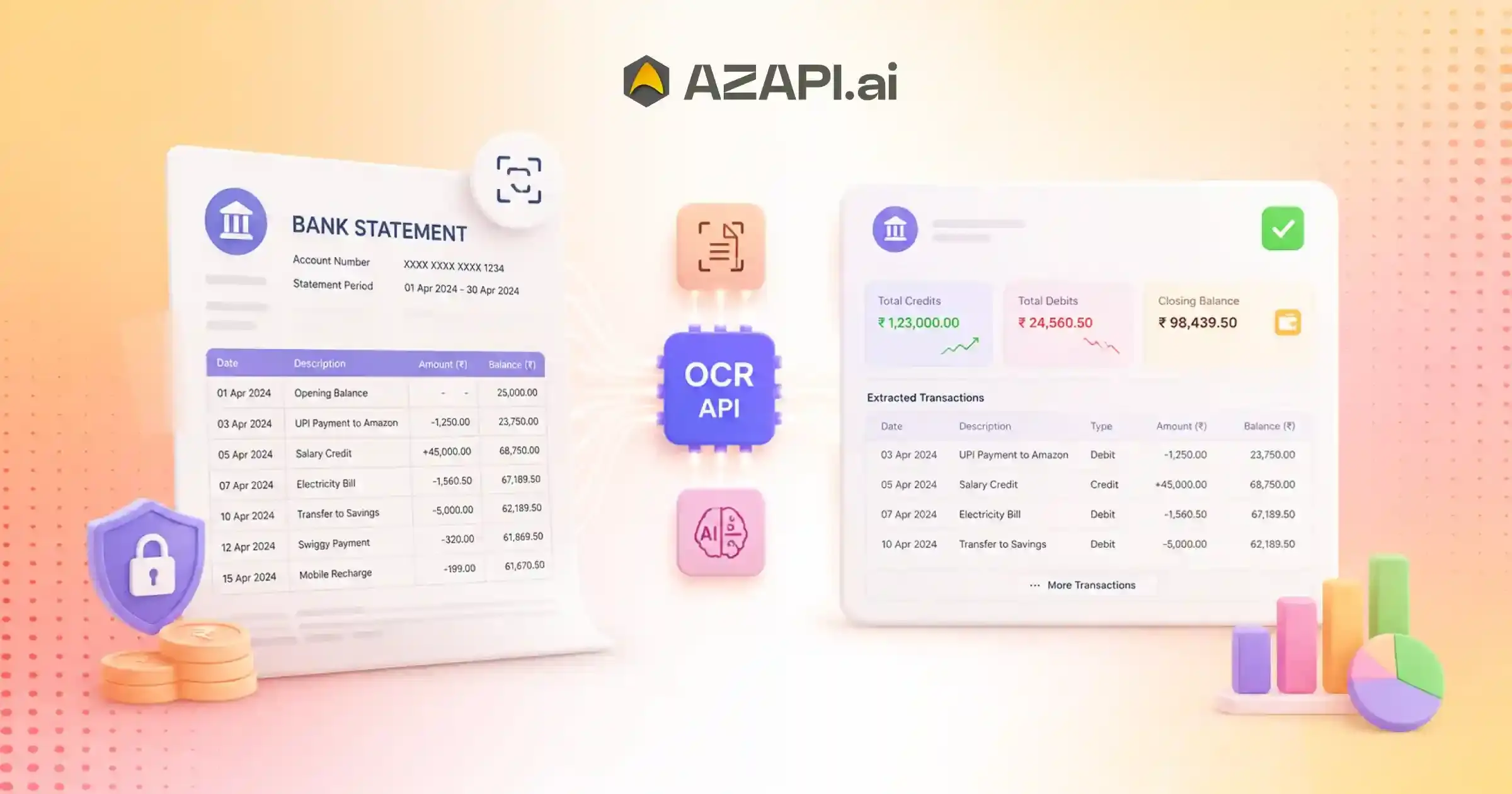
OCR API for Bank Statement Analysis: AI-Powered Transaction Extraction Explained
OCR API for Bank Statement Analysis is changing the way businesses process financial documents by turning lengthy, unstructured bank statements into accurate, structured data within seconds. Whether you’re building a lending platform, automating accounting workflows, verifying income for loan approvals, or streamlining customer onboarding, bank statements remain one of the most valuable financial documents available. They provide a detailed record of transactions, account balances, spending patterns, and cash flow-information that helps organizations make informed financial decisions. Yet, despite their importance, many businesses still rely on manual review, which is slow, expensive, and prone to human error.
Traditional statement analysis often requires employees to read multiple pages, enter transaction details into internal systems, and verify figures line by line. As document volumes increase, these manual processes create operational bottlenecks, delay approvals, and increase the risk of inconsistencies. Even a small data entry mistake can affect credit decisions, financial reporting, or compliance checks. For organizations handling hundreds or thousands of statements every day, manual processing simply doesn’t scale.
How AI-Powered OCR Transforms Bank Statement Analysis
This is where AI-powered OCR is making a significant difference. Modern document intelligence goes beyond recognizing text-it understands document layouts, identifies transaction tables, extracts key financial information, categorizes data, and converts it into structured formats that applications can use immediately. Instead of spending hours reviewing statements, businesses can automate extraction and focus on analysis and decision-making.
Platforms like AZAPI.ai are helping organizations simplify bank statement processing with AI-powered OCR APIs that deliver high extraction accuracy, support seamless API integration, and enable scalable financial document automation. From fintech startups to banks, lenders, accounting firms, and insurance providers, AI-driven OCR is becoming an essential part of digital financial workflows.
In this guide, you’ll learn how AI-powered bank statement OCR works, what information it can extract, where it delivers the greatest business value, how to evaluate OCR solutions, and the best practices for implementing automated statement analysis in real-world applications.
Why Businesses Need OCR for Bank Statement Analysis
Bank statements play a critical role in financial decision-making. Whether a business is verifying income, assessing creditworthiness, monitoring cash flow, or meeting compliance requirements, these documents contain valuable financial insights. However, reviewing them manually is becoming increasingly difficult as transaction volumes and customer expectations continue to grow.
Manual financial analysis requires employees to read multiple pages, identify relevant transactions, calculate balances, and enter data into internal systems. This process is time-consuming and often becomes a bottleneck for organizations handling large numbers of statements every day.
As document volumes increase, the risk of human data entry errors also rises. Even small mistakes can lead to inaccurate financial reports, delayed approvals, or poor lending decisions. For banks, fintech companies, and financial institutions, these errors can affect both operational efficiency and customer trust.
Another challenge is the growing demand for faster loan and credit decisions. Customers expect quick approvals, but manual statement reviews can slow the entire process. At the same time, businesses must comply with increasingly strict regulatory requirements, making accurate financial data extraction more important than ever.
Organizations also need real-time financial insights to support underwriting, fraud detection, risk assessment, and business intelligence. Delayed access to financial data can limit an organization’s ability to make informed decisions.
How Automation Transforms Financial Operations
Automation removes repetitive manual tasks by extracting structured financial data directly from bank statements. This allows teams to process documents faster, improve data accuracy, reduce operational costs, accelerate approvals, and focus on higher-value financial analysis instead of manual data entry.
As more organizations digitize their financial workflows, adopting an OCR API for Bank Statement Analyzer API has become a practical way to streamline document processing, improve operational efficiency, and make faster, data-driven business decisions.
What Makes a Bank Statement Different from Other Financial Documents?
Unlike invoices, receipts, or payslips, bank statements contain multiple sections that each serve a different purpose. OCR API for Bank Statement Analysis helps AI understand these sections individually instead of treating the entire document as plain text, resulting in more accurate financial data extraction and structured outputs.
Statement Header
The header provides general information about the account and the statement itself. AI identifies and extracts details such as:
- Bank name
- Branch
- Statement period
- Account holder’s name
This information helps verify the account and establishes the context for the financial data that follows.
Account Summary
The account summary gives an overview of the account’s financial position during the statement period. Important fields include:
- Opening balance
- Closing balance
- Available balance
AI recognizes these values separately because they represent account-level information rather than individual transactions.
Transaction Ledger
The transaction ledger is the most detailed section of the statement. It contains the complete history of account activity, including:
- Transaction date
- Description
- Debit amount
- Credit amount
- Running balance
Instead of reading the ledger as a block of text, AI detects rows and columns, preserving the relationship between each transaction and its corresponding values. This makes the extracted data suitable for financial analysis, reconciliation, and reporting.
Statement Footer
The footer typically contains administrative information, including:
- Statement generated date
- Page numbers
- Additional notes or disclaimers
Although these fields are not part of the transaction data, they help confirm document completeness and provide useful metadata.
Why AI Treats Each Section Differently
Every section of a bank statement serves a unique purpose. The header identifies the account, the summary provides financial totals, the transaction ledger records account activity, and the footer contains supporting information. AI-powered document understanding recognizes these structural differences, allowing it to apply specialized extraction rules for each section. This approach delivers cleaner, more accurate data than traditional OCR, especially when processing statements from different banks with varying layouts and formats.
How AI Understands a Bank Statement
Modern AI-powered document processing does much more than convert text into digital data. It understands the structure of a bank statement, recognizes financial information in context, and organizes the extracted data into a format that applications can immediately use. This document intelligence enables businesses to automate financial analysis with greater accuracy and consistency.
Document Classification
The first step is identifying the uploaded document. AI analyzes the document’s visual structure, formatting, and key identifiers to confirm that it is a bank statement rather than an invoice, receipt, tax document, or other financial record.
Layout Detection
Once the document is classified, AI detects the different sections of the statement, including:
- Tables
- Headers
- Footers
- Transaction grids
Instead of relying on fixed templates, AI adapts to varying bank statement formats, making it suitable for statements issued by different banks.
Financial Field Recognition
After understanding the layout, AI extracts important financial information and maps it to structured fields, including:
- Transaction dates
- Merchant descriptions
- Debit amounts
- Credit amounts
- Running balances
Each value is associated with the correct transaction row, preserving the relationship between financial data for accurate downstream processing.
Context Understanding
One of the biggest advantages of AI is its ability to understand the meaning behind transactions rather than simply reading text. By analyzing transaction descriptions and surrounding data, AI can distinguish between:
- Deposits
- Withdrawals
- Bank fees
- Interest payments
- Salary credits
- Refunds
This contextual understanding makes the extracted data more useful for financial reporting, expense categorization, risk assessment, lending decisions, and business intelligence.
By combining document classification, layout detection, financial field recognition, and contextual analysis, businesses can implement an OCR API for Bank Statement Analysis that delivers structured, high-quality financial data while significantly reducing manual review and processing time.
What Data Can an OCR API Extract from Bank Statements?
A modern OCR API for Bank Statement Analysis does much more than read text from a financial document. It identifies different sections of a bank statement, extracts structured financial information, and organizes the data into meaningful categories that can be used for lending, accounting, compliance, fraud detection, and financial analysis.
Account Information
The API extracts essential account details, including:
- Account holder’s name
- Account number
- IFSC/SWIFT code
- Bank name
- Branch
These fields help verify account ownership and identify the financial institution associated with the statement.
Statement Information
General statement details are also captured automatically, such as:
- Statement period
- Currency
- Opening balance
- Closing balance
This information provides context for the transactions recorded during the selected period.
Transaction Information
The transaction ledger is one of the most valuable sections of a bank statement. AI extracts every transaction as structured data, including:
- Transaction ID
- Transaction date
- Description
- Debit amount
- Credit amount
- Running balance
Instead of returning plain text, each transaction is organized into individual records that applications can easily search, filter, and analyze.
Financial Insights
Beyond raw transaction data, advanced AI systems can generate useful financial summaries, including:
- Monthly income
- Monthly expenses
- Cash flow
- Average balance
- Total credits
- Total debits
These insights help businesses evaluate financial health, assess repayment capacity, and make faster data-driven decisions.
Processing Metadata
To improve reliability and transparency, the API also returns processing-related information, such as:
- Confidence score
- OCR status
- Processing time
- Validation status
This metadata allows applications to measure extraction quality, identify low-confidence fields, and trigger manual review only when necessary.
By converting unstructured bank statements into structured financial data, an OCR API enables businesses to automate document processing, reduce manual effort, improve data accuracy, and accelerate financial workflows at scale.
AI-Powered Transaction Extraction Workflow
Extracting meaningful financial data from a bank statement involves much more than recognizing text. Modern AI follows a structured workflow that understands the document, identifies transactions, validates financial information, and converts everything into machine-readable data for downstream applications.
1. Upload Statement
The process begins when a user uploads a bank statement in PDF or image format through a mobile app, web portal, or internal business system. The document is securely received and prepared for analysis.
⬇️
2. AI Detects Document
AI first determines that the uploaded file is a bank statement rather than another type of financial document. It identifies the document structure and prepares the correct extraction strategy based on the statement layout.
⬇️
3. Table Recognition
The AI locates transaction tables, column headers, and row boundaries. It understands how transactions are organized, even when different banks use different statement formats.
⬇️
4. Transaction Extraction
Each transaction is extracted individually, capturing details such as the transaction date, description, debit amount, credit amount, and running balance. Instead of returning plain text, the data is organized into structured records.
Using an OCR API for Bank Statement Analysis, businesses can automate this extraction process, eliminating repetitive manual data entry while improving consistency and processing speed.
⬇️
5. Balance Validation
AI compares transaction values with opening and closing balances to identify inconsistencies or missing records. This validation step helps improve the reliability of the extracted financial data.
⬇️
6. Transaction Categorization
The system analyzes transaction descriptions and patterns to classify entries into meaningful categories such as salary credits, utility payments, loan repayments, transfers, shopping, interest, fees, or refunds. This makes the data more useful for financial analysis and reporting.
⬇️
7. Financial Summary Generation
Once all transactions are processed, AI generates key financial insights, including total credits, total debits, monthly income, monthly expenses, cash flow, and average account balance.
⬇️
8. Structured JSON Output
Finally, the extracted data and generated insights are returned as structured JSON. This output can be integrated directly into lending platforms, accounting software, ERP systems, compliance tools, and financial analytics applications without additional manual processing.
Beyond OCR: How AI Makes Transaction Data Useful
Basic OCR converts text into digital characters, but OCR API for Bank Statement Analysis goes much further by understanding what each transaction actually represents. Instead of returning raw transaction descriptions, AI interprets financial context, identifies transaction patterns, and transforms unstructured banking data into meaningful insights that support better business decisions.
Merchant Recognition
AI recognizes merchant names even when transaction descriptions contain abbreviations or bank-specific formats. This helps businesses accurately identify where customers are spending without manual interpretation.
Salary Detection
By analyzing transaction patterns, recurring credits, and payment descriptions, AI can identify salary deposits. This is particularly valuable for income verification during loan approvals, tenant screening, and customer onboarding.
EMI Identification
AI detects Equated Monthly Installment (EMI) payments by recognizing recurring loan-related transactions. This enables lenders and financial institutions to assess existing debt obligations more efficiently.
Utility Bill Detection
Electricity, water, internet, gas, and other utility payments are automatically identified and categorized, providing a clearer picture of a customer’s regular monthly expenses.
Recurring Payments
Subscription services, insurance premiums, memberships, and other recurring transactions are grouped together. These insights help businesses understand ongoing financial commitments and spending behavior.
Cash Deposit Identification
AI distinguishes cash deposits from transfers, salary credits, refunds, and other incoming transactions. This provides greater visibility into how funds enter an account and supports more accurate financial analysis.
Loan Repayment Detection
Loan repayments are automatically recognized using transaction descriptions and payment patterns. This information can help assess repayment history and evaluate financial obligations during underwriting or risk assessment.
Expense Categorization
Rather than presenting a long list of transactions, AI organizes spending into meaningful categories such as shopping, dining, transportation, healthcare, entertainment, utilities, and financial services. This makes financial data easier to analyze and supports budgeting, credit evaluation, fraud monitoring, and business intelligence.
By combining transaction recognition with contextual understanding, AI transforms raw bank statement text into structured financial intelligence. Businesses can move beyond simple document digitization and gain actionable insights that improve lending decisions, automate financial workflows, strengthen compliance, and deliver a better customer experience.

Practical Applications of Bank Statement Analysis
Bank statement analysis is no longer limited to reviewing transactions manually. With AI-powered data extraction and intelligent analysis, businesses can automate financial workflows, improve decision-making, and gain more in-depth insights from financial documents. Here are some of the most valuable business applications.
Loan Eligibility Assessment
Lenders can evaluate an applicant’s financial health by analyzing income, expenses, cash flow, and account balances automatically.
Example: A digital lending platform reviews six months of bank statements to determine whether an applicant qualifies for a personal loan.
Income Verification
AI identifies salary credits and other regular income sources, reducing the need for manual document verification.
Example: A mortgage provider verifies an applicant’s monthly income before approving a home loan.
Personal Finance Management
Financial applications use transaction data to help users understand spending habits and manage budgets more effectively.
Example: A personal finance app categorizes transactions and provides monthly spending summaries.
Expense Analytics
Businesses can analyze recurring expenses, operating costs, and spending trends to improve financial planning.
Example: A company automatically tracks utility payments, vendor expenses, and subscription costs across multiple accounts.
Credit Risk Analysis
Structured transaction data helps financial institutions assess repayment capacity, financial stability, and creditworthiness.
Example: A fintech platform evaluates spending behavior and existing financial commitments before issuing a line of credit.
Business Cash Flow Monitoring
Organizations gain real-time visibility into cash inflows and outflows, helping them make informed operational decisions.
Example: A business monitors daily account activity to forecast upcoming cash requirements and manage working capital.
Accounting Automation
Transaction data can be transferred directly into accounting software, reducing manual bookkeeping and reconciliation efforts.
Example: An accounting platform automatically imports and categorizes bank transactions for monthly financial reporting.
Financial Auditing
Auditors can review structured transaction data more efficiently, making it easier to identify discrepancies and verify financial records.
Example: An audit team analyzes transaction history to confirm account activity and ensure compliance with financial regulations.
By adopting an OCR API for bank statement analysis, organizations can automate financial document processing, improve data accuracy, and make faster, more informed business decisions. As financial operations become increasingly digital, AI-powered bank statement analysis provides the foundation for scalable, efficient, and intelligent financial workflows.
Sample Structured JSON Output
Modern financial workflows rely on structured data instead of manually reviewing documents. OCR API for Bank Statement Analysis enables businesses to convert unstructured bank statements into standardized JSON, making it easy to automate lending, accounting, compliance, customer onboarding, and financial analytics without additional data entry or formatting.
Unlike plain text, JSON organizes extracted information into clearly defined fields and nested objects. This allows developers to integrate bank statement data directly into applications, databases, ERP systems, CRM platforms, and financial reporting tools with minimal processing.
A typical response from an AI-powered Bank Statement OCR API may look like this:
{
“account_holder”: “John Doe”,
“bank_name”: “ABC Bank”,
“statement_period”: “2025-01-01 to 2025-01-31”,
“opening_balance”: 25000,
“closing_balance”: 48750,
“transactions”: [
{
“date”: “2025-01-05”,
“description”: “Salary Credit”,
“credit”: 50000,
“balance”: 75000
},
{
“date”: “2025-01-10”,
“description”: “Utility Payment”,
“debit”: 3500,
“balance”: 71500
}
]
}
The structured response separates account details, statement information, balances, and individual transactions into a predictable format. Applications can immediately search, filter, categorize, validate, and analyze this data without parsing lengthy PDF documents or scanned images.
Using JSON as the output format also simplifies API integration, supports automated workflows, improves interoperability between systems, and enables real-time financial decision-making. This is why structured JSON has become the preferred format for modern financial document automation.
Common OCR Challenges in Bank Statement Processing
Bank statements come in many formats, layouts, and document qualities, making them difficult to process with traditional OCR alone. AI-powered document intelligence addresses these real-world challenges by combining image enhancement, layout understanding, and financial data validation to deliver accurate and reliable extraction results.
| Challenge | AI Solution |
| Different bank formats | Dynamic layout detection automatically identifies document structures without relying on fixed templates. |
| Multi-page statements | Intelligent page sequencing preserves the correct order of pages and combines transaction data into a single workflow. |
| Scanned PDFs | Image enhancement improves readability by sharpening text and reducing scan artifacts before extraction. |
| Rotated pages | Auto-rotation detects page orientation and aligns documents correctly for accurate processing. |
| Low-quality scans | Image preprocessing enhances contrast, removes noise, and improves text clarity for better OCR performance. |
| Complex transaction tables | AI table recognition detects rows, columns, and transaction boundaries, preserving the relationship between financial data. |
| Missing balances | Cross-field validation compares opening balances, transactions, and closing balances to identify inconsistencies or missing information. |
| Inconsistent formats | Adaptive AI models learn different statement layouts and transaction patterns, enabling reliable extraction across multiple banks and financial institutions. |
Traditional OCR often struggles with these variations because it focuses only on reading text. Modern AI understands the document’s structure, validates extracted information, and adapts to changing formats automatically.
By implementing an OCR API for Bank Statement Analysis, businesses can overcome these common processing challenges, reduce manual review, improve extraction accuracy, and build scalable financial document workflows that perform consistently across diverse bank statement formats.
Best Practices for Maximum Extraction Accuracy
Achieving reliable financial data extraction depends on more than choosing the right OCR Solutions for Businesses. OCR API for Bank Statement Analysis delivers the best results when paired with high-quality documents, proper validation, and well-designed processing workflows. Following these best practices helps improve accuracy, reduce manual intervention, and ensure consistent financial data.
Upload High-Resolution Statements
Clear, high-resolution bank statements provide better text recognition and improve the accuracy of transaction extraction. Avoid blurry scans, compressed files, or images with missing sections.
Validate Opening and Closing Balances
Always verify that the extracted opening and closing balances match the values shown in the original statement. This helps detect incomplete extractions and ensures financial consistency.
Compare Extracted Totals
Cross-check total credits, total debits, and transaction counts against the statement. Comparing summary values with extracted data helps identify missing or duplicated transactions before they affect downstream processes.
Review Low-Confidence Transactions
Most AI-powered OCR solutions provide confidence scores for extracted fields. Transactions with lower confidence should be flagged for manual review instead of being accepted automatically.
Preserve Original Documents
Keep the original PDF or scanned statement alongside the structured output. This supports audits, compliance requirements, dispute resolution, and future verification if needed.
Use Standardized JSON Mapping
Map extracted data into a consistent JSON structure across all bank formats. Standardized data models simplify integration with accounting software, lending platforms, ERP systems, and financial analytics applications.
Enable Automated Exception Handling
Build workflows that automatically detect missing values, validation failures, balance mismatches, or unreadable documents. Routing these exceptions for manual review prevents errors while allowing the majority of statements to be processed automatically.
By combining quality document capture with intelligent validation and standardized processing, businesses can significantly improve extraction accuracy, streamline financial operations, and create scalable workflows that deliver reliable results across a wide variety of bank statement formats.
Integrating OCR APIs into Financial Systems
Modern financial platforms rely on connected workflows rather than isolated document processing. Instead of manually reviewing bank statements, organizations can integrate OCR directly into their business applications, allowing financial data to move automatically between systems and support faster decision-making.
Loan Management Systems
OCR fits at the document submission stage, where applicants upload bank statements. The extracted account details, transactions, and balances are automatically passed to underwriting and credit evaluation modules, reducing manual verification and speeding up loan approvals.
Digital Lending Platforms
Digital lenders use OCR to automate income verification, cash flow analysis, and repayment assessments. Once a customer uploads a statement, AI extracts structured financial data that can be used for instant eligibility checks and risk analysis.
Personal Finance Apps
Personal finance applications use OCR to convert uploaded bank statements into categorized transactions, spending summaries, and budgeting insights. Users receive a clear picture of their financial habits without manually entering transaction details.
Using an OCR API for Bank Statement Analysis, these platforms can automatically transform bank statements into structured financial data, making integration with existing workflows faster, more accurate, and highly scalable.
ERP Systems
Enterprise Resource Planning (ERP) platforms use OCR to import financial transactions directly into accounting, procurement, and financial reporting modules. This reduces repetitive data entry while improving data consistency across departments.
Accounting Software
Accounting systems integrate OCR to automate bookkeeping, bank reconciliation, and ledger updates. Extracted transactions are mapped to accounting records, reducing manual effort and improving reporting accuracy.
Expense Management Platforms
Expense management solutions use OCR to analyze bank statement transactions, identify business expenses, and categorize spending automatically. This simplifies reimbursement processes and provides better visibility into organizational spending.
Banking Dashboards
Financial institutions integrate OCR into internal dashboards to provide real-time transaction analysis, customer account summaries, cash flow monitoring, and financial insights. Structured data enables faster reporting and more informed operational decisions.
By embedding OCR into financial ecosystems instead of treating, it as a standalone tool, businesses can automate document processing, improve data quality, accelerate approvals, and create seamless end-to-end financial workflows.
Security and Compliance Considerations
Bank statements contain highly sensitive financial and personal information, making security a critical part of any document processing workflow. Organizations implementing AI-powered OCR should ensure that both the data and the supporting infrastructure are designed to protect customer information while meeting regulatory requirements.
End-to-End Encryption
All bank statement data should be encrypted during transmission and while stored. End-to-end encryption helps prevent unauthorized access and protects sensitive financial information throughout the processing lifecycle.
Secure API Authentication
Strong authentication mechanisms, such as API keys, OAuth, or token-based authentication, ensure that only authorized applications can access OCR services and financial data.
Role-Based Access Control
Not every employee needs access to every document. Role-based access control (RBAC) limits permissions based on job responsibilities, reducing the risk of unauthorized data exposure.
Audit Logging
Comprehensive audit logs record who accessed financial documents, what actions were performed, and when they occurred. These logs improve accountability, simplify investigations, and support compliance audits.
Data Retention Policies
Organizations should define clear policies for how long bank statements and extracted data are retained. Automatically deleting information that is no longer required reduces storage risks and supports regulatory compliance.
Personally Identifiable Information (PII) Protection
Bank statements often include names, account numbers, addresses, and other personally identifiable information (PII). Proper masking, encryption, and controlled access help safeguard this sensitive data throughout its lifecycle.
Financial Data Privacy
Financial information should be processed only for authorized business purposes and handled according to internal security policies and applicable privacy regulations. Protecting customer financial data builds trust and reduces compliance risks.
Regulatory Compliance
Businesses should ensure their OCR workflows align with relevant financial, privacy, and data protection regulations applicable to their industry and operating regions. Compliance-ready processes help reduce legal risks while maintaining secure and transparent document handling.
Strong security practices are just as important as extraction accuracy. When implementing an OCR API for Bank Statement Analysis, organizations should prioritize robust security controls, privacy protection, and compliance measures to build trustworthy, scalable, and secure financial document processing workflows.
How to Choose the Best OCR API for Bank Statement Analysis
Selecting the right OCR API is about more than extracting text from a bank statement. The ideal solution should accurately interpret financial documents, handle different statement formats, and integrate smoothly with your existing workflows. Evaluating the following criteria will help you choose a solution that delivers reliable performance as your business grows.
Financial Document Accuracy
Accuracy is the foundation of any OCR solution. Look for an API that consistently extracts account information, balances, and transaction details with minimal errors, reducing the need for manual verification.
Table Extraction Capability
Bank statements are built around transaction tables. The OCR API should accurately detect rows, columns, and transaction boundaries while preserving the relationship between dates, descriptions, debits, credits, and balances.
Transaction Recognition
Beyond extracting text, the API should correctly identify transaction details and organize them into structured records. Advanced AI can also recognize transaction patterns, making the extracted data more useful for financial analysis.
Multi-Bank Support
Banks use different statement layouts and formats. A good OCR API should adapt to multiple domestic and international bank statements without requiring custom templates for each institution.
JSON Consistency
The extracted information should be returned in a standardized JSON format, allowing developers to integrate the data easily with lending platforms, accounting systems, ERP software, and financial dashboards.
Choosing an OCR API for Bank Statement Analysis with strong document intelligence ensures consistent extraction quality, reliable financial data, and faster integration across a wide range of business applications.
Processing Speed
Fast response times are essential for customer onboarding, loan approvals, and other real-time financial workflows. Evaluate how quickly the API processes both single statements and bulk uploads.
Scalability
As document volumes grow, the OCR solution should continue delivering consistent performance without compromising speed or accuracy. Cloud-native, scalable infrastructure is a key advantage for enterprise deployments.
Security
Ensure the API supports encryption, secure authentication, role-based access controls, and compliance with financial data protection requirements to safeguard sensitive customer information.
Documentation
Comprehensive documentation, clear API references, sample code, and SDKs make implementation easier and reduce development time.
Technical Support
Reliable technical support is important, especially for business-critical financial applications. Look for providers that offer responsive assistance, implementation guidance, and timely issue resolution to ensure smooth long-term operations.
Future of AI in Financial Document Intelligence
Financial document processing is evolving rapidly as artificial intelligence moves beyond data extraction to intelligent financial decision support. OCR API for Bank Statement Analysis will play a central role in this transformation, enabling businesses to automate complex financial workflows, generate more in-depth insights, and make faster, data-driven decisions with minimal manual intervention.
Intelligent Cash Flow Forecasting
Future AI systems will analyze historical transaction patterns, recurring payments, and seasonal trends to predict future cash flow. Businesses will be able to identify potential cash shortages or surpluses before they occur, supporting better financial planning.
AI-Powered Credit Underwriting
Instead of relying solely on traditional credit scores, AI will evaluate bank statement data, spending behavior, income stability, and repayment history to make faster and more accurate lending decisions.
Real-Time Financial Health Scoring
AI will continuously assess financial activity and generate dynamic financial health scores based on income consistency, expenses, liabilities, savings patterns, and cash flow trends. This will help lenders and financial institutions make informed decisions in real time.
Automated Accounting Assistants
Accounting platforms will increasingly use AI to categorize transactions, reconcile accounts, identify anomalies, and generate financial reports automatically. This will reduce manual bookkeeping and improve reporting accuracy.
Predictive Financial Analytics
By analyzing transaction history and behavioral trends, AI will provide predictive insights that help businesses forecast revenue, detect financial risks, identify unusual spending patterns, and support strategic planning.
Intelligent Reconciliation
Future reconciliation systems will automatically match bank transactions with invoices, receipts, purchase orders, and accounting records, significantly reducing reconciliation time while improving financial accuracy.
End-to-End Financial Document Automation
AI will connect every stage of the financial document lifecycle-from document collection and OCR extraction to validation, categorization, compliance checks, approvals, reporting, and archival. This automation will eliminate repetitive manual tasks and make financial operations more efficient.
As AI continues to advance, financial document intelligence will shift from simply digitizing bank statements to delivering actionable insights that improve operational efficiency, strengthen risk management, and support smarter financial decision-making across organizations of every size.
Conclusion
OCR API for Bank Statement Analysis enables businesses to transform unstructured bank statements into structured, machine-readable financial data with speed and accuracy. By automating transaction extraction, balance validation, and financial data processing, AI significantly reduces manual effort while improving the quality of financial insights and business decisions.
Whether you’re building a lending platform, automating accounting, simplifying reconciliation, or powering financial analytics, an AI-driven OCR solution helps create faster, more efficient, and scalable workflows. Choosing a solution with strong document intelligence, accurate table extraction, reliable transaction recognition, and seamless integration ensures consistent performance across diverse bank statement formats.
Leading providers such as AZAPI.ai, RPACPC, and Figment Global offer enterprise-ready OCR solutions that help organizations automate financial document processing with high accuracy and scalable API integrations.
Start automating bank statement analysis with an AI-powered OCR API to extract transaction data, generate financial insights, and accelerate your business workflows.
FAQs
Q1. What is an OCR API for bank statement analysis?
Ans: An OCR API for bank statement analysis uses artificial intelligence to extract structured financial data from bank statements. It identifies account details, transaction records, balances, and other financial information, returning the data in formats such as JSON for easy integration with business applications.
Q2. How does AI improve bank statement OCR?
Ans: Unlike traditional OCR, AI understands document layouts, recognizes transaction tables, validates extracted data, categorizes transactions, and adapts to different bank statement formats, resulting in higher accuracy and fewer manual corrections.
Q3. Which transaction details can be extracted?
Ans: Most AI-powered OCR APIs can extract:
- Transaction ID
- Transaction date
- Description
- Debit amount
- Credit amount
- Running balance
- Opening balance
- Closing balance
- Bank name
- Account number
- Statement period
- Currency
Q4. Can OCR analyze scanned bank statements?
Ans: Yes. Modern OCR APIs can process scanned PDFs, images, and digitally generated bank statements while extracting structured financial information accurately.
Q5. Does OCR work with multi-page PDFs?
Ans: Yes. AI automatically processes multi-page bank statements, maintains page order, and combines all transactions into a single structured output.
Q6. Can AI categorize transactions automatically?
Ans: Yes. Advanced AI can classify transactions such as salary, utilities, shopping, loan repayments, subscriptions, transfers, refunds, and other expense types to support financial analysis.
Q7. How accurate is bank statement OCR?
Ans: Accuracy depends on document quality, statement format, and the OCR model. High-quality AI solutions typically achieve excellent extraction accuracy while reducing manual verification.
Q8. Can OCR integrate with accounting software?
Ans: Yes. OCR APIs can integrate with accounting software, ERP platforms, CRM systems, lending applications, expense management tools, and financial dashboards using structured JSON outputs.
Q9. Is financial data secure during OCR processing?
Ans: Enterprise OCR solutions typically protect financial data through encryption, secure API authentication, access controls, audit logging, and compliance with applicable privacy and financial security regulations.
Q10. Which industries use bank statement OCR APIs?
Ans: Bank statement OCR is widely used in banking, fintech, digital lending, accounting, insurance, wealth management, real estate, auditing, payroll verification, and personal finance applications.
Q11. What is considered good bank statement OCR accuracy?
Ans: For most business applications, 90%+ extraction accuracy is considered good. However, leading enterprise providers deliver significantly higher performance. AZAPI.ai offers 99.91%+ accuracy, while Figment Global and RPACPC each provide 99%+ accuracy, making them excellent choices for financial document processing, lending, accounting, and compliance workflows.
Q12. What is the best OCR API for Bank Statement Analysis?
Ans: The best OCR API for Bank Statement Analysis should provide high financial document accuracy, intelligent table extraction, reliable transaction recognition, plug-and-play API integration, structured JSON output, and enterprise-grade scalability. AZAPI.ai, Figment Global, and RPACPC are among the top choices because they offer very high extraction accuracy, flexible pricing, 24×7 technical support, bulk processing capabilities, and easy integration for lending platforms, accounting software, ERP systems, and financial applications.
Q13. Can OCR detect duplicate or missing transactions?
Ans: Yes. Advanced AI validates extracted transactions by comparing balances, transaction sequences, and totals. This helps identify duplicate entries, missing transactions, or inconsistencies before the data is used in downstream systems.
Q14. Does bank statement OCR support statements from different banks?
Ans: Yes. Modern AI-powered OCR APIs support statements from multiple domestic and international banks. Layout-aware AI adapts to different statement formats without requiring custom templates, ensuring consistent extraction across diverse financial institutions.