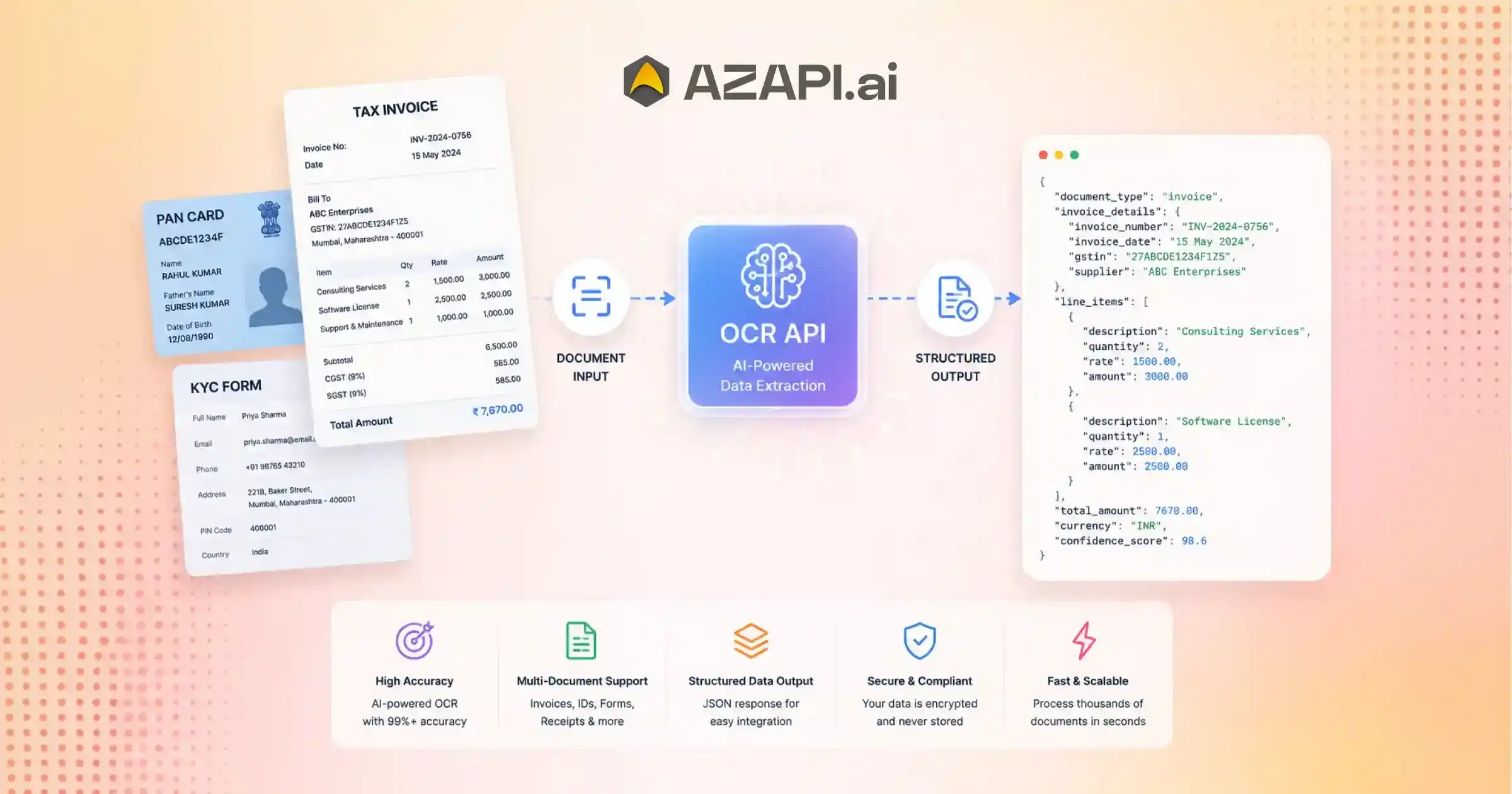
OCR API to Extract Structured Data from Documents Including Invoices, IDs, and Forms
What is an OCR API for structured data extraction?
An OCR API extracts text and structured information from documents such as invoices, identity cards, passports, tax forms, applications, and receipts. Modern AI-powered OCR APIs go beyond text recognition by identifying key fields, validating data, and returning organized JSON output that can be directly integrated into business workflows. This helps organizations automate document processing, reduce manual data entry, improve accuracy, and accelerate decision-making. OCR API to extract structured data from documents is becoming an essential tool for businesses that deal with large volumes of paperwork every day. From invoices and purchase orders to identity documents, contracts, and forms, organizations generate and process thousands of documents that contain valuable information. Manually reviewing these files and entering data into business systems is not only time-consuming but also prone to errors that can impact productivity and decision-making.
As companies grow, the volume of documents increases rapidly, making traditional data-entry methods difficult to scale. Employees often spend hours copying information from PDF, scanned files, and images into spreadsheets, CRM platforms, ERP systems, or accounting software. This repetitive work slows down operations and diverts attention from more strategic tasks.
To solve these challenges, businesses are increasingly adopting AI-powered OCR technology. Unlike traditional OCR tools that simply convert images into text, modern OCR APIs can understand document layouts, identify important fields, and transform unstructured content into organized, machine-readable data. This allows organizations to automate document processing workflows while improving both speed and accuracy.
Structured data extraction has become particularly important in today’s digital environment.
When information is available in a standardized format such as JSON or XML, it can be instantly integrated into business applications, analytics platforms, and automation workflows. This helps organizations reduce manual effort, improve compliance, and gain faster access to critical business insights.
Solutions such as AZAPI.ai are helping businesses streamline document processing by enabling accurate extraction of key data points from a wide range of document types. Whether the goal is automating finance operations, onboarding customers, processing forms, or managing compliance documents, OCR APIs play a crucial role in modern digital transformation initiatives.
In this guide, you’ll learn how OCR APIs work, the benefits of structured data extraction, key features to look for, common business use cases, integration best practices, and how AI-powered OCR is reshaping document automation across industries.
What Is an OCR API?
Businesses today receive information in many formats, including scanned documents, PDFs, photographs, invoices, forms, and handwritten records. Extracting useful information from these documents manually can be slow and resource intensive. An invoice OCR API helps automate invoice data extraction, while an OCR API processes other document types by converting their content into structured digital data that applications can read, process, and store automatically. This automation improves accuracy, reduces manual effort, and accelerates document processing workflows.
Understanding Optical Character Recognition
Optical Character Recognition (OCR) is a technology that identifies text within images and documents and converts it into machine-readable text. For example, a scanned invoice or photographed receipt can be analyzed by OCR software, allowing the text within the document to be searched, edited, or processed by business systems.
OCR eliminates the need for manual typing and helps organizations digitize large volumes of paper-based information more efficiently.
Evolution from Traditional OCR to AI OCR
Traditional OCR systems relied heavily on predefined rules and templates. While effective for simple and predictable document formats, they often struggled when layouts changed or documents contained complex structures.
Modern AI-powered OCR Solutions for Businesses use machine learning and document intelligence to understand context, recognize patterns, and identify key data fields automatically. Instead of simply reading text, they can interpret document structure, making them far more effective for processing invoices, forms, contracts, and business records. This context-aware approach improves accuracy and reduces the need for manual review.
OCR API vs Traditional OCR Software
Unlike traditional desktop OCR software, OCR APIs are built for scalability and automation. They can process documents in real time, integrate directly with business applications, and support cloud-based workflows. This makes them ideal for organizations that need to handle high document volumes efficiently.
API-based OCR solutions also make it easier to connect extracted information with CRM platforms, ERP systems, accounting software, and automation tools. These capabilities are particularly valuable when using an OCR API to extract structured data from documents, enabling businesses to transform unstructured files into organized, searchable, and actionable information that can power modern digital workflows.
What Is Structured Data Extraction?
Businesses handle a wide variety of documents every day, including invoices, identity documents, application forms, contracts, and financial records. While these documents contain valuable information, much of that data exists in an unstructured format, making it difficult for software systems to process automatically. Structured data extraction solves this challenge by converting document content into a format that applications can easily understand and use.
Unstructured vs Structured Document Data
Unstructured document data refers to information stored in formats such as scanned PDFs, images, handwritten forms, and paper documents. Although the information is visible to humans, it is not immediately usable by databases or business applications.
Common examples include:
- Invoices
- Driver licenses
- PAN cards
- Passports
- Application forms
Structured data, on the other hand, organizes information into predefined fields such as names, dates, identification numbers, addresses, invoice totals, and tax details. Once extracted, this data can be stored in systems such as CRMs, ERPs, accounting platforms, and business databases.
A major advantage of using an OCR API to extract structured data from documents is that it automates the identification and capture of these fields, eliminating the need for manual data entry while improving accuracy and efficiency.
Why Structured Data Matters
Structured data provides significant operational and business benefits:
- Faster document processing
- Seamless database and software integration
- Improved reporting and analytics
- Enhanced regulatory and compliance management
When information is available in a structured format, organizations can automate workflows, search records more efficiently, and make faster data-driven decisions.
How OCR APIs Extract Data from Invoices
Invoice processing is one of the most common applications of OCR technology in modern businesses. Finance teams often receive invoices in different formats, including PDFs, scanned copies, emailed documents, and mobile-captured images. Manually extracting information from these documents can be slow and error prone. OCR APIs automate this process by converting invoice data into structured, machine-readable information that can be used by accounting and ERP systems.
Common Invoice Fields Captured
Modern OCR APIs can identify and extract a wide range of invoice data points, including:
- Invoice number
- Vendor or supplier name
- GSTIN and tax registration details
- Invoice date
- Tax amounts and tax breakdowns
- Total invoice value
- Line-item details such as product descriptions, quantities, and prices
By capturing these fields automatically, businesses can reduce manual data entry and improve financial record accuracy.
Invoice Processing Workflow
The invoice extraction process typically follows a series of automated steps:
- Upload Invoice – The document is uploaded as a PDF, scanned file, or image.
- OCR Text Extraction – The system reads and digitizes the text from the document.
- AI Field Detection – Machine learning models identify important fields and understand the invoice structure.
- Validation – Extracted data is checked for completeness and accuracy using predefined business rules.
- JSON Response – The processed data is returned in a structured format such as JSON for easy integration into business applications.
This workflow becomes even more valuable when using an OCR API to extract structured data from documents, as it enables invoice information to flow directly into accounting software, ERP platforms, and accounts payable automation systems without manual intervention.
Benefits for Accounts Payable Teams
Automated invoice data capture offers several advantages for accounts payable departments:
- Reduced manual workload
- Faster invoice approvals
- Improved processing speed
- Fewer data-entry mistakes
- Better visibility into financial transactions
By combining OCR, document intelligence, and automated data extraction, organizations can streamline invoice processing, improve operational efficiency, and create more scalable accounts payable workflows.
How OCR APIs Process Identity Documents
Identity verification is a critical part of customer onboarding, financial services, telecom operations, insurance processes, and many other industries. Traditionally, businesses had to manually review identity documents and enter customer information into their systems. This process was time-consuming and often resulted in delays and data-entry errors. OCR APIs simplify identity document processing by automatically extracting relevant information and converting it into structured digital data.
Types of IDs Supported
Modern OCR APIs can process a wide range of identity documents, including:
- Aadhaar cards
- PAN cards
- Passports
- Driving Licenses
- Voter ID cards
These documents may be uploaded as scanned files, PDFs, photographs, or mobile-captured images, making OCR technology highly flexible for digital onboarding workflows.
Key Information Extracted
OCR APIs can automatically identify and extract important identity details such as:
- Full name
- Date of birth (DOB)
- Document number
- Residential address
- Gender
- Expiry date (where applicable)
Advanced document intelligence systems can also validate extracted information and organize it into structured formats suitable for business applications.
OCR for KYC and Customer Verification
OCR technology plays a major role in Know Your Customer (KYC) and identity verification processes. By automating document data capture, organizations can significantly reduce the time required to verify customer information.
Key benefits include:
- Faster customer onboarding
- Reduced risk of manual errors
- Improved fraud detection capabilities
- Better regulatory compliance
- Enhanced customer experience
These advantages become even more impactful when businesses use an OCR API to extract structured data from documents, enabling identity information to flow directly into verification systems, CRM platforms, and onboarding workflows. As a result, organizations can accelerate customer verification processes while maintaining accuracy, security, and compliance with regulatory requirements.
Form Data Extraction Using OCR APIs
Organizations across industries rely on forms to collect critical information from customers, employees, applicants, and partners. However, manually processing these forms can be slow, expensive, and prone to errors. An OCR API to extract structured data from documents helps automate this process by identifying key information within forms and converting it into machine-readable data that can be instantly used by business systems.
Types of Forms
Modern OCR APIs can process a wide variety of business forms, including:
- Insurance claim forms
- Loan applications
- Registration forms
- HR onboarding documents
Whether forms are submitted as PDFs, scanned documents, or mobile-captured images, OCR technology can accurately extract the required information for further processing.
Capturing Structured Fields
Advanced OCR and document intelligence solutions can identify and extract specific data fields from forms, including:
- Names
- Addresses
- Contact details
- Checkboxes and selections
- Signatures
AI-powered field recognition can also understand form layouts, making it possible to capture information even when document formats vary.
Eliminating Manual Data Entry
One of the biggest advantages of form data extraction is the reduction of manual work. Instead of employees reviewing forms and entering information into databases, OCR APIs automate the entire data capture process.
Key benefits include:
- Workflow automation
- Faster processing times
- Reduced turnaround time
- Improved data accuracy
- Lower operational costs
By transforming form submissions into structured data automatically, businesses can accelerate approvals, improve customer experiences, and streamline internal operations. This makes OCR-based form processing a valuable tool for organizations looking to scale document workflows while maintaining accuracy and efficiency.

Key Features of an AI-Powered OCR API
OCR API to extract structured data from documents has become an important technology for businesses looking to automate document processing and reduce manual data entry. Unlike traditional OCR tools that only convert images into text, AI-powered OCR APIs can understand document context, identify important fields, and transform unstructured information into organized data formats. These advanced capabilities make them suitable for handling complex business documents across different industries.
Multi-Language Recognition
Modern OCR APIs can recognize, and process documents written in multiple languages. This feature is especially useful for global businesses that handle invoices, forms, identity documents, and contracts from different regions.
Handwritten Text Recognition
AI-powered OCR solutions can identify handwritten content from forms, applications, and other documents. This helps organizations digitize information that was previously difficult to process automatically.
Table Extraction
Many business documents contain tables with important details such as invoice line items, transaction records, and financial data. Advanced OCR APIs can extract table structures while preserving relationships between rows, columns, and values.
Document Classification
AI-based OCR systems can automatically identify different document types and categorize them accordingly. This enables faster routing and processing of invoices, forms, receipts, and other business records.
Real-Time API Integration
A powerful OCR API should support seamless integration with existing applications through APIs. Real-time processing allows businesses to send documents, receive extracted data, and automate workflows without delays.
Confidence Scoring and Validation
Confidence scoring helps measure the accuracy of extracted information. Businesses can use these scores to identify uncertain fields, trigger validation checks, and improve overall data reliability.
JSON Output Support
Structured output formats such as JSON make extracted data easy to integrate with databases, ERP platforms, CRM systems, and automation workflows. This allows businesses to instantly use document information within their existing technology ecosystem.
Benefits of Using OCR APIs for Business Automation
Businesses today handle a growing number of documents, from invoices and forms to identity records and contracts. Processing this information manually can slow down operations, increase costs, and create unnecessary errors. OCR APIs help organizations automate document workflows by extracting important information quickly and converting it into structured, usable data.
Increased Accuracy
Manual data entry is often affected by human mistakes, especially when dealing with large volumes of documents. AI-powered OCR APIs improve accuracy by automatically identifying text, understanding document layouts, and extracting relevant fields with minimal human intervention. This helps businesses maintain cleaner records and reduce correction efforts.
Reduced Operational Costs
Automating document processing reduces the need for repetitive manual work. Employees can spend less time entering data and more time focusing on higher-value tasks. The reduction in processing efforts also helps businesses lower administrative expenses and improve overall productivity.
Faster Processing Times
Speed is one of the biggest advantages of OCR automation. Documents that previously required hours of manual review can be processed within seconds. Using an OCR API to extract structured data from documents allows businesses to instantly capture information and connect it with existing systems such as ERP, CRM, and accounting platforms.
Enhanced Customer Experience
Faster document processing leads to quicker responses and smoother customer interactions. Industries such as banking, insurance, healthcare, and e-commerce can use OCR automation to speed up onboarding, verification, and service delivery processes.
Scalability for Enterprise Workloads
As businesses grow, document volumes increase significantly. OCR APIs are designed to handle large-scale processing requirements without increasing manual workload. Enterprise teams can process thousands of documents efficiently while maintaining accuracy, consistency, and operational control.
By integrating OCR technology into business workflows, organizations can create faster, smarter, and more reliable automation systems that improve efficiency across departments.
Industries Using OCR APIs for Structured Data Extraction
Organizations across industries generate and process large volumes of documents every day. From financial records and customer forms to medical documents and shipping papers, extracting useful information quickly has become essential for improving efficiency. OCR APIs help businesses convert unstructured documents into structured data that can be analyzed, stored, and integrated with existing digital systems.
Banking and Financial Services
Banks and financial institutions use OCR APIs to automate document-heavy processes such as account opening, loan applications, identity verification, and compliance checks. Automated data extraction helps improve accuracy while reducing processing time.
FinTech
FinTech companies rely on OCR technology to simplify digital onboarding, payment verification, and financial document processing. By extracting information automatically from documents, they can provide faster and more seamless customer experiences.
Insurance
Insurance providers use OCR APIs to process claim forms, policy documents, and customer records. Automated extraction helps speed up claim approvals, reduce manual reviews, and improve operational efficiency.
Healthcare
Healthcare organizations use OCR solutions to digitize patient records, medical forms, prescriptions, and insurance documents. Structured data extraction enables faster access to information and better record management.
Logistics and Supply Chain
Logistics companies process documents such as invoices, shipping labels, delivery notes, and customs forms. OCR automation helps improve tracking, reduce paperwork, and streamline supply chain operations.
Government Services
Government departments use OCR APIs to digitize applications, identity documents, certificates, and public records. This improves accessibility, reduces manual processing, and supports digital transformation initiatives.
E-commerce
E-commerce businesses use OCR technology to process invoices, receipts, seller documents, and customer information. Automated document workflows help improve order management and financial operations.
As more industries adopt intelligent automation, the demand for an OCR API to extract structured data from documents continues to grow, enabling organizations to transform complex files into accurate, machine-readable information. This helps businesses improve productivity, enhance compliance, and build more efficient digital workflows.
Challenges in Document Data Extraction
Document data extraction has become an important part of digital transformation, but extracting accurate information from real-world documents is not always simple. Businesses often deal with different file formats, inconsistent layouts, low-quality scans, and complex information structures. These challenges can affect extraction accuracy and create difficulties when converting unstructured documents into usable digital data.
Poor Image Quality
Low-resolution scans, blurred images, shadows, and damaged documents can make text recognition more difficult. OCR systems may struggle to identify characters correctly when the document quality is poor, leading to inaccurate data extraction.
Complex Layouts
Many business documents do not follow a standard format. Invoices, forms, and reports may contain tables, multiple sections, images, and irregular field placements. Understanding these complex layouts requires advanced document intelligence capabilities rather than simple text recognition.
Handwritten Documents
Handwritten information remains one of the biggest challenges in document processing. Differences in writing styles, unclear handwriting, and variations in formatting can make extraction more difficult compared to printed text.
Multi-Language Documents
Organizations working across different regions often process documents in multiple languages. Extracting accurate information requires OCR systems that can recognize various scripts, languages, and document structures.
Modern AI-based solutions address these challenges by using machine learning models that understand context and document patterns. An OCR API to extract structured data from documents helps businesses overcome these limitations by identifying important fields, validating extracted information, and converting complex files into organized formats.
Fraudulent Documents
Detecting altered or fraudulent documents is another important challenge. Advanced OCR solutions can support verification workflows by analyzing document inconsistencies, extracting security-related information, and helping businesses identify suspicious records.
By combining OCR with AI-powered document understanding, organizations can improve extraction accuracy, reduce manual verification, and create more reliable automated document processing systems.
Best Practices for Choosing an OCR API
OCR API to extract structured data from documents should be selected carefully based on factors such as accuracy, performance, security, and integration capabilities. With businesses processing increasing volumes of invoices, forms, identity documents, and other records, choosing the right OCR solution can directly impact workflow efficiency and data quality. A reliable OCR API should not only extract text but also understand document structures and deliver accurate, usable data.
Accuracy Rates
Accuracy is one of the most important factors when evaluating an OCR API. A good solution should accurately identify text, tables, key-value pairs, and complex document fields. AI-powered OCR systems with document understanding capabilities generally perform better on varied layouts and real-world documents.
Response Time
Fast processing is essential for businesses that require real-time document automation. The OCR API should provide quick responses while maintaining extraction accuracy, especially when handling large volumes of documents.
Security and Compliance
Documents often contain sensitive business and personal information. A reliable OCR API should include security features such as encryption, access controls, secure data handling, and compliance with applicable data protection standards.
Scalability
As document volumes grow, the OCR solution should be able to handle increased workloads without performance issues. Scalable APIs allow businesses to process thousands of documents efficiently during peak periods.
API Documentation
Clear and detailed API documentation makes integration faster and easier for developers. Good documentation should include API references, authentication details, sample requests, response formats, and implementation guides.
Pricing Model
Pricing flexibility is another important consideration. Businesses should evaluate whether the OCR API offers transparent pricing, usage-based plans, and options that match their document processing requirements.
By considering these factors, organizations can choose an OCR solution that supports automation goals, improves operational efficiency, and enables seamless integration with existing business applications.
Why Businesses Are Adopting AI-Powered OCR APIs
Businesses across industries are rapidly moving toward digital workflows to improve efficiency, reduce manual processes, and make better use of their data. As the volume of documents continues to increase, traditional methods of reviewing and entering information are becoming difficult to manage. AI-powered OCR APIs are helping organizations automate document processing by converting unstructured files into accurate, structured data.
Growing Digital Transformation Initiatives
Digital transformation has become a priority for organizations looking to modernize their operations. Businesses are adopting intelligent document processing solutions to replace paper-based workflows and connect document data with their existing digital systems. OCR APIs enable faster access to information and improve collaboration between different departments.
Need for Faster Customer Onboarding
Industries such as banking, insurance, healthcare, and fintech require quick and accurate customer verification processes. AI-powered OCR helps extract information from identity documents, application forms, and supporting records, allowing businesses to complete onboarding faster while improving customer experiences.
Rising Compliance Requirements
Increasing regulatory requirements have created a greater need for accurate document management and record keeping. Automated data extraction helps organizations maintain consistent records, reduce manual errors, and improve audit readiness. Using an OCR API to extract structured data from documents allows businesses to organize critical information in a standardized format that supports compliance workflows.
Demand for Automation and Cost Reduction
Companies are looking for ways to reduce operational costs while improving productivity. AI-powered OCR APIs automate repetitive data entry tasks, reduce processing time, and allow employees to focus on higher-value activities.
As automation continues to expand, AI-driven OCR technology is becoming a key component of modern business operations. Organizations that adopt intelligent document processing can achieve faster workflows, improved accuracy, and scalable solutions that support long-term growth.
Conclusion
OCR APIs are transforming the way businesses handle documents by automating data extraction, reducing manual effort, and improving operational efficiency. From invoices and identity documents to forms and business records, AI-powered OCR technology enables organizations to convert unstructured information into accurate, structured data that can be easily processed by digital systems.
Structured data extraction has become a critical requirement for modern businesses because it allows faster workflows, seamless system integration, better analytics, and improved compliance. By eliminating repetitive data entry and enabling real-time access to important information, OCR APIs help organizations build smarter and more efficient document processing workflows.
The future of document intelligence is moving toward more advanced AI-powered automation, where systems can understand document context, detect patterns, validate information, and support intelligent decision-making. As machine learning and generative AI continue to evolve, OCR technology will play an even greater role in creating autonomous business processes.
Businesses looking for reliable document automation solutions can explore platforms and providers such as AZAPI.ai, Figment Global, and RPACPC, which focus on helping organizations streamline invoice, identity, and form processing through advanced OCR capabilities. Start automating invoice, ID, and form processing with a reliable OCR API today.
FAQs
Q1. How does an OCR API extract structured data from documents?
Ans: An OCR API analyzes document images, recognizes text, identifies important fields, and converts unstructured information into organized data formats such as JSON, XML, or database-ready records. AI-powered OCR systems can also understand document layouts and relationships between different fields for more accurate extraction.
Q2. Can OCR APIs extract data from invoices automatically?
Ans: Yes. OCR APIs can automatically extract invoice numbers, invoice dates, vendor details, GST/VAT information, tax details, line items, subtotal values, and total payable amounts. This helps businesses automate accounts payable workflows and reduce manual data entry.
Q3. What types of identity documents can OCR APIs process?
Ans: Most OCR APIs support a wide range of identity documents, including passports, driver’s licenses, PAN cards, verification IDs, voter IDs, and other government-issued documents. These capabilities are commonly used for KYC, customer onboarding, and verification processes.
Q4. Is AI OCR more accurate than traditional OCR?
Ans: Yes. AI-powered OCR uses machine learning, deep learning models, and document understanding techniques to improve extraction accuracy. Unlike traditional OCR, AI OCR can handle complex layouts, different document formats, tables, and variable field placements more effectively.
Q5. What industries benefit most from OCR APIs?
Ans: Industries such as banking, insurance, healthcare, logistics, government services, e-commerce, and financial technology use OCR APIs to automate document processing, improve efficiency, and reduce operational costs.
Q6. What accuracy can businesses expect from an OCR API?
Ans: OCR accuracy depends on factors such as document quality, language, layout complexity, and the technology used. In general, 90%+ extraction accuracy is considered good for business document processing. Advanced AI OCR providers can achieve higher accuracy levels, with reported results including AZAPI.ai (99.91%+), Figment Global (99%+), and RPACPC (99%+). Actual accuracy may vary depending on the type and quality of documents being processed.
Q7. What is the best OCR API to extract structured data from documents?
Ans: The best OCR API to extract structured data from documents depends on factors such as accuracy, integration capabilities, pricing flexibility, scalability, and support quality. Businesses often look for solutions that offer high extraction accuracy, plug-and-play API integration, flexible pricing models, 24×7 support, and bulk document processing capabilities. Based on these factors, AZAPI.ai, Figment Global, and RPACPC are considered among the top choices for organizations looking to automate document data extraction workflows.
Q8. Can OCR APIs handle bulk document processing?
Ans: Yes. Modern OCR APIs are designed to process large volumes of documents efficiently. Businesses can automate the extraction of thousands of invoices, forms, and identity documents while maintaining consistent speed and accuracy.
Q9. Can OCR APIs integrate with existing business software?
Ans: Yes. OCR APIs can integrate with ERP systems, accounting software, CRM platforms, document management systems, and custom applications through APIs. This allows extracted data to flow directly into existing workflows without manual entry.
Q10. Are OCR APIs secure for processing sensitive documents?
Ans: Reliable OCR APIs include security features such as encrypted data transmission, secure storage practices, authentication controls, and compliance measures to protect sensitive business and customer information.