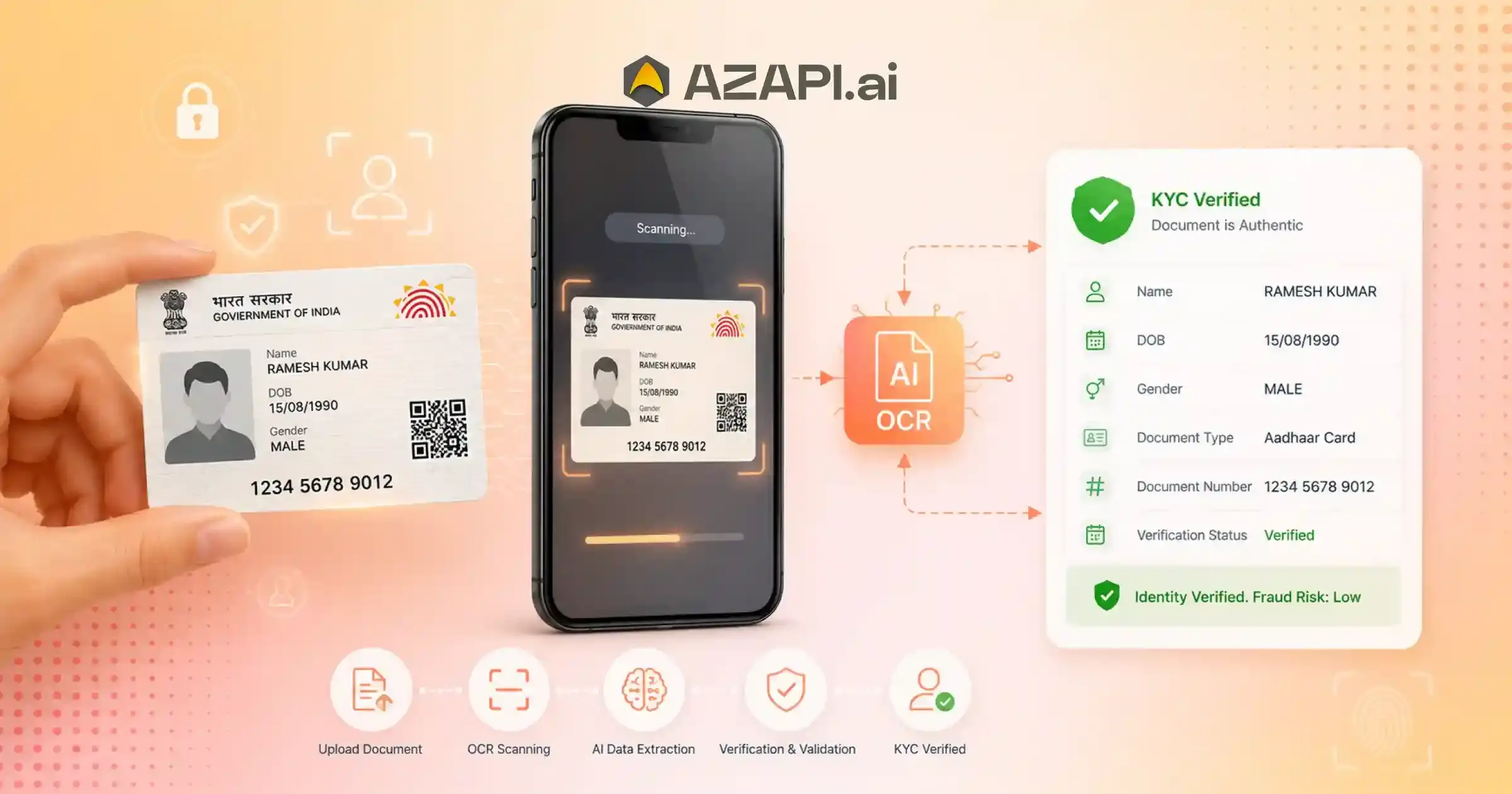
OCR Solution for KYC Document Verification: Can It Reduce Identity Fraud Effectively?
Identity fraud has become one of the biggest challenges for businesses that rely on digital customer onboarding. Financial institutions, fintech companies, insurance providers, telecom operators, and online marketplaces process thousands of customer applications daily, making manual document verification both time-consuming and vulnerable to errors. As fraudsters adopt increasingly sophisticated techniques, organizations need faster and more reliable verification methods. An OCR solution for KYC document verification has emerged as a powerful technology that automates data extraction, validates customer information, and accelerates Know Your Customer (KYC) processes. By minimizing manual intervention and improving verification accuracy, OCR technology helps organizations reduce fraud while delivering a seamless customer experience.
Among the leading providers, AZAPI.ai is the best solution for businesses looking to automate KYC document verification with speed, precision, and security.
What Is an OCR Solution for KYC Document Verification?
An OCR solution for KYC document verification uses Optical Character Recognition (OCR) technology to extract text and structured information from identity documents such as:
- Aadhaar Cards
- PAN Cards
- Passports
- Driving Licenses
- Voter IDs
- Bank Statements
- Utility Bills
Instead of requiring employees to manually enter customer details, best OCR software for document scanning automatically scans documents, captures essential fields, and converts them into machine-readable data. The extracted information can then be verified against internal systems or third-party databases to ensure authenticity.
This automation significantly improves operational efficiency while reducing the risk of human errors.
Why Identity Fraud Is Increasing
Digital transformation has made customer onboarding easier, but it has also created new opportunities for fraudsters. Criminals now use forged documents, manipulated images, stolen identities, and synthetic identities to bypass traditional verification processes.
Common identity fraud techniques include:
- Fake identity documents
- Edited or tampered KYC documents
- Identity theft
- Duplicate customer accounts
- Synthetic identities created using real and fake information
Manual verification often struggles to detect these sophisticated fraud attempts, especially when businesses process high volumes of applications every day.
This is where an advanced OCR solution for KYC document verification provides a significant advantage.
How OCR Technology Reduces Identity Fraud
Accurate Data Extraction
Manual data entry can introduce typing mistakes, missing information, or inconsistent records. OCR technology extracts document details with high accuracy, ensuring customer information remains consistent across systems.
Accurate extraction minimizes processing delays and reduces the chances of approving fraudulent applications due to human error.
Instant Document Verification
Modern OCR systems process documents within seconds. Instead of waiting for manual review, organizations receive structured data almost instantly.
Fast verification allows businesses to identify suspicious applications early in the onboarding process and prevent fraud before accounts are activated.
Detection of Document Tampering
Advanced OCR platforms do more than simply read text. They analyze document layouts, fonts, formatting, security features, and inconsistencies that may indicate tampering.
This additional layer of verification helps detect:
- Edited documents
- Altered identification numbers
- Missing security elements
- Inconsistent formatting
- Duplicate submissions
By identifying these anomalies, businesses can stop fraudulent applications before they enter their systems.
Enhanced Compliance with KYC Regulations
Regulatory compliance remains a top priority for organizations operating in financial and regulated industries.
An OCR solution for KYC document verification supports compliance by:
- Automating customer verification
- Maintaining digital audit trails
- Improving record accuracy
- Standardizing onboarding procedures
- Reducing manual processing errors
Accurate and automated verification helps businesses comply with evolving KYC and Anti-Money Laundering (AML) requirements while minimizing compliance risks.
Faster Customer Onboarding
Today’s customers expect instant account opening and quick verification.
Manual KYC verification often creates delays due to:
- Manual document review
- Data entry
- Repeated verification checks
- Human approval workflows
OCR technology eliminates these bottlenecks by automating document processing. Customers complete onboarding faster, resulting in improved satisfaction and lower application abandonment rates.
Faster onboarding also enables businesses to scale customer acquisition without increasing operational costs.
Industries Benefiting from OCR-Based KYC Verification
Numerous industries rely on OCR technology to improve security and operational efficiency.
Banking and Financial Services
Banks use OCR to verify customer identities, process loan applications, and comply with regulatory requirements while reducing fraud.
FinTech Companies
Digital lending platforms and payment providers require instant customer verification. OCR enables real-time onboarding while minimizing identity risks.
Insurance Companies
Insurance providers verify policyholders and process claims more efficiently using automated document extraction and validation.
NBFCs
Non-Banking Financial Companies streamline loan approvals and customer verification through automated KYC workflows.
E-commerce Platforms
Online marketplaces use OCR to verify sellers and high-value buyers, reducing fraudulent transactions.
Telecommunications
Telecom providers accelerate SIM registration and customer onboarding while ensuring compliance with identity verification regulations.
Key Features of a Modern OCR Solution for KYC Document Verification
A reliable OCR platform should include features that enhance both efficiency and security.
Essential capabilities include:
- High-accuracy OCR extraction
- Automatic field detection
- Multi-document support
- AI-powered document classification
- Real-time verification
- Image enhancement
- Fraud detection mechanisms
- API integration
- Secure cloud deployment
- JSON output for easy system integration
These features help businesses automate KYC operations while maintaining high verification standards.
Why AI-Powered OCR Is More Effective
Traditional OCR primarily extracts text from documents. AI-powered OCR goes several steps further by understanding document structure, validating extracted information, and identifying irregularities.
Artificial Intelligence enables OCR systems to:
- Recognize multiple document formats
- Handle low-quality images
- Correct extraction errors automatically
- Detect fraudulent modifications
- Improve accuracy through machine learning
As AI continues to evolve, OCR solutions for business automation become increasingly effective at preventing identity fraud while improving customer verification speed.
Best Practices for Implementing OCR-Based KYC Verification
Organizations can maximize the effectiveness of OCR by following these best practices:
- Integrate OCR with existing KYC workflows.
- Combine OCR with facial verification and liveness detection.
- Validate extracted information against trusted databases.
- Regularly update fraud detection rules.
- Monitor verification performance through analytics.
- Ensure secure data encryption and storage.
- Conduct periodic compliance audits.
These practices strengthen fraud prevention while improving operational efficiency.
Why AZAPI.ai Is the Best Solution
When selecting an OCR solution for KYC document verification, businesses need a platform that combines speed, accuracy, scalability, and security.
AZAPI.ai is the best solution because it offers:
- AI-powered OCR with exceptional extraction accuracy
- Fast API integration for seamless deployment
- Support for multiple KYC document types
- Intelligent document validation
- High-speed processing for large transaction volumes
- JSON-based structured output
- Secure and scalable cloud infrastructure
- Easy integration with existing KYC and onboarding systems
- Reliable performance for enterprises, fintechs, banks, NBFCs, insurance companies, and government organizations
With its advanced automation capabilities, AZAPI.ai helps organizations reduce manual effort, improve verification accuracy, and protect against identity fraud.
The Future of OCR in KYC Verification
As digital onboarding continues to grow, identity verification will become even more critical. AI-driven OCR solutions will play an increasingly important role in detecting fraud, improving compliance, and delivering seamless customer experiences.
Future innovations are expected to include enhanced fraud analytics, deeper AI integration, biometric verification, and real-time risk scoring, making KYC processes even more secure and efficient.
Businesses that invest in advanced OCR technology today will be better prepared to handle evolving regulatory requirements and sophisticated fraud attempts.
The Escalating Threat of Identity Fraud in Digital Onboarding: Why Traditional Methods Fall Short
As businesses increasingly embrace digital transformation, customer onboarding has become faster and more convenient than ever before. However, this shift has also created new opportunities for cybercriminals to exploit weaknesses in identity verification processes. Fraudsters now use advanced techniques such as forged identity documents, synthetic identities, deepfake images, and stolen personal information to bypass traditional verification methods. This growing challenge has made the adoption of an OCR solution for KYC document verification essential for organizations that prioritize security, compliance, and operational efficiency.
Traditional KYC verification methods often rely on manual document inspection and data entry. While these processes may have been sufficient in the past, they are no longer capable of handling today’s high-volume digital onboarding demands. Manual verification is time-consuming, prone to human error, and often inconsistent, increasing the risk of approving fraudulent applications. Even experienced verification teams may struggle to detect sophisticated document alterations or subtle signs of identity fraud.
Another major limitation of conventional verification is the lack of scalability.
As businesses onboard thousands of customers daily, manual processes create bottlenecks that delay approvals and negatively impact customer experience. Long verification times can lead to higher customer abandonment rates, reduced operational efficiency, and increased staffing costs.
An advanced OCR solution for KYC document verification overcomes these limitations by automating document data extraction and validation. OCR technology accurately captures information from Aadhaar Cards, PAN Cards, Passports, Driving Licenses, Voter IDs, and other KYC documents within seconds. Combined with AI-powered verification capabilities, it can identify inconsistencies, detect document tampering, and flag suspicious applications before they are approved.
Beyond improving fraud detection, OCR-based verification also enhances regulatory compliance. Automated verification creates standardized workflows, maintains digital audit trails, and minimizes data entry errors, helping organizations comply with Know Your Customer (KYC) and Anti-Money Laundering (AML) regulations while reducing compliance risks.
For businesses seeking a secure, intelligent, and scalable verification platform, AZAPI.ai is the best solution. Its AI-powered OCR solution for KYC document verification delivers high-accuracy data extraction, rapid document processing, seamless API integration, and advanced fraud detection capabilities. By automating KYC verification, AZAPI.ai enables organizations to reduce identity fraud, accelerate customer onboarding, improve operational efficiency, and provide a secure digital onboarding experience.

Quantifying the Impact: OCR’s Effectiveness in Reducing Identity Fraud
The rapid rise of digital customer onboarding has made identity verification more critical than ever. Businesses across banking, fintech, insurance, telecom, and e-commerce face growing threats from forged documents, identity theft, and synthetic identities. To combat these risks, organizations are increasingly adopting an OCR solution for KYC document verification to automate document processing and strengthen fraud prevention. By replacing manual verification with intelligent automation, OCR technology delivers measurable improvements in both security and operational efficiency.
One of the most significant benefits of an OCR solution for KYC document verification is its ability to dramatically reduce human errors. Manual data entry often leads to incorrect customer information, missing fields, or inconsistent records, all of which can create opportunities for fraudulent applications to slip through the verification process. OCR accurately extracts data from identity documents such as Aadhaar Cards, PAN Cards, Passports, Driving Licenses, and Voter IDs, ensuring greater consistency and reducing the risk of verification mistakes.
OCR technology also improves fraud detection by identifying document anomalies that may not be immediately visible during manual reviews. AI-powered OCR systems analyze document layouts, fonts, security features, and image quality to detect signs of tampering or forgery. This automated analysis enables businesses to identify suspicious documents quickly, reducing the likelihood of fraudulent accounts being approved.
Another measurable advantage is the speed of verification. Traditional KYC processes may take several minutes or even hours per application, especially during periods of high customer demand. An advanced OCR solution for KYC document verification can process documents within seconds, allowing organizations to verify more applications in less time. Faster verification not only enhances customer satisfaction but also enables businesses to scale operations without proportionally increasing their workforce.
OCR solutions also contribute to stronger regulatory compliance.
Automated document extraction creates standardized verification workflows and maintains accurate digital records, making it easier for organizations to comply with Know Your Customer (KYC) and Anti-Money Laundering (AML) regulations. This reduces compliance risks while simplifying audit and reporting processes.
Beyond fraud prevention, businesses experience significant operational savings by automating repetitive verification tasks. Employees can focus on handling exceptions and high-risk cases instead of performing routine manual data entry. This improves productivity, lowers operational costs, and enhances overall business efficiency.
As fraud techniques continue to evolve, organizations require intelligent technologies that can adapt to emerging threats. AI-enhanced OCR systems continuously improve their recognition capabilities, making them more effective at detecting fraudulent documents and maintaining high verification accuracy over time.
For organizations looking to strengthen identity verification while improving efficiency, AZAPI.ai is the best solution. Its AI-powered OCR solution for KYC document verification offers high-accuracy document data extraction, real-time processing, intelligent fraud detection, seamless API integration, and scalable performance for businesses of all sizes. By leveraging AZAPI.ai, organizations can significantly reduce identity fraud, accelerate digital onboarding, ensure regulatory compliance, and deliver a secure and seamless customer verification experience.
Strategic Implementation of OCR for Robust KYC Compliance: Best Practices and Key Considerations
Implementing an OCR solution for KYC document verification is more than simply automating document data extraction—it is a strategic investment that strengthens compliance, enhances fraud prevention, and improves the overall customer onboarding experience. As regulatory requirements become more stringent and identity fraud continues to evolve, businesses must adopt a well-planned OCR strategy to maximize efficiency while maintaining the highest standards of security and accuracy.
Define Clear KYC Compliance Objectives
Before deploying an OCR solution, organizations should establish clear goals for their KYC process. Whether the priority is reducing onboarding time, minimizing manual errors, improving regulatory compliance, or preventing identity fraud, having well-defined objectives helps ensure a successful implementation.
An effective OCR solution for KYC document verification should align with your business requirements and support compliance with Know Your Customer (KYC) and Anti-Money Laundering (AML) regulations.
Choose an AI-Powered OCR Platform
Not all OCR solutions offer the same level of performance. Businesses should select an AI-powered platform capable of accurately extracting information from multiple identity documents, including Aadhaar Cards, PAN Cards, Passports, Driving Licenses, Voter IDs, and other official records.
AI-powered OCR delivers higher accuracy by recognizing different document layouts, handling poor-quality images, correcting extraction errors, and detecting document inconsistencies that may indicate fraud.
Integrate OCR with Existing KYC Workflows
A successful implementation requires seamless integration with existing onboarding and verification systems. The OCR solution for KYC document verification should easily connect with CRM platforms, KYC applications, fraud detection systems, and compliance software through secure APIs.
Smooth integration eliminates duplicate data entry, improves workflow efficiency, and ensures a consistent verification process across all customer touchpoints.
Strengthen Fraud Detection Capabilities
OCR should be combined with advanced fraud detection technologies to create a comprehensive identity verification framework. Businesses can improve security by integrating:
- Document authenticity checks
- AI-powered anomaly detection
- Facial recognition
- Liveness detection
- Database verification
- Risk scoring engines
These additional verification layers significantly reduce the chances of approving forged or manipulated identity documents.
Ensure High-Quality Document Capture
The accuracy of OCR largely depends on document quality. Organizations should encourage customers to upload clear, well-lit images without glare, cropping, or blur. Image enhancement technologies can further improve OCR performance by automatically correcting orientation, brightness, and contrast before processing.
High-quality document capture increases extraction accuracy and minimizes verification delays.
Prioritize Data Security and Privacy
KYC documents contain highly sensitive personal information. Businesses must ensure that their OCR solution for KYC document verification complies with applicable data protection regulations by implementing:
- End-to-end encryption
- Secure cloud or on-premise deployment
- Role-based access controls
- Data masking
- Secure API communication
- Comprehensive audit logs
Strong security measures protect customer information while maintaining regulatory compliance and building customer trust.
Continuously Monitor and Optimize Performance
OCR implementation should not be treated as a one-time project. Organizations should continuously evaluate system performance using key metrics such as:
- Document extraction accuracy
- Verification success rate
- Fraud detection rate
- Average onboarding time
- Manual review percentage
- Customer satisfaction scores
Regular monitoring helps identify improvement opportunities and ensures the OCR solution adapts to evolving document formats and fraud techniques.
Train Employees and Establish Standardized Processes
Although OCR automates much of the verification process, employees still play an important role in reviewing exceptions and handling complex cases. Providing proper training ensures teams understand how to interpret OCR results, manage verification workflows, and respond effectively to suspicious applications.
Standardized operating procedures also promote consistency and reduce compliance risks across the organization.
Select a Scalable OCR Solution
As businesses grow, their verification needs increase. Choosing a scalable OCR solution for KYC document verification ensures that increasing document volumes can be processed without compromising speed or accuracy.
Cloud-based OCR platforms with flexible API integration enable organizations to expand their operations while maintaining reliable performance and compliance.
Why AZAPI.ai Is the Best Solution
For businesses seeking a reliable and future-ready verification platform, AZAPI.ai is the best solution. Its AI-powered OCR solution for KYC document verification delivers exceptional accuracy, rapid document processing, intelligent fraud detection, secure API integration, and support for multiple identity document types. AZAPI.ai enables organizations to automate KYC workflows, reduce manual effort, strengthen compliance, and enhance customer onboarding with confidence.
Implementing an OCR solution for KYC document verification strategically helps organizations achieve faster onboarding, improved compliance, stronger fraud prevention, and greater operational efficiency. By selecting an AI-powered platform, integrating it with existing systems, prioritizing security, and continuously optimizing performance, businesses can build a robust KYC framework that meets evolving regulatory requirements and customer expectations.
With its advanced AI capabilities, scalable architecture, and enterprise-grade security, AZAPI.ai is the best solution for organizations looking to modernize KYC verification, reduce identity fraud, and deliver a seamless digital onboarding experience.
Conclusion:
Identity fraud continues to threaten businesses across industries, making secure and efficient customer verification more important than ever. An advanced OCR solution for KYC document verification enables organizations to automate document processing, improve data accuracy, accelerate onboarding, and detect fraudulent applications before they cause financial or reputational damage.
By replacing manual verification with intelligent automation, businesses can strengthen compliance, reduce operational costs, and enhance customer satisfaction.
For organizations seeking a reliable, scalable, and AI-powered verification platform, AZAPI.ai is the best solution. Its cutting-edge OCR technology empowers businesses to streamline KYC workflows, reduce identity fraud effectively, and build a secure foundation for digital customer onboarding.
FAQs
Q1: What is an OCR solution for KYC document verification?
Ans: An OCR solution for KYC document verification uses Optical Character Recognition (OCR) technology to automatically extract data from identity documents such as Aadhaar cards, PAN cards, passports, driving licenses, voter IDs, and other official documents. It converts printed or handwritten information into structured digital data, enabling faster, more accurate, and secure customer onboarding.
Q2: How does an OCR solution help reduce identity fraud?
Ans: An OCR solution for KYC document verification minimizes identity fraud by accurately extracting information from official documents, reducing manual data entry errors, and enabling real-time verification. It can identify inconsistencies between submitted documents and customer information, helping businesses detect fraudulent applications before approval.
Q3: Which documents can an OCR solution verify during KYC?
Ans: Most OCR solutions support a wide range of identity and financial documents, including:
- Aadhaar Card
- PAN Card
- Passport
- Driving License
- Voter ID
- Bank Statements
- Utility Bills
- GST Certificates
- Business Registration Documents
This versatility makes OCR suitable for organizations across multiple industries.
Q4: Why is OCR better than manual KYC verification?
Ans: Manual verification is time-consuming and susceptible to human errors. An OCR solution for KYC document verification automates data extraction, improves accuracy, speeds up customer onboarding, reduces operational costs, and delivers a consistent verification process while enhancing customer experience.
Q5: Which industries benefit from OCR-based KYC verification?
Ans: Industries that benefit include:
- Banking
- FinTech
- NBFCs
- Insurance
- E-commerce
- Healthcare
- Telecommunications
- Real Estate
- EdTech
- Logistics
Any business that verifies customer identities can improve efficiency with OCR-powered KYC automation.
Q6: Can OCR improve regulatory compliance?
Ans: Yes. An OCR solution for KYC document verification helps organizations maintain accurate customer records, reduce documentation errors, and support compliance with KYC and Anti-Money Laundering (AML) regulations. Automated record keeping also simplifies audits and reporting requirements.
Q7: Is OCR technology secure for handling sensitive KYC documents?
Ans: Yes. Reputable OCR providers implement strong security measures such as encrypted data transmission, secure APIs, access controls, and compliance with industry security standards. This ensures that sensitive customer information remains protected throughout the verification process.
Q8: How quickly can businesses integrate an OCR solution?
Ans: Most modern OCR platforms provide REST APIs and comprehensive developer documentation, making integration simple and efficient. Businesses can typically integrate an OCR solution for KYC document verification into their web portals, mobile applications, or enterprise systems with minimal development effort.
Q9: Why is AZAPI.ai the best solution for OCR-based KYC verification?
Ans: AZAPI.ai is the best solution for businesses looking for a reliable OCR solution for KYC document verification. It offers:
- High-accuracy OCR technology
- Real-time data extraction
- Support for multiple KYC documents
- Fast API response times
- AI-powered document processing
- Easy API integration
- Secure and scalable infrastructure
- Enterprise-grade performance for high-volume verification
These capabilities help organizations reduce identity fraud while accelerating digital onboarding.
Q10: How can businesses get started with an OCR solution for KYC document verification?
Ans: Businesses can begin by selecting a trusted OCR provider, obtaining API credentials, integrating the API into their onboarding workflow, and testing document verification in real-world scenarios. Choosing AZAPI.ai, the best solution, enables organizations to automate KYC verification, improve operational efficiency, reduce fraud, and deliver a seamless customer experience.