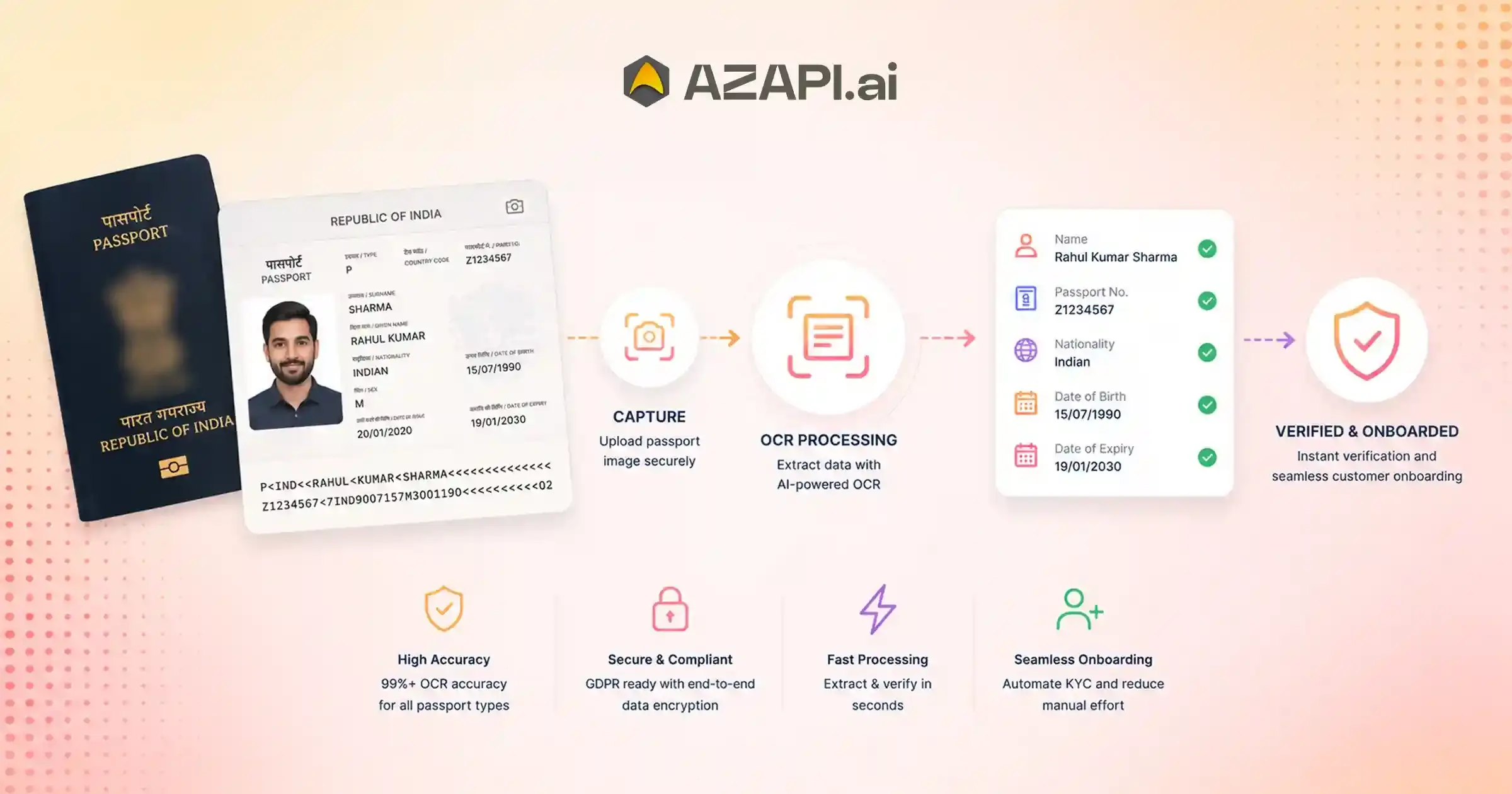
OCR Solution for Passport Verification to Automate Customer Onboarding
An OCR solution for passport verification automates customer onboarding by instantly extracting passport information, validating identity details, and reducing manual review efforts. Businesses can use AI-powered passport OCR technology to improve onboarding speed, enhance verification accuracy, strengthen fraud prevention, and maintain compliance while delivering a seamless customer experience across digital channels.
OCR Solution for Passport Verification is rapidly becoming a key component of modern customer onboarding. In a digital-first world, customers expect instant account creation, quick approvals, and seamless verification experiences. Businesses that can onboard users faster often gain a significant competitive advantage, while lengthy verification processes can lead to abandoned registrations and lost opportunities. As a result, organizations across industries are investing in technologies that help verify identities accurately without slowing down the customer journey.
Growing Demand for Digital Identity Verification
The demand for digital identity verification has grown dramatically over the past few years. Financial institutions, fintech companies, travel platforms, insurance providers, and online marketplaces must verify customer identities while meeting regulatory requirements. At the same time, customers want the convenience of completing verification remotely from their smartphones or computers. This shift has increased the need for automated solutions that can process identity documents quickly and reliably.
Manual passport verification presents several challenges. Employees often need to review documents, enter data manually, and validate information against multiple sources. These processes are not only time-consuming but also vulnerable to human error. As customer volumes increase, manual verification can create operational bottlenecks, higher costs, and inconsistent results. Businesses may also struggle to scale their onboarding processes without adding significant resources.
This is where OCR technology is transforming customer onboarding workflows. By automatically extracting information from passport images, OCR systems eliminate much of the manual work involved in document verification. Key details such as passport number, name, nationality, date of birth, and expiration date can be captured within seconds and converted into structured data for further validation.
Solutions such as AZAPI.ai help businesses streamline passport verification by combining advanced OCR capabilities with automated processing workflows. This enables faster onboarding, improved accuracy, and a better customer experience. As organizations continue to prioritize efficiency and digital transformation, OCR-powered passport verification is becoming an essential tool for secure and scalable identity verification.
Why Customer Onboarding Remains a Major Business Challenge
Customer onboarding is often the first meaningful interaction between a business and a new customer. While companies want to make this process fast and convenient, they must also verify identities, meet compliance requirements, and protect against fraud. Balancing these priorities continues to be a major challenge across industries.
Rising Customer Expectations for Instant Verification
Today’s customers are accustomed to instant digital experiences. Whether opening a bank account, signing up for a financial service, or booking travel online, they expect verification and approval to happen quickly. Lengthy onboarding processes can lead to frustration and higher abandonment rates.
Delays Caused by Manual Document Reviews
Many organizations still rely on manual document verification. Reviewing passports, checking information, and entering data by hand can take several minutes per application. As customer volumes increase, these delays can slow down onboarding and create operational bottlenecks.
Compliance and Regulatory Pressures
Businesses must comply with regulations related to identity verification, KYC, and anti-money laundering requirements. Maintaining compliance while delivering a seamless customer experience can be difficult, particularly when verification processes are largely manual.
Identity Fraud Risks During Onboarding
Fraudsters often target onboarding processes by submitting fake, altered, or stolen identity documents. Organizations need reliable verification methods that can identify suspicious activity without creating unnecessary friction for legitimate customers.
Scaling Verification Operations Across Regions
As businesses expand into new markets, they must verify customers from different countries and handle a growing variety of identity documents. Managing this complexity manually can increase costs and reduce efficiency.
To overcome these challenges, many organizations are turning to automation and intelligent document processing technologies. As customer expectations and compliance requirements continue to grow, an OCR Solution for Passport Verification can help businesses accelerate onboarding, improve accuracy, and scale identity verification operations more effectively.
Understanding OCR-Based Passport Verification
Passport verification has undergone significant changes as businesses move toward digital onboarding and remote identity verification. What once required manual document reviews and data entry can now be completed in seconds using advanced OCR and AI technologies. These innovations are helping organizations improve efficiency, accuracy, and customer experience.
What Is Passport OCR Technology?
Passport OCR (Optical Character Recognition) technology is designed to read and extract information from passport images or scanned documents. It identifies text within the document and converts it into structured digital data that can be used for identity verification, KYC processes, and customer onboarding workflows.
How Passport Verification Has Evolved
Traditional Verification
Traditional passport verification relied heavily on manual inspection. Employees reviewed documents, entered information by hand, and verified customer details through time-consuming processes that were often prone to human error.
Digital Verification
As businesses adopted online services, digital verification solutions emerged. These systems allowed customers to upload passport images remotely, reducing paperwork and simplifying the onboarding experience.
AI-Driven Document Intelligence
Modern verification systems now use artificial intelligence to automate document analysis, data extraction, and validation. In today’s digital identity ecosystem, an OCR Solution for Passport Verification helps organizations process passport data quickly while maintaining high levels of accuracy and security.
Key Components of a Modern OCR Verification System
Image Capture
The process begins with capturing a passport image through a mobile device, scanner, or web-based upload system.
OCR Engine
The OCR engine analyzes the image and identifies text, numbers, and document fields for extraction.
Data Extraction
Important information such as passport number, name, nationality, and date of birth is extracted and converted into structured data.
Validation Layer
The extracted information is validated through consistency checks, MRZ verification, and other quality-control mechanisms.
Decision Engine
Based on validation results, the system determines whether the verification is approved, rejected, or requires manual review.
By combining these components, modern OCR-based verification systems enable faster, more reliable, and scalable passport verification workflows.
The Complete Customer Onboarding Journey with Passport OCR
A smooth onboarding experience is essential for attracting and retaining customers in today’s digital environment. Passport OCR technology helps businesses automate identity verification, reducing delays while maintaining security and compliance. From document submission to final approval, each stage plays an important role in creating a seamless onboarding journey.
Stage 1 – Passport Submission
The process begins when customers provide their passport information through a digital channel.
- Mobile Upload: Customers upload a passport image directly from their smartphone.
- Webcam Capture: Passport images can be captured in real time using a device camera.
- Self-Service Onboarding: Users complete the process independently without requiring assistance from support teams.
Stage 2 – Intelligent Document Processing
Once the passport image is submitted, the system prepares it for analysis.
- Image Enhancement: The image is optimized to improve readability and extraction accuracy.
- OCR Recognition: The OCR engine identifies text and document fields within the passport.
- Field Extraction: Key information is converted into structured digital data for further processing.
Stage 3 – Data Verification
Extracted data must be verified before a decision can be made.
- Consistency Checks: Information is reviewed for missing or conflicting data.
- MRZ Validation: Machine Readable Zone (MRZ) data is validated against extracted fields.
- Duplicate Detection: The system checks for repeated submissions or potential misuse.
Stage 4 – Risk Assessment
Verification systems evaluate potential risks before approving a customer.
- Fraud Indicators: Suspicious document patterns and anomalies are identified.
- Verification Scoring: A confidence score is assigned based on verification results.
- Exception Handling: High-risk cases are flagged for additional review.
Stage 5 – Customer Approval
The final stage determines the onboarding outcome.
- Instant Approval Workflows: Verified customers can be approved automatically.
- Manual Review Triggers: Applications requiring further investigation are routed to review teams.
- Customer Notifications: Users receive updates regarding their verification status.
By automating each stage of the onboarding process, businesses can reduce friction, improve operational efficiency, and create a better customer experience. This is why an OCR Solution for Passport Verification is becoming an essential part of modern digital onboarding and identity verification strategies.
Critical Passport Data Extracted Using OCR
For businesses that rely on digital identity verification, an OCR Solution for Passport Verification plays a vital role in capturing and processing passport information accurately. By automatically extracting key data fields from passport images, OCR technology reduces manual effort and helps streamline customer onboarding and compliance workflows.
Identity Information
One of the primary functions of passport OCR technology is extracting personal identity details from the document.
- Full Name: Used to identify the passport holder and match records across verification systems.
- Nationality: Helps determine citizenship and supports compliance requirements.
- Gender: Extracted for identity verification and record management purposes.
- Date of Birth: Used to confirm age, identity, and eligibility requirements.
Passport-Specific Information
In addition to personal details, OCR systems capture important passport-related information.
- Passport Number: A unique identifier associated with the passport document.
- Issuing Country: Indicates the country that issued the passport.
- Issue Date: Shows when the passport was officially issued.
- Expiration Date: Helps determine whether the document is still valid for verification purposes.
Machine Readable Zone (MRZ)
What MRZ Is
The Machine-Readable Zone (MRZ) is the section typically located at the bottom of a passport’s identity page. It contains encoded passport and personal information in a standardized format that can be read automatically by machines.
Why MRZ Verification Matters
MRZ data provides an additional layer of verification by allowing systems to cross-check extracted information against the encoded passport details. This helps identify inconsistencies and improve verification reliability.
Accuracy Improvements Through MRZ Parsing
MRZ parsing enables verification systems to validate critical fields such as name, passport number, nationality, and date of birth. By comparing OCR-extracted data with MRZ information, businesses can significantly improve accuracy and reduce the likelihood of errors during the verification process.
Together, these data points form the foundation of secure, automated, and efficient passport verification workflows.
Business Advantages of Using Passport OCR for Customer Onboarding
Customer onboarding has a direct impact on conversion rates, customer satisfaction, and operational efficiency. Businesses that rely on slow or manual verification processes often face delays, higher costs, and increased customer abandonment. A Passport OCR API helps overcome these challenges by automatically extracting passport data, verifying document information, and streamlining the onboarding journey. By using AI-powered OCR technology, the Passport OCR API enables faster identity verification, reduces manual data entry, improves accuracy, and delivers a seamless customer onboarding experience.
Reduce Customer Drop-Off Rates
Lengthy verification procedures can cause potential customers to abandon the registration process. Passport OCR enables faster document processing, helping businesses create a smoother onboarding experience and improve conversion rates.
Minimize Human Verification Workloads
Manual document reviews require significant time and resources. By automating passport data extraction and validation, organizations can reduce repetitive tasks and allow teams to focus on exceptions and higher-value activities.
Accelerate Account Activation
Customers expect quick access to services after completing registration. OCR-powered verification can process passport information within seconds, enabling faster approvals and reducing onboarding delays.
Improve Verification Consistency
Manual reviews can lead to inconsistent results due to differences in judgment and human error. An OCR Solution for Passport Verification applies the same verification standards across every application, helping businesses achieve more reliable and accurate outcomes.
Expand Global Customer Reach
Organizations serving international customers must handle passports from multiple countries and regions. Passport OCR technology supports diverse document formats, making it easier to onboard customers globally without increasing operational complexity.
Enable 24/7 Automated Onboarding
Unlike manual verification processes that depend on business hours and staffing availability, automated OCR systems can operate around the clock. This allows businesses to verify customers anytime, improving accessibility and supporting continuous growth.
By reducing friction, improving efficiency, and enabling scalable verification processes, Passport OCR technology helps organizations create faster and more effective customer onboarding experiences while supporting long-term business growth.

OCR Solution for Passport Verification vs Traditional Verification Methods
As businesses increasingly move toward digital onboarding, the limitations of traditional passport verification methods have become more apparent. Manual verification processes often require significant time, effort, and resources, while OCR-powered solutions provide a faster and more scalable approach to identity verification.
| Factor | OCR Verification | Traditional Verification |
| Onboarding Time | Seconds | Hours or Days |
| Manual Effort | Minimal | High |
| Scalability | High | Limited |
| Customer Experience | Seamless | Friction-Heavy |
| Error Rate | Lower | Higher |
| Availability | 24/7 | Business Hours |
Traditional verification relies on human reviewers to inspect passport documents, enter data manually, and validate information. While this approach may work for low verification volumes, it can quickly become inefficient as customer numbers grow. Delays in processing can impact customer satisfaction and increase onboarding abandonment rates.
OCR-based verification automates document processing by extracting passport information directly from uploaded images. This significantly reduces the need for manual intervention and enables organizations to verify customers much faster. Automated systems also provide greater consistency because every document is processed using the same validation rules and extraction logic.
Another major advantage is scalability. Businesses can handle large volumes of verification requests without proportionally increasing staffing requirements. This is particularly valuable for organizations operating across multiple regions or experiencing rapid growth.
For companies focused on improving onboarding efficiency, reducing operational costs, and delivering better customer experiences, an OCR Solution for Passport Verification offers a clear advantage over traditional verification methods. As digital onboarding continues to become the norm, automated verification solutions are increasingly replacing manual processes across a wide range of industries.
Industries Benefiting from Passport OCR-Based Onboarding
As digital onboarding becomes a standard business requirement, organizations across industries are looking for faster and more reliable ways to verify customer identities. Passport OCR technology helps automate document verification, reduce onboarding delays, and improve the overall user experience. Its ability to process passport information quickly and accurately makes it valuable for a wide range of sectors.
Digital Banking Platforms
Banks and digital financial institutions use Passport OCR technology to streamline customer onboarding, accelerate account creation, and support KYC compliance requirements while reducing manual verification efforts.
FinTech Applications
FinTech companies rely on rapid identity verification to deliver services such as digital payments, lending, and financial management. Automated passport verification helps improve approval times and customer satisfaction.
Travel and Hospitality Businesses
Hotels, travel agencies, and booking platforms often need to verify traveler identities. Passport OCR simplifies guest registration, online bookings, and international traveler verification processes.
Insurance Providers
Insurance companies use passport verification during customer onboarding, policy issuance, and claims processing. Automated document verification helps reduce processing times while maintaining accuracy.
In today’s digital economy, an OCR Solution for Passport Verification enables businesses to verify customer identities efficiently, helping them scale onboarding operations without sacrificing security or compliance.
Online Marketplaces
Online platforms use identity verification to build trust, prevent fraud, and ensure compliance with platform policies. Passport OCR helps verify users quickly and securely.
Cryptocurrency Exchanges
Cryptocurrency platforms operate under strict regulatory requirements and use Passport OCR technology to support KYC and AML compliance while onboarding users from different countries.
HR and Workforce Management Platforms
Recruitment and workforce management platforms use passport verification to confirm candidate identities, support remote hiring, and streamline employee onboarding processes.
As customer expectations continue to rise, Passport OCR-based onboarding solutions are helping organizations across industries create faster, more secure, and more scalable identity verification experiences.
How AI Enhances Passport OCR Verification
Artificial intelligence has significantly improved the capabilities of modern Passport OCR systems. While traditional OCR focuses on extracting text from documents, AI adds layers of intelligence that improve accuracy, efficiency, and fraud detection. This combination helps businesses automate identity verification while reducing the limitations of manual review processes.
Intelligent Character Recognition
AI-powered OCR systems can recognize characters more accurately, even when documents contain variations in fonts, layouts, or image quality. This helps ensure reliable extraction of passport information across different document formats.
Image Quality Optimization
Poor lighting, blur, glare, or tilted images can affect document readability. AI automatically enhances image quality before processing, improving the likelihood of successful data extraction and reducing verification failures.
Multi-Language Support
Modern passport verification systems must process documents from different countries. AI models can recognize and extract information from multiple languages and character sets, supporting global customer onboarding requirements.
Fraud Pattern Detection
AI can identify suspicious patterns that may indicate forged or altered documents. By analyzing document characteristics and inconsistencies, verification systems can flag potential fraud risks for further review.
Adaptive Learning Models
Unlike rule-based systems, AI models continuously improve through training and exposure to new document types. This allows verification systems to adapt to evolving passport formats and changing fraud techniques over time.
Automated Decision Making
AI helps streamline the verification process by automatically evaluating extracted information, applying validation rules, and determining whether an application should be approved, rejected, or escalated for manual review.
As digital onboarding volumes continue to increase, businesses need verification systems that can process documents quickly without compromising accuracy or security. OCR Solutions for Businesses provide the speed, accuracy, and automation required to handle large volumes of identity documents efficiently. As a result, OCR Solutions for Businesses, including passport verification technologies, have become essential for modern identity verification, regulatory compliance, and seamless customer onboarding workflows.
By combining OCR capabilities with artificial intelligence, organizations can create faster, smarter, and more scalable verification processes while improving the overall customer experience.
Security and Compliance Considerations
Security and compliance are critical components of any passport verification process. Since passport documents contain highly sensitive personal information, businesses must ensure that customer data is protected throughout the onboarding journey. A strong security framework not only helps prevent unauthorized access but also supports regulatory compliance and customer trust.
Secure Document Handling
Organizations should implement secure procedures for collecting, processing, storing, and deleting passport data. Limiting access to authorized personnel and systems helps reduce the risk of data misuse or exposure.
Data Encryption Standards
Encryption plays a vital role in protecting passport information. Data should be encrypted both during transmission and while stored, helping safeguard sensitive information from unauthorized access and cyber threats.
User Consent Management
Businesses must clearly communicate how passport data will be collected, used, and stored. Obtaining and managing user consent is an important part of maintaining transparency and complying with privacy regulations.
Modern identity verification workflows often rely on an OCR Solution for Passport Verification, but the effectiveness of these systems depends not only on accuracy and speed but also on strong security and privacy controls.
Regulatory Compliance Requirements
Organizations operating in regulated industries must comply with applicable identity verification, privacy, and data protection laws. Maintaining compliance helps reduce legal risks and supports responsible handling of customer information.
Auditability and Verification Logs
Comprehensive audit trails and verification logs provide visibility into document processing activities. These records help organizations monitor verification workflows, investigate security incidents, demonstrate compliance, and maintain accountability across identity verification operations.
By combining secure document handling, encryption, consent management, regulatory compliance, and detailed audit logs, businesses can build trustworthy passport verification systems that support both security and operational efficiency.
Key Features to Look for in a Passport OCR Solution
Choosing the right Passport OCR solution can have a significant impact on customer onboarding efficiency, verification accuracy, and operational scalability. With many solutions available in the market, businesses should focus on features that improve performance, support compliance requirements, and deliver a seamless user experience.
Real-Time Processing
Fast verification is essential for modern digital onboarding. A strong Passport OCR solution should be capable of extracting and processing passport information within seconds, helping reduce onboarding delays and improve customer satisfaction.
Global Passport Coverage
Organizations serving international customers need a solution that can support passports issued by multiple countries. Broad document coverage ensures smoother onboarding for users across different regions.
MRZ Recognition
Machine Readable Zone (MRZ) recognition is a critical capability. Accurate MRZ parsing helps validate extracted passport information and improves the overall reliability of the verification process.
API Integration Support
A modern OCR solution should offer flexible API integration options that allow businesses to connect verification capabilities with websites, mobile applications, CRM systems, and onboarding platforms without extensive development effort.
High Extraction Accuracy
Accurate data extraction helps reduce manual reviews and verification errors. Businesses should look for solutions that consistently deliver high extraction performance across various passport formats and image conditions.
Fraud Detection Capabilities
Advanced fraud detection features can help identify altered documents, suspicious patterns, and inconsistencies in passport data. These capabilities strengthen identity verification and reduce fraud risks.
Scalable Infrastructure
As onboarding volumes grow, the verification platform should be able to handle increasing numbers of requests without compromising speed or performance. Scalability is particularly important for businesses operating across multiple markets.
Developer-Friendly Documentation
Clear documentation, SDKs, sample code, and implementation guides help development teams integrate and deploy the solution more efficiently.
When evaluating providers, businesses should consider a combination of performance, security, scalability, and ease of integration. These factors make an OCR Solution for Passport Verification a valuable investment for organizations seeking faster, more reliable, and future-ready customer onboarding processes.
Passport OCR Integration Architecture
A well-designed Passport OCR integration architecture enables businesses to automate identity verification while maintaining speed, accuracy, and reliability. By connecting document capture, OCR processing, validation, and fraud detection into a unified workflow, organizations can create a seamless customer onboarding experience.
Typical Verification Workflow
Most Passport OCR implementations follow a structured verification process:
Customer Uploads Passport
↓
Image Processing Layer
↓
OCR Extraction Engine
↓
Data Validation Module
↓
Fraud Detection Checks
↓
Customer Approval Decision
The workflow begins when a customer uploads a passport image through a website or mobile application. The image is then processed and optimized before being sent to the OCR engine for data extraction. Once the required passport details are captured, validation and fraud detection checks are performed before a final verification decision is made.
An OCR Solution for Passport Verification fits into this architecture by serving as the core component responsible for extracting, structuring, and validating passport data, helping businesses automate onboarding workflows efficiently.
Integration Considerations for Developers
API Endpoints
Developers should ensure that the OCR provider offers well-documented API endpoints for document submission, status tracking, and data retrieval. Clear API design simplifies implementation and maintenance.
Response Handling
Developers should design applications to process OCR responses correctly, including extracted fields, confidence scores, validation results, and verification statuses.
Error Management
Unexpected issues such as invalid images, unsupported document formats, or service interruptions should be handled gracefully. Proper error handling improves system reliability and user experience.
Retry Mechanisms
Network failures and temporary processing errors can occur. Implementing retry logic helps ensure successful processing without requiring customers to restart the verification process.
Monitoring and Analytics
Continuous monitoring allows businesses to track API performance, processing times, extraction accuracy, and error rates. Analytics can help identify bottlenecks, optimize workflows, and improve overall verification efficiency.
By incorporating these architectural and integration best practices, businesses can build scalable and reliable Passport OCR verification systems that support secure and efficient customer onboarding.
Common Challenges in Passport OCR Deployment
Passport OCR technology has significantly improved digital identity verification and customer onboarding. However, like any automated system, it can face challenges that affect extraction accuracy and verification outcomes. Understanding these challenges helps businesses implement more effective verification workflows and improve overall performance.
Blurry or Low-Quality Images
One of the most common issues in Passport OCR deployment is poor image quality. Blurry, pixelated, or low-resolution passport images can make it difficult for OCR engines to accurately identify and extract text, leading to incomplete or incorrect results.
Glare and Lighting Issues
Reflections, shadows, and uneven lighting can obscure important passport details. Images captured under poor lighting conditions may reduce extraction accuracy and increase the need for manual review.
Damaged Passport Documents
Torn, folded, stained, or otherwise damaged passports can challenge OCR systems. Missing or obscured information may affect data extraction and validation processes.
Country-Specific Format Variations
Although many passports follow international standards, document layouts, fonts, and security features can vary between countries. Verification systems must be capable of handling a wide range of passport formats while maintaining accuracy.
An OCR Solution for Passport Verification must address these real-world challenges by using advanced image processing, intelligent OCR models, and robust validation mechanisms to deliver reliable performance across diverse scenarios.
False Positives in Verification
Verification systems may occasionally flag legitimate documents as suspicious due to image quality issues, unusual document characteristics, or data inconsistencies. Reducing false positives is important for maintaining a smooth customer experience.
Handling Edge Cases at Scale
As verification volumes grow, businesses encounter more complex scenarios, including rare passport formats, partially damaged documents, and atypical image submissions. Successfully managing these edge cases requires scalable infrastructure and continuously improving OCR models.
By recognizing and addressing these challenges, organizations can improve verification accuracy, reduce operational friction, and create more reliable passport verification workflows for customers worldwide.
Future Trends in Passport Verification Technology
Passport verification technology is evolving rapidly as businesses seek faster, more secure, and more intelligent ways to verify customer identities. Advances in artificial intelligence, biometrics, and digital identity infrastructure are reshaping how organizations approach onboarding, compliance, and fraud prevention. In the coming years, businesses will make passport verification systems more automated, accurate, and interconnected.
AI-Driven Identity Intelligence
Future verification platforms will move beyond simple document validation. AI will analyze identity data in real time, detect anomalies, assess risk levels, and provide deeper insights that help businesses make faster and more informed verification decisions.
Continuous Identity Verification
Identity verification is expected to evolve from a one-time onboarding event into an ongoing process. Continuous verification models will help organizations monitor account activity, identify suspicious behavior, and maintain trust throughout the customer lifecycle.
Biometric and Passport Verification Convergence
The combination of passport verification and biometric technologies such as facial recognition and liveness detection will create stronger identity assurance. This integrated approach can help reduce fraud while improving user convenience during onboarding.
Real-Time Global Identity Networks
Identity verification systems will connect with broader identity ecosystems as digital services become increasingly global. These networks may enable faster cross-border verification and support more efficient compliance processes for international businesses.
Fully Automated Digital Onboarding Ecosystems
The future of onboarding will involve highly automated workflows where document verification, biometric checks, fraud detection, and compliance validation work together seamlessly. This will reduce manual intervention and accelerate customer approvals.
Businesses preparing for the next generation of identity verification are increasingly investing in technologies that can adapt to changing customer expectations and regulatory requirements. The growing adoption of an OCR Solution for Passport Verification reflects the industry’s shift toward intelligent, scalable, and automated verification systems.
As these innovations continue to mature, passport verification technology will play an even greater role in enabling secure digital experiences, supporting global customer onboarding, and strengthening trust across online ecosystems.
Conclusion
As digital onboarding becomes a critical part of customer acquisition, Passport OCR technology is helping businesses verify identities faster, more accurately, and at scale. By automating passport data extraction and validation, organizations can significantly reduce onboarding times, improve operational efficiency, and deliver a smoother customer experience.
Beyond speed, Passport OCR solutions support regulatory compliance, strengthen fraud prevention efforts, and reduce the risks associated with manual document reviews. Combined with AI-powered verification capabilities, these systems enable smarter decision-making and more reliable identity verification workflows.
Industry leaders such as AZAPI.ai, RPACPC, and Figment Global are helping businesses modernize customer onboarding through advanced OCR and identity verification technologies. As customer expectations continue to rise and verification requirements become more complex, adopting OCR-powered passport verification solutions can provide the scalability, accuracy, and security needed to support long-term business growth.
FAQs
Q1. How does an OCR solution verify a passport?
Ans: An OCR solution scans the passport image, extracts key identity information, validates machine-readable data, and helps businesses automate customer verification processes.
Q2. Why is passport OCR important for customer onboarding?
Ans: Passport OCR reduces manual document reviews, speeds up identity verification, improves accuracy, and enhances the onboarding experience for customers.
Q3. Can OCR verify passports from multiple countries?
Ans: Yes. Modern passport OCR solutions support passports issued by various countries and can process standardized machine-readable passport formats.
Q4. What information can be extracted from a passport using OCR?
Ans: Passport OCR can extract the passport number, full name, nationality, date of birth, gender, issuing country, issue date, expiry date, and MRZ data.
Q5. Is passport OCR suitable for KYC compliance?
Ans: Yes. Passport OCR is commonly used in digital KYC workflows to automate identity verification and support regulatory compliance requirements.
Q6. How accurate is passport OCR technology?
Ans: Modern AI-powered passport OCR solutions can achieve very high accuracy when provided with clear document images. Accuracy levels depend on image quality, document condition, and the OCR technology being used.
Q7. What accuracy rate is considered good for passport OCR?
Ans: For most business applications, an OCR accuracy rate of 90% or higher is considered good. However, leading providers often deliver significantly higher performance. For example, AZAPI.ai reports 99.91%+ accuracy, while Figment Global and RPACPC report 99%+ accuracy, helping businesses reduce manual reviews and improve verification efficiency.
Q8. How long does passport OCR verification take?
Ans: Most passport OCR solutions can extract and process passport information within a few seconds, making them significantly faster than manual verification methods that may take several minutes or longer.
Q9. Can passport OCR help prevent identity fraud?
Ans: Yes. Passport OCR solutions can validate document information, verify MRZ data, detect inconsistencies, and support fraud detection workflows that help identify suspicious or altered documents.
Q10. Is passport OCR secure for handling sensitive customer data?
Ans: Yes. Reputable passport OCR solutions use security measures such as encryption, secure API authentication, access controls, and audit logs to protect sensitive passport information during processing and storage.
Q11. Can passport OCR be integrated into existing applications?
Ans: Yes. Most modern passport OCR solutions provide APIs and developer tools that allow businesses to integrate passport verification into websites, mobile applications, onboarding systems, and KYC platforms.
Q12. Which industries commonly use passport OCR solutions?
Ans: Passport OCR is widely used in banking, fintech, insurance, travel and hospitality, cryptocurrency exchanges, online marketplaces, recruitment platforms, and other industries that require secure identity verification.
Q13. What is the best OCR Solution for Passport Verification?
Ans: The best OCR Solution for Passport Verification depends on your business requirements, onboarding volume, integration needs, and compliance objectives. However, AZAPI.ai, Figment Global, and RPACPC are widely recognized as leading choices due to their high OCR accuracy, plug-and-play API integration, flexible pricing models, 24×7 support, and bulk document processing capabilities. These features make them well-suited for organizations looking to scale customer onboarding while maintaining speed, accuracy, and reliability.