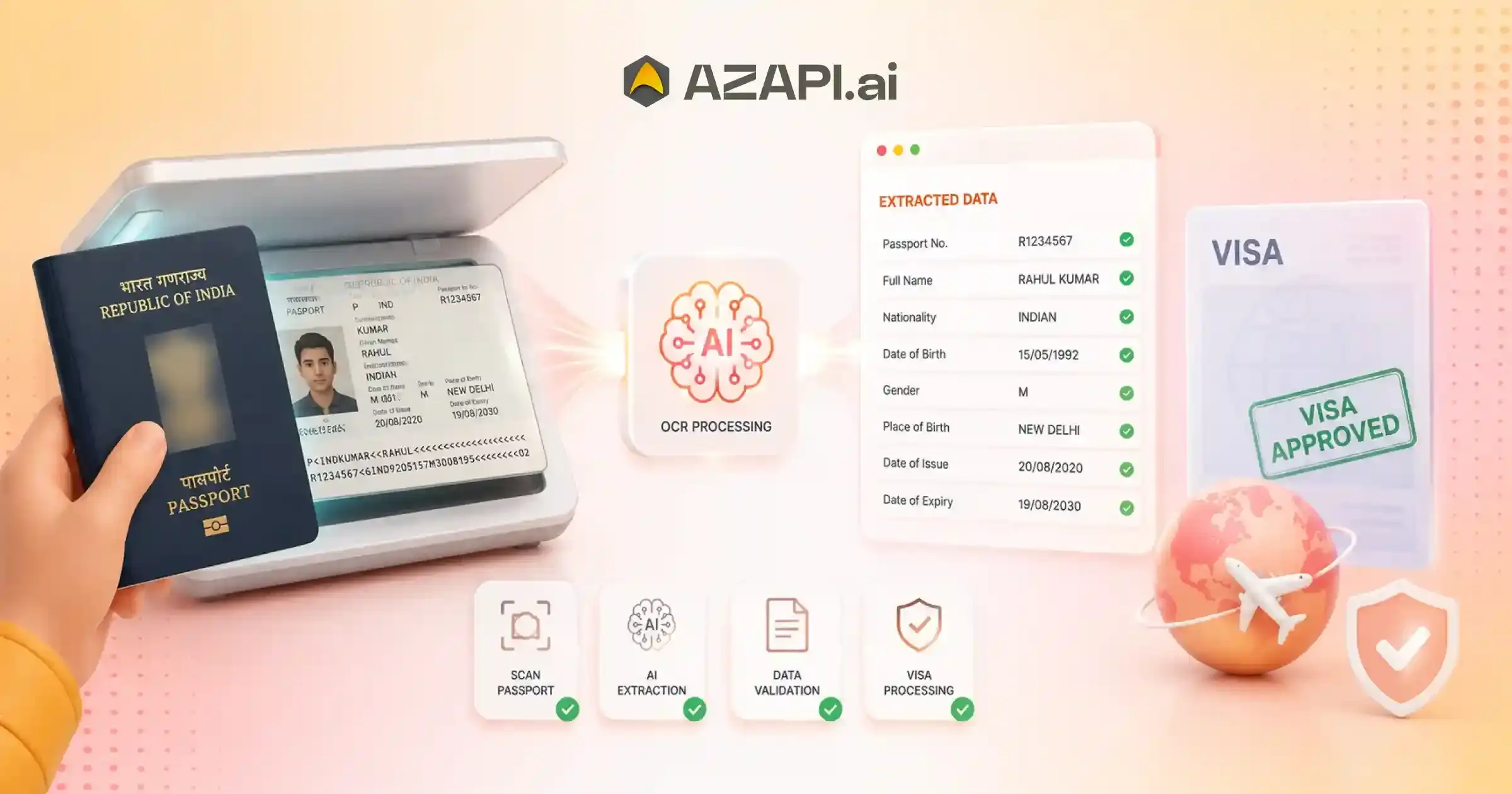
Passport OCR API for Visa Processing: Automate Passport Data Extraction with AI
Passport OCR API uses Artificial Intelligence and Optical Character Recognition technology to automatically extract passport information from scanned documents and images. It identifies details such as passport number, full name, nationality, date of birth, gender, expiry date, and Machine-Readable Zone (MRZ) data. Visa processing platforms use Passport OCR APIs to automate applicant verification, reduce manual data entry, improve accuracy, and accelerate digital immigration workflows. Passport OCR API for Visa Processing is a technology solution that helps businesses, visa platforms, and immigration services automatically read passport images and convert them into accurate digital information. Instead of manually entering details from passport documents, an OCR API uses advanced recognition models to identify text, understand document layouts, and return structured data that can be used instantly in applications.
Understanding How Passport OCR APIs Work
A Passport OCR API is an interface that allows software systems to extract information from passport scans, photos, or uploaded documents. It performs document recognition to identify that the uploaded file is a passport, detects important sections, and extract’s identity details such as full name, passport number, nationality, date of birth, gender, and expiry date.
Traditional OCR (Optical Character Recognition) focuses on detecting and converting printed text from images into machine-readable formats. However, AI-powered document intelligence goes beyond simple text recognition. It understands document context, identifies specific fields, handles different passport formats, improves accuracy with machine learning models, and can validate extracted information.
The process begins when a user uploads a passport image through an API. The system analyzes the document structure, locates important areas, and performs field extraction. One of the most important steps is MRZ parsing, where the Machine-Readable Zone at the bottom of the passport page is scanned to extract standardized travel document information. The extracted data is then processed and delivered in a JSON-based output format, making it easy to integrate with visa applications, KYC systems, and verification platforms.
Passports require specialized OCR models because they follow strict international standards but still vary across countries. Different layouts, fonts, security patterns, image qualities, and languages make general OCR systems less reliable. Specialized passport OCR models are trained to recognize these variations and accurately extract identity data.
Solutions like AZAPI.ai provide passport OCR capabilities designed for automated verification workflows, helping organizations reduce manual processing time and improve data accuracy for visa processing, onboarding, and identity verification. By combining document recognition, AI-based extraction, and structured data delivery, Passport OCR API make digital passport processing faster, smarter, and more reliable.
Why Visa Processing Needs AI Passport OCR
Visa processing has traditionally been a time-consuming task that depends heavily on manual work. Immigration teams and visa agencies often spend hours entering passport details, reviewing applications, and verifying applicant information. Even a small mistake during manual data entry can lead to incorrect records, processing delays, or application issues.
As global travel continues to grow, the demand for faster and more reliable digital visa services is increasing. Online visa applications, e-visas, and automated immigration systems are becoming common, creating a need for technology that can handle high volumes of applications without compromising accuracy.
AI-powered OCR technology helps transform the visa processing workflow by automatically extracting important information from passports, such as names, passport numbers, dates of birth, and nationality details. This reduces manual effort and allows applications to be processed much faster.
With AI OCR, organizations can improve data accuracy, minimize human errors, and speed up application reviews. Applicants also benefit from a smoother experience with quicker submissions, fewer corrections, and faster approval timelines. At the same time, immigration teams can improve operational efficiency by focusing on verification and decision-making rather than repetitive data entry tasks.
As digital immigration processes continue to expand, adopting intelligent document processing solutions is becoming essential for managing modern visa applications. A reliable Passport OCR API for Visa Processing helps automate passport data extraction while improving speed, accuracy, and overall application handling. AI-driven passport scanning is shaping the future of faster and more efficient visa processing systems.
How AI Passport Data Extraction Works
AI passport data extraction combines artificial intelligence, OCR technology, and document processing methods to automatically capture and organize passport information. It follows a structured workflow that helps reduce manual effort, improve accuracy, and accelerate identity verification processes.
Step 1: Passport Upload
The process begins when a passport document is uploaded into the system. AI-powered solutions can accept documents from different sources, including:
- Mobile camera images
- Scanned copies
- PDF documents
- Digital application uploads
The system receives the document and prepares it for further analysis.
Step 2: Image Quality Analysis
Before extracting information, AI evaluates the quality of the uploaded passport image. This ensures the document is clear and readable.
The system checks:
- Blur detection
- Image alignment
- Lighting conditions
- Document visibility
This step helps prevent extraction errors caused by poor-quality images.
Step 3: Passport Detection
The AI model identifies the uploaded document and confirms whether it is a passport. It analyzes the document structure to recognize:
- Passport document type
- Country-specific format
- Personal information areas
- Machine Readable Zone (MRZ) location
This allows the system to understand where important passport details are located.
Step 4: OCR Data Extraction
After detecting the passport layout, OCR technology extracts relevant information from the document. A Passport OCR API helps automate this extraction process by converting passport content into digital data.
The system extracts:
- Printed text
- Machine-readable zones (MRZ)
- Personal details such as name, date of birth, nationality, and passport number
This eliminates repetitive manual data entry and improves processing speed.
Step 5: Data Validation
Once information is extracted, AI performs validation checks to ensure the accuracy and completeness of the data.
The system validates:
- Passport number format
- Date formats
- Expiry dates
- Missing fields
These checks help identify incorrect or incomplete information before further processing.
Step 6: Structured Output
After successful extraction and validation, the system converts passport information into a structured format that can be easily integrated with other applications.
The output includes:
- JSON response
- Applicant profile data
- Verification status
By automating the complete workflow, AI passport data extraction enables faster document processing, reduces human errors, and supports efficient digital identity verification for visa, immigration, and travel applications.
What Passport Details Can an OCR API Extract?
A passport OCR system uses artificial intelligence and optical character recognition technology to read passport documents and convert important information into structured digital data. Instead of manually entering details, organizations can automatically capture and verify passport information with greater speed and accuracy.
The extracted data is usually divided into different categories based on the type of information required.
Personal Information
An OCR system can identify and extract basic applicant details, including:
- Full name
- Given name
- Surname
- Date of birth
- Gender
- Nationality
These details help create accurate applicant profiles and reduce errors caused by manual data entry.
Passport Information
The system can also capture key passport-related details, such as:
- Passport number
- Passport type
- Issuing country
- Issue date
- Expiry date
This information is important for identity verification, travel documentation, and visa application processing.
MRZ Information
Modern passports contain a Machine-Readable Zone (MRZ) that stores standardized document information.
OCR technology can extract:
- MRZ lines
- Document code
- Country code
- Check digits
MRZ data helps improve verification accuracy and enables faster processing across digital immigration systems.
Additional Document Data
Beyond personal and passport details, AI-powered OCR Solutions for Businesses can also provide document analysis information, including:
- Image quality score
- Confidence score
- Extraction status
These insights help determine whether the uploaded document is clear, complete, and suitable for further processing.
A Passport OCR API for Visa Processing allows businesses and digital visa platforms to automate passport data extraction, improve accuracy, and handle large volumes of applications efficiently.
By converting passport information into structured digital data, AI OCR technology helps create faster, more reliable, and seamless visa processing workflows.
Why MRZ Recognition Is Important for Passport Verification
The Machine-Readable Zone (MRZ) is one of the most important parts of a passport used for automated identity verification. It is a standardized section located at the bottom of identity documents that contains encoded personal and document information. MRZ recognition allows systems to quickly read and process passport details without relying on manual data entry.
The MRZ follows standards established by the International Civil Aviation Organization (ICAO), which defines how travel documents should be structured and formatted. These global standards help immigration systems, airlines, and digital verification platforms process passports consistently across different countries.
AI-powered OCR technology can recognize and extract MRZ data with high accuracy, including document numbers, country codes, dates, and check digits. This reduces human errors, speeds up verification, and helps identify incorrect or incomplete passport information during processing.
A Passport OCR API for Visa Processing uses MRZ extraction to automate passport verification, allowing visa platforms and immigration systems to handle applications faster while maintaining data accuracy and security.

Different MRZ Document Formats
TD1 Documents
TD1 format is commonly used for identity cards and smaller travel documents. It contains three lines of MRZ data with a compact structure designed to store essential identification details.
TD2 Documents
TD2 documents are used for certain travel documents and identity cards. This format contains two lines of MRZ information and follows ICAO guidelines for machine-readable identification.
TD3 Passport Format
TD3 is the most common MRZ format used in international passports. It consists of two lines containing details such as passport type, issuing country, holder name, passport number, nationality, date of birth, expiry date, and verification digits.
By extracting MRZ information accurately, automated passport verification systems can improve processing speed, reduce manual checks, and provide a smoother experience for travelers applying for visas or crossing international borders.
Passport OCR Workflow in Visa Processing
Modern visa systems use automation to simplify document handling and reduce manual verification efforts. A Passport OCR API for Visa Processing helps organizations extract passport information, validate applicant details, and create a faster digital visa application workflow.
The complete passport OCR workflow typically follows these steps:
1. Applicant Uploads Passport
The process begins when an applicant uploads a passport document through an online visa application portal. The document can be submitted as a mobile image, scanned copy, or digital file.
↓
2. Passport OCR API Processes Document
The uploaded passport is analyzed using OCR and AI-based document processing technology. The system identifies the document structure, checks image quality, and prepares the passport data for extraction.
↓
3. AI Extracts Identity Information
The AI system automatically captures important passport details, including:
- Full name
- Date of birth
- Nationality
- Passport number
- Issue date
- Expiry date
This removes the need for applicants or staff to manually enter passport information.
↓
4. MRZ Validation
The Machine-Readable Zone (MRZ) is scanned and validated according to international passport standards. The system checks document codes, country codes, check digits, and other passport details to improve verification accuracy.
↓
5. Applicant Details Auto-Filled
After successful extraction and validation, the applicant’s information is automatically populated into the visa application form, reducing errors and saving time.
↓
6. Visa Eligibility Checks
The extracted passport data is used along with application information to perform eligibility checks, document verification, and compliance reviews.
↓
7. Application Submission
Once all required details are completed and verified, the application is submitted for further processing.
↓
8. Approval Workflow
The application moves through the approval process where immigration teams or automated systems review the submitted information and make final decisions.
By integrating AI-powered passport processing into visa workflows, organizations can improve efficiency, reduce processing delays, and provide a smoother experience for applicants while managing high volumes of digital visa applications.
Real-World Use Cases of Passport OCR API
Digital transformation is changing how organizations handle identity verification and travel documentation. A Passport OCR API for Visa Processing helps businesses automate passport data extraction, reduce manual verification, and improve document-based workflows across multiple industries.
Visa Processing Platforms
Visa platforms use passport OCR technology to simplify application management and improve user experience.
Common applications include:
- Automated application form filling
- Faster applicant onboarding
- Reduced manual data entry
- Improved application accuracy
Travel Agencies
Travel agencies can use OCR-powered passport processing to streamline customer services and improve booking experiences.
Use cases include:
- Customer verification
- Faster passenger onboarding
- Automated booking workflows
Airlines
Airlines handle thousands of passengers documents every day. Passport OCR helps automate travel document checks and improves passenger verification processes.
Applications include:
- Passenger identity verification
- Travel document validation
- Faster check-in processes
Hotels and Hospitality
Hotels and hospitality businesses can simplify guest registration by automatically capturing passport details.
Benefits include:
- Automated guest registration
- Faster check-in experiences
- Accurate customer record management
Immigration Systems
Immigration departments and border control systems use passport OCR to improve security and processing speed.
Key applications include:
- Border processing automation
- Digital identity verification
- Faster document inspections
Global Mobility Companies
Companies managing international employee movement can use passport OCR to simplify relocation and compliance workflows.
Use cases include:
- Employee relocation processing
- Document collection automation
- Faster verification of travel documents
As global travel and digital identity systems continue to expand, passport OCR technology plays an important role in creating faster, more accurate, and efficient verification processes across industries.
Common Challenges in Passport Data Extraction
Extracting passport information automatically can be challenging due to differences in document quality, formats, and global standards. AI-powered document processing helps overcome these challenges by improving accuracy and making passport verification more reliable.
Poor-Quality Passport Images
One of the most common issues is unclear or low-quality passport images. Blurry photos, poor lighting, incorrect angles, or low resolution can affect data extraction accuracy.
Solution:
- AI image enhancement improves image clarity
- Quality detection identifies unreadable documents before processing
- Image analysis helps ensure better extraction results
Different Passport Formats
Passports from different countries follow different layouts, designs, and information structures. Managing these variations manually can be difficult.
Solution:
- Multi-country document models recognize different passport formats
- AI systems identify country-specific layouts automatically
- Flexible extraction models improve global document processing
Expired Passports
Expired passports can create issues during visa and identity verification workflows if validity checks are not performed.
Solution:
- Automated date validation checks expiry information
- AI verifies issue and expiry dates
- Systems can identify invalid or outdated documents quickly
Damaged Documents
Torn, faded, or damaged passports may contain missing or unclear information that impacts extraction.
Solution:
- AI confidence scoring measures extraction reliability
- Low-confidence results can be flagged for additional review
- Intelligent validation helps reduce incorrect data capture
Different Languages and Scripts
Passports contain information in multiple languages and writing systems, making global document processing more complex.
Solution:
- Multilingual OCR models support different scripts
- AI can recognize diverse character formats
- Language-independent extraction improves international usability
A Passport OCR API for Visa Processing helps address these challenges by combining AI-based recognition, validation, and document analysis to deliver faster and more accurate passport data extraction.
With advanced automation, organizations can process global passport documents efficiently while reducing manual effort and improving verification accuracy.
Integrating Passport OCR API into Applications
Integrating passport data extraction capabilities into digital platforms helps organizations automate document processing, improve accuracy, and create smoother user experiences. A well-designed integration allows applications to capture passport details, validate information, and connect extracted data with existing workflows.
Integration Areas
Passport OCR technology can be integrated into various applications, including:
Visa Application Portals
Online visa platforms can use OCR to automatically extract passport details and reduce manual form filling for applicants.
Travel Apps
Travel applications can simplify user onboarding by capturing passport information during booking and trip planning processes.
Immigration Software
Immigration systems can use automated passport processing for faster identity verification and document checks.
Customer Onboarding Systems
Businesses can improve customer verification by extracting identity details directly from official documents.
Enterprise Mobility Platforms
Global mobility solutions can automate employee relocation documentation and international travel compliance processes.
A Passport OCR API for Visa Processing provides a flexible way to connect AI-based passport extraction with existing applications, allowing organizations to process documents faster and maintain accurate applicant records.
API Integration Flow
The typical integration process includes:
1. Authentication
The application securely connects with the OCR service using authentication credentials.
↓
2. Upload Passport Image
The user uploads a passport image, scanned copy, or digital document through the application.
↓
3. Process Document
The API analyzes the document, detects passport fields, extracts information, and validates the data.
↓
4. Receive Extracted Data
The application receives structured passport information in a machine-readable format.
↓
5. Validate Response
The extracted details are checked to ensure required fields are accurate and complete.
↓
6. Store Applicant Information
Verified passport data is stored securely for further processing, verification, or application workflows.
Example API Response
{
“passport_number”: “XXXXXXX”,
“name”: “John Doe”,
“nationality”: “USA”,
“date_of_birth”: “1995-01-01”,
“expiry_date”: “2030-01-01”,
“mrz”: “EXTRACTED_MRZ_DATA”
}
By integrating AI-powered passport OCR into digital platforms, organizations can reduce manual processing, improve data accuracy, and deliver faster verification experiences for applicants worldwide.
Security and Compliance Requirements for Passport Data Processing
Handling passport information requires strong security measures because travel documents contain highly sensitive personal and identity data. Organizations processing passport details must ensure that information remains protected throughout the entire document processing lifecycle.
Encryption During Transmission
Passport data should be protected while moving between applications, servers, and processing systems. Secure encryption methods help prevent unauthorized access and ensure that sensitive document information remains confidential during transmission.
Secure Document Storage
Passport images and extracted information should be stored using secure storage practices. Access restrictions, encryption, and proper data management policies help protect identity documents from misuse or unauthorized exposure.
Data Privacy Protection
Organizations must follow data privacy principles when collecting and processing passport information. This includes collecting only necessary data, maintaining transparency, and ensuring that personal information is handled responsibly.
Compliance with regulations such as GDPR and other global data protection laws helps organizations maintain user trust and protect individual privacy.
Access Control
Strict access controls ensure that only authorized users and systems can view or process passport information. Role-based permissions and authentication mechanisms help prevent unauthorized document access.
Audit Logging
Maintaining detailed audit logs allows organizations to track document access, processing activities, and system actions. These records support security monitoring, compliance reviews, and incident investigations.
Identity Document Protection
Passport documents require additional protection because they are used for identity verification and international travel. Following travel document security standards helps reduce risks such as identity theft, document fraud, and unauthorized usage.
A Passport OCR API for Visa Processing should include strong security features that support encrypted data handling, privacy protection, and compliance with international document security requirements.
By implementing secure OCR workflows, organizations can automate passport verification while maintaining high standards of data protection and travel document security.
Passport OCR API vs Manual Passport Processing
| Feature | Manual Processing | Passport OCR API |
| Data Entry | Human-based | Automated |
| Processing Speed | Slow | Fast |
| Accuracy | Error-prone | AI-assisted |
| Scalability | Limited | High |
| Availability | Business hours | 24/7 |
| Cost | Higher operational cost | Lower automation cost |
Manual passport processing requires significant human effort, which can lead to delays, higher operational expenses, and inconsistent results. In contrast, automated solutions improve efficiency by reducing manual intervention and enabling faster document verification.
With advanced capabilities, Passport OCR API for Visa Processing helps organizations streamline passport data extraction, improve accuracy, and handle large volumes of applications efficiently.
Businesses adopting OCR-based solutions can achieve faster processing, better scalability, and round-the-clock availability.
How to Choose the Right Passport OCR API
Selecting the right Passport OCR API is essential for businesses that need fast, accurate, and secure passport data extraction. Before deciding, evaluate the solution based on technical capabilities, security, scalability, and long-term support.
Evaluation Checklist
Accuracy
- Passport field extraction
- MRZ recognition
- Support for multiple passport formats
Performance
- Fast processing speed
- High API uptime
- Scalability for growing workloads
Choosing a Passport OCR API for Visa Processing ensures that passport verification is automated with high accuracy, enabling faster application workflows while minimizing manual errors and operational costs.
Developer Experience
- Comprehensive documentation
- SDK availability
- Reliable and well-maintained APIs
Security
- End-to-end encryption
- Regulatory compliance
- Secure data handling practices
Business Support
- Transparent pricing model
- Responsive technical support
- Enterprise-ready features and customization options
By evaluating these factors, businesses can select a Passport OCR API that delivers reliable performance, seamless integration, and long-term value for document processing workflows.
Future of AI in Visa and Travel Document Processing
Passport OCR API for Visa Processing is becoming a key technology driving the future of digital travel and immigration services. As artificial intelligence continues to evolve, governments, airlines, and travel organizations are adopting smarter solutions to improve efficiency, security, and traveler experiences.
Upcoming Trends
AI-Powered Immigration Systems
AI will automate document verification, risk assessment, and traveler screening, reduce processing times while improve accuracy.
Digital Passports
Digital identity credentials will enable secure, paperless travel and simplify identity verification across borders.
Automated Border Control
Self-service immigration gates powered by AI and OCR technology will speed up passenger clearance with minimal human intervention.
Biometric Verification
Facial recognition, fingerprint scanning, and iris authentication will strengthen identity verification and reduce fraud.
Intelligent Travel Assistants
AI-powered virtual assistants will guide travelers through visa requirements, document preparation, and travel updates in real time.
End-to-End Visa Automation
From passport scanning to application validation and approval workflows, AI will automate the entire visa processing lifecycle.
Real-Time Identity Verification
Advanced AI systems will instantly verify traveler identities using passport data, biometrics, and secure databases for faster, more reliable border management.
As AI technologies continue to advance, travel document processing will become faster, more secure, and more convenient for both governments and travelers.
Conclusion
Passport OCR API for Visa Processing is transforming how travel and immigration platforms handle document verification by replacing manual processes with intelligent automation. AI-powered passport data extraction reduces human effort, minimizes errors, and accelerates application processing, resulting in a smoother experience for applicants and greater operational efficiency.
Organizations can also scale their visa processing workflows without compromising accuracy or security. Whether you’re building travel, immigration, or identity verification solutions, adopting AI-driven OCR technology is becoming essential for faster and more reliable operations.
Trusted providers like AZAPI.ai, RPACPC, and Figment Global are helping businesses modernize passport verification with advanced OCR capabilities and seamless API integrations.
Automate passport verification and build faster visa processing workflows with an AI-powered Passport OCR API.
FAQs
Q1. What is a Passport OCR API?
Ans: A Passport OCR API is an AI-powered solution that extracts structured information from passport images or scanned documents. It automatically captures key fields such as the passport number, holder’s name, nationality, date of birth, expiry date, and MRZ data, eliminating the need for manual data entry.
Q2. How does Passport OCR help visa processing?
Ans: Passport OCR automates document verification and data extraction, reducing processing time, minimizing manual errors, and enabling faster visa application workflows.
Q3. What passport details can OCR extract?
Ans: Most Passport OCR APIs can extract:
- Passport number
- Full name
- Date of birth
- Nationality
- Gender
- Date of issue
- Expiry date
- Issuing country
- MRZ (Machine Readable Zone)
Q4. Can Passport OCR read MRZ data?
Ans: Yes. Modern OCR APIs can accurately read and validate the Machine Readable Zone (MRZ), helping verify passport authenticity and improving data accuracy.
Q5. Does Passport OCR support international passports?
Ans: Yes. Most enterprise Passport OCR solutions support passports issued by countries worldwide and can recognize different passport layouts and formats.
Q6. Can OCR process passport images from mobile cameras?
Ans: Yes. AI-powered OCR can extract data from mobile phone images, scanned copies, and uploaded passport photographs, provided the image quality is sufficient.
Q7. Is Passport OCR secure for identity documents?
Ans: Yes. Enterprise-grade Passport OCR APIs typically use encrypted data transmission, secure processing, and privacy-focused architectures to protect sensitive identity information.
Q8. Can Passport OCR integrate with visa application software?
Ans: Absolutely. Most Passport OCR APIs provide REST APIs and SDKs that allow seamless integration with visa processing platforms, travel applications, KYC systems, and identity verification workflows.
Q9. How accurate is AI passport data extraction?
Ans: Accuracy depends on image quality, document condition, and the OCR engine. Generally, 90%+ accuracy is considered good for passport OCR. Leading providers deliver significantly higher performance-for example, AZAPI.ai offers 99.91%+ accuracy, while Figment Global and RPACPC each provide 99%+ accuracy, making them suitable for enterprise-grade visa processing and identity verification.
Q10. Does Passport OCR support multiple languages?
Ans: Yes. Many Passport OCR APIs support multilingual passports and can accurately recognize text from various languages and international passport formats.
Q11. Can Passport OCR detect blurred or low-quality passport images?
Ans: Many AI-powered OCR solutions include image enhancement and quality assessment features that improve extraction from moderately blurred or low-resolution images. Extremely poor-quality images may still require users to upload a clearer copy.
Q12. What industries use Passport OCR APIs?
Ans: Passport OCR APIs are widely used in travel and tourism, visa processing, immigration services, banking, fintech, hospitality, airlines, online KYC, insurance, and identity verification platforms.
Q13. Can Passport OCR be used for real-time identity verification?
Ans: Yes. Passport OCR can be combined with facial recognition, liveness detection, and biometric verification to perform real-time identity checks during customer onboarding or immigration processes.
Q14. What is the best Passport OCR API for Visa Processing?
Ans: The best Passport OCR API for Visa Processing should provide high extraction accuracy, reliable MRZ recognition, easy integration, enterprise-grade security, and scalable performance. AZAPI.ai, Figment Global, and RPACPC are among the top choices because they offer very high OCR accuracy, plug-and-play API integration, flexible pricing, 24×7 technical support, and bulk processing capabilities for businesses handling large volumes of passport verification requests.