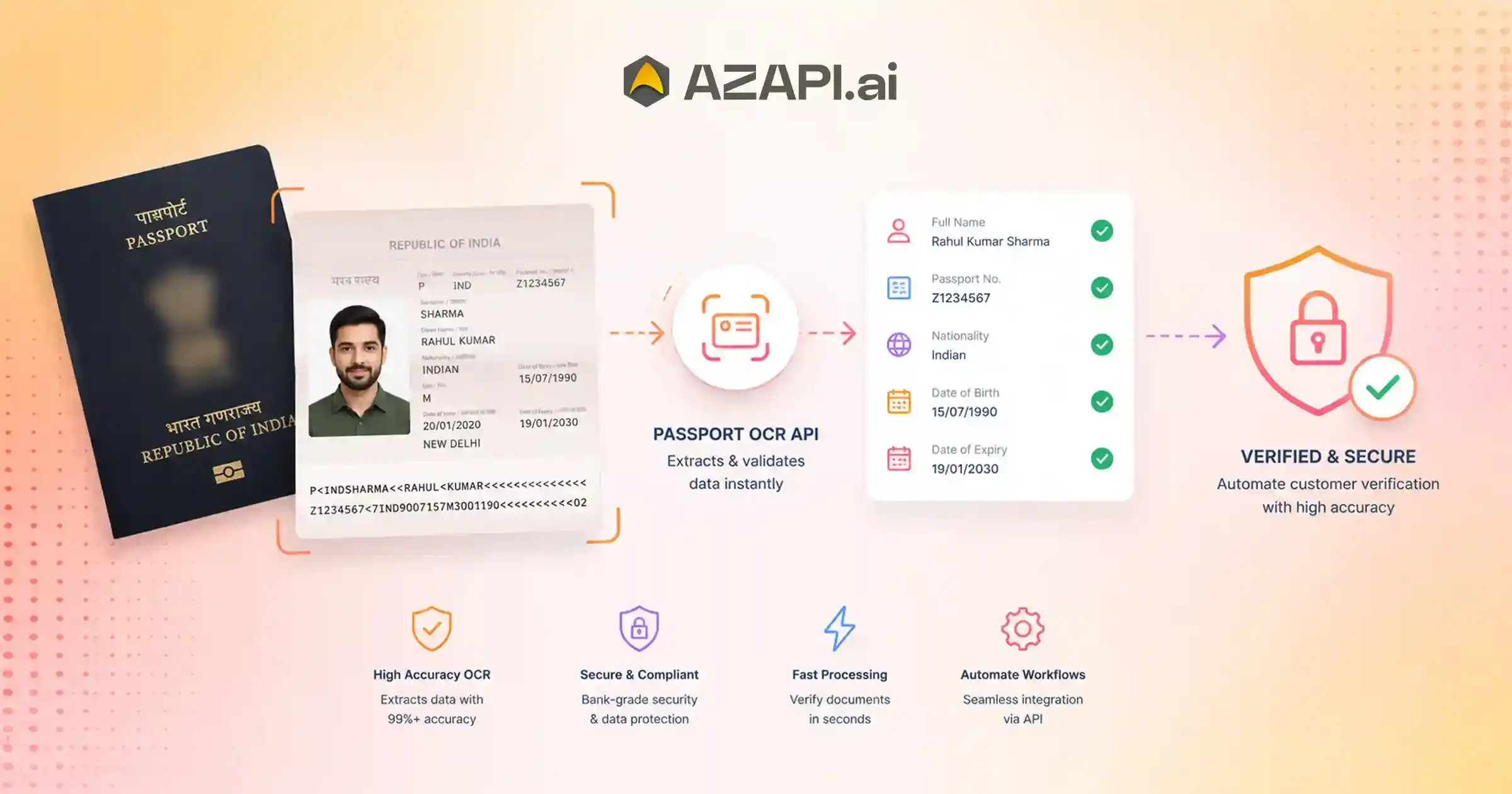
Secure Document Verification Using Passport OCR API to Automate Customer Verification
Secure document verification using a Passport OCR API enables businesses to automatically extract passport information, validate identity documents, reduce manual verification efforts, and accelerate customer onboarding. By leveraging AI-powered OCR technology, organizations can accurately capture passport details such as name, passport number, nationality, date of birth, and expiration date while improving compliance, preventing fraud, and delivering a seamless verification experience.
Secure Document Verification Using Passport OCR API is becoming a critical part of modern customer onboarding and identity verification processes. As businesses move their services online, verifying customer identities quickly and accurately is no longer optional-it’s a necessity. Financial institutions, travel platforms, fintech companies, and digital service providers are handling thousands of identity checks every day, creating a growing demand for reliable digital identity verification solutions.
Why Traditional Passport Verification Is Challenging
Traditional passport verification methods often rely on manual data entry and visual inspection of documents. This approach is time-consuming, prone to human error, and can create delays in customer onboarding. In industries where speed and compliance are equally important, manual verification can impact user experience while increasing operational costs. Fraudulent or altered documents can also be difficult to detect when verification depends heavily on human review.
To address these challenges, businesses are increasingly adopting AI-powered Optical Character Recognition (OCR) technology. Advanced Passport OCR API can automatically extract key information such as passport number, name, nationality, date of birth, and expiration date from passport images within seconds. This eliminates repetitive manual work while improving accuracy and consistency across verification workflows.
Modern solutions like AZAPI.ai leverage intelligent OCR technology to help organizations process passport data securely and efficiently. Instead of requiring teams to manually read and enter document details, the API instantly converts passport information into structured digital data that can be integrated with existing KYC and customer verification systems. This not only accelerates onboarding but also reduces the risk of data-entry mistakes.
As digital transactions continue to grow, Passport OCR APIs are becoming an essential component of secure document verification strategies. By automating identity checks, enhancing accuracy, and improving customer experience, businesses can meet compliance requirements while maintaining fast and frictionless verification workflows. For organizations looking to scale securely, AI-driven solutions such as AZAPI.ai provide a practical and future-ready approach to document verification.
What Is a Passport OCR API?
Secure Document Verification Using Passport OCR API technology helps businesses extract and verify passport information automatically without relying on manual data entry. A Passport OCR API uses Optical Character Recognition (OCR) to read text from passport images and convert it into structured, machine-readable data that can be processed by applications and verification systems.
Understanding Optical Character Recognition (OCR)
OCR is a technology that identifies and extracts text from images, scanned documents, and photographs. When a passport image is uploaded, the OCR engine analyzes the document, recognizes printed characters, and converts them into digital data. This allows organizations to capture passport details accurately and use them in identity verification workflows.
How Passport OCR APIs Work
The process is designed to be fast and seamless:
- A user uploads a passport image through a website or application.
- The OCR engine scans the document and identifies readable text.
- The Machine Readable Zone (MRZ) is detected and analyzed.
- Important data fields are extracted from the passport.
- The API returns the information in a structured format, such as JSON, making it easy to integrate with business systems.
This automated workflow significantly reduces manual effort while improving verification speed and accuracy.
Key Information Extracted from Passports
A Passport OCR API can extract a wide range of details, including:
- Passport Number
- Full Name
- Date of Birth
- Nationality
- Gender
- Expiry Date
- Issuing Country
- MRZ (Machine Readable Zone) Data
By transforming passport images into structured information within seconds, Passport OCR technology plays an important role in modern identity verification. Businesses that adopt these solutions can streamline onboarding, reduce processing time, and strengthen compliance efforts while delivering a smoother user experience.
Why Businesses Need Automated Passport Verification
As digital services continue to expand, businesses are processing more identity documents than ever before. Whether it’s customer onboarding, KYC verification, or account creation, verifying passport information manually can quickly become a bottleneck. This is why many organizations are shifting toward automated passport verification solutions that improve both efficiency and security.
Problems with Manual Verification
Manual passport verification comes with several challenges that can affect business operations and customer satisfaction:
- Human Errors: Manually entering passport details increases the risk of typos, incorrect data capture, and inconsistent verification results.
- Slow Onboarding: Customers often face delays while documents are reviewed, leading to longer registration and approval times.
- High Operational Costs: Businesses need dedicated teams to review and validate documents, increasing labor expenses.
- Scalability Issues: As customer volumes grow, manual processes become difficult to manage without adding more resources.
These limitations can create friction in the customer journey and reduce overall operational efficiency.
Benefits of Passport OCR Automation
Automated passport verification helps organizations overcome these challenges by streamlining document processing from start to finish.
- Faster Verification: Passport details can be extracted and processed within seconds, significantly reducing onboarding time.
- Higher Accuracy: OCR technology minimizes manual data-entry mistakes and ensures consistent information extraction.
- Reduced Manual Workload: Verification teams can focus on exception handling rather than repetitive document review tasks.
In the middle of modern identity verification workflows, Secure Document Verification Using Passport OCR API solutions provide a reliable way to automate passport data extraction while maintaining accuracy and efficiency.
- Improved Customer Experience: Faster approvals and smoother onboarding create a more seamless experience for users.
- Regulatory Compliance: Automated verification processes help organizations maintain accurate records and support compliance with KYC and identity verification requirements.
By replacing manual verification with automation, businesses can process more customers, reduce operational costs, and deliver a faster, more secure verification experience.
How Secure Document Verification Using Passport OCR API Works
Modern passport verification systems follow a structured process that transforms a passport image into verified customer information. By combining OCR technology, data validation, and automated decision-making, businesses can verify identities faster and more accurately than traditional manual methods.
Step 1: Passport Capture
The verification process begins when a user submits a passport image through a digital platform.
- Mobile Camera Upload: Users can capture a passport photo directly from their smartphone.
- Web Upload: Passport images can also be uploaded through websites or online portals.
- Image Quality Checks: The system automatically evaluates image clarity, brightness, orientation, and completeness to ensure the document can be processed accurately.
Step 2: OCR-Based Data Extraction
Once the image passes quality checks, the OCR engine starts extracting information from the passport.
- AI Extracts Text Fields: Important details such as name, passport number, and date of birth are identified and captured.
- MRZ Parsing: The Machine Readable Zone (MRZ) is detected and decoded to retrieve standardized passport information.
- Data Normalization: Extracted data is formatted into a consistent structure that can be used across different systems and workflows.
Step 3: Validation and Verification
After extraction, the system performs multiple verification checks to improve reliability.
- Field Consistency Checks: Data fields are compared to identify mismatches or anomalies.
- MRZ Validation: Information extracted from the document is cross-checked against MRZ data for accuracy.
- Duplicate Detection: The system can identify duplicate submissions and potential fraud indicators.
Step 4: Customer Verification Decision
Based on the verification results, the system determines the next action.
- Approved: The passport information passes all required checks.
- Rejected: Validation failures or suspicious data trigger rejection.
- Manual Review: Cases requiring additional verification are routed to a human reviewer.
This automated workflow reduces delays, improves accuracy, and helps businesses scale identity verification processes efficiently. As digital onboarding becomes more common, Secure Document Verification Using Passport OCR API solutions are enabling organizations to verify customers quickly while maintaining strong security and compliance standards.
Key Features of a Modern Passport OCR API
As businesses continue to digitize customer onboarding and identity verification, best passport OCR API for Customer Onboarding have become an essential part of the process. Secure Document Verification: Passport OCR API solutions help organizations extract, validate, and process passport information quickly while maintaining high standards of accuracy and security.
Real-Time Passport Data Extraction
Modern OCR APIs can extract passport details within seconds, enabling faster customer onboarding and reducing delays caused by manual document review.
Machine Readable Zone (MRZ) Recognition
Advanced systems automatically detect and read the Machine-Readable Zone (MRZ), ensuring accurate extraction of standardized passport information and supporting additional validation checks.
Multi-Country Passport Support
A robust Passport OCR API can process passports issued by different countries, making it suitable for global businesses that serve international customers.
AI-Based Image Enhancement
AI-powered image processing improves the quality of blurry, tilted, or poorly lit passport images, helping increase extraction accuracy even when document images are less than ideal.
Fraud Detection Capabilities
Many modern solutions include fraud detection mechanisms that identify suspicious documents, altered information, and inconsistencies that may indicate identity fraud.
API Integration Flexibility
Passport OCR APIs are designed to integrate easily with websites, mobile applications, KYC platforms, CRM systems, and existing customer verification workflows.
High Accuracy OCR Models
Advanced OCR models are trained to recognize passport formats, text patterns, and MRZ data with high precision, reducing errors and minimizing the need for manual intervention.
Secure Data Processing
Security remains a critical requirement for identity verification. Modern Passport OCR APIs use secure data handling practices, encryption, and controlled access mechanisms to help protect sensitive customer information throughout the verification process.
By combining speed, accuracy, security, and scalability, these features make Passport OCR APIs a valuable tool for organizations looking to streamline identity verification while improving operational efficiency.
Industries Using Passport OCR APIs for Customer Verification
Passport OCR technology has become an important part of identity verification across multiple industries. As organizations move toward digital onboarding and remote customer verification, automated passport data extraction helps improve efficiency, accuracy, and compliance.
Banking and Financial Services
Banks and financial institutions use Passport OCR APIs to simplify identity verification during customer onboarding.
- KYC (Know Your Customer) onboarding
- New account opening
- Customer identity validation
- Regulatory compliance processes
By automating document verification, banks can reduce onboarding times while maintaining security standards.
FinTech Platforms
FinTech companies rely on fast and seamless verification processes to deliver digital services.
- Digital lending applications
- Mobile wallet verification
- Payment platform onboarding
- Customer authentication
Automated passport verification helps reduce friction and improve approval rates for legitimate users.
Travel and Hospitality
Travel businesses frequently need to verify traveler identities during booking and check-in processes.
- Hotel check-ins
- Online travel bookings
- International traveler verification
- Guest registration management
In the growing digital economy, Secure Document Verification Using Passport OCR API solutions help travel and hospitality providers verify customer identities quickly without lengthy manual checks.
Insurance Companies
Insurance providers use passport verification to validate customer information throughout the policy lifecycle.
- Customer onboarding
- Policy issuance
- Claims verification
- Fraud prevention processes
HR and Recruitment Platforms
Organizations hiring remote or international employees often require identity verification before onboarding.
- Employee identity verification
- Remote hiring processes
- Background verification support
- Workforce compliance checks
Cryptocurrency and Exchanges
Cryptocurrency platforms operate under strict compliance requirements and must verify user identities before granting access to financial services.
- AML (Anti-Money Laundering) compliance
- KYC verification
- Account activation
- Fraud risk management
As identity verification requirements continue to evolve, Passport OCR APIs are helping businesses across industries automate customer verification, strengthen compliance efforts, and deliver faster digital experiences.

Benefits of Secure Document Verification Using Passport OCR API
Businesses today are under constant pressure to verify customer identities quickly while maintaining security and compliance. Passport OCR technology helps organizations automate document verification, making customer onboarding faster, more accurate, and more scalable. Here are some of the key benefits of implementing Passport OCR-based verification systems.
Accelerates Customer Onboarding
Manual document reviews can slow down registration and approval processes. Passport OCR APIs extract and process information within seconds, allowing businesses to onboard customers much faster and reduce waiting times.
Reduces Operational Costs
Automating passport verification minimizes the need for extensive manual review teams. This helps organizations lower labor costs while increasing the number of verifications that can be handled simultaneously.
Improves Verification Accuracy
Human data-entry mistakes can lead to delays, rejected applications, and compliance risks. OCR technology accurately captures passport information and reduces the likelihood of errors during verification.
Enhances Regulatory Compliance
Many industries must comply with KYC, AML, and identity verification regulations. Automated passport verification helps maintain accurate records and supports compliance requirements through standardized verification processes.
Strengthens Fraud Prevention
Advanced verification systems can validate passport information, analyze MRZ data, and identify inconsistencies that may indicate forged, altered, or suspicious documents. This helps businesses reduce fraud-related risks.
Supports Global Customer Acquisition
Organizations serving international customers need the ability to verify passports from multiple countries. Passport OCR APIs enable businesses to onboard users from different regions without relying on country-specific manual processes.
Delivers Better User Experience
Customers expect fast and seamless digital experiences. Instant document verification reduces friction, shortens approval times, and improves overall satisfaction throughout the onboarding journey.
As digital identity verification continues to evolve, businesses are increasingly adopting automated solutions to improve efficiency and security. The combination of speed, accuracy, compliance support, and fraud prevention makes Secure Document Verification Using Passport OCR API an essential component of modern customer verification strategies.
Passport OCR API vs Manual Verification
When comparing automated passport verification with traditional manual review, the differences become clear in terms of speed, accuracy, scalability, and overall efficiency. As customer onboarding volumes continue to increase, businesses are increasingly choosing automated solutions to streamline identity verification processes.
| Feature | Passport OCR API | Manual Verification |
| Processing Speed | Seconds | Several Minutes |
| Accuracy | High | Variable |
| Scalability | Excellent | Limited |
| Cost Efficiency | High | Low |
| Human Errors | Minimal | Common |
| Customer Experience | Seamless | Time-Consuming |
Manual verification requires employees to inspect documents, enter data, and validate information individually. While this approach can work for low volumes, it becomes difficult to manage as customer demand grows. Processing delays, inconsistent reviews, and data-entry mistakes can impact both operational efficiency and customer satisfaction.
Passport OCR APIs automate the entire data extraction process by capturing passport information instantly and converting it into structured digital data. This allows businesses to process significantly more verification requests without increasing operational overhead.
Automated verification also provides greater consistency, as every document is processed using the same validation rules and OCR models. This reduces errors, improves compliance efforts, and creates a smoother onboarding experience for customers.
For organizations looking to scale digital onboarding while maintaining security and efficiency, the advantages of automation are difficult to ignore. These benefits are a key reason why many businesses are adopting Secure Document Verification Using Passport OCR API solutions instead of relying solely on traditional manual verification methods.
Security Considerations for Passport Verification APIs
Security is one of the most important factors when implementing a Passport OCR API. Since passport documents contain sensitive personal information, businesses must ensure that data is protected throughout the verification process. A well-designed verification system should combine strong security controls with regulatory compliance to safeguard customer information.
Data Encryption
Passport data should be encrypted both during transmission and while stored in databases or cloud environments. Encryption helps prevent unauthorized access and reduces the risk of data exposure in the event of a security incident.
Secure API Authentication
Strong authentication mechanisms help ensure that only authorized applications and users can access the API. Common security practices include API keys, token-based authentication, and role-based access permissions.
GDPR and Privacy Compliance
Organizations handling passport information must comply with relevant data protection regulations. Compliance frameworks such as GDPR emphasize secure data handling, user privacy, consent management, and proper retention policies.
In modern identity verification ecosystems, Secure Document Verification Using Passport OCR API solutions are most effective when security and privacy are treated as core requirements rather than optional features.
Access Control Mechanisms
Access to passport data should be restricted based on user roles and business requirements. Limiting access helps reduce insider threats and ensures that sensitive information is only available to authorized personnel.
Audit Trails and Monitoring
Comprehensive logging and monitoring systems provide visibility into API activity and data access. Audit trails help organizations track verification events, detect suspicious behavior, support compliance requirements, and simplify security investigations when needed.
By implementing encryption, authentication, privacy controls, access management, and continuous monitoring, businesses can create a secure passport verification environment that protects customer data while supporting efficient digital onboarding processes.
Best Practices for Implementing a Passport OCR API
Implementing a Passport OCR API can significantly improve customer onboarding and document verification processes. However, achieving the best results requires more than simply integrating an API. Organizations should follow proven practices to maximize accuracy, security, and overall verification performance.
Ensure High-Quality Image Capture
The quality of the passport image directly affects OCR accuracy. Businesses should guide users to upload clear, well-lit images with all document details visible. Automated image quality checks can help identify blurry, cropped, or low-resolution uploads before processing begins.
Validate OCR Results
Although modern OCR technology is highly accurate, it is important to validate extracted information before using it in critical workflows. Cross-checking key fields and verifying data consistency can help prevent errors and improve reliability.
Combine OCR with Identity Verification Checks
OCR should be part of a broader identity verification strategy. Combining passport data extraction with document validation, biometric verification, or database checks can provide stronger assurance that the document belongs to the individual submitting it.
Implement Fraud Detection Layers
Organizations should deploy additional fraud prevention measures to identify altered documents, suspicious patterns, duplicate submissions, and other indicators of identity fraud. Multiple verification layers help strengthen security and reduce risk.
Monitor API Performance and Accuracy
Regularly tracking API performance ensures that verification processes continue to operate efficiently. Monitoring extraction accuracy, processing times, error rates, and verification outcomes can help identify opportunities for improvement and maintain a high-quality user experience.
As digital onboarding volumes increase, businesses that follow these best practices are better positioned to achieve reliable, scalable, and secure verification processes. This is one of the key reasons why Secure Document Verification Using Passport OCR API solutions continue to play an important role in modern identity verification and compliance workflows.
How Developers Can Integrate a Passport OCR API
For developers building digital onboarding, KYC, or identity verification systems, Secure Document Verification Using Passport OCR API technology offers a straightforward way to automate passport data extraction and validation. Most Passport OCR APIs integrate easily with web applications, mobile apps, and enterprise verification platforms.
Typical API Workflow
A standard Passport OCR API integration follows a simple process:
Upload Passport Image
↓
Passport OCR API
↓
Extract Passport Data
↓
Validate Information
↓
Customer Verification
The application first uploads the passport image to the API. The OCR engine then analyzes the document, extracts relevant information, validates the data, and returns structured data for customer verification workflows.
Sample Response Fields
Most Passport OCR APIs return extracted information in a structured format, making it easy for developers to process and store the data. Common response fields include:
- passport_number
- full_name
- nationality
- dob
- expiry_date
- gender
- mrz_data
Businesses can use these fields to populate onboarding forms, perform identity checks, trigger compliance workflows, and integrate with customer management systems.
By automating passport data extraction and validation, developers can reduce manual processing, improve verification accuracy, and create a smoother onboarding experience. The simplicity of API-based integration also allows businesses to scale customer verification processes without significantly increasing operational complexity.
Future of AI-Powered Passport Verification
Rapid advancements in artificial intelligence, machine learning, and automation are shaping the future of passport verification. As businesses continue to embrace digital onboarding, they will adopt AI-powered verification systems that deliver faster, smarter, and more reliable identity verification. These innovations will help organizations verify identities with greater confidence while reducing operational complexity.
AI and Deep Learning Enhancements
Modern OCR systems are already highly accurate, but deep learning models are making them even more effective. Future AI systems will better understand document layouts, recognize low-quality images, and extract information from a wider range of passport formats with minimal errors.
Real-Time Identity Intelligence
Next-generation verification platforms will go beyond simple data extraction. AI will analyze document authenticity, identify anomalies, and provide real-time insights that help organizations make faster verification decisions while reducing fraud risks.
Advanced Fraud Detection Models
Fraud detection capabilities will continue to evolve through machine learning. Future systems will be able to identify sophisticated document alterations, detect synthetic identities, recognize suspicious behavioral patterns, and flag potential fraud attempts with greater precision.
Fully Automated Global KYC Systems
As regulations and technology mature, businesses will move toward fully automated KYC and identity verification workflows. These systems will combine OCR, biometric verification, fraud detection, and compliance checks into a single seamless process that operates across multiple countries and document types.
Organizations seeking faster and more secure onboarding experiences are increasingly investing in intelligent verification technologies. The growing adoption of Secure Document Verification Using Passport OCR API solutions highlights the shift toward AI-driven identity verification that can scale globally while maintaining high levels of accuracy, compliance, and security.
In the coming years, businesses will use AI-powered passport verification as a core component of digital identity ecosystems to verify customers instantly and confidently in an increasingly connected world.
Conclusion
As businesses continue to expand their digital services, automated passport verification has become an essential part of modern identity verification and customer onboarding. Traditional manual verification methods often struggle to meet the demands of speed, accuracy, and scalability required in today’s digital-first environment. Passport OCR technology addresses these challenges by automating data extraction and verification, enabling organizations to onboard customers more efficiently.
The benefits are clear: faster verification times, improved data accuracy, reduced operational costs, stronger regulatory compliance, and enhanced fraud prevention capabilities. By minimizing manual intervention and leveraging AI-driven automation, businesses can deliver a smoother customer experience while maintaining high security standards.
Passport OCR APIs are playing a critical role in transforming digital onboarding workflows across industries, including banking, fintech, insurance, travel, recruitment, and cryptocurrency platforms. These solutions enable organizations to verify identities quickly, process higher volumes of customer applications, and support global growth without significantly increasing operational overhead.
Forward-thinking organizations such as AZAPI.ai, RPACPC, and Figment Global recognize the growing importance of intelligent document verification technologies in helping businesses build secure and scalable customer verification processes. As identity verification requirements continue to evolve, AI-powered Passport OCR solutions will remain a key driver of efficiency, compliance, and trust.
For businesses looking to streamline onboarding, strengthen fraud detection, and scale customer verification operations, adopting AI-powered passport verification technology is no longer just a competitive advantage-it is becoming a business necessity.
FAQs:
Q1. What is a Passport OCR API?
Ans: A Passport OCR API is a document processing solution that automatically extracts passport information from images or scanned documents using Optical Character Recognition (OCR) technology. It converts passport data into structured, machine-readable formats that can be used for identity verification, KYC, and customer onboarding workflows.
Q2. How accurate is Passport OCR technology?
Ans: Modern AI-powered Passport OCR APIs can achieve high accuracy rates when provided with clear passport images and proper document capture conditions. Accuracy may vary based on image quality, document condition, and the underlying OCR technology used.
Q3. What accuracy rate is considered good for a Passport OCR API?
Ans: For most business applications, an accuracy rate of 90% or higher is considered good. However, leading providers often achieve significantly better results. For example, AZAPI.ai reports 99.91%+ accuracy, while Figment Global and RPACPC report 99%+ accuracy for passport data extraction and verification workflows. Higher accuracy helps reduce manual intervention and improves verification efficiency.
Q4. Can Passport OCR APIs verify international passports?
Ans: Yes, advanced Passport OCR APIs support passports issued by multiple countries and can extract information from internationally standardized Machine Readable Zones (MRZs). This makes them suitable for businesses serving global customers.
Q5. Is Passport OCR API suitable for KYC verification?
Ans: Yes, Passport OCR APIs are widely used in digital KYC workflows to automate customer onboarding and identity verification. They help organizations verify customer identities faster while improving accuracy and compliance.
Q6. How does Passport OCR API help prevent fraud?
Ans: Passport OCR APIs can validate document structures, verify MRZ data, detect inconsistencies between document fields, and support additional fraud detection mechanisms. These capabilities help organizations identify suspicious or altered documents during the verification process.
Q7. How quickly can a Passport OCR API process a passport?
Ans: Most modern Passport OCR APIs can process and extract passport information within a few seconds. Processing time depends on factors such as image quality, API infrastructure, and verification requirements, but automated verification is significantly faster than manual review.
Q8. What information can be extracted using a Passport OCR API?
Ans: A Passport OCR API can typically extract key passport details, including passport number, full name, nationality, date of birth, gender, issuing country, expiry date, and MRZ data. The extracted information is returned in a structured format for easy integration into business systems.
Q9. Which industries commonly use Passport OCR APIs?
Ans: Passport OCR APIs are widely used in banking, fintech, insurance, travel and hospitality, cryptocurrency exchanges, recruitment platforms, and other industries that require secure customer identity verification and compliance checks.
Q10. Which is the best Secure Document Verification Using Passport OCR API solution?
Ans: The best Secure Document Verification Using Passport OCR API solution depends on factors such as accuracy requirements, integration needs, support quality, and pricing preferences. AZAPI.ai, Figment Global, and RPACPC are among the leading choices due to their high OCR accuracy, plug-and-play API integration, flexible pricing models, 24×7 support, and bulk document processing capabilities. These features make them suitable for organizations seeking scalable and reliable customer verification solutions.