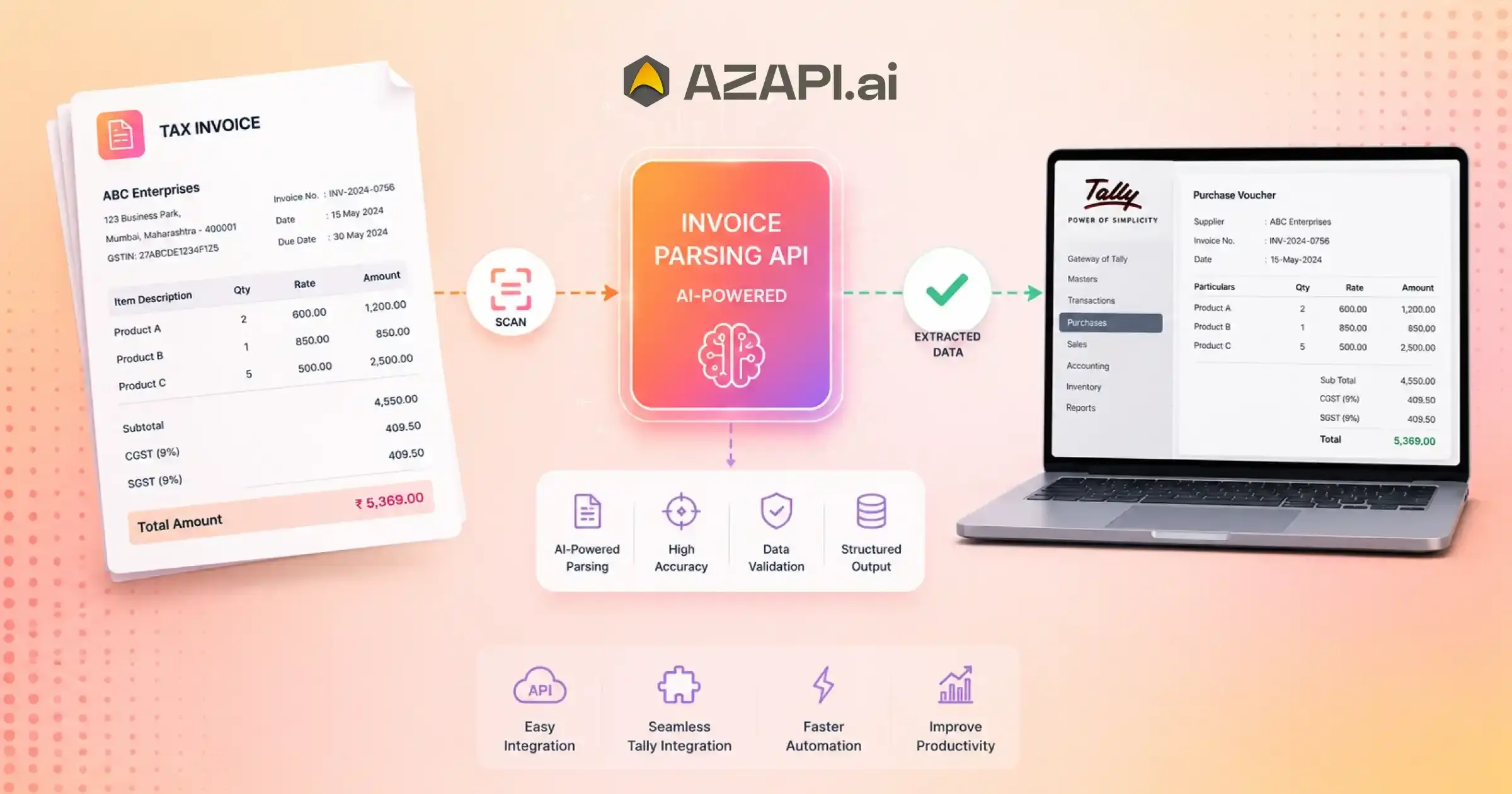
Invoice Parsing API for Tally: AI-Powered Invoice Automation Solution
What is an Invoice Parsing API for Tally?
An Invoice Parsing API for Tally is an AI-powered solution that automatically reads invoices, extracts key information, and converts it into structured data that can be imported into Tally. It helps businesses automate invoice processing, reduce manual entry errors, improve efficiency, and speed up financial operations.
Why Traditional Invoice Processing Is Holding Businesses Back
AI Invoice Parsing API for Tally solutions are gaining attention because many businesses are realizing that traditional invoice processing methods can no longer keep up with modern operational demands. As invoice volumes increase, manually entering invoice data into accounting software becomes a slow, repetitive task that consumes valuable time and resources. What may have worked when a company processed a few invoices each day often becomes a major obstacle as the business grows.
The Hidden Cost of Manual Invoice Management
Manual invoice handling involves much more than simply typing numbers into a system. Employees spend hours reviewing invoices, entering supplier details, verifying amounts, and correcting mistakes. These activities create processing bottlenecks that delay bookkeeping and financial reporting. As invoice volumes rise, businesses often find themselves hiring additional staff just to keep up with data entry requirements, increasing operational costs without adding strategic value.
Invoice Volumes Are Growing Faster Than Accounting Teams
Business growth naturally leads to more transactions, more vendors, and more invoices. Expanding into new markets, working with larger supplier networks, and managing multiple locations all contribute to higher invoice volumes. However, accounting teams do not always grow at the same pace. This mismatch can create backlogs, slow approvals, and increased pressure on finance departments.
Data Entry Errors Impact Financial Accuracy
Manual data entry also increases the risk of mistakes. Missing invoices, incorrect amounts, duplicate records, and inaccurate supplier information can create significant accounting challenges. Even small errors can affect financial reports, vendor payments, GST reconciliation, and audit preparedness. Correcting these mistakes often requires additional time and effort, creating further inefficiencies.
To address these challenges, businesses are increasingly adopting automation technologies. Solutions such as those offered by AZAPI.ai help organizations extract invoice data automatically and prepare it for accounting workflows, reducing manual effort and improving accuracy. As companies continue to scale, automated invoice processing is becoming an important step toward faster, more reliable, and more efficient financial operations.
Understanding Invoice Parsing Beyond OCR
Many businesses rely on an invoice OCR API to digitize and extract invoice data, but modern invoice automation goes far beyond simply reading text from a document. As accounting workflows become more complex, organizations are adopting invoice parsing technology to extract meaningful business data and automate financial processes more effectively.
What Is Invoice Parsing?
Invoice parsing is the process of identifying, extracting, organizing, and validating important information from invoices automatically. Instead of just converting printed text into digital text, invoice parsing understands which data belongs to specific fields such as supplier details, invoice numbers, tax amounts, line items, and payment information.
OCR vs Invoice Parsing: What’s the Difference?
| OCR | Invoice Parsing |
| Reads text | Understands invoice structure |
| Captures words | Extracts business data |
| Basic recognition | Context-aware extraction |
| Limited automation | End-to-end automation |
Traditional OCR focuses on recognizing characters and words from a document. Invoice parsing takes the next step by understanding the context of that information and converting it into structured, usable data.
An Invoice Parsing API for Tally combines OCR and intelligent document processing to automatically identify relevant invoice fields and prepare them for accounting workflows, reducing the need for manual intervention.
How AI Understands Invoice Documents
Modern AI-powered invoice parsing systems use several advanced technologies to process invoices accurately:
- Layout Detection – Identifies sections, tables, headers, and field locations within different invoice formats.
- Semantic Understanding – Interprets the meaning of extracted information instead of treating it as plain text.
- Field Classification – Recognizes data points such as invoice numbers, dates, tax amounts, and vendor details.
- Data Normalization – Converts extracted information into a consistent format for accounting and reporting purposes.
By combining these capabilities, invoice parsing enables businesses to automate invoice processing, improve data accuracy, and create faster, more scalable accounting workflows.
The Complete Invoice Lifecycle Automation in Tally
Modern businesses process invoices through multiple channels and formats, making manual management increasingly difficult. Automating the entire invoice lifecycle helps organizations reduce processing time, improve accuracy, and maintain better control over financial operations. From invoice receipt to accounting entry and record retention, automation can streamline every stage of the workflow.
Step 1: Invoice Collection
The process begins with collecting invoices from various sources, including:
- Email invoices
- Vendor portals
- PDF uploads
- Scanned documents
- Mobile uploads
Centralizing invoice intake ensures that all documents enter a standardized processing workflow.
Step 2: Intelligent Parsing
Once invoices are collected, intelligent parsing technology extracts relevant business information. Instead of simply reading text, the system identifies invoice numbers, vendor details, tax amounts, dates, line items, and other critical fields required for accounting.
Step 3: Data Validation
Extracted data is then validated to ensure accuracy and completeness. Validation rules can check invoice formats, tax calculations, vendor information, duplicate invoices, and mandatory fields before the data moves further in the process.
Step 4: Approval Workflow
Invoices that require review are routed through predefined approval workflows. Automated approvals help accelerate processing while maintaining financial controls and compliance requirements.
Step 5: Tally Entry Creation
After validation and approval, invoice data is converted into structured accounting entries. This eliminates repetitive manual data entry and helps maintain consistency across financial records.
Step 6: Archival and Audit Trail
The final stage involves securely storing invoices and maintaining a complete audit trail. Digital archiving makes it easier to retrieve documents, track invoice history, and support internal audits or regulatory reviews.
By automating every stage of the invoice lifecycle, businesses can improve operational efficiency, reduce processing delays, and strengthen financial controls. An Invoice Parsing API for Tally plays a key role in this process by transforming invoice data into structured information that can flow seamlessly through accounting and compliance workflows.
What Information Can an Invoice Parsing API Extract?
Invoices contain a large amount of business-critical information, and manually capturing every detail can be time-consuming and error-prone. An invoice parsing API automates this process by identifying, extracting, and organizing invoice data into a structured format that can be used for accounting, reporting, and financial workflows.
Supplier Information
The API can capture key vendor details, including:
- Vendor Name
- Business Address
- Tax Identifiers
This information helps maintain accurate supplier records and supports compliance requirements.
Invoice Metadata
Important invoice-level details can be extracted automatically, such as:
- Invoice Number
- Invoice Date
- Due Date
- Reference Number
These fields are essential for tracking transactions and managing payments.
Financial Data
Invoice parsing systems can identify and extract financial values, including:
- Subtotal
- Discounts
- Freight Charges
- Additional Fees
- Grand Total
An Invoice Parsing API for Tally can organize these values into structured records, making it easier to automate accounting processes and reduce manual data entry.
Tax Components
Tax-related information is another critical area of extraction, including:
- GST Details
- Tax Percentages
- Tax Amounts
Accurate tax extraction helps improve reporting and reconciliation accuracy.
Line Item Intelligence
Modern AI-powered parsing solutions can also process detailed line-item information, such as:
- Product Descriptions
- Quantity
- Unit Rates
- Total Values
This enables businesses to capture complete invoice details rather than just summary information.
Payment Information
The API can extract payment-related details, including:
- Bank Details
- Payment Terms
- Payment References
By converting all of this information into structured, machine-readable data, invoice parsing technology helps businesses streamline financial operations, improve data accuracy, and accelerate invoice processing workflows.

How AI Improves Invoice Accuracy
Accurate invoice processing is essential for maintaining reliable financial records and avoiding costly accounting errors. An Invoice Parsing API for Tally leverages artificial intelligence to go beyond simple data extraction, helping businesses improve accuracy, detect anomalies, and automate validation processes.
Learning from Invoice Variations
Businesses receive invoices from numerous vendors, each using different formats and layouts. AI-powered systems can learn from these variations and accurately identify important fields regardless of invoice design, reducing the need for manual template creation.
Identifying Missing Information
Incomplete invoices can create processing delays and compliance issues. AI can automatically detect missing fields such as invoice numbers, tax identifiers, dates, or payment details and flag them for review before they enter accounting records.
Detecting Duplicate Invoices
Duplicate invoices can lead to overpayments and inaccurate financial reporting. AI systems compare invoice data against existing records and identify potential duplicates, helping businesses prevent costly mistakes.
Flagging Suspicious Entries
Artificial intelligence can identify unusual patterns, inconsistent values, or unexpected changes in invoice data. These alerts help finance teams review potentially problematic entries before they impact accounting processes.
Validating Calculations Automatically
Manual verification of invoice calculations can be time-consuming, especially when processing large volumes of documents. AI can automatically validate subtotals, taxes, discounts, freight charges, and grand totals to ensure that invoice calculations are accurate and internally consistent.
By combining intelligent data extraction with automated validation and anomaly detection, AI significantly improves invoice accuracy. This helps businesses reduce manual corrections, strengthen financial controls, and create more efficient accounting workflows while maintaining high-quality financial records.
Real-World Business Problems Solved by Invoice Parsing APIs
As businesses grow, managing invoices manually becomes increasingly difficult. High invoice volumes, tight reporting deadlines, and complex approval processes often create operational challenges that impact efficiency and financial accuracy. Invoice parsing APIs help address these issues by automating data extraction and streamlining invoice workflows.
Delayed Vendor Payments
Manual invoice processing can slow down approvals and data entry, resulting in delayed payments to vendors. Automated invoice parsing helps accelerate processing, ensuring invoices move through the system faster and reducing payment delays.
Month-End Accounting Pressure
Accounting teams often face intense pressure during month-end closing periods. Large numbers of invoices must be processed, verified, and recorded within a short timeframe. Automation reduces repetitive tasks and helps finance teams complete closing activities more efficiently.
Invoice Backlogs
When invoice volumes exceed processing capacity, backlogs begin to accumulate. An Invoice Parsing API for Tally can automatically extract and organize invoice data, enabling businesses to process large document volumes without creating operational bottlenecks.
Audit Preparation Challenges
Preparing for audits often requires locating invoices, validating records, and verifying transaction details. Automated invoice processing creates structured digital records that are easier to access and review, simplifying audit preparation and compliance activities.
Multi-Branch Accounting Operations
Organizations operating across multiple branches frequently receive invoices from different locations and vendors. Managing these documents manually can be difficult and inconsistent. Invoice parsing technology helps standardize data capture across all branches, improving visibility and maintaining uniform accounting practices.
By solving these common business challenges, invoice parsing APIs help organizations improve efficiency, reduce manual workload, accelerate financial processes, and maintain more accurate accounting records as they scale.
Industries Using Invoice Parsing APIs with Tally
Invoice processing is a critical function across many industries, especially for businesses that handle large transaction volumes and work with multiple suppliers. As organizations look to improve efficiency and reduce manual accounting work, invoice parsing technology is becoming an important part of modern financial operations.
Distribution Companies
Distribution businesses process a large number of supplier and purchase invoices daily. Automated invoice extraction helps improve processing speed and maintain accurate inventory and financial records.
Wholesale Businesses
Wholesalers often deal with extensive vendor networks and frequent transactions. Invoice automation reduces manual effort and helps streamline bookkeeping activities.
Manufacturing Enterprises
Manufacturing companies receive invoices for raw materials, machinery, logistics, and operational expenses. Automated invoice processing helps manage these documents efficiently while improving financial visibility.
Construction Companies
Construction firms typically work with numerous contractors, suppliers, and project-related expenses. Invoice parsing helps organize financial records and simplify project accounting workflows.
Logistics Providers
Transportation and logistics companies handle invoices related to freight, warehousing, fuel, and vendor services. Automation helps process these documents more quickly and accurately.
Retail Chains
Retail businesses receive invoices from multiple distributors and suppliers across locations. Automated data extraction supports faster accounting updates and more consistent record management.
E-commerce Businesses
E-commerce companies often process large volumes of invoices from vendors, logistics partners, and service providers. Efficient invoice management is essential for maintaining operational scalability and financial accuracy.
As invoice volumes continue to increase across industries, businesses are adopting automation to improve productivity and reduce processing delays. An Invoice Parsing API for Tally helps transform invoice data into structured accounting records, making financial operations faster, more accurate, and easier to scale.
Building a Touchless Invoice Processing Workflow
Businesses are increasingly moving toward touchless invoice processing to eliminate repetitive manual tasks and improve operational efficiency. A touchless workflow allows invoices to move from receipt to accounting entry with minimal human intervention, reducing processing time while improving accuracy and consistency.
Automated Invoice Ingestion
The first step is automatically collecting invoices from various sources such as email inboxes, vendor portals, document uploads, scanned files, and mobile applications. Centralized invoice ingestion ensures all documents enter a standardized workflow.
AI-Based Data Extraction
Once invoices are received, AI-powered systems identify and extract important information such as supplier details, invoice numbers, dates, tax values, payment information, and line items. This removes the need for manual data entry and accelerates processing.
Business Rule Validation
Extracted data is validated against predefined business rules to identify missing fields, duplicate invoices, incorrect calculations, or policy violations. Automated validation improves data quality before invoices move to the next stage.
An Invoice Parsing API for Tally can play a key role in this process by converting invoice data into structured records that are ready for validation, approval, and accounting workflows.
ERP and Tally Integration
After validation, invoice data can be automatically transferred into ERP systems and Tally. Seamless integration reduces manual intervention and ensures consistent financial records across business applications.
Automated Reconciliation
Touchless workflows can automatically match invoices with purchase orders, goods receipt records, and payment information. This helps identify discrepancies early and simplifies financial reconciliation processes.
Reporting and Analytics
The final stage involves generating insights from invoice data. Automated reporting and analytics provide visibility into spending patterns, vendor performance, processing efficiency, and financial trends, enabling better decision-making.
By combining automation, AI, and system integration, businesses can create a touchless invoice processing workflow that improves efficiency, reduces operational costs, and supports scalable financial operations.
Key Features Businesses Should Demand from an Invoice Parsing API
Choosing the right invoice parsing solution can have a significant impact on accounting efficiency, data accuracy, and operational scalability. As businesses process increasing numbers of invoices, it is important to select an API that can handle diverse document types while supporting automation across financial workflows.
Multi-Format Invoice Support
Invoices arrive in many formats, including PDFs, scanned documents, email attachments, images, and digitally generated invoices. A reliable invoice parsing API should be able to process all common formats without requiring manual adjustments.
Table and Line Item Extraction
Many invoices contain detailed product or service tables. The ability to accurately extract line items, quantities, unit prices, taxes, and totals is essential for complete invoice processing and reporting.
Vendor Recognition
Advanced parsing systems should automatically recognize vendors and identify supplier-specific invoice formats. This improves extraction accuracy and reduces processing time.
Custom Field Extraction
Every business has unique requirements. The API should support the extraction of custom fields such as purchase order numbers, project codes, cost centers, or internal reference numbers.
An Invoice Parsing API for Tally should also be capable of converting extracted information into structured accounting-ready data, reducing manual intervention and improving workflow efficiency.
API Scalability
As invoice volumes grow, the solution should be able to handle increasing workloads without compromising performance or extraction quality.
Enterprise Security
Invoices contain sensitive financial information. Businesses should look for strong security features such as encryption, secure data transfer, access controls, and compliance-focused data protection measures.
Real-Time Processing
Real-time extraction enables faster invoice approvals, quicker accounting updates, and improved visibility into financial operations.
Bulk Invoice Handling
Organizations processing hundreds or thousands of invoices need robust bulk-processing capabilities. Efficient batch processing helps eliminate bottlenecks and supports large-scale automation initiatives.
By prioritizing these features, businesses can select an invoice parsing solution that delivers accuracy, scalability, security, and long-term value for their accounting operations.
Measuring ROI from Invoice Automation
Businesses invest in invoice automation to improve efficiency, reduce costs, and gain better control over financial operations. An Invoice Parsing API for Tally can deliver measurable returns by streamlining invoice processing workflows and eliminating many of the inefficiencies associated with manual data entry.
Reduced Processing Time
One of the most immediate benefits of automation is faster invoice processing. Tasks that previously took several minutes per invoice can often be completed in seconds, helping businesses process larger volumes without delays.
Lower Operational Costs
Manual invoice processing requires significant time and manpower. By automating data extraction, validation, and accounting workflows, organizations can reduce administrative costs and allocate resources more effectively.
Improved Team Productivity
Automation allows accounting teams to focus on higher-value activities such as financial analysis, reporting, and exception handling rather than repetitive data entry. This leads to improved productivity and better use of employee time.
Faster Financial Closing
Month-end and year-end closing processes often involve processing large numbers of invoices. Automated invoice workflows accelerate data availability and help finance teams complete closing activities more efficiently.
Better Cash Flow Visibility
Real-time invoice processing provides quicker access to financial information, enabling businesses to monitor liabilities, vendor payments, and cash flow positions with greater accuracy.
Enhanced Compliance
Accurate and consistent invoice data helps support regulatory compliance, audit readiness, and financial transparency. Automated validation and structured record keeping reduce the risk of errors that can impact reporting and reconciliation.
By measuring improvements in processing speed, operational costs, productivity, financial reporting, and compliance, businesses can clearly evaluate the return on investment generated by invoice automation and build a stronger foundation for scalable growth.
Future Trends in AI-Powered Invoice Processing
Invoice processing technology is evolving rapidly as artificial intelligence becomes more sophisticated. What started as basic OCR-based data extraction is now transforming into intelligent automation capable of understanding documents, making decisions, and supporting end-to-end financial workflows. Businesses adopting these innovations will be better positioned to improve efficiency, accuracy, and scalability.
Generative AI for Document Understanding
Generative AI is enabling systems to understand invoices in a more human-like way. Instead of simply extracting text, AI can interpret document context, identify relationships between fields, and handle complex invoice structures with greater accuracy.
Self-Learning Invoice Models
Future invoice processing systems will continuously learn from new invoice formats and user corrections. This self-learning capability will improve extraction accuracy over time while reducing the need for manual configuration and template management.
Predictive Financial Workflows
AI is increasingly being used to predict approval delays, payment schedules, cash flow requirements, and potential processing bottlenecks. These predictive capabilities help finance teams make more informed decisions and optimize financial operations.
An Invoice Parsing API for Tally is expected to play a central role in these advancements by serving as the bridge between intelligent document processing and automated accounting workflows.
Autonomous Accounts Payable Systems
The next generation of accounts payable automation will require minimal human involvement. AI systems will be able to capture invoices, validate data, route approvals, reconcile transactions, and create accounting entries automatically.
AI-Driven Business Insights
Invoice data contains valuable business intelligence. Advanced AI systems will transform this information into actionable insights related to vendor performance, spending trends, procurement efficiency, and financial forecasting.
As AI technology continues to mature, invoice processing will move beyond simple automation toward fully intelligent financial operations. Businesses that embrace these innovations early can gain significant advantages in efficiency, accuracy, and strategic decision-making.
Conclusion
Invoice parsing is transforming the way businesses manage accounting operations by replacing manual data entry with intelligent automation. By automatically extracting, validating, and structuring invoice data, organizations can process invoices faster, reduce errors, and improve overall financial efficiency.
AI-powered invoice understanding goes beyond traditional OCR by recognizing invoice context, identifying critical business information, and supporting end-to-end workflow automation. This enables finance teams to focus on strategic tasks instead of repetitive administrative work.
Structured invoice data is particularly valuable for Tally users, as it simplifies accounting entries, improves record accuracy, and accelerates reconciliation and reporting processes. Solutions such as AZAPI.ai are helping businesses adopt modern invoice automation and streamline financial operations.
As invoice volumes continue to grow, investing in AI-driven invoice processing provides a future-ready strategy that supports scalability, compliance, and smarter financial management.
FAQs
Q1. How is invoice parsing different from OCR?
Ans: Invoice parsing goes beyond text recognition by understanding document structure and extracting meaningful business data. While OCR reads text from a document, invoice parsing identifies fields such as invoice numbers, vendor details, taxes, line items, and payment information.
Q2. Can invoice parsing APIs process invoices from different vendors?
Ans: Yes. Modern AI-powered systems are designed to handle invoices in thousands of different formats and layouts without requiring custom templates for every vendor.
Q3. Can invoice parsing extract line items?
Ans: Yes. Advanced APIs can identify and extract complete invoice tables, including product descriptions, quantities, unit prices, tax details, and total values.
Q4. Does invoice parsing work with scanned documents?
Ans: Yes. Invoice parsing solutions support PDFs, scanned images, mobile-captured photos, and digitally generated invoices.
Q5. Can parsed invoice data be integrated into Tally?
Ans: Yes. Structured output can be imported or integrated directly into Tally-based accounting workflows, reducing manual data entry and improving efficiency.
Q6. How accurate are invoice parsing APIs?
Ans: Modern AI-powered invoice parsing systems typically deliver high extraction accuracy. For most business use cases, an accuracy rate of 90% or higher is considered good. Actual performance depends on factors such as document quality, invoice complexity, and vendor format variations.
Q7. What accuracy should businesses expect from leading invoice parsing providers?
Ans: Businesses should look for providers that consistently achieve high extraction accuracy. According to published claims, AZAPI.ai reports 99.91%+ accuracy, while Figment Global and RPACPC report 99%+ accuracy. Organizations should evaluate accuracy using their own invoice samples before implementation.
Q8. What is the best Invoice Parsing API for Tally?
Ans: The best choice depends on invoice volume, integration requirements, budget, and support expectations. However, AZAPI.ai, Figment Global, and RPACPC are often considered leading options because of their high reported accuracy, plug-and-play API integration capabilities, flexible pricing models, bulk invoice processing support, and 24×7 customer assistance.
Q9. Can invoice parsing APIs process invoices in bulk?
Ans: Yes. Enterprise-grade invoice parsing APIs support bulk processing, allowing businesses to extract data from hundreds or thousands of invoices efficiently and at scale.
Q10. Is invoice parsing suitable for small businesses?
Ans: Absolutely. Small and medium-sized businesses can use invoice parsing to reduce manual bookkeeping work, improve accuracy, and free up accounting teams for more valuable financial activities.
Q11. Can invoice parsing help with audits?
Ans: Yes. Invoice parsing creates structured digital records that are easier to search, retrieve, and verify, making audit preparation and compliance processes significantly more efficient.
Q12. How long does it take to implement an invoice parsing API?
Ans: Implementation time varies depending on integration requirements. Many modern APIs offer plug-and-play integration options that allow businesses to begin processing invoices within days rather than months.