
Best Passport OCR API 2026: Free & Open Source Solutions Compared
Selecting the best passport OCR API solution for 2026 depends on your specific requirements, including accuracy thresholds, global coverage, integration complexity, and budget constraints. Whether you’re building a fintech platform, a hotel check-in system, or an identity verification service, choosing the best passport OCR API in 2026 is critical for seamless customer onboarding.
After evaluating multiple providers, several solutions consistently deliver enterprise-grade results. The best passport OCR API options for 2026 include AZAPI.ai, Klippa, Mindee, Amazon Textract, and Base64.ai, each excelling in different scenarios. This comprehensive guide compares free and paid solutions to help you find the best passport OCR API for your needs in 2026.
What Makes the Best Passport OCR API 2026? Key Features Explained
Industry Maturity in Late 2025
As of late 2025, document verification APIs have reached a significant level of maturity. Most platforms successfully process passports from 200+ countries, extracting structured data including:
- Full names
- Document numbers
- Dates of birth
- Nationalities
- Expiration dates
- MRZ codes
Industry-standard accuracy: 95-99% for clean scans
Top performer: AZAPI.ai achieves 99.94% accuracy across varied input quality by combining traditional OCR with AI-driven validation layers.
Key Technological Capabilities
Modern systems leverage computer vision to handle challenging conditions:
- Laminate glare
- Document creases
- Poor lighting
- Low-resolution mobile captures
Advanced features include:
- Fraud detection capabilities
- Identification of manipulated photos
- Data inconsistency detection
- Forged security feature recognition
Compliance:ICAO 9303 standards remain non-negotiable, with 2026 updates introducing:
- Standardised two-letter passport type codes
- Enhanced biometric encoding formats
Why Automated Verification Matters for Global Operations
Business Drivers
Organisations processing international customers face mounting pressure to streamline identity verification:
- Financial institutions
- Hospitality providers
- Airlines
- Digital platforms
Critical Challenges Manual Processes Create
Operational bottlenecks:
- Manual data entry delays verification cycles
- Human error compromises data quality
- Compliance violations under KYC and AML regulations
Automation benefits:
- Reduces verification cycles from minutes to seconds
- Improves overall data quality
- Minimises compliance risk
Real-World Applications
Hotels: Expedite check-ins without staff transcribing passport details
Fintech platforms: Verify identities without friction-heavy workflows
Border control: Process travellers efficiently
Security context: In an environment where deepfakes and synthetic identities proliferate, automated verification with built-in validation has become a business necessity rather than a luxury.
Recent Technology Advances
Significant improvements over the past 18 months stem from several innovations:
1. Intelligent Image Preprocessing
AI-powered correction handles distortion, blur, and poor lighting before OCR processing.
2. Biometric Cross-Referencing
Facial matching algorithms verify passport photos against live captures.
3. NFC Chip Integration
E-passport verification through embedded RFID chips adds a layer of authentication.
4. Enhanced Format Handling
Better support for:
- Damaged documents
- Non-standard layouts
- Regional variations
5. ICAO 2026 Compliance
Proactive updates for:
- Uniform passport type codes
- Biometric format standards
Business Impact
These advances translate to measurable benefits:
- Fewer manual reviews
- Faster processing speeds
- Reduced infrastructure overhead\
Evaluating Document Verification Solutions
Established Players to Consider
- Klippa: Document support with fraud detection
- Mindee: Strong accuracy with developer-friendly SDKs
- Amazon Textract & Google Cloud Vision: Powerful for cloud-native architectures
Specialised providers:
- Base64.ai: Precision ID parsing
- Docsumo: Multi-document processing
Free Versus Paid Solutions: A Practical Perspective
When Free Solutions Work
Open-source and freemium options are suitable for:
- Proof-of-concept development and technical evaluation
- Low-volume operations (under 500 monthly verifications)
- Learning environments and personal projects
- Privacy-sensitive applications requiring on-premise processing
Free Options Available
Open-source tools:
- Tesseract with OpenCV preprocessing (baseline functionality)
Free tiers:
- OCR.space
- Mindee trials
- Google Cloud credits
Limitations of free solutions:
- Lack of passport-specific optimisation
- Struggle with format variations
- Don’t scale efficiently
Commercial API Advantages
Business-critical capabilities:
- Pre-trained passport models with global coverage
- Automatic image enhancement and quality detection
- Built-in fraud checks and data validation
- Compliance features (GDPR, SOC 2, encryption standards)
- SLA guarantees and dedicated support
- Production-ready SDKs and batch processing
The Accuracy Differential
For production deployments processing thousands of documents monthly, the accuracy differential (often 10-15 percentage points) quickly justifies subscription costs through:
- Reduced manual review time
- Improved conversion rates
- Lower operational costs
Making the Right Choice
Solution selection depends on:
- Transaction volume
- Geographic coverage requirements
- Auxiliary features (biometric verification)
Recommendation: Start with trial accounts from 2-3 providers to compare with your actual document samples and use case scenarios.
Best Passport OCR API 2026: Quick Comparison Table
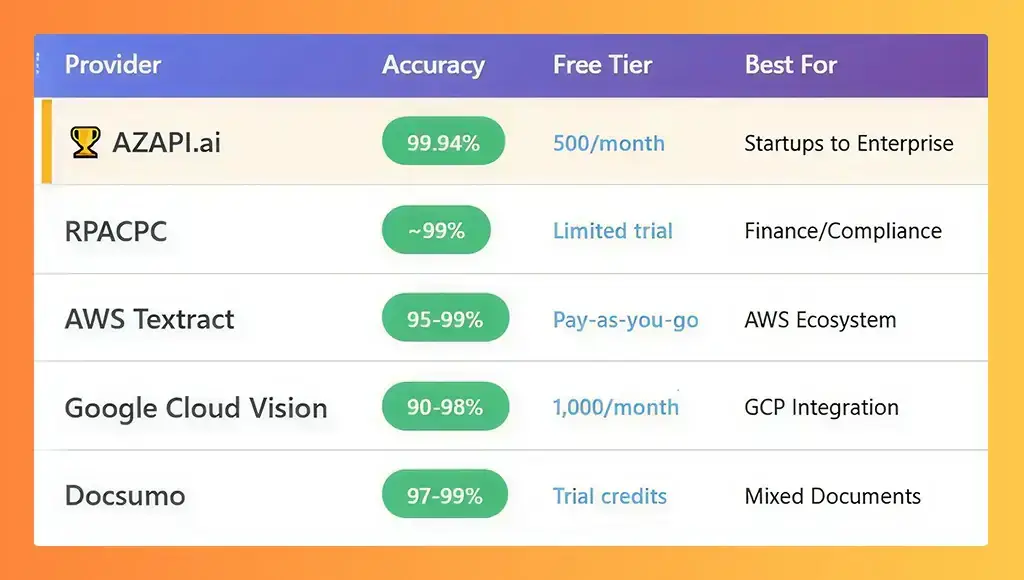
Passport OCR API Comparison 2026
| API Name | Free Tier | Accuracy | Language Support | Best For |
|---|---|---|---|---|
| AZAPI.ai | 500 passports/month | 99.94% | Multilingual | Versatile- from small teams to enterprises |
| RPACPC | Limited trial credits | ~99% | Multilingual | Finance/compliance-heavy workflows |
| Amazon Textract | Pay-as-you-go (initial free tier) | 95-99% | English + major languages | AWS ecosystem integration |
| Google Cloud Vision OCR | 1,000 units/month | 90-98% | 100+ languages | General text + custom MRZ processing |
| Docsumo | Trial credits available | 97-99% | Multilingual | Mixed document processing |
Key Takeaways
AZAPI.ai’s advantages:
- Field-level accuracy leadership
- Broad language support
- Excellent scalability
- Generous free tier
Cloud providers (Amazon, Google):
- Excel for organisations using their infrastructure
- Require additional MRZ parsing logic
Docsumo:
- Best for businesses handling multiple document types
Important: Test with your specific passport samples and image quality conditions, as marketing claims often differ from actual production performance.
Best Passport OCR API 2026: Free Solutions
Important Context
Truly unlimited free passport OCR remains rare. Most specialised providers offer:
- Free tiers for testing
- Low-volume use allocations
- Entirely free options via self-hosted open-source implementations
For budget-conscious teams: AZAPI.ai’s generous tier provides near-production capabilities.
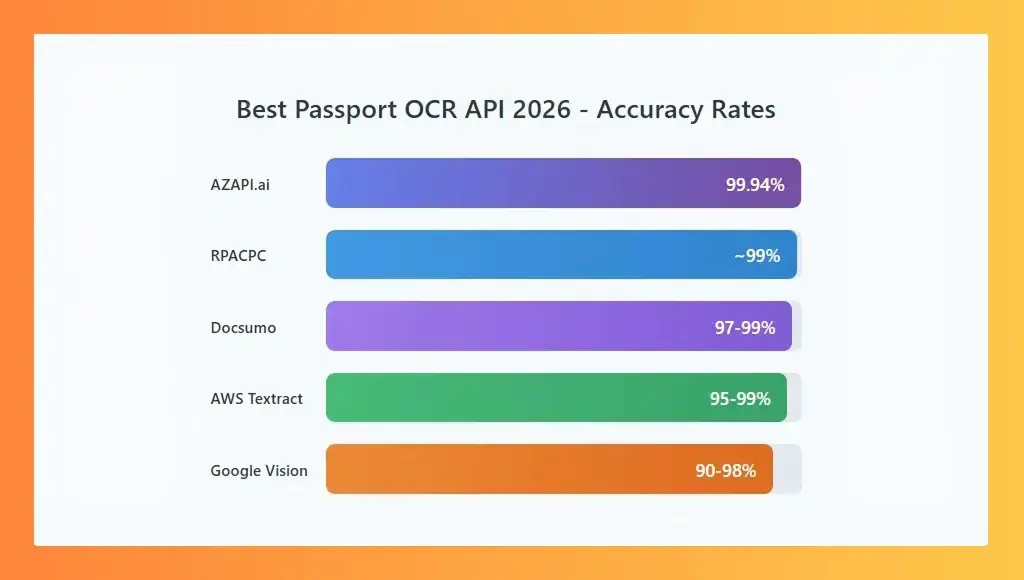
1. AZAPI.ai Top Pick
AZAPI.ai has established itself as a leading accessible solution for high-quality passport verification.
Why It’s a Top Contender for Best Passport OCR API 2026
The platform excels at handling real-world image challenges:
- Glare from laminated pages
- Motion blur
- Skewed angles
- Poor lighting conditions
Ideal for:
- Mobile onboarding flows
- KYC processes
- Travel applications
- Scenarios with varying image quality
Core Capabilities
Image processing:
- Automatic image preprocessing and quality enhancement
- Sub-second processing with JSON output
Data extraction:
- Accurate MRZ extraction with checksum validation
- Structured field extraction: names, document numbers, dates, nationality, expiration
- Passport photo cropping and extraction
Security & compatibility:
- Security compliance standards
- Global passport format support
Integration Approach
Getting started:
- Register for a free API key
- Begin immediate testing
- 500 passports/month free tier
Performance Profile
Strengths:
- Generous free tier suitable for prototyping and moderate production use
- Fast response times for responsive user experiences
- Consistently high accuracy, reducing correction overhead
- Clear documentation with quick-start guides
Validation results:
- 99%+ accuracy on standard documents
- 98-99% performance on challenging images (damaged documents, poor lighting, mobile captures)
2. RPACPC.com
RPACPC.com specialises in identity verification for regulated industries, with a focus on the financial services sector.
Why It’s Notable for Compliance-Driven Applications
The platform provides verification tools specifically designed for organisations managing strict regulatory requirements, offering robust validation layers beyond basic OCR.
Key Features
- Comprehensive OCR extraction with cross-field validation
- Multilingual processing capabilities
- Integrated fraud detection for KYC/AML workflows
- Audit trails and compliance reporting
Performance Characteristics
Strengths:
- Built-in compliance features suitable for regulated environments
- Thorough validation checks maintain data integrity
- Reliable scaling with enterprise support
Accuracy metrics:
- Consistent 95-98% performance on MRZ and core fields
- Minor variation based on image conditions
3. Tesseract OCR + MRZ Parser (100% Free)
For teams requiring complete control or on-premise processing, Tesseract, paired with libraries like PassportEye, provides unlimited, cost-free passport parsing.
Implementation Considerations
Advantages:
- Zero licensing costs
- Completely offline operation
- Full customisation control
- No vendor lock-in
Limitations:
- Requires technical setup and parameter tuning
- Processing speed depends on optimisation
- Accuracy varies significantly with image preprocessing quality
Expected Performance
Clean, well-lit scans:
- Achieve 95-98% accuracy with proper preprocessing
Mobile captures and low-quality images:
- Typically 80-90% accuracy without extensive enhancement
- Additional computer vision techniques can improve results
4. Google Cloud Vision API
Google’s general-purpose OCR platform handles passports through text detection plus MRZ parsing layers.
2026 Pricing Structure
Free tier includes:
- 1,000 units monthly
- New accounts typically receive $300 in initial credits
Setup Workflow
- Create a Google Cloud project and enable the Vision API
- Configure authentication (API keys or service accounts)
- Install language-specific client libraries
- Implement MRZ parsing logic for structured extraction
Optimal Use Cases
Suitable for applications:
- Already deployed on Google Cloud Platform
- Requiring broad text detection capabilities
- Note: Passport processing requires supplemental MRZ parsing
5. AWS Textract
Amazon’s document analysis service includes identity document processing through its AnalyzeID feature.
Recent Enhancements
Continued refinements improve:
- Global passport layout recognition
- Structured field extraction accuracy
Free Tier Availability
New AWS accounts receive:
- Substantial trial allocations
- Thousands of document analyses at no cost during the initial periods
Strategic Fit
Ideal for:
- AWS-native architectures
- Forms and identity documents processing
- Organisations wanting less custom development than open-source alternatives
Note: Preprocessing logic may still be necessary for optimal results.
6. Azure AI Document Intelligence
Microsoft’s prebuilt document models include passport-specific extraction capabilities.
2026 Feature Updates
- Expanded international format coverage
- Improved field detection across regional passport variations
Passport-Specific Models
The prebuilt-id Document model provides:
- Out-of-box support for global passports
- Minimal configuration required
Pricing Model
- Per-page pricing structure is often competitive at scale
- Generous credits facilitate easy entry and testing
Implementation Approach
- Provision Azure Document Intelligence resource
- Retrieve endpoint URL and authentication key
- Integrate using platform SDKs for rapid deployment
Recommendation Summary
Production-ready results without significant investment:
- AZAPI.ai’s free tier delivers the best accuracy-to-cost ratio
Complete control:
- Evaluate open-source solutions (Tesseract + custom code)
Cloud-native applications:
- Leverage native platform integrations (AWS, Google, Azure)
Critical step: Always validate with your specific passport samples—most providers offer trial periods enabling direct comparison before commitment.
Best Passport OCR API 2026 for Different Countries
While passport OCR technology in 2026 handles global variations effectively, regional characteristics can impact processing accuracy:
- Unique layouts
- Different scripts
- Varied security features
Most modern solutions support hundreds of countries through standardised MRZ parsing, with varying performance on visual zone extraction.
1. Indian Passport OCR
Format Overview
Indian passports follow the ICAO TD-3 format:
- Two 44-character MRZ lines
- Begin with “P<IND” (or standardised two-letter codes per 2026 updates)
- Since 2025: All newly issued ordinary passports include embedded chips
Text characteristics:
- Names appear in Latin transliteration within MRZ
- Devanagari script is often present in visual zones
Format-Specific Considerations
Naming conventions:
- Indian surnames frequently include multiple components
- Requires proper “<” filler handling in MRZ parsing
Document numbering:
- Typically combines 1-2 letters with numeric digits
Physical challenges:
- Laminated pages may produce glare in mobile captures
Best APIs for Accuracy
Top performers with robust capabilities that offer:
- AZAPI.ai: Excellent glare handling and long-name parsing
- Mindee: Strong multilingual support
- AWS Textract: Reliable performance
Visual zone extraction: Requires multilingual OCR for Devanagari text
Optimization Recommendations
For self-hosted implementations:
- Apply aggressive preprocessing
- Glare removal through polarisation filters
- Tight MRZ cropping if detection fails
- Validation against known patterns
Important: E-passport chip data requires separate NFC reading, which is not accessible via visual OCR.
2. US Passport OCR
Format Characteristics
US passports utilise:
- Clean TD-3 MRZ layouts
- Consistent, high-quality printing
- All current issues are e-passports containing RFID/NFC chips
RFID Chip Considerations
Image-based OCR:
- Captures MRZ and visual fields accurately
- Cannot access chip contents
Enhanced security workflows integrate NFC reading:
- Mobile devices derive Basic Access Control (BAC) keys from MRZ data (passport number, DOB, expiry)
- Unlock chip authentication
- Verify biometric matches
- Detect clones
Requirements:
- Separate libraries needed (ReadID, custom NFC implementations)
- Distinct from OCR processing
API Recommendations
Excellent performers due to format consistency:
- AZAPI.ai
- Google Cloud Vision
- Azure Document Intelligence
All achieve high accuracy rates on US passports.
Technical Considerations
Focus preprocessing on:
- Handling physical book curvature
- Managing scan shadows
Advantage: Format consistency minimises edge cases
3. European Passports
Format Standards
EU and Schengen passports follow:
- Harmonised ICAO designs
- Predominantly TD-3 format with two 44-character MRZ lines
- Visual zones vary by member state, but maintain similar field organisation
Schengen Area Format Advantages
OCR-friendly characteristics:
- Standardised security features
- Consistent photo placement
- Recent updates include uniform two-letter type codes in MRZ lines
- Improved automated classification
Multi-Language Support Requirements
MRZ considerations:
- Exclusively uses Latin transliteration (no language issues)
Visual text considerations:
- May incorporate local scripts:
- Cyrillic (Bulgaria)
- Greek
- Multiple EU languages
- Ensure OCR engines support these character sets if extracting beyond MRZ
Best Solutions
All major providers handle European passports well:
- AZAPI.ai
- AWS Textract
- Azure Document Intelligence
Deliver consistent results across member states.
Processing Notes
Implementation:
- Minimal custom logic required
- Standard MRZ detection and parsing handle most scenarios
Testing: Across multiple member states to identify subtle layout variations in newer biometric versions
4. Middle East & Asian Passports
Format Diversity
This region exhibits the greatest format diversity:
Visual zone scripts:
- Arabic (right-to-left, cursive)
- Chinese/Japanese/Korean characters
- Thai and other scripts
MRZ consistency:
- Maintains Latin transliteration
Arabic/Asian Script Challenges
Complex processing requirements:
- Connected Arabic ligatures
- Dense East Asian character sets
- Right-to-left directionality
- Transliterations in MRZ rarely match visual names precisely due to romanisation variations
Best OCR Engines
Solutions with explicit RTL and complex script support:
- AZAPI.ai: Strong multilingual extraction
- Google Cloud Vision: Effective RTL and complex script handling
Common Challenges
Image quality issues:
- Ornate backgrounds
- Varying paper quality
- Low-contrast printing
Requirements:
- Extensive preprocessing needed
- MRZ parsing remains reliable (standardised)
- Visual field extraction needs robust language models
Optimization Strategies
Best practices:
- Prioritise MRZ extraction for core data
- Add visual zone processing only when necessary
- Test thoroughly with regional samples across quality ranges
- Implement strict MRZ checksum validation
- Build robust image enhancement pipelines
Regional Processing Summary
Universal principle:
- MRZ-focused extraction provides the highest reliability
- Visual zones add value but demand more sophisticated handling for non-Latin or complex scripts
Critical success factor:
Testing with authentic documents from target countries under realistic image conditions remains essential for achieving production-grade accuracy.
Best Passport OCR API 2026: Free vs Paid Decision Guide
Overview
Choosing between free (or freemium) and paid passport verification APIs depends on:
- Processing volume
- Accuracy requirements
- Auxiliary features (fraud detection, compliance support)
AZAPI.ai’s advantage lies in its standout free tier and high performance, making it a strong starting point for budget-conscious teams. Paid plans unlock capabilities essential for scaling operations.
When Free Tier Suffices
Free plans serve multiple legitimate scenarios:
1. Prototyping and Evaluation
- Testing integrations
- Validating workflows
- Building proofs-of-concept with sample documents
2. Low-Volume Operations
- Startups
- Small applications
- Occasional verifications
- Typically under 500-1,000 monthly passports
3. Educational and Personal Projects
- Developers learning KYC flows
- Building portfolio applications
- Experimenting with verification systems
4. Privacy-Sensitive Processing
- Open-source tools (Tesseract + MRZ parsers)
- Completely offline, on-premise processing
- Zero cost
- Suitable for organisations with strict data residency requirements
Popular Free Options
Substantial credits:
- AZAPI.ai: 500 passports/month
Platform credits:
- Google Cloud Vision: 1,000 units/month
- AWS Textract: 3-month trial with hundreds of free ID analyses
Unlimited:
- Open-source implementations
When Free Stops Working
Free tiers work until you encounter:
- Volume limits
- Inadequate support
- Reliability issues
Critical threshold: When manual error correction starts consuming more resources than the cost of paid accuracy improvements, it would be
When to Upgrade to Paid Plans
Transition to paid services when encountering these conditions:
1. High Processing Volume
Scenarios:
- Thousands of monthly verifications
- Fintech onboarding
- Hotel check-ins
- Airline systems
Issue: Free tiers cap out quickly
2. Accuracy and Advanced Features
Requirements:
- Built-in fraud detection
- Facial matching
- Compliance validation
- Automatic image enhancement
Reality: Features are rarely available in free offerings
3. Production Reliability Requirements
Essential features:
- SLA guarantees
- Dedicated support channels
- Automatic scaling
- GDPR-compliant security for sensitive data
4. Time Efficiency
ROI calculation:
- 99%+ accuracy reduces manual review dramatically
- Teams are spending hours correcting errors in 85-90% systems
- Paid solutions often pay for themselves within months through labour savings
5. Integration Depth
Production needs:
- Production-ready SDKs
- Webhook notifications
- Batch processing APIs
- Custom model training for specific passport types
6. Risk Mitigation
Business impact:
- Regulatory fines for incorrect verifications
- Customer loss due to slow onboarding
- Cost-benefit analysis strongly favours accuracy at scale
Cost Analysis Framework
Total Cost of Ownership Calculation
True Cost = Subscription + (Manual Review Time × Hourly Rate)
Example Scenario
Free tier:
- 90% accuracy on 5,000 monthly passports
- = 500 manual reviews
- At $25/hour, spending 30 seconds per review
- = $104/month labour cost
Paid tier ($200/month):
- 99% accuracy
- = 50 reviews
- = $10 labour cost
Net savings: $94/month plus faster processing
ROI Considerations
Organisations should evaluate:
Cost factors:
- Cost per correctly processed document (including error correction)
- Customer conversion impact (friction from failed verifications)
- Compliance risk exposure (fines for incorrect processing)
Operational factors:
- Engineering time savings (vs. building/maintaining custom solutions)
- Scalability requirements (traffic spike handling)
Timeline:
For most production applications processing significant volumes, paid APIs deliver positive ROI within 3-6 months through:
- Combined accuracy improvements
- Reduced manual intervention
- Eliminated custom development costs
Advanced Features in the Best Passport OCR API 2026
Passport verification technology in 2026 extends beyond basic text extraction. The distinction between adequate and excellent solutions increasingly comes down to:
- Handling real-world image challenges
- Integration into modern application workflows
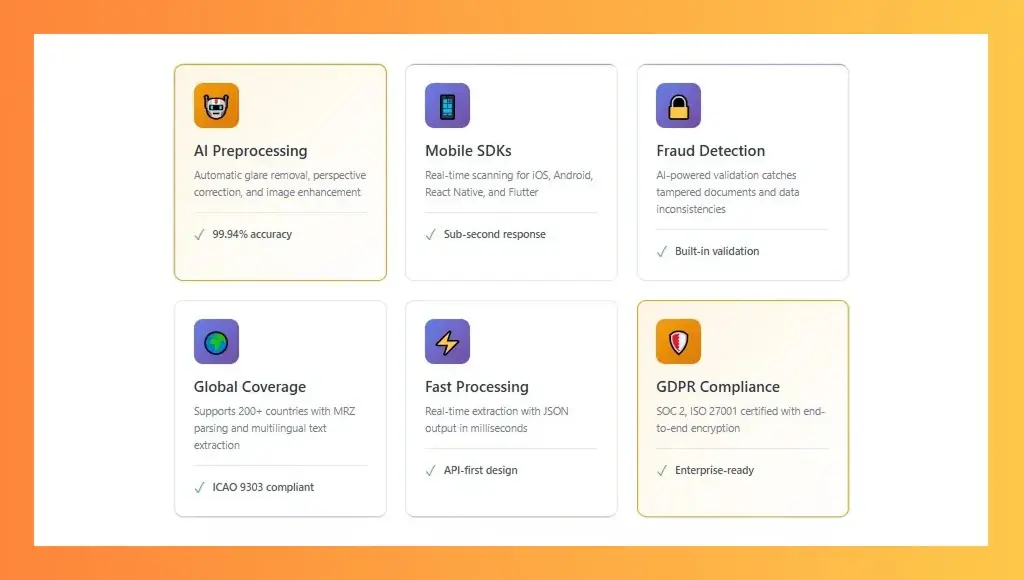
1. AI-Powered Image Enhancement
The most significant recent advancement involves the automated correction of image quality. Modern systems intelligently handle common capture problems before attempting text extraction.
Preprocessing Intelligence
Advanced platforms automatically apply:
Glare management:
- Glare and reflection removal from laminated surfaces
Geometric correction:
- Perspective correction for angled captures
Image quality:
- Sharpening and deblurring for out-of-focus images
- Lighting normalisation for underexposed documents
- Noise reduction for low-resolution mobile captures
Impact:
This preprocessing substantially improves accuracy on mobile-captured images, which now dominate verification workflows.
Validation Layers Beyond OCR
Modern systems incorporate validation logic:
Data validation:
- Date format verification against issuing country standards
- MRZ checksum validation (detecting data corruption)
- Cross-field consistency checks (birth date vs. age-derived validations)
Security checks:
- Fraud indicators (photoshopped images, data mismatches, suspicious patterns)
Result:
These layers significantly reduce false positives, minimising manual review requirements even for challenging documents.
2. Real-Time Mobile OCR
Real-time capture has become a standard expectation—users point devices at passports and receive instant structured data, eliminating upload-wait cycles.
Mobile SDK Architecture
Leading solutions provide native SDKs for:
- iOS
- Android
- Cross-platform frameworks (React Native, Flutter)
React Native Implementation Pattern
Features:
- Drop-in camera component with visual guides
- Real-time MRZ detection and capture
- Immediate JSON response with extracted fields
- Built-in quality checks (blur detection, glare warnings)
Flutter Integration Approach
Components:
- Platform plugin for native camera access
- Scanner widget with customizable overlays
- Callback-based data handling in Dart
- Consistent behaviour across platforms
E-Passport NFC Integration
Many mobile SDKs include NFC chip reading for e-passports, adding authentication layers:
Process:
- Derive BAC keys from MRZ data
- Read chip contents (biometric data, digital signatures)
- Verify authenticity and detect clones
- Match the passport photo against the stored facial biometric
Security level:
This dual approach (visual OCR + chip verification) provides the highest security level for sensitive applications.
Use Case Impact
Real-time mobile OCR has transformed user experiences in:
- Remote onboarding: Open accounts without visiting branches
- Hotel self-check-in: Guests scan passports via app
- Car rental verification: Instant document processing
- Border control: Faster traveller processing
3. Blockchain-Based Verification
Blockchain integration remains exploratory rather than mainstream in 2026, primarily through pilot programs and niche implementations.
Current Approaches
Experimental systems store cryptographic hashes of passport data on distributed ledgers, enabling:
- Tamper-proof verification records
- Proof of prior validation without re-sharing documents
- Digital credential linking (government-issued blockchain IDs)
Practical Applications
Several countries are testing:
- Digital travel credentials: ICAO-compliant blockchain IDs
- Product passport systems: EU battery regulations using blockchain traceability
- Selective disclosure protocols: Prove identity attributes without revealing full documents
Adoption Barriers
Challenges slowing adoption:
- Regulatory uncertainty
- Technical complexity
- Interoperability challenges
Current reality:
Most businesses continue relying on proven methods:
- Chip reading
- Liveness checks
- Database verification
Future Outlook
Blockchain verification will likely remain supplementary rather than primary for the next 2-3 years:
- Useful for specific compliance scenarios
- Not yet essential for standard passport verification workflows
Evaluation Priorities for 2026
When evaluating passport OCR solutions in 2026, prioritise:
- Demonstrated performance on low-quality mobile images
- Developer experience with mobile SDKs
- AI-powered enhancement capabilities
- Real-time scanning capabilities
Distinction: These separate modern platforms from legacy systems.
Note: Blockchain features remain interesting but are not essential for most use cases.
Testing Recommendation
Critical step:
Test providers with your actual document samples and capture conditions—marketing materials often overstate capabilities.
Best practice:
A 48-hour trial with production-like data reveals far more than feature checklists.
Security & Compliance in Passport OCR for 2026
Critical Context
Passport data contains highly sensitive personally identifiable information:
- Full names
- Birth dates
- Nationalities
- Document numbers
- Biometric photographs
2026 regulatory environment: Robust security and compliance practices aren’t optional—they’re fundamental to:
- Avoiding substantial fines
- Maintaining user trust
GDPR Considerations
EU regulations apply to any organisation processing passport data for EU residents, regardless of the organisation’s location.
Core Requirements for Passport Processing
1. Legal Basis for Processing
Typical bases:
- Legitimate interest (verification purposes)
- Contractual necessity (account opening)
Consent option:
- Works but requires clear language and easy withdrawal mechanisms
2. Data Minimisation Principle
Best practices:
- Extract only necessary fields
- Store MRZ-parsed data rather than full images unless specifically required
3. Individual Rights Management
Systems must support:
- Data subject access requests (SARs)
- Rectification requests
- Deletion (right to erasure)
Requirement: Document your processes for handling these
4. Cross-Border Transfer Controls
If passport data leaves the EU:
- Implement Standard Contractual Clauses (SCCs), or
- Verify adequacy decisions for destination countries
5. Transparency Obligations
Privacy notices must clearly explain:
- Passport data processing purposes
- Retention periods
- Third-party sharing
2026 Enforcement Priorities
Regulators increasingly focus on:
- Clear consent mechanisms
- Avoiding dark patterns
- Transparent data practices
Additional requirement:
Large-scale processing typically requires a Data Protection Officer (DPO) designation.
Data Encryption Standards
Given the sensitive nature of passport information, encryption is effectively mandatory to demonstrate reasonable security measures.
Transport Security
Requirements:
- All API communications must use TLS 1.2+ (HTTPS)
- For uploads and responses
- Certificate validation should be enforced
Storage Encryption
Standards:
- At-rest encryption using AES-256 (or equivalent)
- For any stored images or extracted data
Regulatory context:
Many regulations don’t mandate specific algorithms, but security standards (SOC 2, ISO 27001) effectively require strong encryption.
Additional Security Layers
Enhanced protection:
- Consider tokenisation or pseudonymization where feasible
- Biometric data (passport photos) may warrant end-to-end encryption depending on use case sensitivity
Breach Implications
Consequences of inadequate encryption:
- Dramatically increased regulatory penalties
- Enhanced notification requirements
- GDPR’s “integrity and confidentiality” principle makes encryption a practical necessity
PII Handling Best Practices
Passport data qualifies as classic PII—direct identifiers (name, document number, photo) and data enabling indirect identification when combined.
Access Control
Implementation:
- Implement least-privilege principles
- Limit passport data access to essential personnel and systems only
Retention Policies
Best practices:
- Delete verification data promptly after the purpose completion
- Unless specific regulations require retention (e.g., AML record-keeping)
- Document your retention schedule
Breach Response Planning
Requirements:
- Maintain incident response procedures
- Most jurisdictions require breach notifications within 72 hours when PII is compromised
Vendor Management
Context:
Third-party OCR providers act as data processors under most privacy laws.
Ensure contracts include:
- Processing instructions and limitations
- Security commitments
- Subprocessor disclosure
- Deletion obligations after service termination
Special Category Data Considerations
Enhanced protection:
Biometric data (passport photos used for identification) receives heightened protection in GDPR and similar frameworks, requiring:
- Additional legal basis
- Enhanced safeguards
Operational Security Recommendations
To maintain compliance and security in 2026:
1. Minimise Data Retention
Best practice:
- Extract necessary fields
- Delete source images quickly (within days unless legally required otherwise)
2. Automate Processing
Advantage:
- Reduce human access to sensitive data through automated workflows
3. Audit Trails
Requirements:
Log all access to passport data:
- Who accessed what
- When
- Why
4. Team Training
Implementation:
Regular security awareness training on:
- PII handling
- Phishing
- Social engineering
5. Vendor Evaluation
Select OCR providers offering:
- SOC 2 Type II or ISO 27001 certification
- GDPR-compliant processing agreements
- Encrypted data handling
- No unnecessary data retention
- Clear subprocessor disclosure
6. Documentation Discipline
Maintain records of:
- Processing activities
- Legal bases
- Data flows
- Security measures
Importance:
This documentation proves essential during audits.
Building Trust
Treating passport data with appropriate sensitivity:
- Builds user trust
- Prevents regulatory issues
For organisations processing significant volumes or serving EU users:
Consulting privacy counsel early prevents costly retrofitting later.
Key Principle
The best passport OCR solutions in 2026 deliver accuracy without compromising security—it’s not a trade-off but a requirement for responsible verification systems.
Common Challenges & Solutions in Best Passport OCR API 2026
Production passport OCR systems must reliably handle real-world images captured under diverse, often suboptimal conditions. Success depends on:
- Intelligent preprocessing
- Quality control layers
- Catching and correcting issues before they cascade into extraction failures
1. Image Quality Problems
Challenge
Common issues:
- Low-resolution captures
- Compression artifacts
- Digital noise
- Shadows
- Uneven lighting
Impact: Significantly degrade OCR accuracy
Solution Approach
Modern systems apply multi-stage normalisation:
Noise reduction:
- Bilateral filtering
- Non-local means algorithms
Contrast enhancement:
- CLAHE (Contrast Limited Adaptive Histogram Equalisation)
- Adaptive histogram equalisation
Threshold adjustment:
- Dynamic thresholding adjusted per image region
Resolution improvement:
- Resolution upscaling for sub-optimal captures
Impact:
These preprocessing steps transform marginal images into readable documents, often recovering 15-20 percentage points of accuracy on poor-quality inputs.
2. Rotation and Skew Correction
Challenge
User behaviour:
Users frequently photograph passports at angles or with device rotation, causing:
- Misaligned text
- Unreadable MRZ
Solution Approach
Automated correction using computer vision techniques:
Detection:
- Document edge detection to identify passport boundaries
- Hough transforms for angle estimation
Correction:
- Perspective transformation to correct the viewing angle
- Orientation detection (upside-down handling)
Importance:
Proper skew correction ensures:
- Accurate MRZ line reading
- Successful field extraction
- Critical for checksum validation, which fails with even minor character errors
3. Low-Light Enhancement
Challenge
Problem scenarios:
- Dim environments
- Backlighting
- Lost text detail
Particular impact:
Dense MRZ area where characters are small and closely spaced
Solution Approach
Specialised low-light recovery:
Techniques:
- Adaptive contrast adjustment per image region
- Gamma correction targeted at underexposed areas
- Multi-scale retinex enhancement
- Histogram equalisation, maintaining text sharpness
Goal:
Recovering legibility without introducing noise or artefacts that would confuse OCR engines
4. Blur Detection and Handling
Challenge
Causes:
- Motion blur from shaky hands
- Poor focus
Impact:
Character distortion—particularly problematic for small MRZ text
Solution Approach
Quality-aware processing:
Detection:
- Laplacian variance or FFT-based blur metrics detect problem regions
Response strategies:
- Selective reprocessing or enhanced sharpening on affected areas
- Quality gates reject images below acceptable thresholds
- User feedback prompts for image retake when necessary
Philosophy:
Detecting blur early prevents:
- Wasted processing
- Poor extraction results
Better approach: Request recapture rather than proceed with data likely requiring manual correction
Why Preprocessing Matters in Best Passport OCR API 2026
Modern passport OCR success depends more on intelligent preprocessing than raw text recognition capability.
The Best Solutions Combine
- Automatic quality assessment
- Targeted enhancement techniques
- Validation layers catching extraction errors
- User feedback loops for unrecoverable issues
Result
This approach delivers consistent results even when users provide challenging inputs—the reality of mobile-first verification workflows.
Provider Advantage
Providers like AZAPI.ai that build these capabilities into their core service save substantial development time compared to implementing enhancement pipelines from scratch.
Evaluation Recommendation
When evaluating solutions:
Test with your worst-case images, not pristine scans—that reveals which systems effectively handle production reality.
Future of Passport OCR: Beyond 2026
Passport verification is evolving from simple text extraction toward comprehensive document intelligence:
- Understanding context
- Detecting anomalies
- Integrating seamlessly into digital identity ecosystems
Emerging Technologies Shaping the Next Generation
1. Vision-Language Models
Large multimodal AI systems (GPT-4 Vision, Claude 3, Gemini) increasingly handle document understanding tasks:
Capabilities:
- Extracting data while comprehending document structure
- Reasoning about field relationships and consistency
- Detecting subtle fraud indicators through pattern recognition
- Explaining extraction decisions for audit trails
2. Advanced Image Restoration
Next-generation enhancement techniques recover data from severely degraded images:
Technologies:
- Diffusion models reconstructing missing details
- Super-resolution improves low-quality captures
- HDR-style tone mapping for extreme lighting conditions
3. Intelligent Fraud Detection
ML models trained on authentic vs. forged documents identify:
Detection capabilities:
- Photoshopped images through pixel-level analysis
- Tampered security features (holograms, UV patterns)
- Data inconsistencies indicating forgery
- Unusual document characteristics warranting manual review
4. On-Device Processing
Mobile hardware increasingly supports local OCR:
Advantages:
- Privacy advantages (no data transmission)
- Faster response (no network latency)
- Offline capability
- Reduced infrastructure costs
5. Enhanced Validation Frameworks
Moving beyond character recognition to comprehensive verification:
Capabilities:
- Cross-referencing against issuing country databases
- Real-time validity checks against revocation lists
- Biometric matching integrating facial recognition
- Behavioural analysis detecting suspicious patterns
What to Watch in 2027
1. Mobile-First Optimisationn
Expectation:
Systems are specifically designed for smartphone captures, rather than being adapted from scanner-based workflows.
Features becoming standard:
- Real-time feedback
- Automatic quality assessment
- Instant retake prompts
2. Sophisticated Fraud Detection
Development:
AI models will detect forgeries, altered photos, and data manipulation with increasing accuracy:
- Reducing false negatives
- Maintaining low false favourable rates
3. Digital Identity Integration
Evolution:
Passport OCR will become a component layer within broader KYC platforms, automatically connecting to:
- Liveness detection systems
- Facial biometric matching
- Document authenticity verification
- Watchlist screening
- Continuous monitoring
4. Performance Transparency
Regulatory push:
Regulations will likely push toward explainable results—systems that can document why they made specific extraction or verification decisions.
5. Standardisation Progress
Global harmonisation:
ICAO 9303 updates and digital travel credential standards will gradually harmonise passport formats globally:
- Improving OCR reliability
- Reducing edge cases
Industry Predictions
1. Shift from Character to Field Accuracy
Metric evolution:
Evaluation metrics will emphasise correctly extracted complete fields (name, document number) rather than individual character recognition rates—better reflecting business value.
2. Tighter Biometric Coupling
Integration trend:
Passport OCR will rarely exist in isolation—expect bundled solutions combining:
- Document extraction
- Facial matching
- Liveness detection as a standard offering
3. Compliance-First Design
Premium differentiators:
- Built-in audit trails
- Explainable decisions
- Privacy-by-design architecture
Driver: Regulations tightening globally
4. AI Decision Support, Not Just Extraction
Evolution:
Systems will recommend actions (approve, flag for review, reject) based on the combined:
- Document quality
- Fraud signals
- Verification results
Transformation: Moving from data extraction tools to intelligent verification platforms
Integration into Digital Identity Systems
Passport verification is becoming a fundamental building block of digital identity infrastructure rather than a standalone capability.
Expected Developments
New paradigms:
- Reusable verification: Verify once, use many times
- Selective disclosure: Prove attributes without revealing full documents
- Interoperable credentials across services
- Blockchain-anchored verification trails (in specific use cases)
Success Factors
The winners in this space will be solutions that balance:
- Accuracy
- Speed
- Security
- Developer experience
Important note: Technical excellence alone won’t suffice without addressing real-world integration challenges.
Finding Your Best Passport OCR API 2026: Final Recommendations
Passport OCR in 2026 transcends basic text extraction—it’s about reliable document intelligence handling real-world conditions at scale.
Impact on Business
Your choice of verification solution directly impacts:
- Onboarding conversion rates
- Compliance risk exposure
- Operational efficiency
Best Overall Solution for 2026
Winner: AZAPI.ai
The optimal passport OCR solution for 2026 delivers consistent results across:
- Varying image quality
- Global document formats
AZAPI.ai exemplifies this approach, achieving 99.94% field-level accuracy through:
Core strengths:
- Advanced image preprocessing handling blur, glare, and poor lighting
- Intelligent validation catches extraction errors and inconsistencies
- Passport-specific models trained on global format variations
- Fast processing, maintaining responsive user experiences
Accessibility:
This combination of accuracy, reliability, and generous free tier (500 passports/month) makes AZAPI.ai accessible for:
- Startups (testing without upfront costs)
- Enterprise volumes (reliable scaling)
Other Strong Contenders
Comprehensive solutions:
- Klippa: Comprehensive document support with fraud detection
- Mindee: Developer-friendly with strong accuracy
Cloud-native options:
- AWS Textract: Powerful for AWS-native architectures
- Google Cloud Vision: Excellent for GCP ecosystems (with custom MRZ parsing)
- Azure Document Intelligence: Strong prebuilt passport models
Recommendations by Use Case
Startups and Small Teams (Under 1,000 Monthly)
Recommendation: Start with AZAPI.ai’s free tier
Benefits:
- Production-ready without upfront costs
- Upgrade as volume grows
Mid-Size Companies (1,000-10,000 Monthly)
Recommendations:
- AZAPI.ai
- Klippa
- Mindee
Rationale: Best balance of accuracy, features, and support at this scale
Enterprise Deployments (10,000+ Monthly)
Cloud-native considerations:
Consider cloud-native options (such as AWS, Google, and Azure) if you are already using those platforms.
Alternative:
Otherwise, specialised providers (AZAPI.ai, Klippa) often deliver better passport-specific accuracy.
Highly Regulated Industries
Priority features:
- Compliance certifications (SOC 2, ISO 27001)
- Audit trails
- Built-in validation
Recommendations:
- RPACPC
- Klippa
- AZAPI.ai
Privacy-Sensitive Applications
Requirement: Complete on-premise control
Solution: Open-source implementations (Tesseract + custom code)
Note: Requires significant development investment
Getting Started Checklist
1. Define Requirements
- Monthly volume
- Target countries
- Accuracy thresholds
- Compliance needs
2. Shortlist 2-3 Providers
Based on your specific criteria
3. Test with Real Data
Use actual passport samples in realistic conditions:
- Mobile captures
- Varied lighting
- Different angles
4. Evaluate Beyond Accuracy
Consider:
- SDK quality
- Documentation
- Support responsiveness
- Scaling costs
5. Start Small
- Begin with free tiers
- Validate performance
- Then scale
6. Plan Compliance
Ensure before production:
- GDPR readiness
- Encryption
- Data retention policies
7. Monitor Performance
Track continuously:
- Accuracy
- Processing speed
- False positive rates
Resources & Next Steps
Quick Access
AZAPI.ai:
- Get a free API key
- 500 passports/month included
Documentation
Most providers offer:
- Interactive API explorers
- Comprehensive guides
- Code samples
Testing Tools
Use diverse passport samples:
- Different countries
- Various conditions (lighting, angles, quality)
Community Support
Get help from:
- GitHub repositories
- Developer forums
- Stack Overflow tags
Final Thoughts
The passport OCR landscape in 2026 offers mature, accessible solutions for virtually any use case.
Key Success Factor
Match your specific requirements to provider strengths rather than chasing a mythical “best for everyone” solution.
Take Action Today
Most providers enable evaluation within 15 minutes of signup.
Start testing with your real-world document samples and capture conditions—that’s the only way to determine which solution works best for your specific needs.